Content Navigation

In the state of Kansas, the Motor Vehicle Power of Attorney form serves as a vital legal instrument that empowers an individual to designate another person to act on their behalf concerning various matters related to motor vehicles. This form is particularly useful when the vehicle owner is unable to attend to necessary transactions, such as transferring ownership, registering a vehicle, or obtaining title documents. By completing this form, the principal, or the vehicle owner, grants specific authority to the agent, who can then perform these tasks efficiently and effectively. The form must be filled out with care, ensuring that all relevant details, such as the names of both parties and the specific powers being granted, are clearly outlined. Additionally, it requires signatures from both the principal and the agent, and it is advisable to have the document notarized to enhance its legal validity. Understanding the nuances of this form can significantly ease the process of managing motor vehicle affairs, providing peace of mind to those who may be facing challenges that prevent them from handling such matters directly.

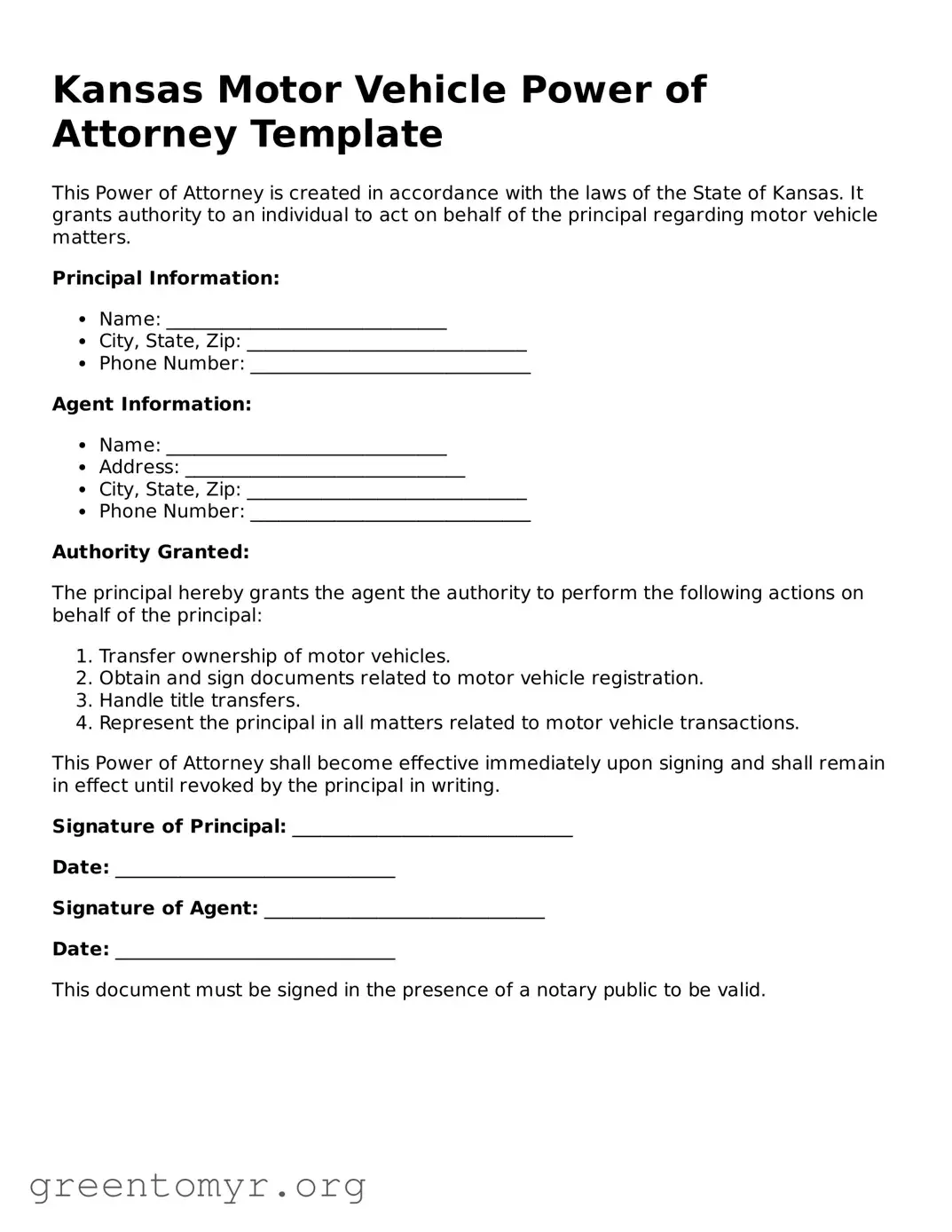
Kansas Motor Vehicle Power of Attorney Example

Kansas Motor Vehicle Power of Attorney Template

This Power of Attorney is created in accordance with the laws of the State of Kansas. It grants authority to an individual to act on behalf of the principal regarding motor vehicle matters.

Principal Information:

  • Name: ______________________________
  • City, State, Zip: ______________________________
  • Phone Number: ______________________________

Agent Information:

  • Name: ______________________________
  • Address: ______________________________
  • City, State, Zip: ______________________________
  • Phone Number: ______________________________

Authority Granted:

The principal hereby grants the agent the authority to perform the following actions on behalf of the principal:

  1. Transfer ownership of motor vehicles.
  2. Obtain and sign documents related to motor vehicle registration.
  3. Handle title transfers.
  4. Represent the principal in all matters related to motor vehicle transactions.

This Power of Attorney shall become effective immediately upon signing and shall remain in effect until revoked by the principal in writing.

Signature of Principal: ______________________________

Date: ______________________________

Signature of Agent: ______________________________

Date: ______________________________

This document must be signed in the presence of a notary public to be valid.

PDF Form Features

Fact Name Description
Purpose The Kansas Motor Vehicle Power of Attorney form allows an individual to designate another person to handle vehicle-related transactions on their behalf.
Governing Law This form is governed by Kansas Statutes Annotated (K.S.A.) 58-632 through 58-634.
Principal The person granting the power of attorney is known as the principal.
Agent The individual receiving the authority to act is referred to as the agent or attorney-in-fact.
Scope of Authority The agent can perform various tasks, including transferring title, registering vehicles, and obtaining license plates.
Duration The power of attorney remains effective until revoked by the principal or until the principal's death.
Revocation The principal can revoke the power of attorney at any time, provided they notify the agent in writing.
Signature Requirements The form must be signed by the principal and may require notarization to be valid.
Use Cases This form is commonly used when the principal is unable to be present for vehicle transactions, such as during relocation or travel.

Guide to Using Kansas Motor Vehicle Power of Attorney

After obtaining the Kansas Motor Vehicle Power of Attorney form, you'll need to complete it accurately to ensure it serves its intended purpose. This document allows you to designate someone to handle specific vehicle-related tasks on your behalf. Follow the steps below to fill out the form correctly.

  1. Begin by entering the date at the top of the form.
  2. Provide your full name as the principal. This is the person granting the power of attorney.
  3. Write your address, including the city, state, and zip code.
  4. Identify the attorney-in-fact by entering their full name. This person will act on your behalf.
  5. Include the attorney-in-fact's address in the same format as yours.
  6. Specify the powers you are granting. This may include tasks like signing documents or transferring ownership.
  7. Indicate the vehicle details, including the make, model, year, and Vehicle Identification Number (VIN).
  8. Sign and date the form at the bottom. Ensure your signature matches the name you provided as the principal.
  9. Have the form notarized if required. This adds an extra layer of validation to the document.

Once you've completed the form, keep a copy for your records. Then, provide the original to the person you've designated as your attorney-in-fact. They can now act on your behalf for the specified vehicle-related matters.

Get Answers on Kansas Motor Vehicle Power of Attorney

What is a Kansas Motor Vehicle Power of Attorney form?

The Kansas Motor Vehicle Power of Attorney form is a legal document that allows an individual, known as the principal, to authorize another person, called the agent, to act on their behalf in matters related to motor vehicle transactions. This can include tasks such as transferring ownership, registering a vehicle, or obtaining a title.

Who can be appointed as an agent?

Any competent adult can be appointed as an agent under the Kansas Motor Vehicle Power of Attorney. This includes family members, friends, or professionals like attorneys or auto dealers. It is essential that the agent is trustworthy, as they will have significant authority over the principal's vehicle-related matters.

What powers does the agent have?

The agent's powers can vary based on what the principal specifies in the document. Common powers include:

  • Signing documents related to the sale or transfer of a vehicle
  • Applying for or renewing vehicle registration
  • Obtaining duplicate titles
  • Representing the principal in dealings with the Kansas Department of Revenue

How do I complete the form?

To complete the Kansas Motor Vehicle Power of Attorney form, follow these steps:

  1. Download the form from the Kansas Department of Revenue website or obtain a physical copy.
  2. Fill in the required information, including the names and addresses of both the principal and the agent.
  3. Clearly specify the powers granted to the agent.
  4. Sign and date the document in the presence of a notary public.

Do I need to have the form notarized?

Yes, the Kansas Motor Vehicle Power of Attorney form must be notarized to be valid. This adds a layer of authenticity and helps prevent fraud. The notary will verify the identities of both the principal and the agent before witnessing the signing of the document.

Is there a specific time frame for using the Power of Attorney?

The Kansas Motor Vehicle Power of Attorney does not have a specific expiration date unless stated otherwise in the document. However, it is advisable to review the form periodically and revoke it if the principal's circumstances change or if the agent is no longer trusted.

Can I revoke the Power of Attorney?

Yes, the principal has the right to revoke the Power of Attorney at any time, as long as they are mentally competent. To revoke it, the principal should provide written notice to the agent and any relevant third parties, such as the Kansas Department of Revenue, if applicable.

Where can I find more information or assistance?

For more information about the Kansas Motor Vehicle Power of Attorney form, you can visit the Kansas Department of Revenue's website. Additionally, local legal aid organizations or attorneys specializing in estate planning and vehicle transactions can provide guidance and assistance.

Common mistakes

When filling out the Kansas Motor Vehicle Power of Attorney form, one common mistake is failing to provide complete information. It is essential to include all necessary details, such as the names and addresses of both the principal and the agent. Missing information can lead to delays or even rejection of the document. Always double-check that every section is filled out correctly before submission.

Another frequent error involves the signature. The principal must sign the form in the designated area. If the principal is unable to sign, a signature from a witness may be required. Neglecting to sign or having an incorrect signature can invalidate the form. Therefore, ensuring that the signature matches the name provided is crucial.

People often overlook the date on the form. The Kansas Motor Vehicle Power of Attorney must be dated at the time of signing. Without a date, the document may not be recognized as valid. This can cause significant issues when trying to transfer ownership or make decisions regarding the vehicle.

Finally, individuals sometimes forget to check the form for any additional requirements specific to their situation. For example, if the vehicle is subject to a lien, additional information may be necessary. Being aware of these nuances can prevent complications down the line. Always take the time to review the entire form and ensure all requirements are met.

Documents used along the form

The Kansas Motor Vehicle Power of Attorney form allows an individual to designate someone else to handle motor vehicle transactions on their behalf. This can be particularly useful in situations where the vehicle owner is unable to be present for the transaction. Along with this form, there are several other documents that may be necessary or helpful in managing vehicle-related matters. Below is a list of these documents, each accompanied by a brief description.

  • Kansas Vehicle Title Application: This form is used to apply for a new title for a vehicle. It is typically required when a vehicle is purchased, transferred, or when a title is lost.
  • Kansas Bill of Sale: This document serves as proof of the sale of a vehicle. It includes details such as the buyer and seller's information, the vehicle's identification number (VIN), and the sale price.
  • Kansas Application for Duplicate Title: If a vehicle title is lost or damaged, this form allows the owner to request a duplicate title from the state.
  • Kansas Vehicle Registration Application: This form is used to register a vehicle with the state. Registration is necessary for legal operation on public roads and must be renewed periodically.
  • Kansas Affidavit of Heirship: In cases where a vehicle owner has passed away, this document can help establish the rightful heir to the vehicle, facilitating its transfer without a formal probate process.
  • Kansas Notice of Transfer: This form notifies the state of the transfer of ownership of a vehicle. It helps protect the seller from liability for the vehicle after the sale.
  • Kansas Lien Release Form: If a vehicle has an outstanding lien, this document is used to formally release the lien once the debt has been satisfied, allowing for clear ownership transfer.

Understanding these documents can streamline vehicle transactions and ensure compliance with Kansas state regulations. Having the right forms on hand can alleviate potential complications, making the process smoother for all parties involved.

Similar forms

  • General Power of Attorney: This document allows one person to act on behalf of another in a broad range of legal and financial matters, similar to the Motor Vehicle Power of Attorney, which focuses specifically on vehicle-related transactions.
  • Limited Power of Attorney: Like the Motor Vehicle Power of Attorney, this document grants specific powers for a limited purpose or timeframe, allowing the agent to handle designated tasks.
  • Durable Power of Attorney: This form remains effective even if the principal becomes incapacitated. It shares similarities with the Motor Vehicle Power of Attorney in that both can facilitate necessary actions when the principal is unable to act.
  • Health Care Power of Attorney: This document allows someone to make medical decisions on behalf of another. While its focus is healthcare, it operates on the same principle of delegating authority as the Motor Vehicle Power of Attorney.
  • Real Estate Power of Attorney: This form allows an agent to manage real estate transactions. Both documents empower an agent to act in specific areas, with the Motor Vehicle version focusing on vehicles.
  • Financial Power of Attorney: Similar to the Motor Vehicle Power of Attorney, this document enables someone to manage financial affairs, though it covers a broader range of financial matters.
  • Tax Power of Attorney: This document allows an agent to handle tax-related matters for another person. It is similar in function to the Motor Vehicle Power of Attorney, as both authorize another individual to act on behalf of the principal.
  • Business Power of Attorney: This form allows someone to make business decisions for another person or entity. Like the Motor Vehicle Power of Attorney, it grants specific authority to manage particular tasks.
  • Vehicle Title Transfer Form: While not a power of attorney, this document is used in conjunction with the Motor Vehicle Power of Attorney to facilitate the transfer of vehicle ownership, highlighting the transactional nature of both.
  • Consent to Release Information Form: This document allows a third party to access personal information. It is similar in that both forms enable an agent to act on behalf of another, albeit in different contexts.

Dos and Don'ts

When filling out the Kansas Motor Vehicle Power of Attorney form, it's essential to approach the task with care. Here are four important do's and don'ts to keep in mind:

  • Do read the form thoroughly before filling it out. Understanding each section will help you provide accurate information.
  • Do ensure that all required signatures are present. Missing signatures can render the document invalid.
  • Don't use white-out or correction fluid on the form. This can create confusion and may lead to rejection of the document.
  • Don't forget to keep a copy for your records. Having a copy can be useful in case any questions arise later.

By following these guidelines, you can help ensure that your Power of Attorney form is completed correctly and is legally valid.

Misconceptions

The Kansas Motor Vehicle Power of Attorney form is an important document, but several misconceptions can lead to confusion. Here are six common misunderstandings:

  • It can only be used for vehicles registered in Kansas. Many believe this form is limited to Kansas-registered vehicles. In reality, it can be used for any vehicle, regardless of where it is registered, as long as the owner is a Kansas resident.
  • Only a lawyer can complete the form. Some think that only legal professionals can fill out this form. However, anyone can complete it as long as they understand the requirements and provide accurate information.
  • The form must be notarized to be valid. While notarization is often recommended for added security, it is not always necessary. The form can be valid without a notary, depending on the situation.
  • It only allows for the transfer of ownership. Many assume this form is solely for transferring vehicle ownership. In fact, it can also grant authority to handle various tasks related to the vehicle, such as registration and title transfer.
  • It expires after a certain period. Some people believe that the Kansas Motor Vehicle Power of Attorney has an expiration date. This is not true; the authority remains in effect until the vehicle owner revokes it or until the specified task is completed.
  • It can be used for any type of vehicle. There is a misconception that this form is applicable to all vehicles, including boats and trailers. However, it specifically pertains to motor vehicles as defined by Kansas law.

Understanding these misconceptions can help individuals use the Kansas Motor Vehicle Power of Attorney form effectively and avoid potential pitfalls.

Key takeaways

Filling out and using the Kansas Motor Vehicle Power of Attorney form can be a straightforward process if you keep a few key points in mind. Here are some important takeaways:

  • Purpose of the Form: This form allows you to designate someone else to handle motor vehicle transactions on your behalf. This can include tasks such as registering a vehicle or transferring ownership.
  • Eligibility: Any adult can serve as an agent, but it is crucial to choose someone you trust to act in your best interest.
  • Completing the Form: Ensure that all required fields are filled out accurately. This includes your name, the agent's name, and specific powers you are granting.
  • Signature Requirements: The form must be signed by you, the principal, in the presence of a notary public to be valid.
  • Revocation: You can revoke the Power of Attorney at any time by providing written notice to your agent and any relevant parties.

Understanding these key points can help ensure that the process goes smoothly and that your intentions are clearly communicated. Always consider consulting with a professional if you have any questions or concerns.