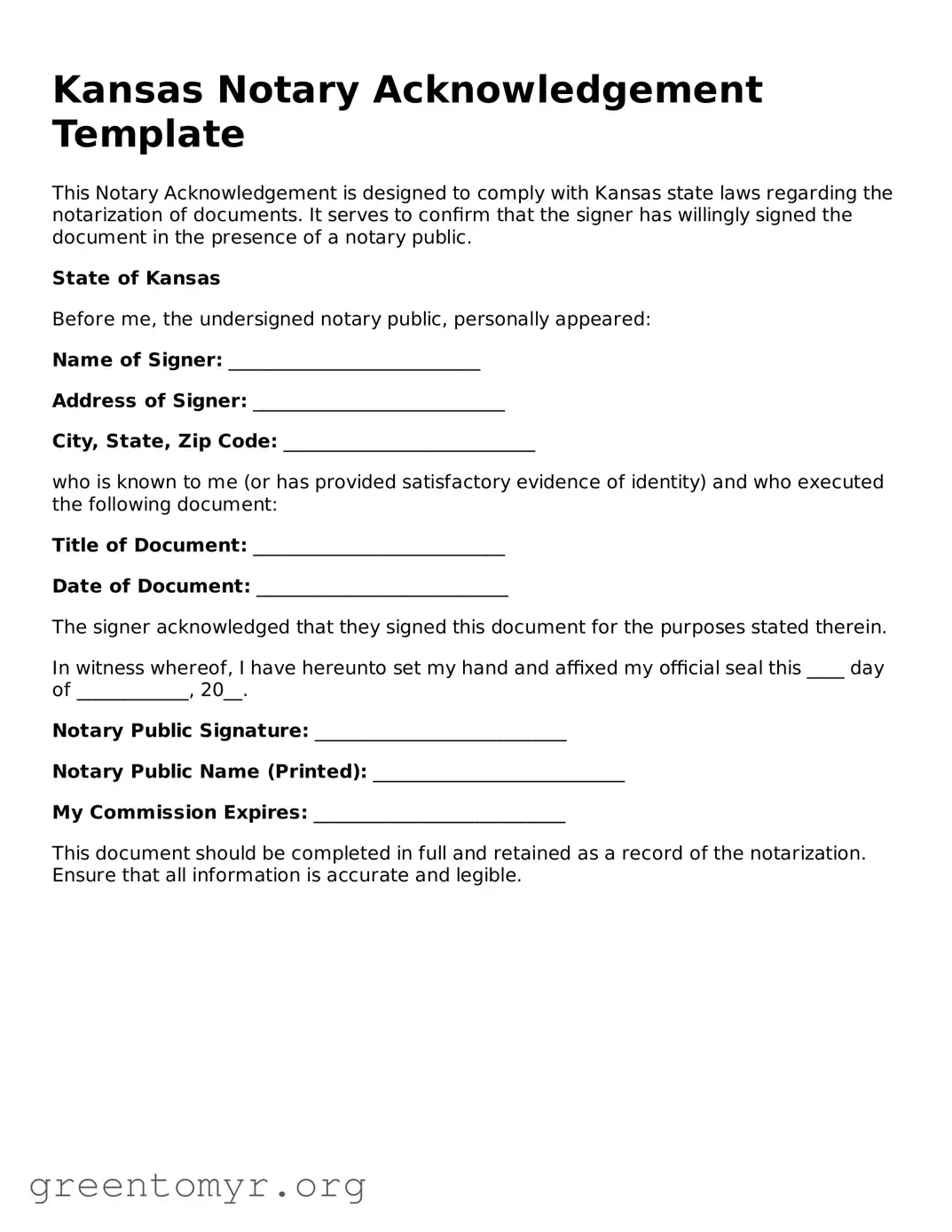
In the state of Kansas, the Notary Acknowledgement form plays a crucial role in verifying the identity of individuals signing important documents. This form serves as a formal declaration that a signer has willingly and knowingly executed a document in the presence of a notary public. By using this form, individuals can ensure that their signatures are authentic and that the document has been executed in compliance with legal requirements. The Notary Acknowledgement form typically includes key elements such as the name of the signer, the date of the acknowledgment, and the notary's signature and seal. It is important to note that this form is often required for various legal documents, including deeds, contracts, and powers of attorney, making it a vital tool in the legal process. Understanding how to properly complete and utilize this form can provide peace of mind and help safeguard against potential disputes regarding the validity of signed documents.
Kansas Notary Acknowledgement Template
This Notary Acknowledgement is designed to comply with Kansas state laws regarding the notarization of documents. It serves to confirm that the signer has willingly signed the document in the presence of a notary public.
State of Kansas
Before me, the undersigned notary public, personally appeared:
Name of Signer: ___________________________
Address of Signer: ___________________________
City, State, Zip Code: ___________________________
who is known to me (or has provided satisfactory evidence of identity) and who executed the following document:
Title of Document: ___________________________
Date of Document: ___________________________
The signer acknowledged that they signed this document for the purposes stated therein.
In witness whereof, I have hereunto set my hand and affixed my official seal this ____ day of ____________, 20__.
Notary Public Signature: ___________________________
Notary Public Name (Printed): ___________________________
My Commission Expires: ___________________________
This document should be completed in full and retained as a record of the notarization. Ensure that all information is accurate and legible.
| Fact Name | Details |
|---|---|
| Purpose | The Kansas Notary Acknowledgement form is used to verify the identity of individuals signing a document. |
| Governing Law | The form is governed by the Kansas Statutes Annotated, specifically K.S.A. 53-601 et seq. |
| Signature Requirement | The signer must personally appear before the notary at the time of the acknowledgment. |
| Identification | A notary must verify the identity of the signer using a government-issued ID or other acceptable means. |
| Notary Seal | The notary must affix their official seal to the form to validate the acknowledgment. |
| Record Keeping | Notaries are required to maintain a record of all acknowledgments performed in their journal. |
| Expiration | The acknowledgment does not expire, but the document itself may have its own validity period. |
| Electronic Acknowledgment | Kansas allows electronic notarizations, provided they comply with state regulations. |
| Witness Requirement | No witnesses are required for a notary acknowledgment in Kansas, unless specified by the document. |
After completing the Kansas Notary Acknowledgement form, you will need to ensure that all required information is accurate. This is important for the validity of the document. Follow the steps below to fill out the form correctly.
The Kansas Notary Acknowledgement form is a document used to verify that a signer has willingly signed a document in the presence of a notary public. This form serves as proof that the notary has confirmed the identity of the signer and witnessed the signing process.
A Notary Acknowledgement is often required to ensure the authenticity of signatures on important documents. It helps prevent fraud and provides assurance to parties involved that the signatures are legitimate. Many legal documents, such as deeds, contracts, and powers of attorney, may require notarization to be considered valid.
In Kansas, a notary public must be at least 18 years old, a resident of the state, and possess the necessary qualifications. They must also complete an application process and receive a commission from the Secretary of State. Notaries are responsible for ensuring that the signing parties understand the document and are signing voluntarily.
To complete the form, follow these steps:
Yes, notaries in Kansas are allowed to charge a fee for their services. The maximum fee is set by state law, and notaries can charge up to $10 per signature. It is advisable to confirm the fee with the notary before the service is rendered.
Common documents that often require a Notary Acknowledgement include:
As of recent regulations, Kansas allows remote notarization under certain conditions. Notaries must use approved technology to verify the identity of the signer. It is essential to ensure that all requirements for remote notarization are met to maintain the validity of the acknowledgment.
If a Notary Acknowledgement is not properly completed, it may lead to the document being deemed invalid. This could result in legal complications or delays in transactions. It is crucial for both the signer and the notary to ensure that all steps are followed correctly.
A Notary Acknowledgement does not have an expiration date in itself. However, the validity of the document it accompanies may depend on other factors, such as the type of document and any applicable statutes of limitations. Always check the specific requirements related to the document in question.
Notaries can be found in various locations, including banks, law offices, and postal service centers. Additionally, the Kansas Secretary of State's website provides a directory of notaries. It is advisable to contact a notary in advance to confirm their availability and any fees they may charge.
Filling out the Kansas Notary Acknowledgement form can seem straightforward, but many people make common mistakes that can lead to delays or issues. One of the most frequent errors is failing to include the date of the acknowledgment. It’s essential to specify when the acknowledgment took place, as this information is crucial for legal records.
Another common mistake is neglecting to sign the form. Both the notary and the individual whose signature is being acknowledged must sign. If one of these signatures is missing, the form may be considered invalid. Always double-check that all required signatures are present before submitting the document.
People often forget to provide the correct identification details. The notary must record the type of identification used, such as a driver's license or passport, along with the ID number. Omitting this information can lead to complications in verifying the identity of the signer.
Additionally, some individuals incorrectly fill out the notary's commission details. The form requires the notary to include their name, commission expiration date, and the county where they are commissioned. Failing to provide accurate information can raise questions about the legitimacy of the notarization.
Another mistake is using the wrong form. It’s important to ensure that you are using the Kansas Notary Acknowledgement form specifically. Using a different state’s form or a different type of notarial act can result in an invalid acknowledgment.
People sometimes overlook the need for a clear and legible print of names. The names of the signers should be printed clearly to avoid any confusion. If the names are illegible, it can lead to disputes about who actually signed the document.
Some individuals forget to check the notary's seal. The seal must be affixed to the acknowledgment form, and it should be clear and readable. An unclear or missing seal can cause the notarization to be questioned.
Lastly, not reviewing the entire form before submission is a common oversight. Taking a moment to go through each section can help catch any mistakes or omissions. A thorough review ensures that the form is complete and accurate, minimizing the risk of complications down the line.
When dealing with the Kansas Notary Acknowledgement form, several other documents often accompany it. These documents serve various purposes, from confirming identities to facilitating transactions. Below is a list of commonly used forms and documents that you may encounter alongside the Notary Acknowledgement form.
Understanding these documents can help streamline the process of completing transactions that require notarization. Each plays a crucial role in ensuring that legal and financial matters are handled correctly and securely.
The Notary Acknowledgment form serves an important function in verifying the identity of signers and their willingness to sign documents. Several other documents share similar characteristics and purposes. Below are eight documents that are comparable to the Notary Acknowledgment form:
Each of these documents plays a crucial role in legal transactions and often requires a notary to ensure the integrity of the signing process. Understanding these similarities can help individuals navigate their legal obligations more effectively.
When filling out the Kansas Notary Acknowledgement form, it's important to approach the task with care. Below is a list of things you should and shouldn't do to ensure the process goes smoothly.
By following these guidelines, you can help ensure that your notary acknowledgment is completed properly and effectively.
When it comes to the Kansas Notary Acknowledgement form, there are several misconceptions that can lead to confusion. Here are six common misunderstandings:
Understanding these misconceptions can help individuals navigate the notary process more effectively and ensure that their documents are properly executed.
When filling out and using the Kansas Notary Acknowledgement form, there are several important points to keep in mind. Here are key takeaways to ensure proper use:
By following these key points, individuals can effectively utilize the Kansas Notary Acknowledgement form, ensuring that their documents are properly acknowledged and legally recognized.