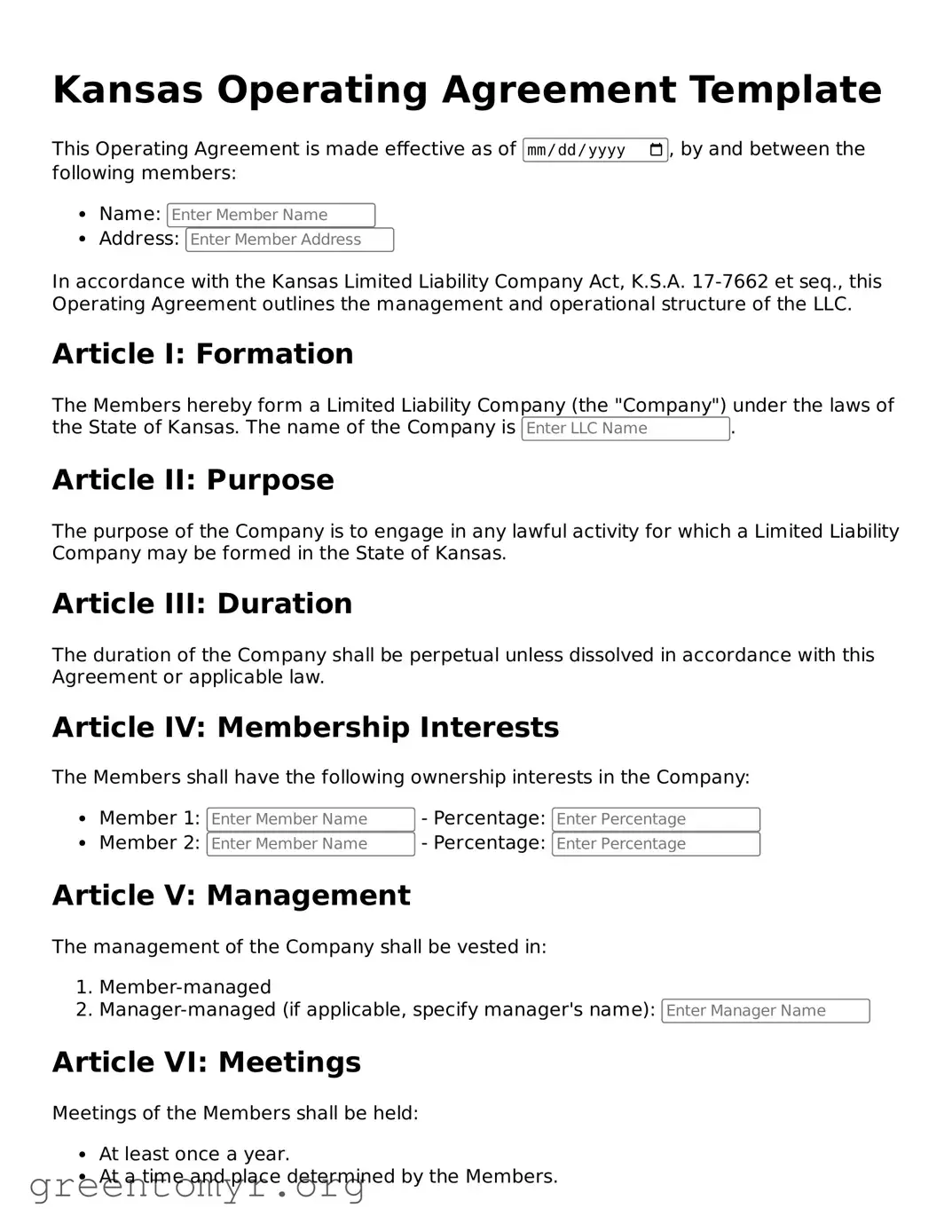
The Kansas Operating Agreement form plays a crucial role in the management and operation of limited liability companies (LLCs) within the state. This document outlines the rights, responsibilities, and obligations of the members, ensuring that everyone involved understands their roles and how the business will be run. Key aspects of the form include provisions for profit and loss distribution, decision-making processes, and procedures for adding or removing members. Additionally, it addresses the management structure, whether the LLC will be member-managed or manager-managed, and sets forth guidelines for resolving disputes. By providing a clear framework, the Kansas Operating Agreement helps to prevent misunderstandings and conflicts among members, fostering a more harmonious business environment. As such, having a well-drafted operating agreement is not just a formality; it is a vital tool for the success and longevity of an LLC in Kansas.
Kansas Operating Agreement Template
This Operating Agreement is made effective as of , by and between the following members:
In accordance with the Kansas Limited Liability Company Act, K.S.A. 17-7662 et seq., this Operating Agreement outlines the management and operational structure of the LLC.
Article I: Formation
The Members hereby form a Limited Liability Company (the "Company") under the laws of the State of Kansas. The name of the Company is .
Article II: Purpose
The purpose of the Company is to engage in any lawful activity for which a Limited Liability Company may be formed in the State of Kansas.
Article III: Duration
The duration of the Company shall be perpetual unless dissolved in accordance with this Agreement or applicable law.
Article IV: Membership Interests
The Members shall have the following ownership interests in the Company:
Article V: Management
The management of the Company shall be vested in:
Article VI: Meetings
Meetings of the Members shall be held:
Article VII: Distributions
Distributions of profits and losses shall be allocated according to each Member’s ownership interest in the Company.
Article VIII: Amendments
This Operating Agreement may be amended only by a written agreement signed by all Members.
Article IX: Governing Law
This Agreement shall be governed by and construed in accordance with the laws of the State of Kansas.
IN WITNESS WHEREOF, the undersigned have executed this Operating Agreement as of the date first above written.
| Fact Name | Description |
|---|---|
| Governing Law | The Kansas Operating Agreement is governed by the Kansas Limited Liability Company Act. |
| Purpose | This form outlines the management structure and operational procedures of a limited liability company (LLC) in Kansas. |
| Members | The agreement must include the names and addresses of all members involved in the LLC. |
| Management Structure | It specifies whether the LLC will be managed by its members or by appointed managers. |
| Voting Rights | The agreement should detail the voting rights of members, including how decisions are made. |
| Amendments | It provides a process for amending the agreement in the future, ensuring flexibility. |
| Dispute Resolution | Provisions for resolving disputes among members can also be included in the agreement. |
| Duration | The agreement may specify the duration of the LLC, whether it is perpetual or for a set term. |
After obtaining the Kansas Operating Agreement form, you will need to complete it accurately to ensure that all relevant information about your business is documented. Follow these steps to fill out the form correctly.
Once you have filled out the form, review it for accuracy and completeness. Ensure that all members have signed before submitting it to the appropriate state agency.
A Kansas Operating Agreement is a legal document that outlines the management structure, operational procedures, and ownership details of a limited liability company (LLC) in Kansas. This agreement serves as a blueprint for how the LLC will operate, detailing the roles and responsibilities of members, the distribution of profits and losses, and the procedures for decision-making. Having this document in place can help prevent disputes among members and provide clarity in operations.
An Operating Agreement is crucial for several reasons:
All members of the LLC should be involved in creating the Operating Agreement. This collaborative approach ensures that everyone's interests and concerns are addressed. While it is possible to draft the agreement without legal assistance, consulting with a legal professional can provide valuable insights and help ensure that the document complies with Kansas laws and accurately reflects the intentions of the members.
A comprehensive Kansas Operating Agreement typically includes the following elements:
No, the Kansas Operating Agreement does not need to be filed with the state. It is an internal document meant for the members of the LLC. However, it is advisable to keep the agreement in a safe place, as it may be required for various purposes, such as opening a business bank account, securing financing, or resolving disputes. Having a well-drafted Operating Agreement can also demonstrate professionalism and preparedness to potential investors or partners.
Filling out the Kansas Operating Agreement form can be a straightforward process, but many individuals make common mistakes that can lead to complications down the road. One frequent error is failing to provide complete information about the members of the LLC. Each member’s name, address, and percentage of ownership should be clearly stated. Omitting any of these details can create confusion and potential disputes later.
Another mistake often seen is neglecting to specify the management structure of the LLC. The form should clearly indicate whether the LLC will be managed by its members or by appointed managers. Without this information, the organization may face challenges in decision-making and governance.
Some individuals overlook the importance of defining the purpose of the LLC. A vague or broad statement can lead to misunderstandings regarding the business's operations. It's crucial to include a clear and concise description of what the LLC intends to do.
Additionally, many people forget to include provisions for profit and loss distribution. This section is vital for outlining how profits and losses will be shared among members. Not addressing this can lead to disputes and dissatisfaction among members.
Another common oversight is failing to outline procedures for adding or removing members. Without clear guidelines, the process can become contentious and complicated. Establishing these procedures in advance helps ensure smooth transitions in membership.
Some individuals mistakenly think that the Operating Agreement is a one-time document that does not require updates. However, as the business grows and changes, so too should the agreement. Regularly reviewing and amending the document as necessary is essential for maintaining its relevance and effectiveness.
Moreover, individuals often do not seek legal advice when completing the form. While it may seem like a simple task, consulting with a legal professional can provide valuable insights and help avoid costly mistakes.
Another issue arises when members fail to agree on the terms before submitting the form. Having a consensus among all members is crucial. Disagreements can lead to confusion and may even invalidate the agreement.
Some people also neglect to consider the tax implications of their choices in the Operating Agreement. Decisions regarding management structure and profit distribution can have significant tax consequences. Understanding these implications can help members make informed decisions.
Finally, many individuals underestimate the importance of signing and dating the agreement. An unsigned or undated document may not hold up in legal situations. Ensuring that all members sign and date the agreement solidifies its validity and helps protect the interests of everyone involved.
The Kansas Operating Agreement is a crucial document for limited liability companies (LLCs) in Kansas. It outlines the management structure, responsibilities, and operating procedures of the LLC. Alongside this agreement, several other forms and documents are commonly utilized to ensure proper compliance and functionality of the business. Below is a list of these documents, each with a brief description.
Utilizing these documents in conjunction with the Kansas Operating Agreement helps ensure that the LLC operates smoothly and remains compliant with state regulations. Proper documentation is essential for protecting the interests of all members and maintaining the integrity of the business.
The Operating Agreement is a crucial document for any Limited Liability Company (LLC). It outlines the management structure, responsibilities, and operating procedures of the company. However, there are several other documents that share similarities with the Operating Agreement. Here are four of them:
Understanding these documents can help clarify the structure and function of your business entity. Each serves a unique purpose but shares common themes of governance and operational clarity.
Filling out the Kansas Operating Agreement form is a crucial step for anyone starting a business in the state. To ensure that the process goes smoothly, here are some important dos and don’ts to keep in mind.
By following these guidelines, you can avoid common pitfalls and create a solid foundation for your business.
Many people have misunderstandings about the Kansas Operating Agreement form. Here are seven common misconceptions:
This form is useful for businesses of all sizes, including small and family-owned enterprises. It helps clarify roles and responsibilities, regardless of the company's scale.
Each Operating Agreement should be tailored to fit the specific needs of a business. Generic templates may not address unique circumstances or requirements.
Relying on verbal agreements can lead to misunderstandings. A written Operating Agreement provides clarity and legal protection for all parties involved.
While LLCs commonly use this form, other business structures can benefit from having an Operating Agreement to outline management and operational procedures.
Operating Agreements can be amended as the business evolves. Regular reviews and updates ensure that the document remains relevant.
While it may seem daunting, many resources and templates are available to simplify the process. Consulting with a professional can also make it easier.
The Operating Agreement addresses various aspects of business operations, including management structure, decision-making processes, and dispute resolution, not just finances.
Filling out and using the Kansas Operating Agreement form is an essential step for any business entity operating in the state. Here are some key takeaways to consider: