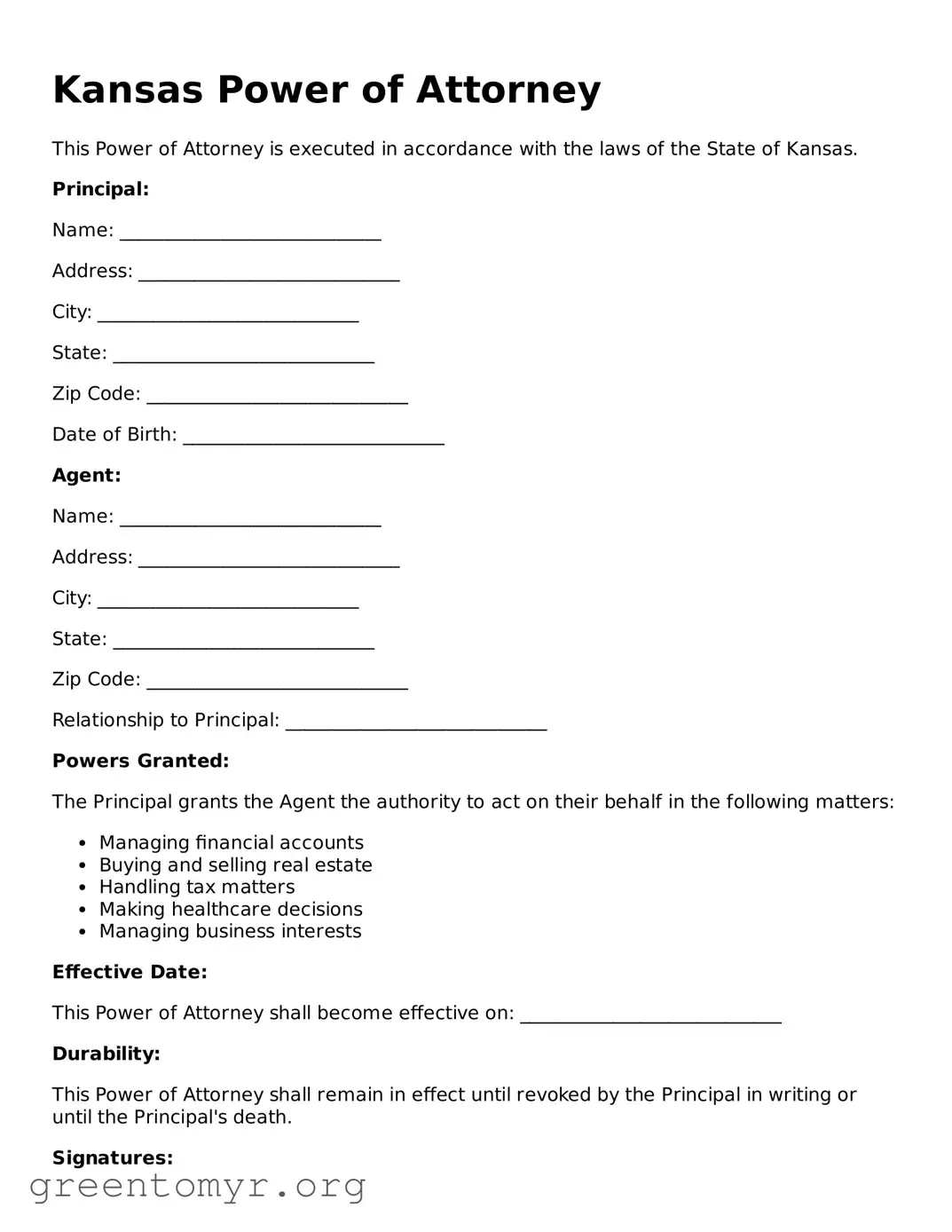
In Kansas, the Power of Attorney (POA) form serves as a vital legal tool that allows individuals to designate someone they trust to make decisions on their behalf. This form can cover a wide range of responsibilities, from managing financial affairs to making healthcare choices, depending on how it is structured. The person granting authority is known as the principal, while the individual receiving that authority is referred to as the agent or attorney-in-fact. It's essential to understand that the POA can be tailored to fit specific needs; for instance, it can be durable, meaning it remains effective even if the principal becomes incapacitated, or it can be limited to certain tasks or a specific time frame. By carefully selecting the right agent and clearly outlining the powers granted, individuals can ensure their wishes are respected and their interests are protected. Whether planning for the future or addressing immediate concerns, having a well-prepared Power of Attorney form can provide peace of mind and clarity in times of uncertainty.
Kansas Power of Attorney
This Power of Attorney is executed in accordance with the laws of the State of Kansas.
Principal:
Name: ____________________________
Address: ____________________________
City: ____________________________
State: ____________________________
Zip Code: ____________________________
Date of Birth: ____________________________
Agent:
Name: ____________________________
Address: ____________________________
City: ____________________________
State: ____________________________
Zip Code: ____________________________
Relationship to Principal: ____________________________
Powers Granted:
The Principal grants the Agent the authority to act on their behalf in the following matters:
Effective Date:
This Power of Attorney shall become effective on: ____________________________
Durability:
This Power of Attorney shall remain in effect until revoked by the Principal in writing or until the Principal's death.
Signatures:
By signing below, the Principal confirms that they understand the powers granted to the Agent and the implications of this document.
Principal's Signature: ____________________________
Date: ____________________________
Agent's Signature: ____________________________
Date: ____________________________
Witnesses:
Witness 1 Name: ____________________________
Witness 1 Signature: ____________________________
Date: ____________________________
Witness 2 Name: ____________________________
Witness 2 Signature: ____________________________
Date: ____________________________
Notary Public:
State of Kansas
County of ____________________________
Subscribed and sworn to before me this ____ day of __________, 20__.
Notary Public Signature: ____________________________
My Commission Expires: ____________________________
| Fact Name | Description |
|---|---|
| Definition | A Kansas Power of Attorney form allows a person to appoint someone else to manage their financial or legal affairs. |
| Governing Law | The Kansas Power of Attorney is governed by the Kansas Statutes Annotated, specifically K.S.A. 58-6501 et seq. |
| Types | There are different types of Power of Attorney, including General, Limited, and Durable Power of Attorney. |
| Durable Option | A Durable Power of Attorney remains effective even if the principal becomes incapacitated. |
| Agent Responsibilities | The agent must act in the best interest of the principal and manage their affairs responsibly. |
| Revocation | The principal can revoke the Power of Attorney at any time, as long as they are competent. |
| Signing Requirements | The form must be signed by the principal and, in some cases, witnessed or notarized. |
| Age Requirement | The principal must be at least 18 years old to create a valid Power of Attorney in Kansas. |
| Limitations | Some actions, like making a will, cannot be delegated through a Power of Attorney. |
| Legal Advice | It is advisable to seek legal counsel when creating a Power of Attorney to ensure it meets all needs. |
Completing the Kansas Power of Attorney form is an important step in designating someone to act on your behalf in financial or legal matters. After filling out the form, ensure that it is signed and witnessed according to Kansas law to make it valid.
A Kansas Power of Attorney (POA) form is a legal document that allows an individual, known as the principal, to designate another person, called the agent or attorney-in-fact, to make decisions on their behalf. This can include financial, legal, or health-related matters. The form must be completed and signed to be valid.
Creating a Power of Attorney is essential for ensuring that your affairs are managed according to your wishes in case you become unable to make decisions due to illness or incapacity. It provides peace of mind, knowing that someone you trust can act on your behalf when needed. Without a POA, family members may face legal hurdles to make decisions for you.
Kansas recognizes several types of Power of Attorney forms, including:
To execute a Kansas Power of Attorney form, follow these steps:
Yes, you can revoke a Power of Attorney at any time as long as you are mentally competent. To do so, you must create a written revocation notice and notify your agent and any institutions or individuals who may have relied on the original POA. It's advisable to also destroy any copies of the original document to prevent confusion.
If you do not have a Power of Attorney and become incapacitated, your family may need to go through a lengthy and potentially costly court process to obtain guardianship or conservatorship. This process can be emotionally taxing and may not align with your personal wishes. Having a POA in place can help avoid these complications.
While Kansas does not require a specific form, it is recommended to use a form that complies with state laws to ensure its validity. Many resources are available online, including templates and guidelines, to help you create a compliant Power of Attorney. Consulting with a legal professional can also provide additional assurance that your document meets all necessary requirements.
Filling out a Kansas Power of Attorney form can be straightforward, but many individuals make common mistakes that can lead to complications. One frequent error is not clearly identifying the principal. The principal is the person granting authority, and their full name should be written exactly as it appears on legal documents. Omitting or misspelling the name can create confusion and invalidate the document.
Another mistake involves the selection of the agent. It’s crucial to choose someone trustworthy, as this person will have significant control over financial and legal matters. People often select an agent without considering their ability to handle responsibilities. This oversight can result in poor decision-making down the line.
Not specifying the powers granted is also a common error. The form allows for broad or limited powers, and failing to clarify these can lead to misunderstandings. For instance, if the document does not explicitly state whether the agent can handle real estate transactions, the agent may not have the authority to act in that area.
Many individuals overlook the importance of including a durable clause. A durable Power of Attorney remains effective even if the principal becomes incapacitated. Without this clause, the agent’s authority may end when the principal is no longer able to make decisions, which can create serious issues during critical times.
Another mistake is neglecting to date the form. A Power of Attorney must be dated to be valid. If there is no date, it can lead to disputes about when the authority was granted, complicating matters for both the principal and the agent.
People often forget to sign the document in the presence of a notary. In Kansas, a Power of Attorney must be notarized to be legally binding. Skipping this step can render the entire document ineffective, leaving the principal without the intended protections.
Failing to inform the agent about the Power of Attorney is another common oversight. The agent should be aware of their role and responsibilities. If they are unaware of the document, they may not act when needed, which defeats the purpose of having a Power of Attorney in place.
Lastly, not keeping copies of the signed and notarized document can lead to issues. It’s essential to provide copies to the agent and any relevant institutions, such as banks or healthcare providers. Without these copies, the agent may face challenges when attempting to exercise their authority.
When dealing with a Kansas Power of Attorney, several other forms and documents may be useful to ensure that your legal and financial matters are handled smoothly. Here’s a list of common documents you might encounter alongside the Power of Attorney form.
Understanding these documents can help you navigate legal and financial responsibilities more effectively. Each serves a specific purpose and can provide peace of mind when planning for the future.
The Power of Attorney (POA) is a powerful legal document that grants one person the authority to act on behalf of another in various matters. Several other documents serve similar functions, each with its own specific focus. Here’s a list of eight documents that share similarities with the Power of Attorney:
Understanding these documents can help individuals make informed decisions about their legal rights and responsibilities. Each serves a unique purpose but shares the common goal of ensuring that someone can act on your behalf when you are unable to do so.
When filling out the Kansas Power of Attorney form, it's essential to approach the task with care. Here are ten things you should and shouldn't do to ensure the document is valid and effective.
Many people have misconceptions about the Kansas Power of Attorney form. Understanding these misconceptions can help individuals make informed decisions about their legal affairs. Here are eight common misconceptions:
This is not true. Anyone, regardless of age, can benefit from having a Power of Attorney. It is useful for anyone who may need someone else to make decisions on their behalf, whether due to travel, illness, or other circumstances.
This misconception is misleading. You can still manage your own affairs after granting someone else Power of Attorney. The document can specify when the authority begins and ends, allowing you to retain control until you choose to delegate it.
This is false. You can revoke a Power of Attorney at any time as long as you are mentally competent. It’s essential to follow the proper procedures to ensure that the revocation is legally binding.
This is incorrect. There are different types of Power of Attorney, such as durable, non-durable, and medical. Each type serves a different purpose and comes with specific powers and limitations.
This is a misunderstanding. An agent must act in your best interest and within the scope of authority granted in the Power of Attorney document. They cannot use the power for personal gain.
This is not entirely accurate. While many people associate Power of Attorney with financial decisions, it can also cover healthcare decisions and other personal matters, depending on how it is drafted.
This is misleading. A will only takes effect after death, while a Power of Attorney is useful during your lifetime. They serve different purposes and can complement each other.
This is not true. Each state, including Kansas, has its own laws and requirements regarding Power of Attorney forms. It is crucial to use the correct form that complies with Kansas law.
By addressing these misconceptions, individuals can better understand the importance of the Kansas Power of Attorney form and how it can serve their needs.
Filling out and using the Kansas Power of Attorney form is an important step in planning for the future. Here are some key takeaways to keep in mind: