Content Navigation

In Kansas, the Power of Attorney for a Child form serves as a vital tool for parents and guardians seeking to delegate specific responsibilities for the care of their children. This legal document allows a designated individual, often referred to as the agent, to make decisions on behalf of a child in various areas, including education, healthcare, and general welfare. By utilizing this form, parents can ensure that their child's needs are met in their absence, whether due to travel, medical emergencies, or other unforeseen circumstances. The form requires clear identification of both the child and the appointed agent, as well as a detailed outline of the powers being granted. It is important for parents to understand the implications of this authority, as the agent will have the ability to make significant decisions that impact the child's daily life and well-being. Additionally, the Power of Attorney for a Child form can be tailored to suit the specific needs of the family, allowing for flexibility in its application. Understanding the nuances of this form can provide peace of mind, ensuring that children are cared for in a manner consistent with their parents' wishes.

Kansas Power of Attorney for a Child Example

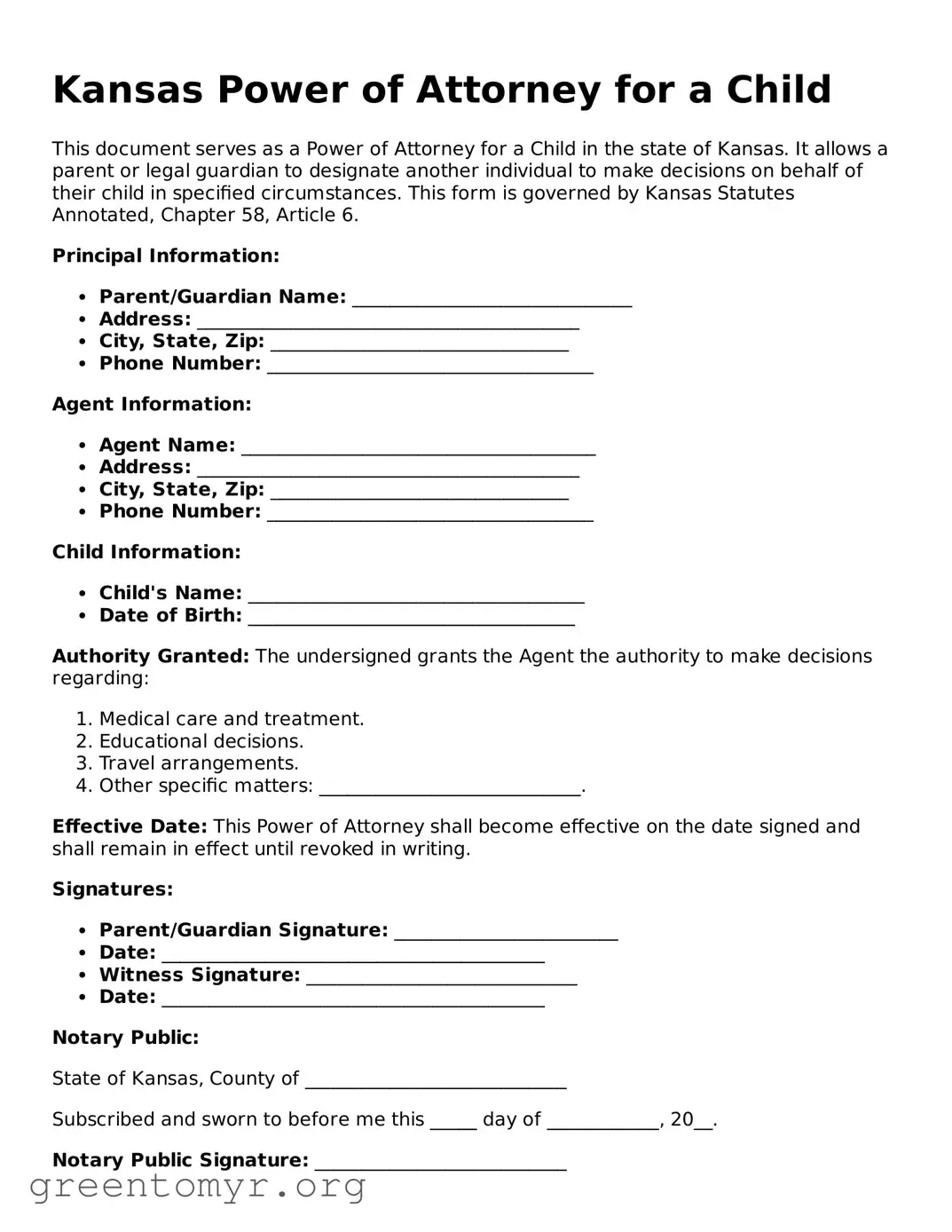
Kansas Power of Attorney for a Child

This document serves as a Power of Attorney for a Child in the state of Kansas. It allows a parent or legal guardian to designate another individual to make decisions on behalf of their child in specified circumstances. This form is governed by Kansas Statutes Annotated, Chapter 58, Article 6.

Principal Information:

  • Parent/Guardian Name: ______________________________
  • Address: _________________________________________
  • City, State, Zip: ________________________________
  • Phone Number: ___________________________________

Agent Information:

  • Agent Name: ______________________________________
  • Address: _________________________________________
  • City, State, Zip: ________________________________
  • Phone Number: ___________________________________

Child Information:

  • Child's Name: ____________________________________
  • Date of Birth: ___________________________________

Authority Granted: The undersigned grants the Agent the authority to make decisions regarding:

  1. Medical care and treatment.
  2. Educational decisions.
  3. Travel arrangements.
  4. Other specific matters: ____________________________.

Effective Date: This Power of Attorney shall become effective on the date signed and shall remain in effect until revoked in writing.

Signatures:

  • Parent/Guardian Signature: ________________________
  • Date: _________________________________________
  • Witness Signature: _____________________________
  • Date: _________________________________________

Notary Public:

State of Kansas, County of ____________________________

Subscribed and sworn to before me this _____ day of ____________, 20__.

Notary Public Signature: ___________________________

My Commission Expires: ____________________________

PDF Form Features

Fact Name Details
Definition The Kansas Power of Attorney for a Child form allows a parent or guardian to designate another adult to make decisions for their child.
Governing Law This form is governed by Kansas Statutes Annotated, Chapter 38, Article 2201.
Duration The authority granted can be limited to a specific time frame or until revoked by the parent or guardian.
Eligibility Any adult can be appointed as an attorney-in-fact, provided they are willing and able to act in the child's best interest.
Scope of Authority The appointed individual can make decisions related to education, healthcare, and general welfare of the child.
Revocation The parent or guardian can revoke the power of attorney at any time, in writing.
Notarization While notarization is not strictly required, it is highly recommended to enhance the document's validity.

Guide to Using Kansas Power of Attorney for a Child

Filling out the Kansas Power of Attorney for a Child form is a straightforward process. Follow these steps carefully to ensure all necessary information is provided accurately.

  1. Obtain the Kansas Power of Attorney for a Child form. You can find it online or request a copy from a local legal office.
  2. Begin by entering the child's full name at the top of the form.
  3. Provide the child's date of birth in the designated section.
  4. Fill in the name and address of the person you are granting power of attorney to. This should include their full name, street address, city, state, and zip code.
  5. Specify the duration of the power of attorney. Indicate whether it is effective immediately or if it will begin on a specific date.
  6. Clearly outline the powers you are granting. Be specific about what decisions the appointed person can make on behalf of the child.
  7. Sign the form in the presence of a notary public. Ensure that the notary's information is included as required.
  8. Provide the date of signing in the appropriate section.
  9. Make copies of the completed form for your records and for the person receiving power of attorney.

Once the form is filled out and signed, it is ready for use. Ensure that the appointed person understands their responsibilities and the authority granted to them.

Get Answers on Kansas Power of Attorney for a Child

What is a Kansas Power of Attorney for a Child?

A Kansas Power of Attorney for a Child is a legal document that allows a parent or guardian to designate another adult to make decisions on behalf of their child. This can include decisions about medical care, education, and general welfare. This form is particularly useful for situations where the parent or guardian may be unavailable, such as during travel or medical emergencies.

Who can be appointed as an agent in the Power of Attorney for a Child?

Any adult can be appointed as an agent, as long as they are willing to accept the responsibility. This could be a relative, family friend, or trusted neighbor. It's important to choose someone who understands the child's needs and can act in their best interest.

How long does the Power of Attorney for a Child remain in effect?

The Power of Attorney for a Child can remain in effect for a specified period, or until the parent or guardian revokes it. If no end date is specified, it typically lasts until the child turns 18 years old. However, parents can always revoke the power at any time if circumstances change.

Do I need to have the Power of Attorney for a Child notarized?

Yes, in Kansas, the Power of Attorney for a Child must be signed in the presence of a notary public to be considered valid. This adds an extra layer of legal protection and ensures that the document is recognized by schools, medical facilities, and other institutions.

What should I include when filling out the Power of Attorney for a Child form?

When completing the form, make sure to include the following:

  • The full names and addresses of both the parent or guardian and the appointed agent.
  • The child's full name and date of birth.
  • A clear statement of the powers being granted to the agent.
  • The duration of the Power of Attorney, if applicable.
  • Signatures of the parent or guardian and the notary public.

Common mistakes

Filling out the Kansas Power of Attorney for a Child form can be a straightforward process, but mistakes can lead to complications. One common error is not providing accurate information about the child. It is essential to ensure that the child's full name, date of birth, and any other identifying details are correct. Inaccuracies can cause delays or even invalidate the document.

Another mistake often made is failing to specify the powers granted. The form allows for a range of responsibilities to be assigned to the agent. Not clearly outlining these powers can lead to confusion later on. It's important to be explicit about what decisions the agent can make on behalf of the child.

Some individuals overlook the requirement for signatures. Both the parent granting the power and the agent must sign the document. Neglecting to include these signatures can render the form ineffective. Always double-check that all necessary signatures are present before submitting the form.

Additionally, people sometimes forget to date the form. A missing date can raise questions about the validity of the document. It is a simple detail but crucial for establishing when the powers come into effect.

Another frequent oversight involves not providing contact information for the agent. Including a phone number and address is vital, as it allows for easy communication if any issues arise. Without this information, it may be challenging to reach the agent when needed.

Some parents may also fail to consider the duration of the power of attorney. The form allows for specifying how long the powers will be in effect. Not addressing this aspect can lead to misunderstandings or unintended consequences regarding the authority granted.

Lastly, individuals sometimes neglect to review the completed form thoroughly. Skimming through the document can result in missed errors or omissions. Taking the time to carefully review the form can help ensure that everything is in order and that the document serves its intended purpose.

Documents used along the form

When establishing a Kansas Power of Attorney for a Child, several other documents may be beneficial to ensure comprehensive care and legal authority. Each of these forms serves a specific purpose and can enhance the overall effectiveness of the Power of Attorney.

  • Parental Consent Form: This document provides formal approval from the child's parents for the designated agent to make decisions on behalf of the child. It clarifies the scope of authority granted to the agent.
  • Medical Authorization Form: This form allows the agent to make medical decisions and access medical records for the child. It is essential for emergencies and routine healthcare needs.
  • School Enrollment Form: If the child will be attending school, this document is necessary for enrollment. It may require the agent's signature to enroll the child in educational programs.
  • Emergency Contact Information: This list includes important contacts, such as family members, doctors, and local authorities. It ensures that the agent can reach necessary parties quickly in case of an emergency.
  • Travel Consent Form: If the child will be traveling with the agent, this document grants permission for travel. It is particularly important for international trips or travel outside the state.
  • Child Care Agreement: This agreement outlines the responsibilities and expectations between the agent and any caregivers. It helps ensure that the child’s needs are met consistently.
  • Financial Power of Attorney: If the agent needs to manage financial matters for the child, this document allows them to handle banking, payments, and other financial responsibilities.

Having these documents in place alongside the Kansas Power of Attorney for a Child can provide clarity and ensure that the child's needs are met effectively. It is advisable to review these forms regularly to ensure they remain current and valid.

Similar forms

  • Guardianship Agreement: This document appoints someone to take care of a child when the parents are unable to do so. It grants similar authority to make decisions about the child's welfare.
  • Medical Power of Attorney: This allows a designated person to make healthcare decisions for another individual. Like the Power of Attorney for a Child, it focuses on the well-being of the person involved.
  • Temporary Custody Agreement: This is often used when parents need someone else to care for their child for a short period. It outlines the responsibilities and rights of the caregiver, similar to a Power of Attorney.
  • Parental Consent Form: This document gives permission for another adult to make decisions or take actions on behalf of a child. It serves a similar purpose in allowing others to act in the child's interest.
  • Child Care Authorization: This form allows a caregiver to make decisions regarding a child's daily care. It shares similarities with the Power of Attorney for a Child in terms of authority granted.
  • Educational Power of Attorney: This document enables someone to make educational decisions for a child, such as enrolling them in school or consenting to special services, paralleling the decision-making aspects of the Power of Attorney.
  • Travel Consent Form: This form is used to give permission for a child to travel with someone else. It reflects the same idea of granting authority over a child's affairs.
  • Authorization for Medical Treatment: This document allows someone to consent to medical care for a child. It is similar in that it gives authority to act in the child's best interest.
  • Child Support Agreement: This outlines the financial responsibilities of parents or guardians towards a child. While it focuses more on finances, it still relates to the overall care and support of the child.
  • Power of Attorney for Minor Child: This is a specific type of Power of Attorney that directly pertains to minors. It grants similar rights and responsibilities as the general Power of Attorney for a Child.

Dos and Don'ts

When filling out the Kansas Power of Attorney for a Child form, there are important guidelines to follow. Here’s a clear list of what to do and what to avoid.

  • Do ensure that you understand the responsibilities you are assigning to the agent.
  • Do provide accurate information about the child and the agent.
  • Do sign and date the form in the presence of a notary public.
  • Do keep a copy of the completed form for your records.
  • Don't leave any sections of the form blank; complete all required fields.
  • Don't use the form for purposes other than what it is intended for.

Following these guidelines will help ensure that the process goes smoothly and that the document is valid. Always double-check your work before submission.

Misconceptions

Understanding the Kansas Power of Attorney for a Child form is crucial for parents and guardians. However, several misconceptions often arise. Here are six common misunderstandings:

  • It can only be used in emergencies. Many believe this form is only for urgent situations. In reality, it can be used for a variety of circumstances, including travel, medical decisions, and everyday care.
  • It gives up parental rights. Some think signing this form means they are relinquishing their parental rights. This is not true. The form allows for temporary delegation of authority, not a permanent transfer of rights.
  • It must be notarized to be valid. While notarization can strengthen the document, it is not always required. In Kansas, the form can be valid without a notary, depending on the situation.
  • It expires immediately after use. There is a belief that the Power of Attorney for a Child is only valid for a short time. In fact, it can remain in effect until the specified end date or until revoked by the parent or guardian.
  • Only parents can create this document. Some think only biological parents have the authority to establish a Power of Attorney for a Child. However, legal guardians and custodians can also create this document.
  • It is only for healthcare decisions. Many assume this form is limited to medical matters. In truth, it covers a broad range of responsibilities, including education and general welfare.

By clarifying these misconceptions, parents and guardians can make informed decisions about the care and authority they wish to delegate for their children.

Key takeaways

When considering the Kansas Power of Attorney for a Child form, it's important to understand its purpose and implications. Here are some key takeaways that can help guide you through the process:

  • The Power of Attorney for a Child allows a parent or legal guardian to designate another adult to make decisions on behalf of their child.
  • This form can be particularly useful in situations such as travel, medical emergencies, or when the parent is unable to care for the child temporarily.
  • It is essential to choose a trusted individual who will act in the best interest of the child, as this person will have significant authority during the specified period.
  • The form must be completed and signed in the presence of a notary public to ensure its validity.
  • Clearly outline the specific powers granted to the designated individual to avoid any confusion or misinterpretation.
  • The Power of Attorney can be revoked at any time by the parent or guardian, provided that the revocation is done in writing and communicated to the designated individual.
  • Keep a copy of the completed form in a safe place and provide copies to relevant parties, such as schools or healthcare providers, to ensure they are aware of the arrangement.

Understanding these aspects can help ensure that the Power of Attorney for a Child is used effectively and responsibly, providing peace of mind for both parents and guardians.