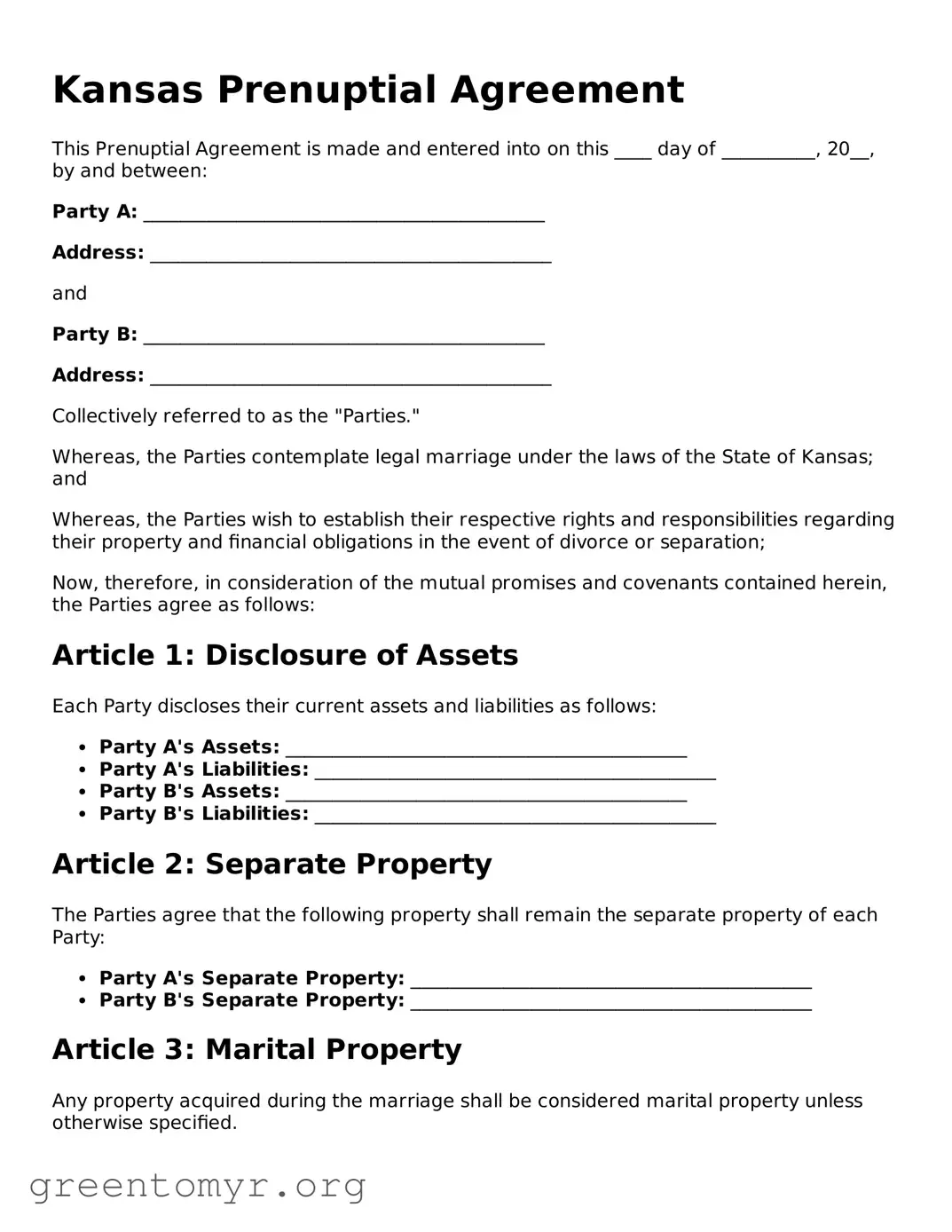
In Kansas, a prenuptial agreement serves as a crucial tool for couples planning to marry, helping them outline their financial rights and responsibilities before tying the knot. This legally binding document can address various aspects, including the division of property, spousal support, and the management of debts. By clearly defining these elements, couples can minimize potential conflicts and misunderstandings in the event of divorce or separation. The Kansas Prenuptial Agreement form must be completed with careful attention to detail, as it requires both parties to disclose their assets and liabilities fully. Additionally, the agreement must be signed voluntarily by both individuals, ideally with independent legal counsel to ensure fairness and understanding. This proactive approach not only fosters transparency but also strengthens the foundation of the marriage by encouraging open discussions about finances and expectations.
Kansas Prenuptial Agreement
This Prenuptial Agreement is made and entered into on this ____ day of __________, 20__, by and between:
Party A: ___________________________________________
Address: ___________________________________________
and
Party B: ___________________________________________
Address: ___________________________________________
Collectively referred to as the "Parties."
Whereas, the Parties contemplate legal marriage under the laws of the State of Kansas; and
Whereas, the Parties wish to establish their respective rights and responsibilities regarding their property and financial obligations in the event of divorce or separation;
Now, therefore, in consideration of the mutual promises and covenants contained herein, the Parties agree as follows:
Article 1: Disclosure of Assets
Each Party discloses their current assets and liabilities as follows:
Article 2: Separate Property
The Parties agree that the following property shall remain the separate property of each Party:
Article 3: Marital Property
Any property acquired during the marriage shall be considered marital property unless otherwise specified.
Article 4: Spousal Support
The Parties agree that in the event of divorce, spousal support shall be addressed as follows:
Article 5: Governing Law
This Agreement shall be governed by and construed in accordance with the laws of the State of Kansas.
Article 6: Amendments
This Agreement may only be amended in writing, signed by both Parties.
Article 7: Signatures
In witness whereof, the Parties have executed this Prenuptial Agreement as of the day and year first above written.
Party A Signature: ___________________________ Date: __________
Party B Signature: ___________________________ Date: __________
Witness Signature: ___________________________ Date: __________
| Fact Name | Description |
|---|---|
| Definition | A Kansas prenuptial agreement is a legal contract between two individuals before marriage, outlining the distribution of assets and responsibilities in the event of divorce or separation. |
| Governing Law | These agreements are governed by the Kansas Uniform Premarital Agreement Act (K.S.A. 23-801 et seq.). |
| Enforceability | For a prenuptial agreement to be enforceable in Kansas, it must be in writing and signed by both parties. |
| Disclosure Requirements | Both parties should fully disclose their financial situations, including assets and debts, to ensure fairness and transparency. |
| Modification | Changes to a prenuptial agreement can be made, but they must also be in writing and signed by both parties to be valid. |
| Legal Advice | It is advisable for each party to seek independent legal counsel before signing a prenuptial agreement to ensure their rights are protected. |
Filling out the Kansas Prenuptial Agreement form is an important step for couples considering marriage. This form helps outline each party's rights and responsibilities regarding property and finances. Once completed, it will need to be signed by both parties, typically in the presence of a notary.
A Kansas prenuptial agreement is a legal document created by two individuals before they get married. It outlines how assets and debts will be handled in the event of a divorce or separation. The agreement can help clarify financial rights and responsibilities, making it easier for both parties to understand their situation.
There are several reasons to consider a prenuptial agreement. It can protect individual assets, clarify financial responsibilities, and reduce conflicts during a divorce. Additionally, it can provide peace of mind by ensuring both parties have a clear understanding of their financial rights.
A prenuptial agreement can include various provisions, such as:
However, certain topics, like child custody and child support, cannot be included as they are typically determined by the court.
To create a prenuptial agreement in Kansas, both parties should discuss their financial situations and what they wish to include in the agreement. It is advisable to consult with an attorney who specializes in family law to ensure that the agreement meets legal requirements. Once drafted, both parties must sign the document, ideally in the presence of a notary public.
Yes, a prenuptial agreement can be enforceable in Kansas if it meets certain legal standards. The agreement must be in writing, signed by both parties, and entered into voluntarily. Additionally, both parties should fully disclose their financial situations before signing.
Yes, a prenuptial agreement can be modified or revoked after marriage. Both parties must agree to the changes, and it is recommended to put any modifications in writing and have them signed by both individuals. Consulting an attorney during this process is also advisable.
If a couple does not have a prenuptial agreement, the division of assets and debts will be determined by Kansas law in the event of a divorce. This may lead to disputes and uncertainty, as the court will make decisions based on statutory guidelines rather than the couple's wishes.
The cost of creating a prenuptial agreement can vary widely. Factors include attorney fees, complexity of the agreement, and whether both parties are using legal representation. On average, couples might expect to pay anywhere from a few hundred to several thousand dollars. It is best to discuss costs upfront with an attorney.
While it is not legally required to have a lawyer for a prenuptial agreement, it is highly recommended. An attorney can provide guidance on legal requirements, ensure that the agreement is fair, and help protect both parties' interests. Having separate legal representation for each party can also enhance the agreement's validity.
Filling out the Kansas Prenuptial Agreement form can be a complex process. Many individuals make common mistakes that can affect the validity of the agreement. One frequent error is failing to fully disclose assets. Both parties should provide a complete list of their individual assets and liabilities. Omitting any significant property or debt can lead to complications later.
Another mistake involves not understanding the legal implications of the agreement. Some individuals may not fully grasp how a prenuptial agreement can affect their rights during a divorce or separation. It is crucial to consult with a legal professional to ensure clarity on these issues.
Inadequate consideration is another issue. A prenuptial agreement must involve mutual consideration, meaning both parties should receive something of value in exchange for the agreement. Failing to include this can render the contract unenforceable.
Individuals sometimes rush through the process, leading to incomplete or unclear terms. It is important to take the time to discuss and outline the specific provisions that will govern the agreement. Ambiguities can lead to disputes in the future.
Not having the agreement notarized can also pose a problem. A prenuptial agreement should be signed in the presence of a notary public to ensure its authenticity. This step is essential for the document to be recognized in legal proceedings.
Another common mistake is neglecting to review and update the agreement regularly. Life changes, such as the birth of children or significant changes in financial status, may necessitate amendments to the original document. Failing to update the agreement can lead to outdated terms that no longer reflect the parties' current situation.
Some individuals mistakenly believe that a prenuptial agreement can address child custody and support issues. In Kansas, courts typically do not enforce provisions regarding child custody and support in prenuptial agreements. These matters are usually determined based on the best interests of the child at the time of the custody decision.
Another issue arises when one party feels pressured to sign the agreement. It is vital that both parties enter into the agreement voluntarily and without coercion. If one party can demonstrate that they were forced to sign, it may invalidate the agreement.
Additionally, not seeking independent legal advice can lead to significant issues. Each party should have their own attorney to ensure that their rights are protected and that they understand the implications of the agreement.
Lastly, individuals may overlook the importance of clear language. Using vague or overly complex language can create confusion and lead to disputes. The terms of the prenuptial agreement should be straightforward and easily understood by both parties.
A prenuptial agreement is an important document for couples considering marriage. It outlines the financial and property rights of each partner in the event of a divorce or separation. Alongside this agreement, several other forms and documents may be beneficial to ensure a comprehensive understanding of each partner's rights and responsibilities. Here are some key documents often used in conjunction with a Kansas Prenuptial Agreement:
Having these documents in place can help couples navigate the complexities of marriage and provide peace of mind regarding financial and personal matters. It's always advisable to consult with a legal professional to ensure that all documents are tailored to individual circumstances and comply with Kansas law.
When considering a prenuptial agreement in Kansas, it is essential to approach the process thoughtfully. Here are ten important dos and don’ts to keep in mind while filling out the form.
Understanding prenuptial agreements can be challenging, especially with the prevalence of misconceptions. Below are eight common misconceptions about the Kansas Prenuptial Agreement form, along with clarifications to help individuals navigate this important legal document.
This is not true. Prenuptial agreements can benefit anyone, regardless of financial status. They help clarify financial responsibilities and protect individual assets.
While having legal representation is advisable, it is not a strict requirement for enforceability. However, having independent legal advice can strengthen the agreement’s validity.
In Kansas, prenuptial agreements cannot dictate child custody or support arrangements. Courts prioritize the child's best interests, which may not align with the terms of a prenup.
While it is best to finalize the agreement well in advance, Kansas law does not specify a required time frame before the wedding. However, signing too close to the wedding may raise questions about fairness.
This is incorrect. Prenuptial agreements can be amended or revoked at any time, provided both parties agree to the changes in writing.
Many view prenuptial agreements as a proactive step rather than a sign of distrust. They can foster open communication about finances and expectations.
Every couple, regardless of marital history, can benefit from a prenuptial agreement. It helps establish clarity and security for both partners.
While prenuptial agreements are generally enforceable, they can be challenged in court under certain circumstances, such as if they were signed under duress or if they are deemed unconscionable.
Addressing these misconceptions can lead to a better understanding of prenuptial agreements and their role in marriage planning. Clear communication and informed decisions are essential for any couple considering this legal tool.
When considering a prenuptial agreement in Kansas, it’s essential to understand several key aspects of the process. Here are some important takeaways to keep in mind:
Understanding these points can help couples navigate the complexities of creating a prenuptial agreement in Kansas. It’s always best to approach this process with clear communication and mutual respect.