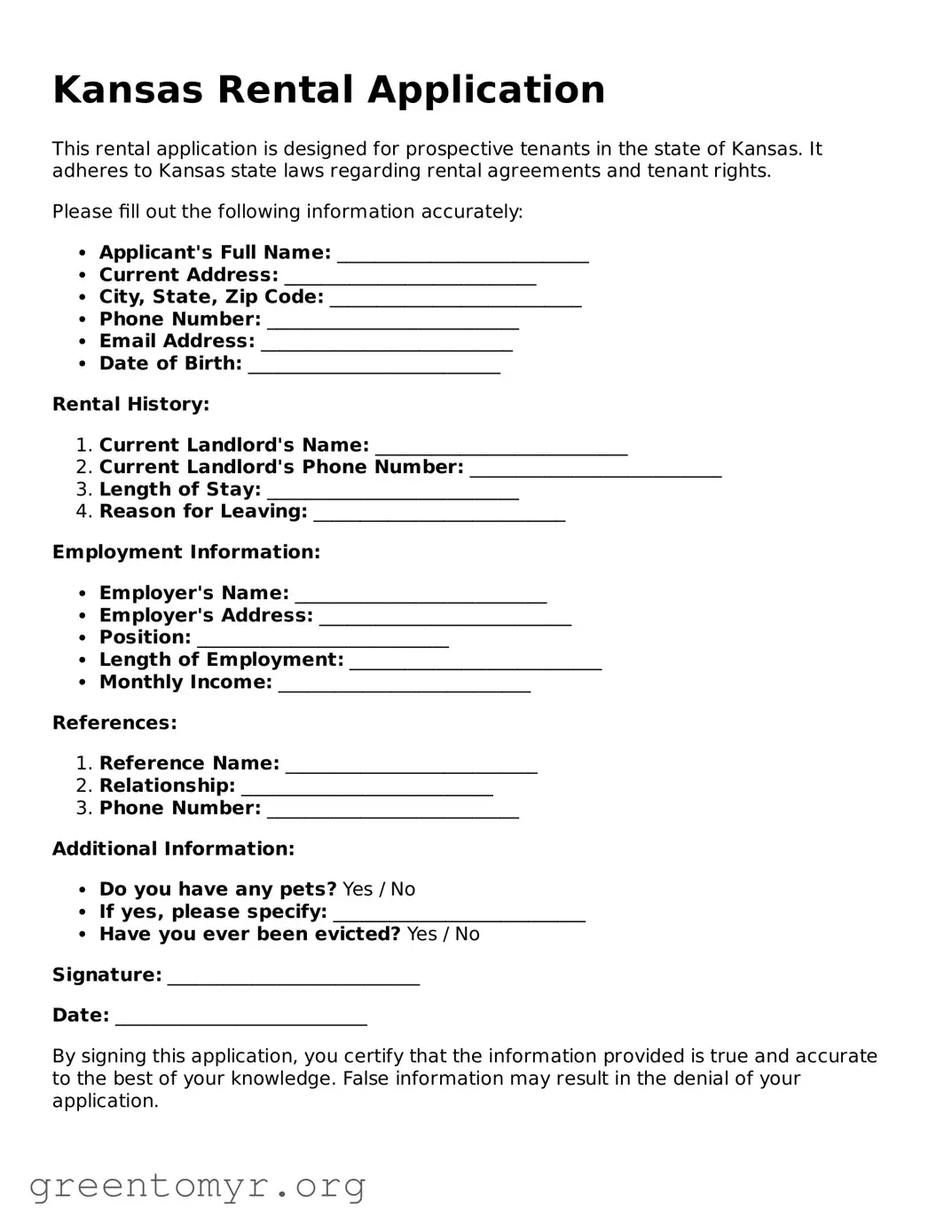
When searching for a new place to live in Kansas, understanding the rental application form is crucial. This document serves as a key tool for both landlords and prospective tenants. It typically includes sections that ask for personal information, such as your name, contact details, and social security number. Landlords often request employment history and income details to assess your financial stability. Additionally, the form may include questions about rental history, allowing landlords to gauge your reliability as a tenant. Some applications also ask for references, which can help landlords understand your character and past behavior as a renter. In some cases, a consent section allows landlords to conduct background checks, ensuring they make informed decisions. Being familiar with these aspects can streamline the application process and increase your chances of securing that perfect rental home.
Kansas Rental Application
This rental application is designed for prospective tenants in the state of Kansas. It adheres to Kansas state laws regarding rental agreements and tenant rights.
Please fill out the following information accurately:
Rental History:
Employment Information:
References:
Additional Information:
Signature: ___________________________
Date: ___________________________
By signing this application, you certify that the information provided is true and accurate to the best of your knowledge. False information may result in the denial of your application.
| Fact Name | Description |
|---|---|
| Purpose | The Kansas Rental Application form is used by landlords to screen potential tenants. |
| Required Information | Applicants must provide personal details, rental history, and employment information. |
| Application Fee | Landlords may charge a non-refundable application fee to cover background checks. |
| Background Check | A background check is typically required to assess the applicant's credit and rental history. |
| Governing Laws | The application process is governed by Kansas landlord-tenant laws, specifically K.S.A. 58-2540. |
| Fair Housing Compliance | Landlords must comply with federal and state fair housing laws when processing applications. |
| Privacy Considerations | Landlords must protect the personal information provided by applicants and use it solely for screening purposes. |
Completing the Kansas Rental Application form is a crucial step in securing a rental property. This process involves providing essential information that landlords use to assess potential tenants. Following the steps outlined below will help ensure that your application is filled out accurately and thoroughly.
The Kansas Rental Application form is designed to collect important information from potential tenants. Landlords use this form to evaluate applicants and make informed decisions about who to rent their properties to. The application typically includes personal details, employment history, rental history, and references. By gathering this information, landlords can assess the suitability of applicants based on their financial stability and rental behavior.
When filling out the Kansas Rental Application form, you will generally need to provide the following information:
Landlords typically evaluate rental applications by reviewing the information provided and conducting background checks. They may look at your credit history, rental history, and employment verification. A good credit score and a positive rental history can significantly enhance your chances of being approved. Additionally, landlords may contact your references to gather insights about your behavior as a tenant.
Many landlords charge a non-refundable application fee to cover the costs of processing your application. This fee can vary widely depending on the landlord or property management company. It's essential to ask about the fee upfront and understand what it covers, such as credit checks or administrative costs. Be prepared to pay this fee when you submit your application.
Once you submit your Kansas Rental Application form, the landlord will begin the evaluation process. This may take anywhere from a few days to a week, depending on the landlord's policies and the volume of applications they are processing. After reviewing your application, the landlord will contact you to inform you of their decision. If approved, you may be asked to sign a lease agreement and provide a security deposit before moving in.
Filling out a rental application in Kansas is a crucial step in securing a rental property. However, many applicants make common mistakes that can jeopardize their chances. One of the most frequent errors is providing inaccurate personal information. When applicants enter incorrect names, addresses, or Social Security numbers, it raises red flags for landlords and property managers.
Another common mistake is failing to disclose rental history. Landlords want to know where you’ve lived and how you’ve maintained those properties. Omitting this information can lead to suspicion and may result in a denied application. Always be thorough and honest about your past residences.
Many applicants also overlook the importance of financial details. Providing incomplete or outdated employment information can hinder your application. Landlords typically check income to ensure tenants can afford the rent. Make sure to include your current employer, job title, and salary.
Inadequate references are another pitfall. Failing to provide reliable references or listing people who cannot vouch for your character can weaken your application. Choose references wisely; they should be individuals who can speak positively about your rental history or character.
Some applicants neglect to read the entire application carefully. Skipping over sections or misunderstanding requirements can lead to errors. Take the time to understand what is being asked and fill out every section completely.
Providing insufficient documentation is also a mistake. Many applications require proof of income, identification, or credit history. Failing to include these documents can delay the process or result in rejection. Always attach the necessary paperwork to support your application.
Another issue arises when applicants do not follow instructions. Each rental application may have specific guidelines regarding how to submit it, what to include, or how to format answers. Ignoring these instructions can lead to a negative impression.
Lastly, some people forget to proofread their applications. Spelling errors or grammatical mistakes can make an applicant appear careless. A clean, well-organized application reflects attention to detail and seriousness about the rental opportunity.
When applying for a rental property in Kansas, there are several forms and documents that landlords and tenants often utilize in conjunction with the Kansas Rental Application form. These documents help ensure a smooth rental process and provide essential information for both parties. Below is a list of common forms that may accompany the rental application.
Each of these documents plays a crucial role in the rental process. By understanding and preparing these forms, both landlords and tenants can ensure a clear and efficient rental experience.
The Rental Application form shares similarities with several other documents commonly used in housing and leasing situations. Below is a list of these documents and how they relate to the Rental Application form:
When filling out the Kansas Rental Application form, there are several important things to keep in mind. Here’s a list of what to do and what to avoid:
Many individuals encounter misconceptions when dealing with the Kansas Rental Application form. Understanding these misconceptions can help both landlords and tenants navigate the rental process more effectively. Here are eight common misconceptions:
Landlords may have different requirements for their rental applications. Some may ask for additional documentation, while others may focus solely on basic personal information.
Submitting an application does not ensure that a tenant will be approved. Landlords evaluate applications based on various criteria, including credit history and rental history.
While credit scores are important, many landlords consider other factors, such as income and rental history. A strong rental history can sometimes offset a lower credit score.
Current tenants may also need to fill out a rental application if they are renewing their lease or if the property ownership changes.
Application fees are typically non-refundable. Tenants should clarify the fee structure with landlords before applying.
Landlords require personal information to assess the suitability of potential tenants. This information helps ensure that the rental agreement is made with responsible individuals.
While landlords must comply with fair housing laws, they can deny applications based on legitimate business reasons, such as insufficient income or poor rental history.
Applicants can often update their information before the landlord makes a decision. Communication with the landlord is key in this process.
By addressing these misconceptions, both landlords and tenants can engage in a more informed and transparent rental process.
When filling out and using the Kansas Rental Application form, it is essential to keep several key points in mind to ensure a smooth process. Here are the takeaways:
By paying attention to these key points, applicants can improve their chances of securing a rental property in Kansas.