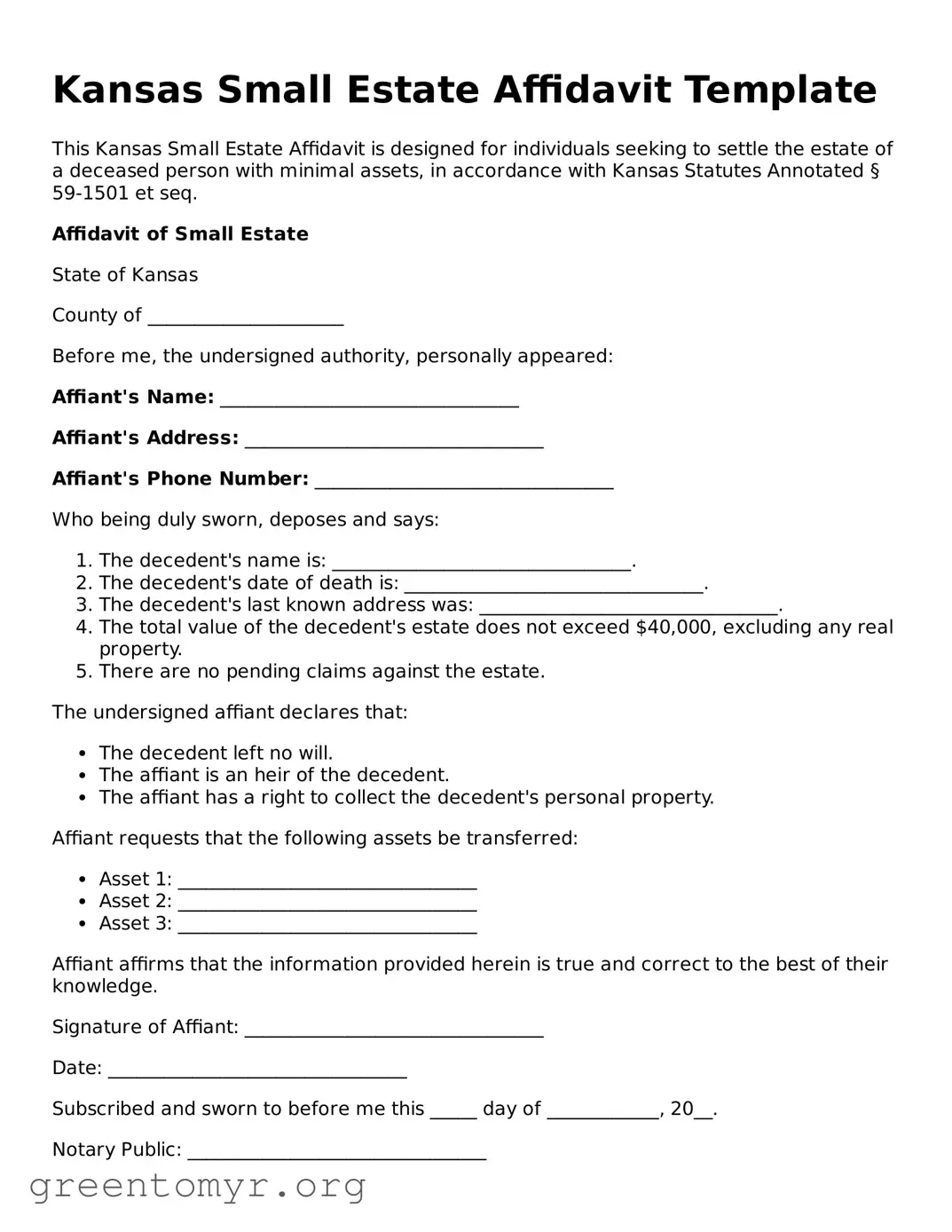
The Kansas Small Estate Affidavit form serves as a vital tool for individuals navigating the often complex process of settling an estate with limited assets. Designed specifically for estates that do not exceed a certain value threshold, this form allows heirs to bypass the lengthy and costly probate process. By utilizing the Small Estate Affidavit, individuals can claim property, access bank accounts, and transfer titles without the need for formal court proceedings. The process is straightforward, yet it requires careful attention to detail to ensure that all necessary information is accurately provided. Heirs must be aware of the specific eligibility criteria, including the value of the estate and the nature of the assets involved. Additionally, the form necessitates the signatures of all heirs, affirming their agreement and understanding of the estate's distribution. Overall, the Kansas Small Estate Affidavit form streamlines the administration of small estates, offering a practical solution for families during a challenging time.
Kansas Small Estate Affidavit Template
This Kansas Small Estate Affidavit is designed for individuals seeking to settle the estate of a deceased person with minimal assets, in accordance with Kansas Statutes Annotated § 59-1501 et seq.
Affidavit of Small Estate
State of Kansas
County of _____________________
Before me, the undersigned authority, personally appeared:
Affiant's Name: ________________________________
Affiant's Address: ________________________________
Affiant's Phone Number: ________________________________
Who being duly sworn, deposes and says:
The undersigned affiant declares that:
Affiant requests that the following assets be transferred:
Affiant affirms that the information provided herein is true and correct to the best of their knowledge.
Signature of Affiant: ________________________________
Date: ________________________________
Subscribed and sworn to before me this _____ day of ____________, 20__.
Notary Public: ________________________________
My Commission Expires: ________________________________
| Fact Name | Description |
|---|---|
| Purpose | The Kansas Small Estate Affidavit allows heirs to claim assets without going through probate. |
| Eligibility | This form is applicable when the total value of the estate is $40,000 or less for individuals or $100,000 or less for married couples. |
| Governing Law | The form is governed by Kansas Statutes Annotated (K.S.A.) 59-1501 et seq. |
| Filing Requirement | The affidavit must be filed with the appropriate county court to be valid. |
| Signature Requirement | All heirs must sign the affidavit, affirming their relationship to the deceased. |
| Asset Types | The affidavit can be used for various assets, including bank accounts and personal property. |
| Timeframe | Heirs must file the affidavit within six months of the deceased's passing. |
| Limitations | Real estate cannot be transferred using this affidavit; a different process is required. |
Once you have the Kansas Small Estate Affidavit form in hand, you will need to fill it out carefully. This document is essential for settling the estate of a deceased person without going through the full probate process. After completing the form, you will submit it to the appropriate court, along with any required supporting documents.
A Kansas Small Estate Affidavit is a legal document that allows individuals to settle the estate of a deceased person without going through the formal probate process. This affidavit can be used when the total value of the estate is below a certain threshold, making the process simpler and faster.
Any individual who is a beneficiary or heir of the deceased can use the Small Estate Affidavit. This includes spouses, children, parents, or other relatives who are entitled to inherit under Kansas law. It is important that the total value of the estate does not exceed the set limit, which is currently $40,000 for individuals and $100,000 for married couples.
The process includes several steps:
Assets that can be claimed include:
There is no filing fee associated with the Small Estate Affidavit itself. However, some institutions may have their own requirements or fees for processing the affidavit when claiming assets.
While it is not a legal requirement to notify creditors before using the Small Estate Affidavit, it is advisable to do so. This can help prevent any disputes or claims against the estate that may arise after the affidavit is submitted.
No, the Small Estate Affidavit cannot be used to settle debts. It is specifically for claiming assets. If there are outstanding debts, those must be settled through the probate process or other legal means.
If the total value of the estate exceeds the $40,000 limit for individuals or $100,000 for married couples, the estate must go through the formal probate process. This process is more complex and may require legal assistance.
The processing time can vary depending on the institution holding the assets. Generally, once the affidavit is submitted, it can take anywhere from a few days to several weeks to access the assets. It is important to follow up with the institution to ensure timely processing.
Once a Small Estate Affidavit is submitted and accepted, it cannot be revoked. If circumstances change or if errors are discovered, it may be necessary to consult with a legal professional to explore options for addressing the situation.
Filling out the Kansas Small Estate Affidavit form can be a straightforward process, but many people make common mistakes that can lead to delays or complications. One frequent error is not providing accurate information about the deceased. It's essential to double-check names, dates, and other personal details. Even a small typo can cause significant issues.
Another mistake often seen is failing to include all necessary assets. The form requires a complete listing of the deceased's assets, and omitting any can lead to legal challenges. Make sure to account for all property, bank accounts, and personal belongings. If you’re unsure, take the time to gather all relevant information.
Some individuals mistakenly believe that they can submit the affidavit without notarization. In Kansas, the affidavit must be signed in the presence of a notary public. Skipping this step could result in the form being rejected. Always ensure that you have a notary available to witness your signature.
People sometimes neglect to have the required witnesses present. The Kansas Small Estate Affidavit mandates that two individuals witness the signing of the document. Failing to have these witnesses can invalidate the affidavit. It’s crucial to arrange for reliable witnesses ahead of time.
Another common oversight is not understanding the limits of the small estate process. In Kansas, the total value of the estate must not exceed a specific threshold. If the estate exceeds this limit, you may need to pursue a different legal route. Familiarize yourself with these limits to avoid unnecessary complications.
Some individuals fill out the form without consulting a legal expert, which can lead to errors. While it may seem straightforward, having someone knowledgeable review the affidavit can help catch mistakes before submission. This extra step can save time and prevent issues down the line.
Another mistake is not keeping copies of submitted documents. After submitting the affidavit, it's wise to retain a copy for your records. This can be helpful if any questions arise later or if you need to reference the information in the future.
People often rush through the process, leading to incomplete forms. Taking your time to carefully read each section and provide thorough answers can make a significant difference. A rushed application is more likely to contain errors that could delay the estate settlement.
Lastly, some individuals fail to follow up after submission. Once the affidavit is filed, it’s important to check on its status. If there are any issues, being proactive can help resolve them quickly. Staying engaged in the process is key to ensuring everything proceeds smoothly.
By avoiding these common mistakes, you can navigate the Kansas Small Estate Affidavit process more effectively. Remember, attention to detail and thorough preparation are your best allies in this important task.
The Kansas Small Estate Affidavit is a useful tool for settling the estates of individuals who have passed away with limited assets. When preparing to use this form, several other documents may be required to ensure a smooth process. Below is a list of forms and documents that are often utilized in conjunction with the Kansas Small Estate Affidavit.
Gathering these documents will help facilitate the estate settlement process. Ensuring that all necessary paperwork is in order can minimize delays and complications during this time. Proper preparation is key to navigating the small estate process in Kansas efficiently.
When completing the Kansas Small Estate Affidavit form, it is essential to approach the task with care. Here are some important dos and don'ts to keep in mind:
Many people hold misconceptions about the Kansas Small Estate Affidavit form. Understanding the realities can help individuals navigate the process more effectively. Here are seven common misconceptions:
This is not true. The Small Estate Affidavit is designed for estates that meet certain value limits, making it accessible for many people, regardless of wealth.
In reality, this form is typically used for personal property and does not apply to real estate. It is important to know which assets qualify.
This is a misconception. While both processes deal with the distribution of a deceased person's assets, the Small Estate Affidavit is a simplified alternative to formal probate.
While it is advisable to have consensus, the law does not require all heirs to agree. The affidavit can be filed by a single heir under certain conditions.
Although the Small Estate Affidavit is simpler than probate, it still requires proper documentation, including a list of assets and debts.
This is misleading. After filing, the heir must still ensure that debts are paid and that the remaining assets are distributed according to the law.
This is incorrect. Each state has its own laws and forms regarding small estates. The Kansas Small Estate Affidavit is specific to Kansas.
Understanding these misconceptions can lead to better decision-making and a smoother process when dealing with small estates in Kansas.
Filling out and using the Kansas Small Estate Affidavit form can simplify the process of settling a deceased person's estate when the estate qualifies as a small estate. Here are some key takeaways to keep in mind: