Content Navigation

When buying or selling a tractor in Kansas, having a proper bill of sale is essential for both parties involved in the transaction. This document serves as proof of the sale and outlines important details about the tractor being exchanged. Key elements include the names and addresses of the buyer and seller, a detailed description of the tractor, including its make, model, and Vehicle Identification Number (VIN), as well as the sale price. Additionally, the form may include information about the date of the sale and any warranties or conditions related to the transaction. Having a well-completed Kansas Tractor Bill of Sale form not only protects both parties but also helps in transferring ownership and registering the vehicle with the state. Understanding how to fill out this form correctly can simplify the process and ensure compliance with state regulations.

Kansas Tractor Bill of Sale Example

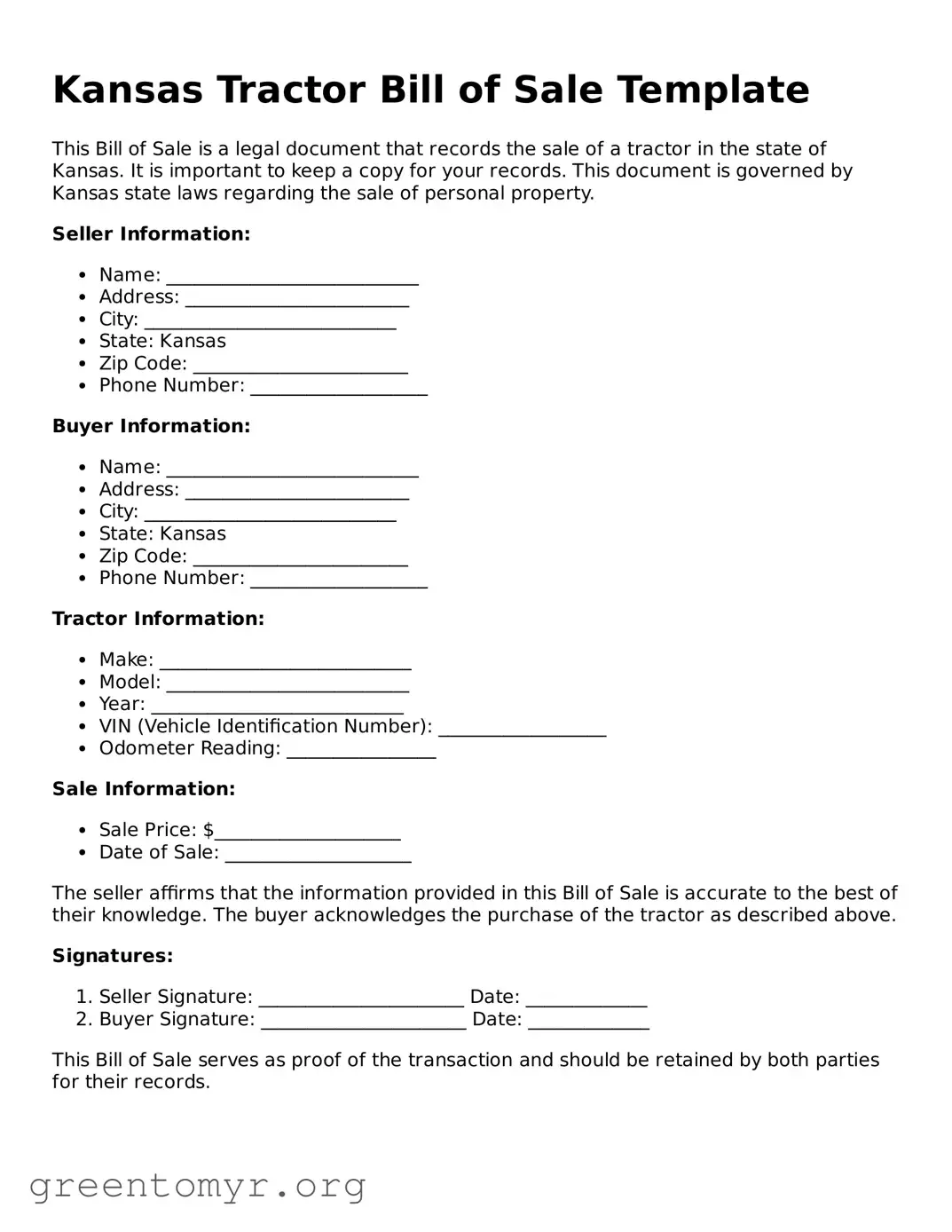
Kansas Tractor Bill of Sale Template

This Bill of Sale is a legal document that records the sale of a tractor in the state of Kansas. It is important to keep a copy for your records. This document is governed by Kansas state laws regarding the sale of personal property.

Seller Information:

  • Name: ___________________________
  • Address: ________________________
  • City: ___________________________
  • State: Kansas
  • Zip Code: _______________________
  • Phone Number: ___________________

Buyer Information:

  • Name: ___________________________
  • Address: ________________________
  • City: ___________________________
  • State: Kansas
  • Zip Code: _______________________
  • Phone Number: ___________________

Tractor Information:

  • Make: ___________________________
  • Model: __________________________
  • Year: ___________________________
  • VIN (Vehicle Identification Number): __________________
  • Odometer Reading: ________________

Sale Information:

  • Sale Price: $____________________
  • Date of Sale: ____________________

The seller affirms that the information provided in this Bill of Sale is accurate to the best of their knowledge. The buyer acknowledges the purchase of the tractor as described above.

Signatures:

  1. Seller Signature: ______________________ Date: _____________
  2. Buyer Signature: ______________________ Date: _____________

This Bill of Sale serves as proof of the transaction and should be retained by both parties for their records.

PDF Form Features

Fact Name Details
Purpose The Kansas Tractor Bill of Sale is used to document the sale of a tractor in Kansas.
Governing Law This form is governed by Kansas Statutes Annotated, Chapter 8, Article 24.
Parties Involved The form requires information from both the seller and the buyer.
Vehicle Information Details about the tractor, including make, model, year, and VIN, must be included.
Sale Price The sale price of the tractor must be clearly stated on the form.
Date of Sale The form should include the date when the sale takes place.
Signatures Required Both the seller and the buyer must sign the form for it to be valid.
Notarization Notarization is not required but can add an extra layer of protection.
Record Keeping It is advisable for both parties to keep a copy of the completed form for their records.

Guide to Using Kansas Tractor Bill of Sale

Filling out the Kansas Tractor Bill of Sale form is a straightforward process. After completing the form, you will have a record of the sale that can be useful for both the buyer and the seller. This document will help ensure that all necessary details are captured and can assist in future transactions or registrations.

  1. Obtain the Kansas Tractor Bill of Sale form from a reliable source.
  2. Enter the date of the sale at the top of the form.
  3. Provide the seller's full name and address in the designated sections.
  4. Enter the buyer's full name and address in the appropriate fields.
  5. Fill in the details of the tractor, including make, model, year, and Vehicle Identification Number (VIN).
  6. Specify the sale price of the tractor clearly.
  7. Include any relevant terms or conditions of the sale, if applicable.
  8. Both the seller and buyer should sign and date the form at the bottom.
  9. Make copies of the completed form for both parties to keep for their records.

Get Answers on Kansas Tractor Bill of Sale

What is a Kansas Tractor Bill of Sale?

A Kansas Tractor Bill of Sale is a legal document that records the sale of a tractor between a buyer and a seller. This form provides essential details about the transaction, including the identities of both parties, the description of the tractor, and the sale price. It serves as proof of ownership transfer and can be useful for registration and tax purposes.

Why is a Bill of Sale important?

A Bill of Sale is important for several reasons:

  1. It provides a written record of the transaction.
  2. It protects both the buyer and the seller by documenting the terms of the sale.
  3. It can help resolve disputes that may arise after the sale.
  4. It may be required for registration with the Kansas Department of Revenue.

What information is needed to complete the form?

To complete the Kansas Tractor Bill of Sale, you will need the following information:

  • Full names and addresses of the buyer and seller.
  • Description of the tractor, including make, model, year, and Vehicle Identification Number (VIN).
  • Sale price of the tractor.
  • Date of the transaction.

Do I need to have the Bill of Sale notarized?

No, notarization is not required for a Kansas Tractor Bill of Sale. However, having the document notarized can provide an additional layer of security and authenticity, which may be beneficial in case of disputes.

Can I use a generic Bill of Sale form?

While a generic Bill of Sale form can be used, it is advisable to use the specific Kansas Tractor Bill of Sale form. This ensures that all necessary information is included and complies with state requirements, reducing the risk of issues during the registration process.

Is there a fee for filing the Bill of Sale?

There is no fee to create or sign a Bill of Sale. However, there may be fees associated with registering the tractor with the Kansas Department of Revenue. It is important to check with local authorities for any applicable fees.

How long should I keep the Bill of Sale?

It is recommended to keep the Bill of Sale for as long as you own the tractor. Once you sell the tractor, retain the document for at least a few years in case any issues arise regarding the sale.

What if I lose the Bill of Sale?

If the Bill of Sale is lost, you can create a new one by gathering the necessary information again. Both the buyer and seller should sign the new document. It may also be helpful to keep copies of any previous documents related to the sale for reference.

Common mistakes

When completing the Kansas Tractor Bill of Sale form, many individuals overlook critical details that can lead to complications down the line. One common mistake is failing to provide accurate identification information for both the buyer and the seller. This includes not only names but also addresses and contact information. Inaccurate or incomplete data can cause issues with ownership transfer and may complicate future transactions.

Another frequent error involves the omission of the tractor's Vehicle Identification Number (VIN). The VIN is essential for identifying the specific tractor being sold. Without it, the bill of sale may be deemed invalid, which can result in legal disputes or difficulties in registering the vehicle. Always double-check that the VIN is correctly entered and matches the tractor's documentation.

People often neglect to include the sale price on the form. This is a critical component that establishes the value of the transaction. Leaving this field blank can create confusion regarding the terms of the sale and may also affect tax obligations. It is advisable to clearly state the sale price to avoid misunderstandings.

Additionally, some individuals fail to sign the document. Both the buyer and the seller must sign the bill of sale for it to be legally binding. Without signatures, the agreement lacks authenticity, which can lead to disputes over ownership. Ensure that both parties sign and date the form to validate the transaction.

Another mistake is not providing a clear description of the tractor. This includes details such as the make, model, year, and condition. A vague description can lead to disputes about the tractor's condition or features. Be specific to ensure that both parties have a mutual understanding of what is being sold.

Lastly, many overlook the importance of keeping a copy of the completed bill of sale. After the transaction, it is crucial for both parties to retain a copy for their records. This document serves as proof of the sale and can be vital in case of future disputes or questions about ownership. Always make copies before finalizing the sale.

Documents used along the form

The Kansas Tractor Bill of Sale form is a crucial document for anyone involved in the sale or purchase of a tractor in Kansas. However, it is often used in conjunction with other forms and documents that facilitate the transaction and ensure compliance with state regulations. Below is a list of these additional documents, each serving a specific purpose in the process.

  • Title Transfer Form: This document is necessary for transferring ownership of the tractor from the seller to the buyer. It provides essential information about the vehicle and confirms the change of ownership.
  • Affidavit of Ownership: In cases where the title is lost or unavailable, this affidavit serves as a sworn statement by the seller affirming their ownership of the tractor.
  • Sales Tax Form: Buyers may need to complete this form to report the sale and calculate any applicable sales tax. It ensures that the state receives the appropriate tax revenue from the transaction.
  • Vehicle Registration Application: After the purchase, the new owner must complete this application to register the tractor with the state. Registration is essential for legal operation on public roads.
  • Bill of Sale for Equipment: While the Tractor Bill of Sale covers the sale of the tractor itself, this document may be used for any additional equipment or attachments sold alongside it.
  • Inspection Certificate: Some buyers may require an inspection certificate to confirm that the tractor is in good working condition before completing the sale.
  • Warranty Agreement: If the seller offers a warranty on the tractor, this document outlines the terms and conditions, providing the buyer with protection against defects.
  • Power of Attorney: In certain situations, a seller may grant power of attorney to another individual to handle the sale or transfer of the tractor on their behalf.
  • Financing Agreement: If the buyer is financing the purchase, this agreement details the terms of the loan, including interest rates and payment schedules.
  • Release of Liability: This document protects the seller by releasing them from any future liability related to the tractor after the sale is completed.

Understanding these additional documents can help both buyers and sellers navigate the complexities of tractor transactions in Kansas. Each document plays a vital role in ensuring that the sale is conducted legally and efficiently, protecting the interests of all parties involved.

Similar forms

The Tractor Bill of Sale form serves as a critical document in the transfer of ownership for tractors. Several other documents share similarities with this form, as they also facilitate the transfer of ownership or record important transactions. Here are ten documents that are similar to the Tractor Bill of Sale:

  • Vehicle Bill of Sale: This document records the sale of a motor vehicle, detailing the buyer, seller, and the vehicle's specifics, much like the Tractor Bill of Sale does for tractors.
  • Boat Bill of Sale: Similar to the Tractor Bill of Sale, this form is used when transferring ownership of a boat, including details about the vessel and its condition.
  • Motorcycle Bill of Sale: This document serves the same purpose for motorcycles, capturing essential information about the transaction and the vehicle.
  • Real Estate Purchase Agreement: While more complex, this agreement outlines the terms of a real estate sale, including buyer and seller information, akin to the ownership transfer in a Tractor Bill of Sale.
  • Equipment Bill of Sale: This form is used for the sale of various types of equipment, documenting the transaction and ensuring both parties have a record of the sale.
  • Mobile Home Bill of Sale: This document facilitates the transfer of ownership for a mobile home, detailing the sale terms similar to those in a Tractor Bill of Sale.
  • Gun Bill of Sale: This document records the sale of firearms, including buyer and seller information, much like the Tractor Bill of Sale does for agricultural machinery.
  • Pet Bill of Sale: This form is used when transferring ownership of a pet, providing details about the animal and the transaction, paralleling the Tractor Bill of Sale's purpose.
  • Business Bill of Sale: When selling a business, this document outlines the terms of the sale, including assets and liabilities, similar to how a Tractor Bill of Sale outlines the sale of a tractor.
  • Personal Property Bill of Sale: This document is used for the sale of various personal items, recording the transaction details in a manner similar to that of a Tractor Bill of Sale.

Dos and Don'ts

When completing the Kansas Tractor Bill of Sale form, it is important to follow certain guidelines to ensure accuracy and compliance. Here is a list of things you should and shouldn't do:

  • Do provide accurate information about the tractor, including make, model, year, and Vehicle Identification Number (VIN).
  • Do include the purchase price in the designated section of the form.
  • Do have both the buyer and seller sign the document to validate the sale.
  • Do keep a copy of the completed bill of sale for your records.
  • Don't leave any sections blank; fill in all required fields to avoid delays.
  • Don't use white-out or erasers on the form; corrections should be made with clear, legible writing.
  • Don't forget to date the bill of sale at the time of signing.

Misconceptions

The Kansas Tractor Bill of Sale form is often misunderstood. Here are six common misconceptions:

  • It is not legally required. Many people believe that a bill of sale is optional for tractor transactions. However, having a bill of sale is important for proving ownership and can be required for registration.
  • It only needs to be signed by the seller. Some think that only the seller's signature is necessary. In reality, both the buyer and seller should sign the document to ensure that both parties agree to the terms of the sale.
  • It can be a verbal agreement. Some individuals assume that a verbal agreement is sufficient. A written bill of sale provides legal protection and clarity, making it essential to have the transaction documented.
  • It does not need to include specific details. Some believe that a simple statement of sale is enough. However, including details like the tractor's make, model, and VIN can prevent future disputes.
  • It is only for new tractors. Many think that a bill of sale is only necessary for new purchases. In truth, it is equally important for used tractors to establish ownership and condition.
  • It is not necessary for private sales. Some people feel that bills of sale are only needed for dealership transactions. However, private sales also benefit from having a bill of sale to document the transfer of ownership.

Understanding these misconceptions can help ensure that tractor transactions are handled properly and legally.

Key takeaways

When it comes to filling out and using the Kansas Tractor Bill of Sale form, there are several important points to keep in mind. Here are five key takeaways:

  1. Accurate Information is Essential: Ensure that all details about the tractor, including the make, model, year, and VIN (Vehicle Identification Number), are correctly filled out. This helps avoid any future disputes.
  2. Seller and Buyer Details: Both the seller and buyer must provide their full names and addresses. This information is crucial for the legal transfer of ownership.
  3. Purchase Price: Clearly state the purchase price of the tractor. This not only serves as a record for both parties but may also be important for tax purposes.
  4. Signatures Required: Both the seller and buyer need to sign the document. This signature validates the sale and confirms that both parties agree to the terms.
  5. Keep a Copy: After completing the form, both parties should retain a copy. This serves as proof of the transaction and can be useful for future reference.

By following these guidelines, you can ensure a smooth transaction when buying or selling a tractor in Kansas.