Content Navigation

The Kansas Transfer-on-Death Deed form serves as a vital legal instrument that enables property owners to transfer real estate to designated beneficiaries upon their death, thereby circumventing the often lengthy and costly probate process. This form allows individuals to retain full ownership and control of their property during their lifetime, while ensuring a seamless transition of ownership upon their passing. By designating beneficiaries, property owners can specify who will inherit their property, which can help to avoid potential disputes among heirs. The form requires the signatures of the property owner and a notary public, ensuring its validity and enforceability. Additionally, it is crucial for property owners to understand the implications of this deed, including the need for proper recording with the county register of deeds, as failure to do so may render the deed ineffective. Overall, the Kansas Transfer-on-Death Deed form provides a straightforward mechanism for estate planning, allowing individuals to make informed decisions about their property and its future ownership.

Kansas Transfer-on-Death Deed Example

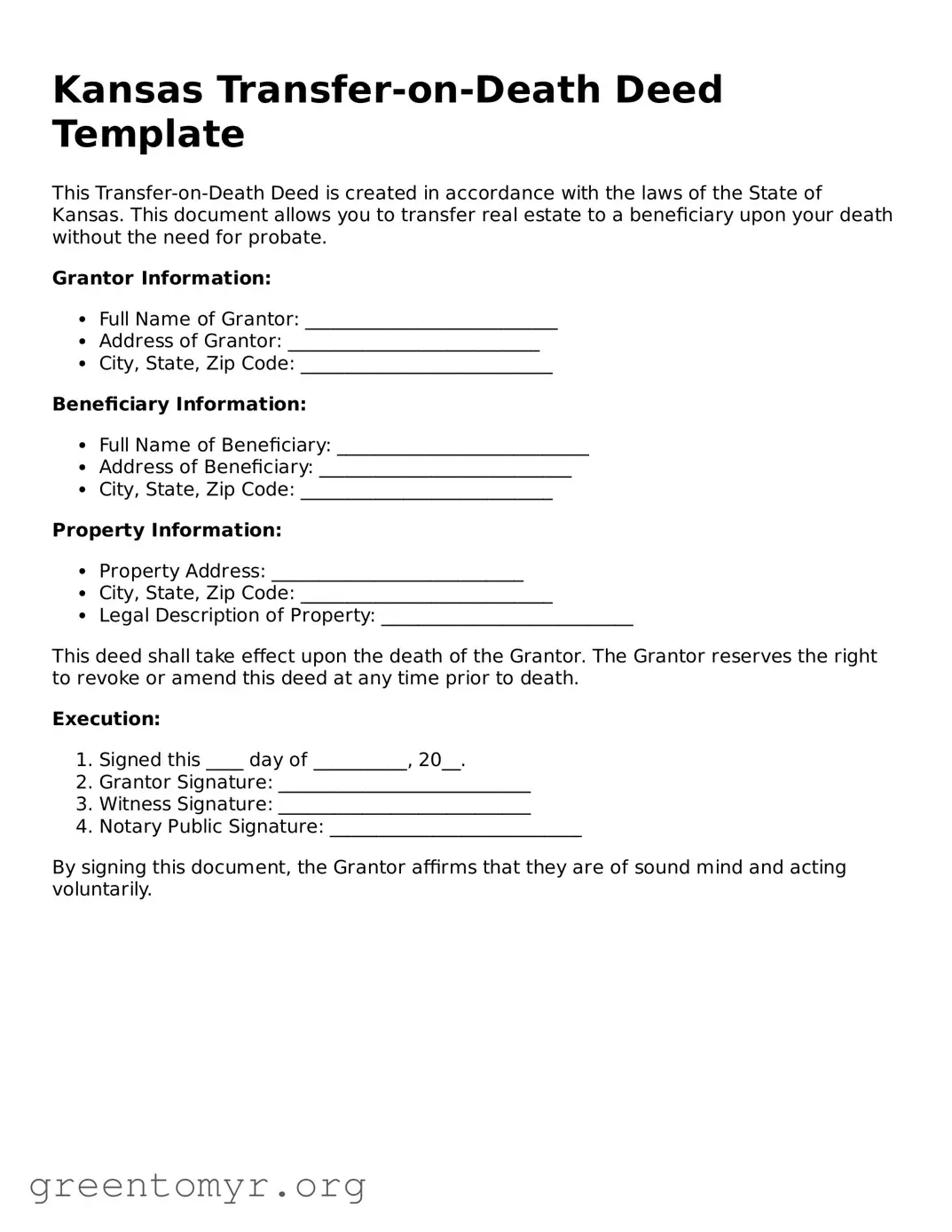
Kansas Transfer-on-Death Deed Template

This Transfer-on-Death Deed is created in accordance with the laws of the State of Kansas. This document allows you to transfer real estate to a beneficiary upon your death without the need for probate.

Grantor Information:

  • Full Name of Grantor: ___________________________
  • Address of Grantor: ___________________________
  • City, State, Zip Code: ___________________________

Beneficiary Information:

  • Full Name of Beneficiary: ___________________________
  • Address of Beneficiary: ___________________________
  • City, State, Zip Code: ___________________________

Property Information:

  • Property Address: ___________________________
  • City, State, Zip Code: ___________________________
  • Legal Description of Property: ___________________________

This deed shall take effect upon the death of the Grantor. The Grantor reserves the right to revoke or amend this deed at any time prior to death.

Execution:

  1. Signed this ____ day of __________, 20__.
  2. Grantor Signature: ___________________________
  3. Witness Signature: ___________________________
  4. Notary Public Signature: ___________________________

By signing this document, the Grantor affirms that they are of sound mind and acting voluntarily.

PDF Form Features

Fact Name Details
Definition A Transfer-on-Death Deed allows property owners to transfer real estate to beneficiaries upon their death, without going through probate.
Governing Law The Kansas Transfer-on-Death Deed is governed by Kansas Statutes Annotated, Chapter 38, Article 32.
Eligibility Any individual who owns real property in Kansas can create a Transfer-on-Death Deed.
Beneficiaries Property owners can name one or more beneficiaries in the deed.
Revocation A Transfer-on-Death Deed can be revoked at any time before the owner's death.
Filing Requirement The deed must be recorded with the county register of deeds to be effective.
Effect on Taxes The property remains part of the owner's estate for tax purposes until their death.
No Immediate Transfer Ownership does not transfer until the property owner's death, allowing the owner to retain full control.
Legal Assistance While not required, consulting an attorney is advisable to ensure the deed is correctly completed.

Guide to Using Kansas Transfer-on-Death Deed

Once you have the Kansas Transfer-on-Death Deed form ready, you will need to fill it out carefully. Completing this form is a straightforward process that involves providing specific information about the property and the beneficiaries. Ensure that all details are accurate to avoid any potential issues later on.

  1. Begin by entering the name of the owner(s) of the property at the top of the form.
  2. Provide the address of the property being transferred. Include the street address, city, and zip code.
  3. Next, identify the legal description of the property. This may be found in your property deed or tax records.
  4. List the name(s) of the beneficiary or beneficiaries who will receive the property upon the owner’s death.
  5. Include the address of each beneficiary. This ensures that there is no confusion about who will inherit the property.
  6. Sign and date the form in the designated area. Ensure that all owners sign if there are multiple owners.
  7. Have the form notarized. This step is crucial as it verifies the identity of the signers.
  8. Finally, file the completed form with the appropriate county office. This step officially records the transfer-on-death deed.

Get Answers on Kansas Transfer-on-Death Deed

  1. What is a Kansas Transfer-on-Death Deed?

    A Kansas Transfer-on-Death Deed is a legal document that allows property owners to transfer their real estate to a designated beneficiary upon their death. This deed avoids probate, simplifying the transfer process for heirs.

  2. Who can use a Transfer-on-Death Deed in Kansas?

    Any individual who owns real estate in Kansas can use a Transfer-on-Death Deed. This includes homeowners and property owners, as long as they are of sound mind and at least 18 years old.

  3. How do I create a Transfer-on-Death Deed?

    To create a Transfer-on-Death Deed, follow these steps:

    • Obtain the form from a legal resource or online.
    • Fill in the required information, including your name, the beneficiary's name, and a description of the property.
    • Sign the deed in the presence of a notary public.
    • Record the deed with the county register of deeds where the property is located.
  4. Can I change or revoke a Transfer-on-Death Deed?

    Yes, you can change or revoke a Transfer-on-Death Deed at any time while you are alive. To do this, you must create a new deed or a revocation document and record it with the county register of deeds.

  5. What happens if I do not name a beneficiary?

    If you do not name a beneficiary in your Transfer-on-Death Deed, the property will not transfer as intended. Instead, it will become part of your estate and will be subject to probate, which can be time-consuming and costly for your heirs.

  6. Is there a fee for filing a Transfer-on-Death Deed?

    Yes, there is typically a fee to record a Transfer-on-Death Deed with the county register of deeds. The fee varies by county, so it’s best to check with your local office for specific amounts.

  7. Can I use a Transfer-on-Death Deed for all types of property?

    A Transfer-on-Death Deed can be used for most types of real estate, such as residential homes and land. However, it cannot be used for personal property like cars or bank accounts.

  8. What are the benefits of using a Transfer-on-Death Deed?

    The benefits include:

    • Avoiding probate, which can save time and money.
    • Maintaining control of the property during your lifetime.
    • Providing a clear transfer plan for your beneficiaries.
  9. Do I need a lawyer to create a Transfer-on-Death Deed?

    While it is not required to have a lawyer, it is often a good idea. A legal professional can ensure that the deed is filled out correctly and meets all legal requirements.

  10. What should I do after creating a Transfer-on-Death Deed?

    After creating the deed, make sure to:

    • Keep a copy in a safe place.
    • Inform your beneficiary about the deed and the property.
    • Consider reviewing the deed periodically to ensure it still reflects your wishes.

Common mistakes

Filling out a Kansas Transfer-on-Death Deed form can be a straightforward process, but many people make common mistakes that can lead to complications down the line. Understanding these pitfalls can help ensure that your intentions are honored when the time comes.

One frequent mistake is failing to properly identify the property. It's essential to provide a complete and accurate legal description of the property being transferred. This description is not just a simple address; it should include details such as the parcel number or any other identifying information. Without this, the deed may be deemed invalid, causing delays or disputes among heirs.

Another common error is neglecting to sign the deed in the presence of a notary. Kansas law requires that the Transfer-on-Death Deed be notarized to be legally binding. Skipping this step can render the deed ineffective, which means that the property may not transfer as intended, potentially leading to unintended consequences for your loved ones.

People often overlook the importance of naming beneficiaries clearly. It’s crucial to specify who will receive the property upon your passing. Vague language can lead to confusion or disputes among family members. Additionally, if you name multiple beneficiaries, be sure to clarify how the property should be divided. Failing to do so may result in unwanted disagreements.

Lastly, many individuals forget to record the deed with the appropriate county office. Even if the form is filled out correctly, if it’s not recorded, the transfer won’t take effect. Recording the deed ensures that the public record reflects your wishes, protecting your beneficiaries' rights to the property. Always confirm that the deed has been filed properly to avoid any future complications.

Documents used along the form

The Kansas Transfer-on-Death Deed is a valuable tool for property owners looking to pass their real estate to beneficiaries without going through probate. However, it often works best in conjunction with other important documents. Here’s a list of forms and documents that are commonly used alongside the Transfer-on-Death Deed.

  • Last Will and Testament: This document outlines how a person's assets should be distributed after their death. While the Transfer-on-Death Deed handles real estate, a will can cover other assets.
  • Durable Power of Attorney: This form allows someone to make financial and legal decisions on your behalf if you become incapacitated. It's essential for managing affairs while you're still living.
  • Living Will: A living will specifies your wishes regarding medical treatment in case you are unable to communicate them yourself. It’s important for end-of-life decisions.
  • Health Care Power of Attorney: This document designates someone to make medical decisions for you if you are unable to do so. It complements a living will by providing a trusted advocate.
  • Beneficiary Designation Forms: These forms are used for financial accounts, insurance policies, and retirement accounts to specify who will receive assets upon your death.
  • Trust Documents: If you create a trust, these documents outline how your assets will be managed and distributed. Trusts can provide additional benefits, such as avoiding probate.
  • Affidavit of Heirship: This document can help establish the heirs of a deceased person, especially when there is no will. It can simplify the transfer of property in certain situations.
  • Quitclaim Deed: This deed transfers ownership of property without any warranties. It’s often used to add or remove a name from a property title.
  • Property Tax Exemption Forms: If applicable, these forms can help beneficiaries claim tax exemptions for inherited property, which can be a significant financial benefit.

Having these documents prepared can streamline the process of transferring your assets and ensure that your wishes are honored. It's wise to consult with a legal professional to determine which forms are best suited for your situation.

Similar forms

The Transfer-on-Death Deed (TOD) form allows property owners to designate beneficiaries who will receive their property upon their death, bypassing probate. Several other documents serve similar purposes in estate planning. Here’s a list of those documents and how they relate to the TOD form:

  • Will: A will outlines how a person's assets will be distributed after their death. Unlike a TOD, a will typically requires probate.
  • Living Trust: A living trust holds property during a person's lifetime and specifies how it should be distributed after death. It avoids probate, similar to a TOD.
  • Beneficiary Designation: This is commonly used for financial accounts and insurance policies. It allows assets to pass directly to named beneficiaries, bypassing probate like a TOD.
  • Joint Tenancy: In joint tenancy, property is owned by two or more people. When one owner dies, their share automatically passes to the surviving owner, similar to a TOD transfer.
  • Payable-on-Death (POD) Accounts: These bank accounts allow the owner to designate a beneficiary who will receive the funds upon the owner's death, avoiding probate, much like a TOD.
  • Transfer-on-Death Registration for Securities: This allows individuals to designate beneficiaries for their securities, ensuring a direct transfer upon death, akin to a TOD deed.
  • Life Estate Deed: This deed allows a person to retain the right to use the property during their lifetime while designating a beneficiary to receive it after death, similar to a TOD.
  • Health Care Proxy: While primarily for medical decisions, it can indirectly affect property transfer by ensuring the individual’s wishes are honored, similar to how a TOD ensures property goes to the intended beneficiary.

Dos and Don'ts

When filling out the Kansas Transfer-on-Death Deed form, it is important to approach the task with care. Below are some guidelines to help ensure that the process goes smoothly.

  • Do make sure all property information is accurate and complete. This includes the legal description of the property.
  • Do sign the form in the presence of a notary public. This step is crucial for the validity of the deed.
  • Do keep a copy of the completed deed for your records. Having a copy can be helpful for future reference.
  • Don't leave any sections blank. Every part of the form should be filled out to avoid confusion or delays.
  • Don't forget to file the deed with the appropriate county office. Filing is necessary for the deed to take effect.

By following these guidelines, you can help ensure that your Transfer-on-Death Deed is properly completed and filed. This can provide peace of mind for you and your loved ones.

Misconceptions

Understanding the Kansas Transfer-on-Death Deed form is crucial for effective estate planning. Unfortunately, there are several misconceptions that can lead to confusion. Here’s a list of common misunderstandings:

  1. It only works for certain types of property. Many people believe that the Transfer-on-Death Deed can only be used for specific properties. In reality, it can apply to most real estate owned in Kansas.
  2. It requires probate. Some think that using this deed means the property will still go through probate. However, properties transferred via this deed do not go through probate, simplifying the process for heirs.
  3. It can be revoked only in writing. While a written revocation is one way to cancel the deed, it can also be revoked by executing a new Transfer-on-Death Deed.
  4. Only married couples can use it. This is not true. Anyone, regardless of marital status, can utilize a Transfer-on-Death Deed to pass on property.
  5. It’s only beneficial for wealthy individuals. Many believe that only those with significant assets need this deed. In fact, it can benefit anyone wanting to ensure their property goes to specific individuals without complications.
  6. It automatically transfers all property upon death. This misconception overlooks that the deed only applies to the property specifically mentioned in it. Other properties will not be affected.
  7. Heirs cannot sell the property until all debts are paid. While debts may need to be settled, heirs can sell the property before debts are cleared, though they must be aware of any liens or obligations attached to it.
  8. It’s a complicated process. Many feel intimidated by the idea of creating a Transfer-on-Death Deed. In reality, the process is straightforward and can often be completed without legal assistance.
  9. It’s not legally binding. Some people mistakenly believe this deed holds no legal weight. However, once properly executed and recorded, it is a legally binding document.

Clearing up these misconceptions can help individuals make informed decisions about their estate planning needs. It’s essential to understand the facts to ensure your wishes are honored.

Key takeaways

Filling out and using the Kansas Transfer-on-Death Deed form can be a straightforward process if you keep a few key points in mind. Here are some essential takeaways to consider:

  • The Transfer-on-Death Deed allows property owners to designate beneficiaries who will receive the property upon their death without going through probate.
  • It is important to ensure that the deed is properly filled out and signed by the property owner while they are still alive.
  • In Kansas, the deed must be recorded with the Register of Deeds in the county where the property is located to be effective.
  • Beneficiaries can be individuals or entities, and multiple beneficiaries can be named.
  • It is advisable to provide the full legal names and addresses of the beneficiaries to avoid confusion later.
  • Once the deed is recorded, it cannot be revoked or changed without filing a new deed unless the original owner is still alive.
  • Consulting with an attorney can be beneficial, especially if there are complex family dynamics or significant assets involved.
  • Remember that the Transfer-on-Death Deed does not affect the property owner’s rights during their lifetime; they can still sell or mortgage the property.
  • Review the deed periodically to ensure that it still reflects your wishes, especially after major life events such as marriage, divorce, or the birth of children.