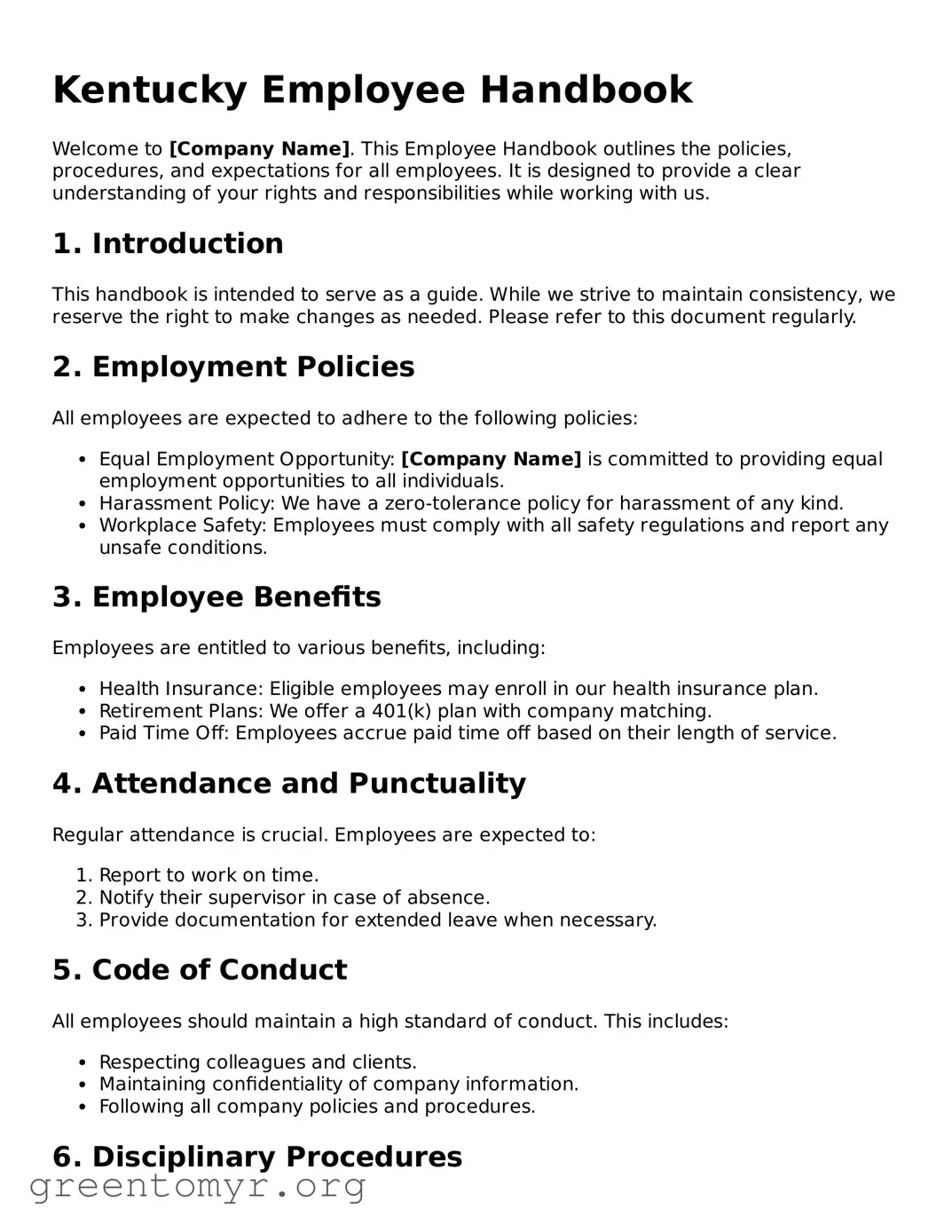
The Kentucky Employee Handbook form serves as a crucial tool for employers in establishing clear guidelines and expectations for their workforce. This document typically outlines important policies related to workplace conduct, attendance, and employee benefits, ensuring that all employees understand their rights and responsibilities. It often includes sections on anti-discrimination policies, disciplinary procedures, and safety protocols, which are essential for maintaining a positive work environment. Additionally, the handbook may cover procedures for reporting grievances and accessing resources, such as health benefits and employee assistance programs. By providing this information, the handbook not only protects the interests of the employer but also fosters transparency and accountability within the organization.
Kentucky Employee Handbook
Welcome to [Company Name]. This Employee Handbook outlines the policies, procedures, and expectations for all employees. It is designed to provide a clear understanding of your rights and responsibilities while working with us.
1. Introduction
This handbook is intended to serve as a guide. While we strive to maintain consistency, we reserve the right to make changes as needed. Please refer to this document regularly.
2. Employment Policies
All employees are expected to adhere to the following policies:
3. Employee Benefits
Employees are entitled to various benefits, including:
4. Attendance and Punctuality
Regular attendance is crucial. Employees are expected to:
5. Code of Conduct
All employees should maintain a high standard of conduct. This includes:
6. Disciplinary Procedures
Violations of company policies may result in disciplinary action, which could include:
7. Acknowledgment of Receipt
By signing below, you acknowledge that you have received, read, and understood the Kentucky Employee Handbook.
Employee Name: [Employee Name]
Signature: [Employee Signature]
Date: [Date]
Thank you for being a part of [Company Name]. We look forward to working together to create a positive and productive workplace.
| Fact Name | Details |
|---|---|
| Purpose | The Kentucky Employee Handbook form serves as a guide for employees regarding company policies, procedures, and expectations. |
| Legal Requirement | While not mandated by law, having an employee handbook is recommended for compliance with employment laws. |
| Governing Law | The Kentucky Revised Statutes, particularly KRS Chapter 337, outlines various employment standards that may be referenced in the handbook. |
| Contents | The handbook typically includes sections on workplace conduct, benefits, and employee rights. |
| Distribution | Employers should provide the handbook to all employees and ensure they acknowledge receipt and understanding of its contents. |
Completing the Kentucky Employee Handbook form is a straightforward process that requires attention to detail. Once you've filled out the form, it will be submitted to your employer for review. Follow these steps carefully to ensure all necessary information is provided accurately.
The Kentucky Employee Handbook form is a document that outlines the policies, procedures, and expectations for employees within a company in Kentucky. It serves as a guide for both employers and employees, ensuring everyone understands their rights and responsibilities in the workplace.
An Employee Handbook is important for several reasons:
Every employee should receive a copy of the Employee Handbook. This includes full-time, part-time, and temporary employees. It's important that all staff members have access to this information to ensure they understand the company's policies and procedures.
The Employee Handbook should be reviewed and updated regularly. Ideally, it should be revisited at least once a year. Changes in laws, company policies, or workplace practices may necessitate updates. Keeping the handbook current helps to ensure that all employees are informed of the latest information.
If you have questions about the Employee Handbook, you should reach out to your supervisor or the human resources department. They can provide clarification on any policies or procedures that may be unclear. It’s always best to ask if you’re unsure about something.
Filling out the Kentucky Employee Handbook form can be a straightforward process, but there are common mistakes that individuals often make. These errors can lead to misunderstandings or issues with employment status. Awareness of these mistakes is essential for ensuring that the form is completed accurately.
One frequent mistake is not reading the instructions carefully. The guidelines provided with the form contain important information about how to fill it out correctly. Skipping this step may result in incomplete or incorrect submissions.
Another common error is providing inaccurate personal information. It is crucial to double-check names, addresses, and contact details. Any discrepancies can lead to delays in processing or complications in communication with the employer.
Individuals often forget to sign and date the form. A signature is a confirmation of the information provided and indicates agreement with the policies outlined in the handbook. Without this, the form may be considered invalid.
In some cases, employees may neglect to update their information when changes occur, such as a new address or a change in emergency contacts. Keeping this information current is vital for effective communication and safety.
Some individuals may also overlook the importance of reading the entire handbook before signing the form. Understanding the policies and procedures helps employees to be fully informed about their rights and responsibilities.
Additionally, failing to ask questions when something is unclear can lead to misunderstandings. Employees should feel empowered to seek clarification on any part of the handbook or form that they do not understand.
Another mistake involves not keeping a copy of the completed form. Retaining a copy for personal records is important for future reference, especially if questions arise regarding employment policies.
Some individuals may also rush through the form, leading to careless errors. Taking the time to complete the form thoughtfully can prevent mistakes that might require corrections later.
Finally, failing to review the final submission before turning it in can result in overlooked errors. A final check can ensure that all information is accurate and complete, ultimately facilitating a smoother onboarding process.
The Kentucky Employee Handbook serves as a vital resource for both employers and employees, outlining company policies, procedures, and expectations. Along with this handbook, several other forms and documents are commonly utilized to ensure clarity and compliance within the workplace. Below is a list of these important documents, each playing a significant role in the employment process.
These documents, in conjunction with the Kentucky Employee Handbook, create a comprehensive framework for managing employment relationships. They help clarify expectations, protect both parties, and ensure compliance with legal requirements, ultimately fostering a positive work environment.
The Employee Handbook serves as a crucial document for organizations. It outlines policies, procedures, and expectations for employees. Here are seven documents that share similarities with the Employee Handbook:
When filling out the Kentucky Employee Handbook form, it is essential to approach the task with care. The following list outlines key actions to take and avoid during this process.
By following these guidelines, individuals can ensure that they complete the Kentucky Employee Handbook form correctly and efficiently.
Understanding the Kentucky Employee Handbook form can be challenging, and several misconceptions often arise. Here are seven common misunderstandings clarified:
This is not true. While having an Employee Handbook is highly recommended for clarity and consistency, it is not a legal requirement for all businesses in Kentucky.
The Employee Handbook serves as a guide for employees and outlines company policies. It is not a legally binding contract unless explicitly stated, which is often not the case.
Policies and regulations change over time. Regular updates ensure that the handbook remains relevant and compliant with current laws and company practices.
Each handbook should reflect the unique culture, values, and policies of the organization. No two handbooks are identical, as they cater to specific company needs.
It is important to communicate the handbook's contents effectively. Employees may need guidance to fully understand and utilize the policies outlined.
While employee rights are a crucial part of any handbook, it also includes employer expectations, company policies, and procedures that govern workplace behavior.
A signed acknowledgment simply indicates that the employee has received and read the handbook. It does not imply total agreement with every policy contained within.
When it comes to filling out and using the Kentucky Employee Handbook form, there are several important points to keep in mind. Here are key takeaways that can help ensure the process goes smoothly:
By keeping these key points in mind, you can create an effective Employee Handbook that serves both the company and its employees well.