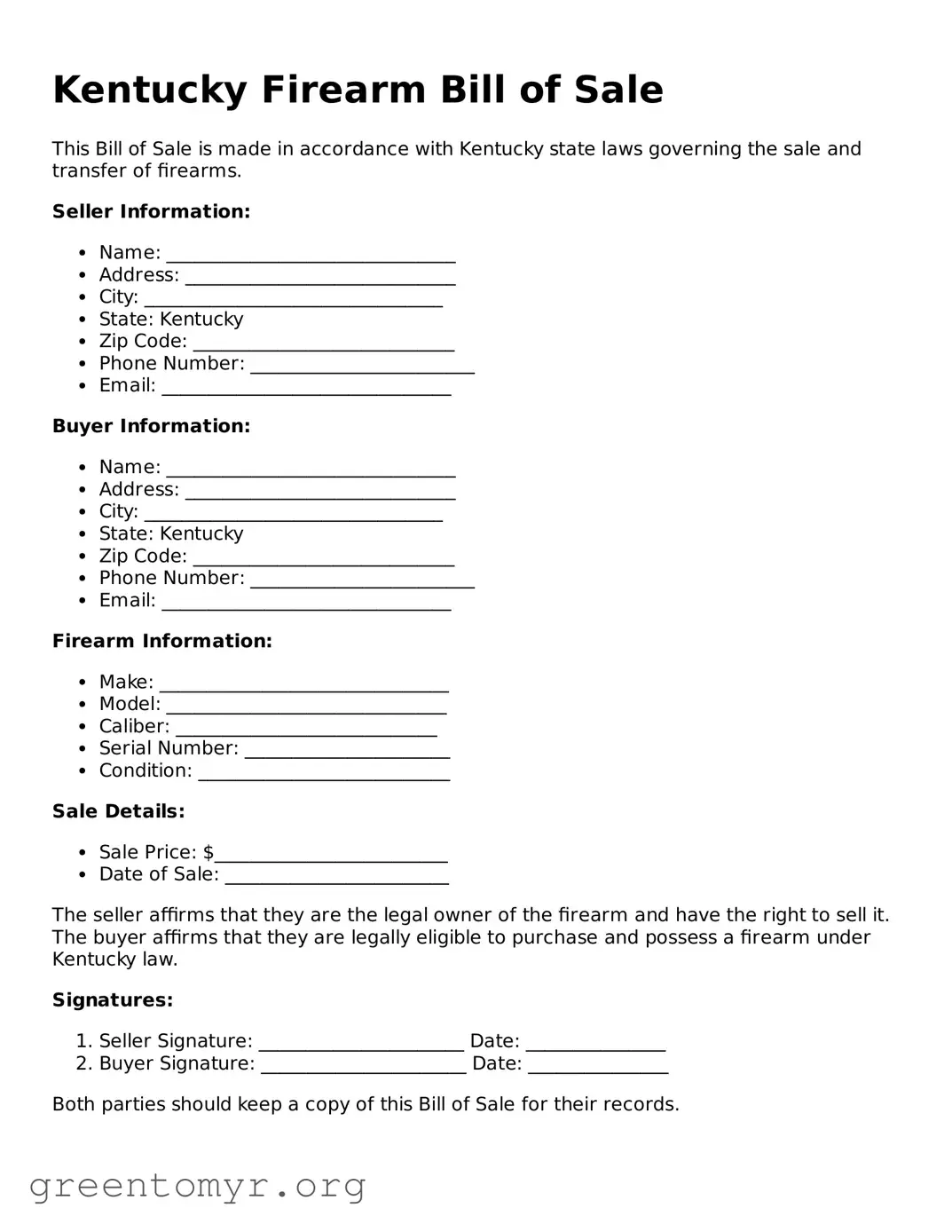
In the state of Kentucky, the Firearm Bill of Sale form plays a crucial role in the legal transfer of ownership for firearms. This document serves as a written record that details the transaction between the seller and the buyer, ensuring that both parties are protected during the exchange. Key aspects of the form include the identification of the firearm being sold, which typically involves the make, model, and serial number. Additionally, the form requires the personal information of both the buyer and the seller, including names, addresses, and signatures, to validate the transaction. Importantly, it also serves to confirm that the buyer is legally eligible to own a firearm, thereby adhering to state and federal regulations. By providing clarity and accountability, the Firearm Bill of Sale form is an essential tool for anyone involved in the sale or purchase of firearms in Kentucky.
Kentucky Firearm Bill of Sale
This Bill of Sale is made in accordance with Kentucky state laws governing the sale and transfer of firearms.
Seller Information:
Buyer Information:
Firearm Information:
Sale Details:
The seller affirms that they are the legal owner of the firearm and have the right to sell it. The buyer affirms that they are legally eligible to purchase and possess a firearm under Kentucky law.
Signatures:
Both parties should keep a copy of this Bill of Sale for their records.
| Fact Name | Description |
|---|---|
| Purpose | The Kentucky Firearm Bill of Sale form serves as a legal record of the sale or transfer of a firearm between parties. |
| Governing Law | The sale of firearms in Kentucky is governed by KRS 237.110 and related statutes. |
| Parties Involved | The form requires information from both the seller and the buyer to ensure accountability. |
| Identification | Both parties must provide valid identification, typically a driver's license or state ID, to verify their identities. |
| Firearm Details | Specific details about the firearm, including make, model, and serial number, must be documented on the form. |
| Payment Terms | The form can include details about the payment method and amount, providing clarity on the transaction. |
| Witness Requirement | While not mandatory, having a witness sign the form can add an extra layer of verification. |
| Record Keeping | Both parties should keep a copy of the completed form for their records, as it serves as proof of the transaction. |
| Legal Implications | Completing this form does not exempt either party from complying with federal laws regarding firearm sales. |
| Transfer of Ownership | The form signifies the legal transfer of ownership from the seller to the buyer upon completion and signing. |
Once you have the Kentucky Firearm Bill of Sale form, the next steps involve carefully filling it out to ensure all necessary information is accurately recorded. This process is important for both the buyer and the seller, as it helps document the transaction clearly.
The Kentucky Firearm Bill of Sale form is a document used to record the sale or transfer of a firearm between two parties in the state of Kentucky. This form serves as proof of the transaction and includes essential details such as the names and addresses of both the buyer and seller, a description of the firearm, and the date of the sale. It is a useful tool for both parties to ensure that the transfer is documented properly.
While it is not legally required to complete a Bill of Sale for private firearm transactions in Kentucky, it is highly recommended. Having a written record can help protect both the buyer and seller in case of future legal issues. It provides evidence of the transfer and can assist in resolving any disputes that may arise regarding ownership or responsibility for the firearm.
The Kentucky Firearm Bill of Sale form should include the following information:
Including this information helps ensure that the document is complete and legally valid.
Yes, the Kentucky Firearm Bill of Sale form can be used for various types of firearms, including handguns, rifles, and shotguns. However, it is essential to note that certain firearms may be subject to additional regulations or restrictions. Always verify that the firearm being sold complies with state and federal laws. If there are any uncertainties, consulting with a legal expert is advisable.
Filling out the Kentucky Firearm Bill of Sale form requires attention to detail. One common mistake is failing to include the correct date of the transaction. The date serves as a legal record of when the sale occurred, and without it, the document may lack validity.
Another frequent error involves incorrect identification of the buyer and seller. Both parties must provide accurate names and addresses. Omitting this information can lead to confusion or disputes later on.
Many individuals neglect to specify the firearm's details. Important information includes the make, model, caliber, and serial number. Leaving out these specifics can result in ambiguity regarding the firearm being sold.
Some people mistakenly assume that a signature is not necessary. Both the buyer and seller must sign the document to confirm the transaction. Without signatures, the bill of sale may not be enforceable.
Additionally, failing to provide a witness signature is another common oversight. In Kentucky, having a witness can strengthen the validity of the bill of sale. Not including a witness may weaken the document's legal standing.
Many individuals overlook the importance of reviewing the form for errors. Typos or incorrect information can lead to complications. Taking the time to double-check the completed form can prevent future issues.
Another mistake involves not keeping a copy of the completed bill of sale. Both parties should retain a copy for their records. This documentation can be crucial if any questions arise regarding the transaction.
Some sellers fail to disclose any known issues with the firearm. Transparency about the condition of the firearm is essential. Not doing so can lead to legal repercussions if the buyer discovers undisclosed problems later.
People often forget to include the purchase price. The bill of sale should clearly state the amount paid for the firearm. Without this information, the document may not accurately reflect the terms of the sale.
Lastly, neglecting to check local laws can be a significant mistake. Firearm regulations can vary by location. Ensuring compliance with local laws is essential for both parties involved in the sale.
When buying or selling a firearm in Kentucky, the Firearm Bill of Sale form is an essential document. However, it's not the only one you'll need. Several other forms and documents can help ensure a smooth and legally compliant transaction. Here’s a list of additional documents that are often used alongside the Kentucky Firearm Bill of Sale.
Using these documents in conjunction with the Kentucky Firearm Bill of Sale can help protect both the buyer and seller. They provide clarity and legal backing to the transaction, making it a safer experience for everyone involved. Always ensure that all paperwork is completed accurately and retained for future reference.
When filling out the Kentucky Firearm Bill of Sale form, it is essential to follow certain guidelines to ensure the process is smooth and compliant. Below are six recommendations that can help you navigate this task effectively.
By adhering to these guidelines, you can help ensure that the transaction is conducted legally and transparently.
The Kentucky Firearm Bill of Sale form is often misunderstood. Here are four common misconceptions that people have about this document:
This is not true. A Bill of Sale is important for all firearm transactions, regardless of whether the firearm is registered. It serves as proof of the sale and can help protect both the buyer and the seller in case of future disputes.
In reality, both the buyer and the seller should sign the Bill of Sale. This signature confirms that both parties agree to the terms of the sale and acknowledges the transfer of ownership.
While verbal agreements can be made, they are not legally binding in the same way that a written Bill of Sale is. Having a written document helps to clarify the terms of the sale and provides legal protection.
This is misleading. While private sales typically require a Bill of Sale, it is also advisable for transactions through dealers or gun shows. A Bill of Sale can provide clarity and documentation for any firearm transaction.
When filling out and using the Kentucky Firearm Bill of Sale form, keep these key takeaways in mind: