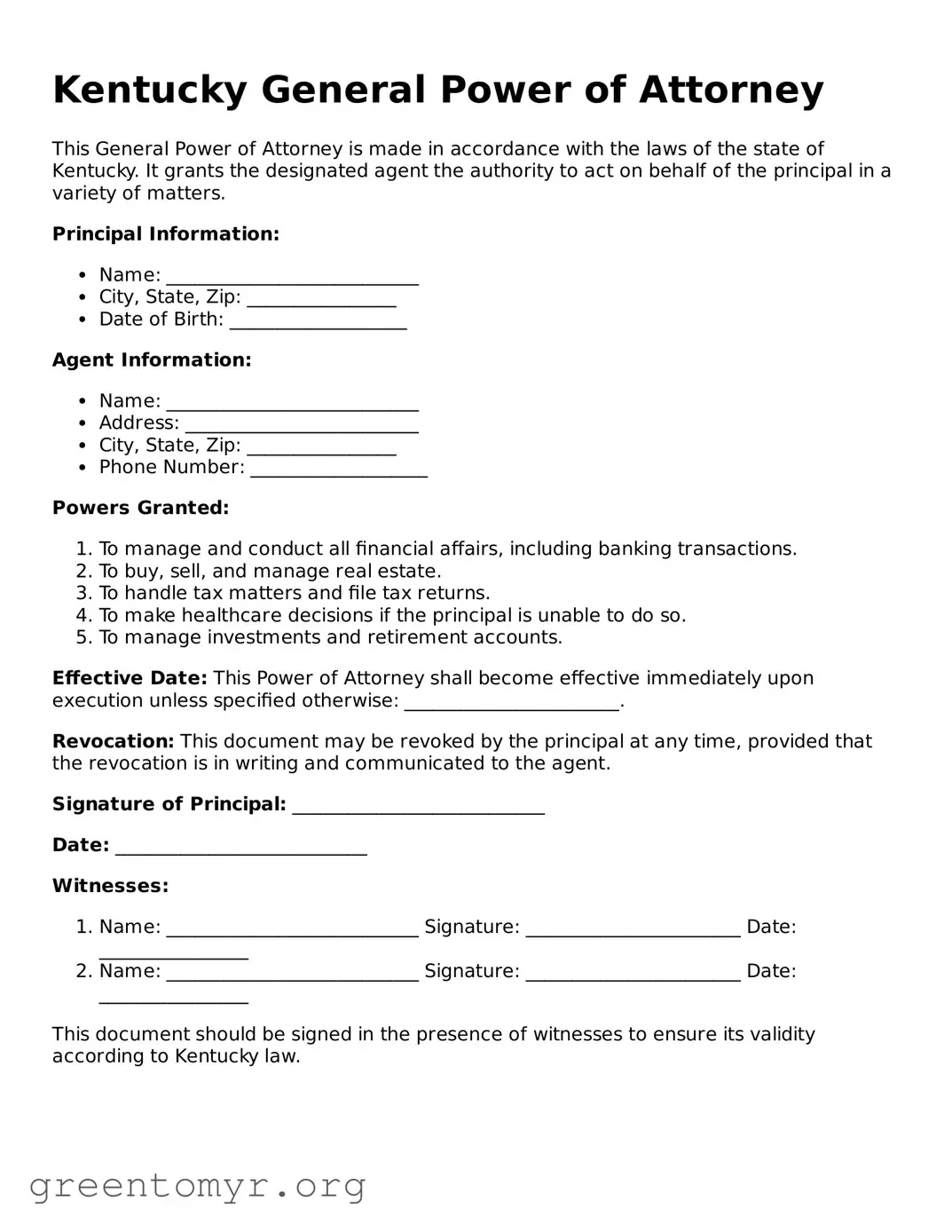
The Kentucky General Power of Attorney form serves as a vital legal document that grants an individual, known as the agent or attorney-in-fact, the authority to make decisions and take actions on behalf of another person, referred to as the principal. This form is particularly important for individuals who wish to ensure that their financial and legal matters are managed according to their preferences, especially in situations where they may become incapacitated or unavailable. The powers bestowed upon the agent can encompass a wide range of responsibilities, including managing bank accounts, signing checks, handling real estate transactions, and making healthcare decisions. It is essential for the principal to clearly outline the scope of authority granted, as the form can be tailored to meet specific needs. Additionally, the Kentucky General Power of Attorney must be executed in accordance with state laws, which often involve the principal's signature, the agent's acceptance, and the presence of a notary public or witnesses. Understanding these key aspects can help individuals navigate the complexities of this important legal tool.
Kentucky General Power of Attorney
This General Power of Attorney is made in accordance with the laws of the state of Kentucky. It grants the designated agent the authority to act on behalf of the principal in a variety of matters.
Principal Information:
Agent Information:
Powers Granted:
Effective Date: This Power of Attorney shall become effective immediately upon execution unless specified otherwise: _______________________.
Revocation: This document may be revoked by the principal at any time, provided that the revocation is in writing and communicated to the agent.
Signature of Principal: ___________________________
Date: ___________________________
Witnesses:
This document should be signed in the presence of witnesses to ensure its validity according to Kentucky law.
| Fact Name | Description |
|---|---|
| Definition | A General Power of Attorney in Kentucky allows an individual (the principal) to appoint another person (the agent) to act on their behalf in various matters. |
| Governing Law | The Kentucky General Power of Attorney is governed by KRS 61.900 to 61.994. |
| Durability | This form can be made durable, meaning it remains effective even if the principal becomes incapacitated. |
| Agent's Authority | The agent can manage financial transactions, make healthcare decisions, and handle other personal matters as specified in the document. |
| Execution Requirements | The form must be signed by the principal and notarized to be valid in Kentucky. |
| Revocation | The principal can revoke the General Power of Attorney at any time, as long as they are mentally competent. |
| Limitations | Some actions, such as making a will or certain health care decisions, cannot be delegated through this form. |
After obtaining the Kentucky General Power of Attorney form, you will need to fill it out carefully. Each section of the form requires specific information, so take your time to ensure accuracy. Once completed, the form must be signed and may need to be notarized, depending on your situation.
A General Power of Attorney (GPOA) in Kentucky is a legal document that allows an individual, known as the principal, to appoint another person, referred to as the agent or attorney-in-fact, to manage their financial and legal affairs. This authority can include a wide range of actions, such as handling bank transactions, managing real estate, and making investment decisions. The GPOA can be effective immediately or can be set to become effective upon a specific event, such as the principal's incapacitation.
To create a General Power of Attorney in Kentucky, follow these steps:
It is advisable to consult with a legal professional to ensure that the document meets all necessary legal requirements and accurately reflects your wishes.
Under a General Power of Attorney, you can grant your agent a wide range of powers, including but not limited to:
It is crucial to specify the powers you wish to grant to avoid any ambiguity and ensure your agent can act effectively on your behalf.
Yes, you can revoke a General Power of Attorney in Kentucky at any time, as long as you are mentally competent. To do this, you should:
Revoking the GPOA ensures that your previous agent no longer has authority to act on your behalf.
If you become incapacitated and have a General Power of Attorney that is effective upon such an event, your agent will be able to step in and manage your affairs as outlined in the document. This can provide peace of mind, knowing that someone you trust will handle your financial and legal matters when you are unable to do so. However, if the GPOA is not effective until a specific event occurs, your agent will not have authority until that event takes place.
Filling out the Kentucky General Power of Attorney form can be a straightforward process, but many individuals make mistakes that can lead to confusion or legal issues. One common error is not clearly identifying the principal. The principal is the person granting authority, and if their name is misspelled or incomplete, it could invalidate the document.
Another frequent mistake is failing to specify the powers granted. The form allows for a range of authorities, from managing finances to making healthcare decisions. If the powers are not explicitly listed, the agent may not have the authority to act in certain situations, leading to potential complications.
People often overlook the importance of signing and dating the document. A General Power of Attorney must be signed by the principal to be valid. If the principal forgets to sign or date the form, it may not hold up in court. Additionally, witnesses may be required, and their absence can render the document ineffective.
In some cases, individuals neglect to discuss their intentions with the chosen agent. It's essential to have a conversation with the person you designate as your agent. Without a clear understanding of your wishes, the agent may make decisions that do not align with your preferences.
Another mistake involves not considering the scope of authority granted. Some individuals give broad powers without realizing the potential consequences. It’s wise to think carefully about what powers are necessary and appropriate for the agent to have.
People sometimes fail to update the General Power of Attorney when their circumstances change. Life events such as marriage, divorce, or the birth of a child can affect your decisions. Regularly reviewing and updating the document ensures it reflects your current wishes.
Additionally, individuals might not be aware of the need for notarization. In Kentucky, while not always required, having the document notarized can add an extra layer of legitimacy and help prevent disputes later on.
Another common oversight is not making copies of the completed form. Once the General Power of Attorney is filled out and signed, it's important to distribute copies to relevant parties, including the agent, financial institutions, and healthcare providers. This ensures that everyone is on the same page when it comes to your wishes.
Lastly, people often forget to consider the revocation of the power. If at any point you wish to change or revoke the authority granted, it’s crucial to do so formally. A failure to properly revoke a General Power of Attorney can lead to confusion and potential misuse of authority.
The Kentucky General Power of Attorney form is a crucial document that allows one person to grant another the authority to act on their behalf in various matters. However, there are several other forms and documents that are commonly used in conjunction with this form to ensure comprehensive legal coverage. Below is a list of these documents, along with a brief description of each.
Using these forms in conjunction with the Kentucky General Power of Attorney can provide a well-rounded approach to managing personal, financial, and medical decisions. Each document plays a distinct role in ensuring that a person's wishes are respected and upheld, making it essential to consider them as part of a comprehensive legal strategy.
When filling out the Kentucky General Power of Attorney form, it’s important to follow certain guidelines to ensure the document is valid and meets your needs. Here’s a list of things to do and avoid:
Many people have misunderstandings about the Kentucky General Power of Attorney form. Here are four common misconceptions:
While a General Power of Attorney often includes financial decisions, it can also cover health care and personal matters. The scope of authority can be tailored to fit specific needs.
This is not true. A General Power of Attorney can be revoked at any time by the principal, as long as they are mentally competent. It’s important to follow the proper steps to ensure the revocation is valid.
While you can choose almost anyone to be your agent, it is wise to select someone you trust. This person will have significant power over your affairs, so careful consideration is essential.
A General Power of Attorney typically ends if the principal becomes incapacitated unless it is designated as a durable power of attorney. A durable power remains in effect even if the principal is no longer able to make decisions.
When filling out and using the Kentucky General Power of Attorney form, it is essential to keep a few key points in mind. Here are seven important takeaways:
By following these guidelines, you can ensure that your General Power of Attorney form serves its intended purpose effectively.