Hold Harmless Agreement Form for the State of Kentucky
A Kentucky Hold Harmless Agreement form is a legal document that protects one party from liability for any damages or injuries that may occur during a specific activity or event. This agreement ensures that both parties understand their responsibilities and the risks involved. To safeguard yourself, consider filling out the form by clicking the button below.
Content Navigation
The Kentucky Hold Harmless Agreement form serves as a crucial legal document designed to protect one party from liability for certain risks associated with activities or events. This agreement typically outlines the responsibilities of each party involved, specifying the extent to which one party agrees to indemnify the other. It is commonly used in various contexts, such as rental agreements, sporting events, and construction projects, where the potential for injury or damage exists. By signing this form, individuals or organizations acknowledge the risks involved and agree not to hold the other party responsible for any resulting harm. The document often includes details about the scope of the indemnification, the duration of the agreement, and any specific conditions that must be met for the agreement to be valid. Understanding the nuances of this form is essential for parties looking to navigate their legal obligations and protect their interests effectively.
Kentucky Hold Harmless Agreement Example
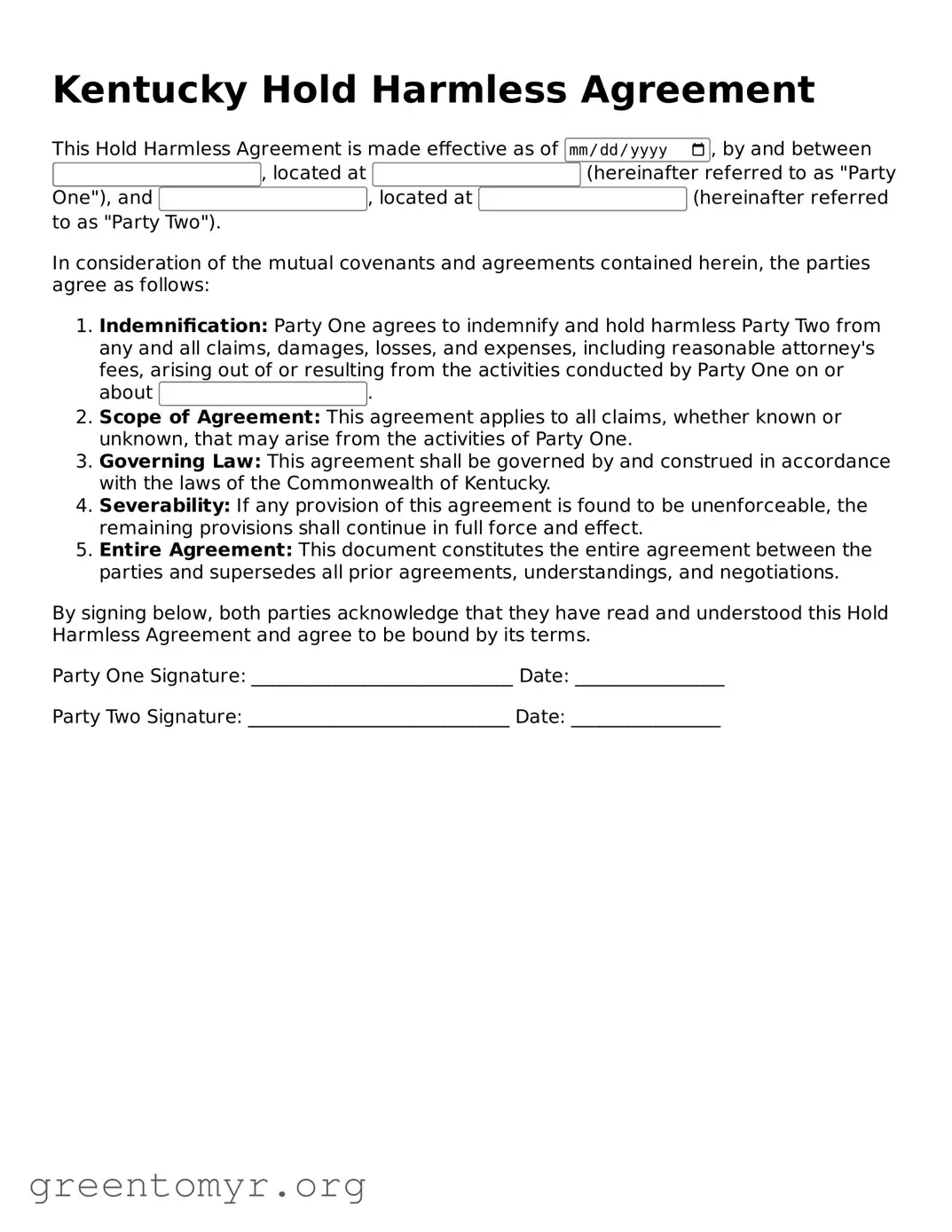
Kentucky Hold Harmless Agreement
This Hold Harmless Agreement is made effective as of , by and between , located at (hereinafter referred to as "Party One"), and , located at (hereinafter referred to as "Party Two").
In consideration of the mutual covenants and agreements contained herein, the parties agree as follows:
Indemnification: Party One agrees to indemnify and hold harmless Party Two from any and all claims, damages, losses, and expenses, including reasonable attorney's fees, arising out of or resulting from the activities conducted by Party One on or about .
Scope of Agreement: This agreement applies to all claims, whether known or unknown, that may arise from the activities of Party One.
Governing Law: This agreement shall be governed by and construed in accordance with the laws of the Commonwealth of Kentucky.
Severability: If any provision of this agreement is found to be unenforceable, the remaining provisions shall continue in full force and effect.
Entire Agreement: This document constitutes the entire agreement between the parties and supersedes all prior agreements, understandings, and negotiations.
By signing below, both parties acknowledge that they have read and understood this Hold Harmless Agreement and agree to be bound by its terms.
Party One Signature: ____________________________ Date: ________________
Party Two Signature: ____________________________ Date: ________________
A Kentucky Hold Harmless Agreement is a legal document where one party agrees to protect another from any claims, damages, or liabilities that may arise from a specific activity or situation.
Purpose
This agreement is often used to mitigate risks in various situations, such as events, construction projects, or other activities that could result in injury or damage.
Governing Law
The agreement is governed by Kentucky state laws, specifically the Kentucky Revised Statutes (KRS).
Parties Involved
Typically, the agreement involves at least two parties: the indemnitor (the one providing protection) and the indemnitee (the one being protected).
Enforceability
For the agreement to be enforceable, it must be clear, unambiguous, and voluntarily signed by both parties.
Limitations
Some limitations may apply, as Kentucky law does not allow hold harmless agreements to absolve a party from liability due to gross negligence or willful misconduct.
Importance of Clarity
Clear language is crucial. Ambiguities in the agreement can lead to disputes and may affect its enforceability.
Legal Advice
Consulting with a legal professional before signing a Hold Harmless Agreement is advisable to ensure that rights and obligations are fully understood.
Guide to Using Kentucky Hold Harmless Agreement
Once you have the Kentucky Hold Harmless Agreement form in front of you, the next step is to fill it out accurately. This form is essential for ensuring that all parties understand their responsibilities and liabilities. Follow the steps below to complete the form correctly.
Begin by entering the date at the top of the form. This helps to establish when the agreement is being made.
Provide your full name in the designated space. Ensure that you write it clearly to avoid any confusion.
Next, include your address. This should be your current residential address, including city, state, and zip code.
Identify the other party or parties involved in the agreement. List their names and addresses as required.
Clearly describe the activity or event that the agreement pertains to. Be specific to avoid any misunderstandings later.
Review the section that outlines the responsibilities and liabilities of each party. Make sure you understand what you are agreeing to.
If applicable, add any additional clauses or stipulations that are relevant to the agreement. This could include special conditions or exceptions.
Sign the form at the bottom where indicated. Your signature signifies that you agree to the terms laid out in the document.
Finally, date your signature. This step is crucial as it confirms when you entered into the agreement.
After completing the form, make sure to keep a copy for your records. You may also need to provide a copy to the other party involved. Being organized will help ensure that everything goes smoothly.
Get Answers on Kentucky Hold Harmless Agreement
What is a Kentucky Hold Harmless Agreement?
A Kentucky Hold Harmless Agreement is a legal document that protects one party from liability for any damages or injuries that may occur during a specific activity or event. It ensures that one party agrees not to hold the other party responsible for certain risks associated with that activity.
Who typically uses a Hold Harmless Agreement?
This agreement is commonly used by businesses, event organizers, and property owners. For example, a venue may require event organizers to sign this agreement to limit liability for accidents that may occur during the event. Similarly, businesses may use it when conducting activities that involve potential risks.
What are the key components of the agreement?
A Hold Harmless Agreement generally includes:
The names and contact information of the parties involved.
A description of the activity or event.
Specific terms outlining the extent of liability protection.
Signatures of all parties involved.
Is a Hold Harmless Agreement legally binding in Kentucky?
Can a Hold Harmless Agreement be challenged in court?
How do I create a Hold Harmless Agreement?
To create a Hold Harmless Agreement, follow these steps:
Identify the parties involved.
Clearly outline the activity or event.
Specify the terms of liability protection.
Include a section for signatures and dates.
Using a template can be helpful, but it is best to have a legal professional review the document to ensure it meets all necessary requirements.
Where can I find a template for a Kentucky Hold Harmless Agreement?
Templates for Hold Harmless Agreements can be found online through legal websites, law firms, or local government resources. However, it is essential to ensure that any template used complies with Kentucky law and is tailored to your specific needs.
Common mistakes
When completing the Kentucky Hold Harmless Agreement form, individuals often overlook critical details that can lead to misunderstandings or invalid agreements. One common mistake is failing to provide accurate information. This includes not listing the correct names of the parties involved or omitting essential details such as addresses. Inaccurate information can create confusion and may render the agreement unenforceable.
Another frequent error is neglecting to read the entire document thoroughly. Many people skim through the terms and conditions without fully understanding their implications. This oversight can result in agreeing to terms that are not fully understood, potentially leading to disputes later on.
Some individuals also forget to specify the scope of the agreement. The Hold Harmless Agreement should clearly outline what activities or circumstances are covered. Without this clarity, it may be difficult to determine when the agreement applies, which could lead to liability issues.
Additionally, individuals sometimes fail to include a date on the form. A dated agreement is crucial for establishing when the terms take effect. Without a date, it can be challenging to enforce the agreement or to prove its validity in the event of a dispute.
Another mistake is not obtaining signatures from all relevant parties. A Hold Harmless Agreement requires the consent of all involved to be effective. If one party does not sign, the agreement may not hold up in court, leaving individuals exposed to potential liabilities.
Lastly, individuals may not seek legal advice before signing the agreement. While it may seem straightforward, the implications of a Hold Harmless Agreement can be significant. Consulting with a legal professional can help ensure that all parties understand their rights and obligations, reducing the risk of future conflicts.
Documents used along the form
A Kentucky Hold Harmless Agreement is a valuable document that protects one party from liability in case of accidents or damages. When using this agreement, several other forms and documents may also be necessary to ensure comprehensive coverage and clarity in legal matters. Below is a list of documents commonly associated with a Hold Harmless Agreement.
Liability Waiver: This document releases a party from legal liability for injuries or damages incurred during an activity. It is often used in recreational settings, like sports or events.
Indemnity Agreement: Similar to a Hold Harmless Agreement, this document obligates one party to compensate another for losses or damages. It is frequently used in contracts where one party assumes risk on behalf of another.
Insurance Certificate: This document proves that a party has the necessary insurance coverage. It is often requested to ensure that liability is covered in case of an incident.
Release of Liability Form: This form allows participants to acknowledge the risks involved in an activity and agree not to hold the organizer responsible for any injuries or damages.
Contract for Services: This agreement outlines the terms and conditions under which services will be provided. It often includes clauses related to liability and indemnification.
Property Lease Agreement: When leasing property, this document may include provisions that address liability and responsibilities of both the landlord and tenant, often incorporating hold harmless clauses.
Event Permit: For public gatherings, this document grants permission to hold an event and may require proof of liability coverage to protect against claims.
Non-Disclosure Agreement (NDA): While primarily used to protect confidential information, an NDA may also include clauses about liability, especially in business partnerships.
Safety Protocols Document: This outlines the safety measures that will be taken during an event or activity. It can help mitigate liability by demonstrating that precautions are in place.
Understanding these documents can significantly enhance protection and clarity in legal agreements. Each serves a unique purpose, and together they create a robust framework for managing risk and liability.
Similar forms
The Hold Harmless Agreement form shares similarities with several other legal documents. Here’s a list of six such documents:
Indemnity Agreement: Like the Hold Harmless Agreement, this document protects one party from financial loss or liability due to the actions of another party.
Waiver of Liability: This form releases one party from responsibility for potential injuries or damages, similar to how a Hold Harmless Agreement limits liability.
Release Agreement: A Release Agreement allows one party to relinquish their right to pursue legal action against another, much like a Hold Harmless Agreement does.
Non-Disclosure Agreement (NDA): While primarily focused on confidentiality, NDAs can also include clauses that protect against liability, echoing the protective nature of a Hold Harmless Agreement.
Service Agreement: This document outlines the terms of service between parties and often includes liability clauses that mirror the intent of Hold Harmless provisions.
Contractual Liability Insurance Policy: This type of insurance provides coverage for damages arising from contractual obligations, similar to the protective function of a Hold Harmless Agreement.
Dos and Don'ts
When filling out the Kentucky Hold Harmless Agreement form, it's important to be careful and thorough. Here’s a helpful list of things to do and avoid.
Do read the entire form carefully before starting.
Do provide accurate information to ensure clarity.
Do sign and date the form where required.
Do keep a copy for your records after submitting.
Don't leave any sections blank unless instructed.
Don't rush through the process; take your time.
Don't use unclear language; be straightforward.
Don't forget to check for any specific requirements related to your situation.
Misconceptions
Understanding the Kentucky Hold Harmless Agreement form can be challenging. Here are seven common misconceptions that need clarification:
It is only for businesses. Many believe that only businesses use Hold Harmless Agreements. In reality, individuals can also utilize this form to protect themselves from liability in various situations.
It eliminates all liability. A Hold Harmless Agreement does not completely eliminate liability. It primarily shifts responsibility from one party to another, but it does not protect against gross negligence or willful misconduct.
It is a one-size-fits-all document. This form is not universal. Each agreement should be tailored to the specific circumstances and parties involved to ensure it meets legal standards and adequately addresses the situation.
Signing it means you can't sue. While the agreement can limit liability, it does not prevent you from pursuing legal action if necessary. It simply outlines the responsibilities of each party.
It must be notarized. Notarization is not a requirement for a Hold Harmless Agreement to be valid in Kentucky. However, having it notarized can add an extra layer of authenticity and may be advisable in certain situations.
It is only valid if signed before an event occurs. While it's best to sign the agreement before any activities take place, it can still be valid if signed afterward, provided both parties agree to the terms.
All Hold Harmless Agreements are enforceable. Not all agreements hold up in court. For an agreement to be enforceable, it must be clear, specific, and comply with state laws. Ambiguities can lead to challenges in enforcement.
Addressing these misconceptions can help individuals and organizations better understand the purpose and limitations of the Kentucky Hold Harmless Agreement form.
Key takeaways
When it comes to using the Kentucky Hold Harmless Agreement form, understanding its purpose and how to fill it out correctly is crucial. Here are some key takeaways to keep in mind:
Purpose: The Hold Harmless Agreement is designed to protect one party from legal liability for any injuries or damages that may occur during an event or activity.
Parties Involved: Clearly identify all parties involved in the agreement. This includes the person or organization being held harmless and the individual or group assuming the risk.
Specificity is Key: Be specific about the activities or events covered under the agreement. This helps to clarify what situations the agreement applies to.
Legal Review: Although it's not always necessary, having a legal professional review the agreement can ensure that it meets all legal requirements and adequately protects your interests.
Signatures Required: Ensure that all parties sign and date the agreement. This confirms that everyone understands and agrees to the terms outlined.
Keep Copies: After the agreement is signed, make sure to keep copies for your records. This can be important for future reference if any issues arise.
By following these guidelines, you can effectively use the Kentucky Hold Harmless Agreement to safeguard yourself or your organization during various activities.