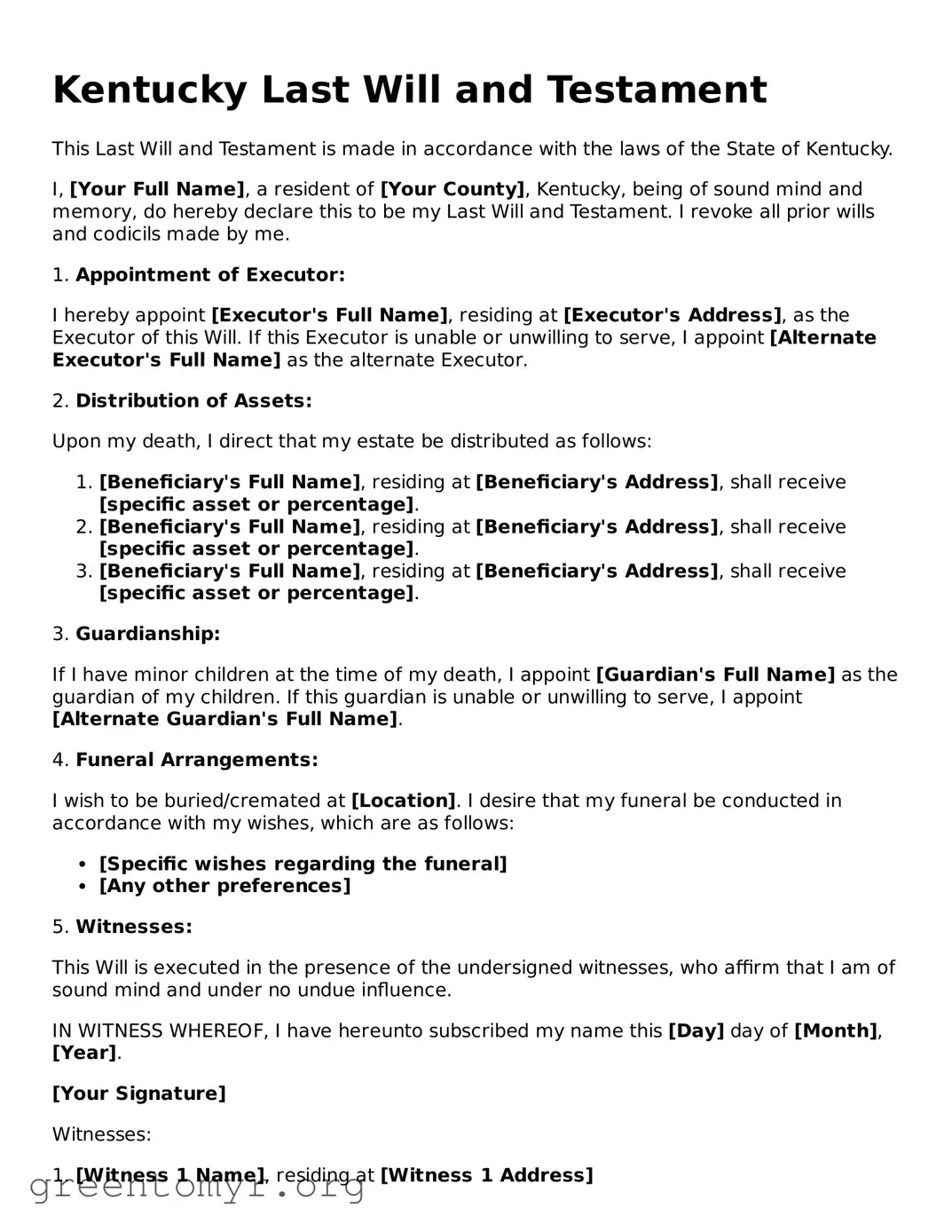
Creating a Last Will and Testament is an essential step in ensuring that your wishes are honored after you pass away. In Kentucky, this legal document serves as a formal declaration of how you want your assets distributed and who will manage your estate. It allows you to designate beneficiaries, appoint an executor, and even name guardians for your minor children. The Kentucky Last Will and Testament form is straightforward yet comprehensive, providing a clear structure for you to articulate your desires. You can specify particular items, such as family heirlooms or financial assets, and outline any specific instructions for their distribution. Additionally, the form requires your signature and the signatures of witnesses to validate your intentions, ensuring that your will is legally binding. Understanding these key components can empower you to make informed decisions about your legacy and provide peace of mind for both you and your loved ones.
Kentucky Last Will and Testament
This Last Will and Testament is made in accordance with the laws of the State of Kentucky.
I, [Your Full Name], a resident of [Your County], Kentucky, being of sound mind and memory, do hereby declare this to be my Last Will and Testament. I revoke all prior wills and codicils made by me.
1. Appointment of Executor:
I hereby appoint [Executor's Full Name], residing at [Executor's Address], as the Executor of this Will. If this Executor is unable or unwilling to serve, I appoint [Alternate Executor's Full Name] as the alternate Executor.
2. Distribution of Assets:
Upon my death, I direct that my estate be distributed as follows:
3. Guardianship:
If I have minor children at the time of my death, I appoint [Guardian's Full Name] as the guardian of my children. If this guardian is unable or unwilling to serve, I appoint [Alternate Guardian's Full Name].
4. Funeral Arrangements:
I wish to be buried/cremated at [Location]. I desire that my funeral be conducted in accordance with my wishes, which are as follows:
5. Witnesses:
This Will is executed in the presence of the undersigned witnesses, who affirm that I am of sound mind and under no undue influence.
IN WITNESS WHEREOF, I have hereunto subscribed my name this [Day] day of [Month], [Year].
[Your Signature]
Witnesses:
1. [Witness 1 Name], residing at [Witness 1 Address]
2. [Witness 2 Name], residing at [Witness 2 Address]
| Fact Name | Description |
|---|---|
| Governing Law | The Kentucky Last Will and Testament is governed by Kentucky Revised Statutes, Chapter 394. |
| Age Requirement | In Kentucky, individuals must be at least 18 years old to create a valid will. |
| Written Document | The will must be in writing, either typed or handwritten, to be considered valid. |
| Signature Requirement | The testator must sign the will at the end of the document, indicating their intent. |
| Witnesses | At least two witnesses are required to sign the will, affirming they observed the testator sign. |
| Self-Proving Will | A will can be made self-proving by including a notarized affidavit from the witnesses. |
| Revocation | A will can be revoked at any time by the testator through a subsequent will or physical destruction of the document. |
| Holographic Wills | Holographic wills, which are handwritten and signed by the testator, are recognized in Kentucky if they meet certain criteria. |
| Probate Process | After the testator's death, the will must go through the probate process to be validated and executed. |
| Limitations on Bequests | Kentucky law places certain limitations on bequests to ensure that spouses and children receive their legal shares. |
After obtaining the Kentucky Last Will and Testament form, you will need to fill it out carefully. This document will outline your wishes regarding the distribution of your assets after your passing. Make sure to have all necessary information at hand before you begin.
A Last Will and Testament is a legal document that outlines how an individual's assets and affairs should be handled after their death. In Kentucky, this document allows you to specify who will inherit your property, appoint guardians for minor children, and name an executor to manage your estate. It ensures that your wishes are respected and can help prevent disputes among family members.
In Kentucky, any person who is at least 18 years old and of sound mind can create a Last Will and Testament. This means you must understand the implications of your decisions and be able to communicate your wishes clearly. If you are younger than 18, you may still create a will if you are legally emancipated.
To ensure your will is valid in Kentucky, it must meet several key requirements:
Yes, you can change or revoke your will in Kentucky at any time while you are alive and of sound mind. To make changes, you can either create a new will that explicitly revokes the previous one or add a codicil, which is an amendment to your existing will. If you wish to revoke your will, you can do so by destroying it or making a written declaration stating your intent to revoke.
If you pass away without a will, you are considered to have died "intestate." In this case, Kentucky's intestacy laws will determine how your assets are distributed. Generally, your property will be divided among your closest relatives, such as your spouse and children. However, without a will, you lose the ability to specify your preferences, which can lead to complications and disputes among family members.
While it is not legally required to hire a lawyer to create a will in Kentucky, it is highly recommended. A lawyer can help ensure that your will meets all legal requirements, accurately reflects your wishes, and addresses any specific concerns you may have. Their expertise can help you navigate complex family dynamics and ensure that your estate is handled according to your wishes.
Filling out a Last Will and Testament form in Kentucky can be a straightforward process, but many individuals make common mistakes that can lead to complications. One frequent error is failing to properly identify the testator. It is essential to include the full legal name and address to avoid any confusion about the individual making the will.
Another mistake involves not clearly stating the distribution of assets. Individuals may assume that their wishes are understood, but vague language can lead to disputes among heirs. It is important to be specific about who receives what to ensure that the testator's intentions are honored.
Some people neglect to name an executor or fail to choose a reliable one. The executor is responsible for carrying out the terms of the will, so selecting someone trustworthy and capable is crucial. Without an executor, the court may appoint one, which may not align with the testator's preferences.
Additionally, failing to sign the will properly is a common pitfall. In Kentucky, the will must be signed by the testator and witnessed by at least two individuals. If these requirements are not met, the will may be deemed invalid.
Another mistake is not dating the will. Without a date, it can be challenging to determine if the document is the most recent version. This can lead to confusion, especially if previous wills exist.
Some individuals also forget to update their will after significant life changes, such as marriage, divorce, or the birth of a child. These events can significantly affect asset distribution and should be reflected in the will to avoid unintended consequences.
People sometimes overlook the need for witnesses to understand their role. Witnesses should not be beneficiaries of the will, as this can lead to challenges regarding the will's validity. Ensuring that witnesses are impartial helps maintain the integrity of the document.
Failing to consider tax implications is another mistake. Individuals may not realize that certain assets can have tax consequences for heirs. Consulting with a financial advisor can provide clarity on how best to structure the will to minimize tax burdens.
Finally, some individuals may not store the will in a secure and accessible location. A will should be kept in a safe place where it can be easily found after the testator's passing. If the will cannot be located, the testator's wishes may not be honored.
When preparing a Last Will and Testament in Kentucky, several other forms and documents may be necessary to ensure that your wishes are clearly expressed and legally recognized. Below is a list of commonly used documents that often accompany a will.
Each of these documents serves a unique purpose and can help facilitate the management of your affairs and the distribution of your assets. It's essential to consider these forms when creating your estate plan to ensure that your wishes are honored and that your loved ones are taken care of.
The Last Will and Testament is a crucial legal document that outlines how a person's assets and affairs should be handled after their death. However, it shares similarities with several other documents that serve various purposes in estate planning and legal affairs. Here are seven documents that are similar to a Last Will and Testament:
When filling out the Kentucky Last Will and Testament form, it’s important to approach the task carefully. Here are some essential dos and don’ts to keep in mind:
Understanding the Kentucky Last Will and Testament form is crucial for anyone looking to ensure their wishes are honored after they pass. However, several misconceptions can lead to confusion. Here are five common misunderstandings:
Misconception 1: A handwritten will is not valid in Kentucky.
This is not entirely true. Kentucky does recognize handwritten wills, known as holographic wills, as valid if they are signed by the testator and the material provisions are in their handwriting. However, following the standard form can provide more clarity and reduce the risk of disputes.
Misconception 2: You can change your will at any time without any formalities.
While it is true that you can change your will, doing so requires following specific procedures. In Kentucky, any changes must be made through a codicil or by creating a new will that explicitly revokes the previous one. Simply crossing out provisions or adding notes may not be legally recognized.
Misconception 3: A will avoids probate.
This is a common belief, but it is incorrect. In Kentucky, a will must go through the probate process, which is the legal procedure for settling an estate. While certain assets can bypass probate, such as those held in a trust or with designated beneficiaries, a will itself does not eliminate the need for probate.
Misconception 4: Only wealthy individuals need a will.
Everyone can benefit from having a will, regardless of their financial status. A will helps ensure that your wishes regarding asset distribution, guardianship for minor children, and other important matters are clearly outlined. This can prevent potential conflicts among family members and provide peace of mind.
Misconception 5: Once a will is created, it cannot be changed.
This is false. Wills can be amended or revoked at any time as long as the person creating the will is of sound mind. It's important to review and update your will periodically, especially after major life events such as marriage, divorce, or the birth of a child.
By understanding these misconceptions, individuals can better navigate the process of creating a Last Will and Testament in Kentucky, ensuring that their wishes are honored and their loved ones are taken care of.
When preparing a Last Will and Testament in Kentucky, it is essential to understand the key elements involved in the process. Here are five important takeaways to keep in mind:
By keeping these key points in mind, you can create a Last Will and Testament that accurately reflects your wishes and provides clarity for your loved ones.