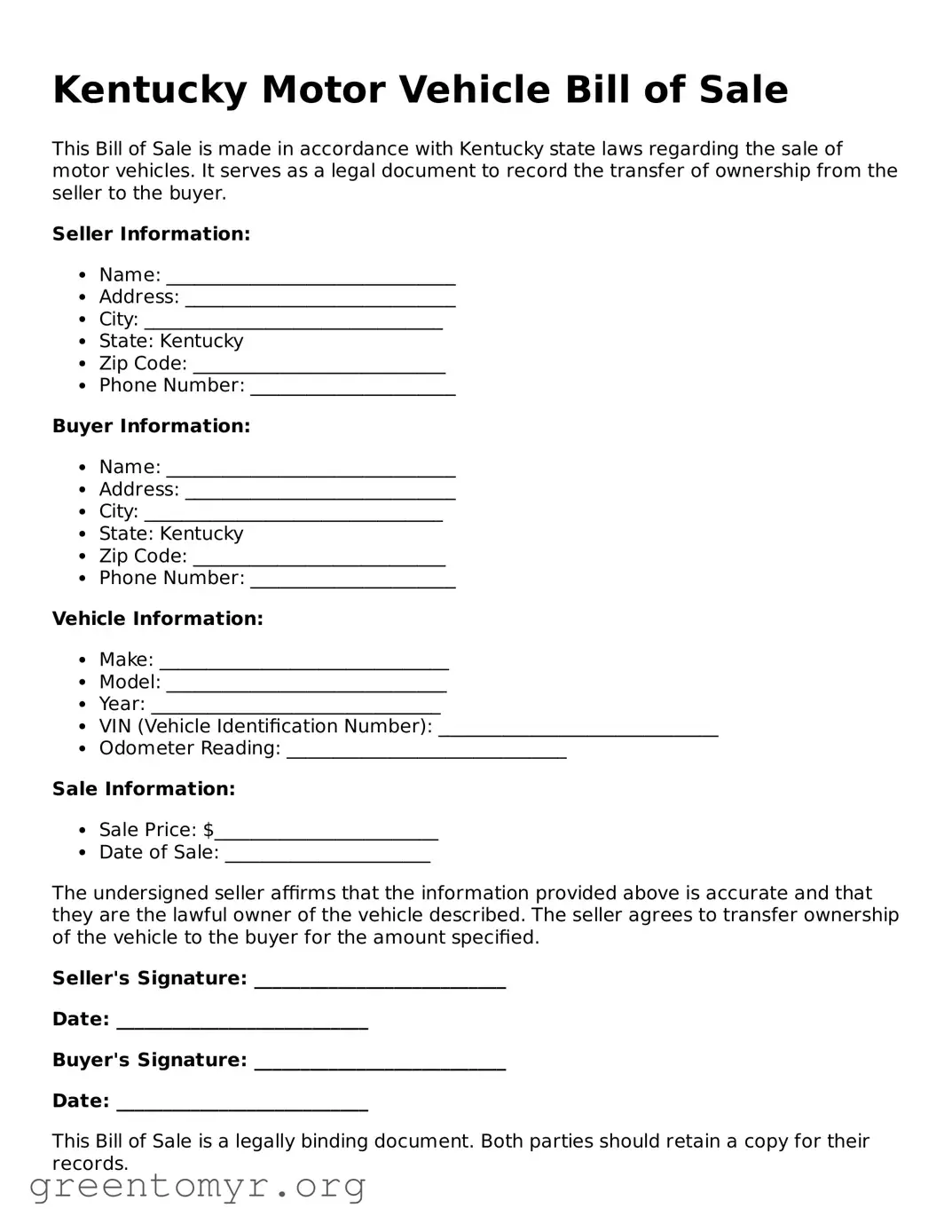
When buying or selling a vehicle in Kentucky, a Motor Vehicle Bill of Sale form is an essential document that protects both parties involved in the transaction. This form serves as a written record of the sale, detailing important information such as the vehicle's make, model, year, and Vehicle Identification Number (VIN). It also includes the names and addresses of both the buyer and the seller, ensuring that all parties are clearly identified. The form typically outlines the sale price, payment method, and any warranties or guarantees associated with the vehicle. Additionally, it may require the seller's signature to validate the transaction. By completing this form, buyers and sellers can avoid potential disputes and provide proof of ownership transfer, making it a crucial step in the vehicle sales process in Kentucky.
Kentucky Motor Vehicle Bill of Sale
This Bill of Sale is made in accordance with Kentucky state laws regarding the sale of motor vehicles. It serves as a legal document to record the transfer of ownership from the seller to the buyer.
Seller Information:
Buyer Information:
Vehicle Information:
Sale Information:
The undersigned seller affirms that the information provided above is accurate and that they are the lawful owner of the vehicle described. The seller agrees to transfer ownership of the vehicle to the buyer for the amount specified.
Seller's Signature: ___________________________
Date: ___________________________
Buyer's Signature: ___________________________
Date: ___________________________
This Bill of Sale is a legally binding document. Both parties should retain a copy for their records.
| Fact Name | Description |
|---|---|
| Purpose | The Kentucky Motor Vehicle Bill of Sale form serves as a legal document to transfer ownership of a vehicle from the seller to the buyer. |
| Governing Law | This form is governed by Kentucky Revised Statutes (KRS) Chapter 186, which outlines vehicle registration and titling requirements. |
| Required Information | The form must include details such as the vehicle's make, model, year, VIN (Vehicle Identification Number), and the sale price. |
| Signatures | Both the seller and buyer must sign the form to validate the transaction and confirm the transfer of ownership. |
| Notarization | While notarization is not mandatory, having the document notarized can provide additional legal protection for both parties. |
| Use for Tax Purposes | The Bill of Sale can be used to establish the purchase price for tax purposes when registering the vehicle with the state. |
| Retention | Both the buyer and seller should retain a copy of the Bill of Sale for their records, as it may be needed for future reference. |
Once you have the Kentucky Motor Vehicle Bill of Sale form in hand, it's essential to complete it accurately to ensure a smooth transaction. This document will be important for both the buyer and the seller, so take your time and follow the steps carefully.
After completing the form, keep a copy for your records. The buyer will need this document for registration purposes, so ensure they receive it promptly.
A Kentucky Motor Vehicle Bill of Sale is a legal document that records the sale of a vehicle between a buyer and a seller. This form serves as proof of the transaction and includes essential details such as the vehicle's make, model, year, and Vehicle Identification Number (VIN). It also outlines the sale price and the date of the transaction.
The Bill of Sale is crucial for several reasons:
A comprehensive Bill of Sale should include the following information:
In Kentucky, notarization of the Bill of Sale is not mandatory. However, having it notarized can add an extra layer of authenticity and may be beneficial in case of future disputes. It is advisable to check with local regulations or the Kentucky Transportation Cabinet for any specific requirements.
While you can use a generic Bill of Sale template, it is recommended to use a form specifically designed for Kentucky. This ensures compliance with state laws and includes all necessary information pertinent to vehicle sales in the state.
After completing the Bill of Sale, both the buyer and seller should keep a copy for their records. The buyer must then take the Bill of Sale to their local county clerk’s office to register the vehicle and obtain a new title. It is also wise to notify the local Department of Motor Vehicles (DMV) of the sale.
Completing the Kentucky Motor Vehicle Bill of Sale form can be straightforward, but several common mistakes often occur. One of the most frequent errors is incomplete information. Buyers and sellers sometimes forget to fill in essential details, such as the vehicle identification number (VIN) or the purchase price. Omitting this information can lead to complications during the registration process.
Another mistake involves incorrect VIN entries. The VIN is a unique identifier for each vehicle, and even a single digit error can create significant issues. Always double-check the VIN against the vehicle's title or registration to ensure accuracy.
People also tend to overlook signature requirements. Both the buyer and seller must sign the form for it to be valid. Failing to obtain both signatures can render the document ineffective, leading to potential disputes down the line.
Additionally, some individuals neglect to date the form. The date is crucial as it marks the official transfer of ownership. Without a date, it may be unclear when the transaction occurred, which can complicate matters if questions arise later.
Another common issue is not providing correct contact information. Buyers and sellers should include their full names, addresses, and phone numbers. Incomplete contact details can hinder communication if any issues arise after the sale.
Additionally, failing to indicate the method of payment can create misunderstandings. Specifying whether the payment was made in cash, by check, or through another method helps clarify the terms of the sale.
Some individuals may also confuse vehicle condition descriptions. Accurately describing the vehicle's condition is essential for transparency. Misrepresenting the condition can lead to disputes and damage trust between parties.
Lastly, not keeping a copy of the completed form is a significant oversight. Both parties should retain a copy for their records. This documentation can be invaluable in case of future disputes or questions regarding the transaction.
When transferring ownership of a vehicle in Kentucky, several forms and documents may accompany the Motor Vehicle Bill of Sale. Each of these documents serves a specific purpose and can help ensure a smooth transaction. Below is a list of commonly used forms that may be needed during this process.
Having these documents ready can facilitate the vehicle transfer process and help both parties fulfill their legal obligations. It is important to ensure that all forms are accurately completed and submitted as required by Kentucky law.
The Motor Vehicle Bill of Sale form is a crucial document for transferring ownership of a vehicle. It shares similarities with several other documents. Here’s a list of nine documents that are similar, along with an explanation of how they relate:
Each of these documents plays a vital role in ensuring clear ownership transfer and protecting the interests of both parties involved in the transaction.
When completing the Kentucky Motor Vehicle Bill of Sale form, there are several important considerations to keep in mind. Here are six key actions to take and avoid:
The Kentucky Motor Vehicle Bill of Sale form is often misunderstood. Here are nine common misconceptions about this important document:
Many believe that a Bill of Sale is only necessary for used vehicles. However, it is also recommended for new vehicle purchases to provide a clear record of the transaction.
Some people think that a Bill of Sale is just a casual agreement. In reality, it serves as a legal document that can be used in court to prove ownership and the terms of the sale.
While the seller's signature is crucial, the buyer's signature is equally important. Both parties must sign the document to validate the transaction.
Even if a title is being transferred, having a Bill of Sale is beneficial. It provides additional proof of the transaction and can help clarify details that may not be on the title.
Some believe a verbal agreement suffices. However, having a written Bill of Sale is essential for clarity and legal protection.
While notarization is not always required, having the document notarized adds an extra layer of authenticity and can be beneficial in disputes.
A receipt simply confirms payment, whereas a Bill of Sale outlines the details of the transaction, including vehicle identification and terms of the sale.
Many think that only private sales require a Bill of Sale. However, dealerships may also use this document for transparency in transactions.
While the Bill of Sale is a formal document, if both parties agree, it can be amended. Any changes should be documented in writing and signed by both parties.
Understanding these misconceptions can help ensure a smoother vehicle transaction process in Kentucky.
When filling out and using the Kentucky Motor Vehicle Bill of Sale form, consider the following key takeaways:
By following these guidelines, you can ensure a smooth transaction when buying or selling a vehicle in Kentucky.