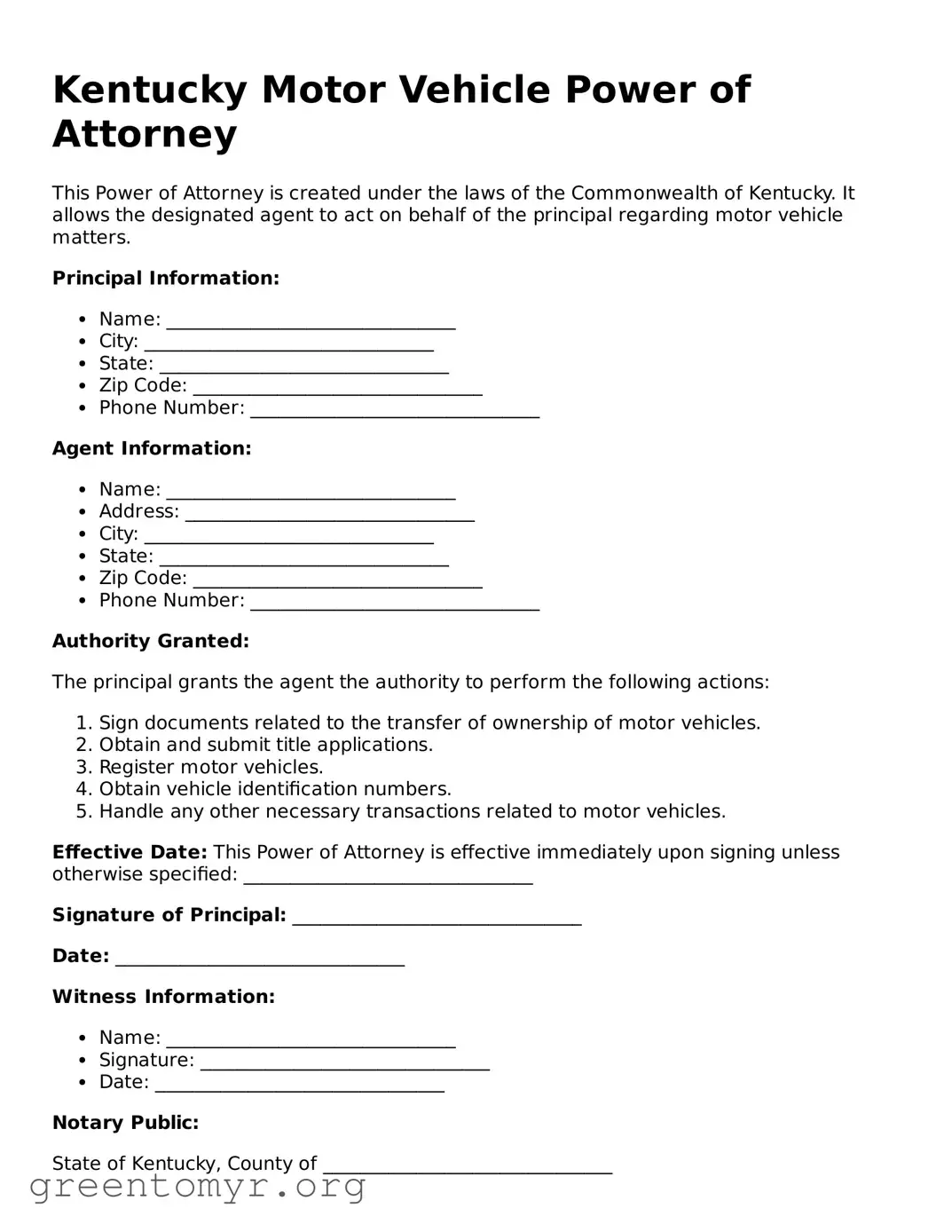
The Kentucky Motor Vehicle Power of Attorney form is an important legal document that allows individuals to designate someone else to act on their behalf regarding motor vehicle matters. This form is commonly used when a vehicle owner cannot be present to complete necessary transactions, such as transferring ownership, registering a vehicle, or obtaining title documents. By filling out this form, the vehicle owner, known as the principal, grants specific powers to the designated agent, enabling them to perform these tasks efficiently. The form typically requires the principal's signature, the agent's information, and may need to be notarized to ensure its validity. Understanding the requirements and implications of this form can help streamline vehicle-related processes, making it easier for individuals to manage their automotive responsibilities even when they cannot be physically present. It is essential to ensure that all details are accurately filled out to avoid complications in the future.
Kentucky Motor Vehicle Power of Attorney
This Power of Attorney is created under the laws of the Commonwealth of Kentucky. It allows the designated agent to act on behalf of the principal regarding motor vehicle matters.
Principal Information:
Agent Information:
Authority Granted:
The principal grants the agent the authority to perform the following actions:
Effective Date: This Power of Attorney is effective immediately upon signing unless otherwise specified: _______________________________
Signature of Principal: _______________________________
Date: _______________________________
Witness Information:
Notary Public:
State of Kentucky, County of _______________________________
Subscribed and sworn to before me this ______ day of _______________, 20__.
_______________________________
Notary Public Signature
My Commission Expires: _______________________________
| Fact Name | Description |
|---|---|
| Purpose | The Kentucky Motor Vehicle Power of Attorney form allows an individual to appoint someone else to handle specific motor vehicle-related transactions on their behalf. |
| Governing Law | This form is governed by the Kentucky Revised Statutes, specifically KRS 186A.190. |
| Signatures Required | The form must be signed by both the principal (the person granting authority) and the agent (the person receiving authority) to be valid. |
| Revocation | The principal can revoke the power of attorney at any time, provided they do so in writing and notify the agent. |
Once you have obtained the Kentucky Motor Vehicle Power of Attorney form, it is essential to complete it accurately to ensure that it is valid. Follow the steps below carefully to fill out the form correctly.
After completing the form, review it for accuracy. Ensure that all required fields are filled out correctly. Once confirmed, the form can be submitted as needed.
The Kentucky Motor Vehicle Power of Attorney form is a legal document that allows one person (the principal) to designate another person (the agent) to act on their behalf regarding matters related to motor vehicles. This can include tasks such as transferring ownership, registering vehicles, or obtaining titles. By using this form, the principal grants specific powers to the agent, making it easier to handle vehicle-related transactions without being physically present.
In Kentucky, the agent can be any adult individual whom the principal trusts. This could be a family member, friend, or even a professional, such as an attorney or a notary public. It is important to choose someone responsible, as the agent will have the authority to make decisions regarding the principal’s motor vehicle matters.
The powers granted can vary based on the principal's needs. Common powers include:
It is crucial for the principal to clearly specify the powers they wish to grant to ensure there is no confusion later on.
Yes, in Kentucky, the Motor Vehicle Power of Attorney form must be notarized to be considered valid. This means that the principal must sign the document in the presence of a notary public, who will then provide their seal and signature. This step helps to verify the authenticity of the document and the identities of the parties involved.
The validity of the Kentucky Motor Vehicle Power of Attorney form typically lasts until the principal revokes it or until the specific tasks outlined in the document are completed. It is advisable for the principal to communicate with the agent regarding the duration of the authority granted and to formally revoke the power if it is no longer needed.
Yes, the principal has the right to revoke the Power of Attorney at any time, as long as they are mentally competent. To revoke it, the principal should create a written notice stating their intention to do so and provide copies to the agent and any relevant parties, such as the Department of Motor Vehicles. This ensures that everyone is aware that the agent no longer has authority to act on the principal's behalf.
While there is no fee specifically for completing the Power of Attorney form itself, there may be fees associated with the transactions that the agent undertakes on behalf of the principal. For example, fees may apply for vehicle registration, title transfers, or notary services. It’s wise to check with the local Department of Motor Vehicles for any applicable fees.
The form can typically be obtained from the Kentucky Department of Motor Vehicles website or from local DMV offices. Additionally, many legal websites offer templates for the Power of Attorney form that can be customized to meet specific needs. Ensure that the form you are using complies with Kentucky state requirements.
If you have further questions or need assistance, consider reaching out to a legal professional who specializes in powers of attorney or motor vehicle laws. They can provide personalized guidance based on your situation. Additionally, the Kentucky DMV can also be a helpful resource for questions regarding vehicle-related transactions.
Filling out the Kentucky Motor Vehicle Power of Attorney form can be a straightforward process, but several common mistakes can lead to complications. One frequent error occurs when individuals fail to provide accurate vehicle information. The form requires specific details about the vehicle, including the make, model, year, and Vehicle Identification Number (VIN). Omitting or misrepresenting any of this information can result in delays or issues with the transfer of authority.
Another common mistake is neglecting to sign the form. The Power of Attorney is not valid without the signature of the person granting authority. Sometimes, individuals may forget to sign or may mistakenly believe that a printed name suffices. It is crucial to ensure that all required signatures are present before submitting the document.
People often overlook the importance of naming a specific agent. The Power of Attorney must clearly identify the person who will act on behalf of the vehicle owner. Failing to do so can lead to confusion and may render the document ineffective. It is essential to provide the full name and contact information of the designated agent to avoid any misunderstandings.
In addition, individuals may not fully understand the powers they are granting. The form allows for various levels of authority, and it is vital to specify what actions the agent is permitted to take. For instance, the agent might need the authority to sell the vehicle, transfer ownership, or handle registration matters. Without clear instructions, the agent may not be able to perform necessary tasks.
Lastly, individuals sometimes forget to include a date on the form. The date is critical as it establishes when the Power of Attorney becomes effective. Without a date, the document may be considered incomplete, leading to potential legal challenges. Ensuring that all sections of the form are filled out correctly, including the date, is essential for a smooth process.
When handling matters related to motor vehicles in Kentucky, several forms and documents may accompany the Motor Vehicle Power of Attorney form. Each of these documents serves a specific purpose and can facilitate various transactions related to vehicle ownership and management. Below is a list of commonly used forms that may be required.
Understanding these documents can simplify the process of managing motor vehicle transactions in Kentucky. Each form plays a vital role in ensuring that all legal requirements are met, protecting the rights of all parties involved.
When filling out the Kentucky Motor Vehicle Power of Attorney form, it is essential to follow certain guidelines to ensure the process goes smoothly. Here are some dos and don'ts to keep in mind:
Understanding the Kentucky Motor Vehicle Power of Attorney form is essential for anyone needing to delegate authority regarding vehicle transactions. However, several misconceptions can lead to confusion. Here are eight common misunderstandings:
Being aware of these misconceptions can help individuals navigate the process more effectively and ensure that their vehicle transactions proceed smoothly.
When dealing with the Kentucky Motor Vehicle Power of Attorney form, it is essential to understand its purpose and the implications of filling it out correctly. Here are six key takeaways to consider: