In the competitive landscape of today’s job market, protecting business interests while fostering employee growth is a delicate balance. One tool that many employers in Kentucky utilize to achieve this balance is the Non-compete Agreement form. This document serves as a legal agreement between an employer and an employee, outlining the terms under which the employee agrees not to engage in certain competitive activities for a specified period after leaving the company. Key aspects of this form include the definition of the geographical area in which the restrictions apply, the duration of the non-compete clause, and the specific activities that are prohibited. By clearly delineating these elements, the Non-compete Agreement aims to safeguard proprietary information and trade secrets while also ensuring that employees have a clear understanding of their post-employment obligations. As businesses navigate the complexities of workforce management, understanding the nuances of this agreement becomes essential for both employers and employees alike.
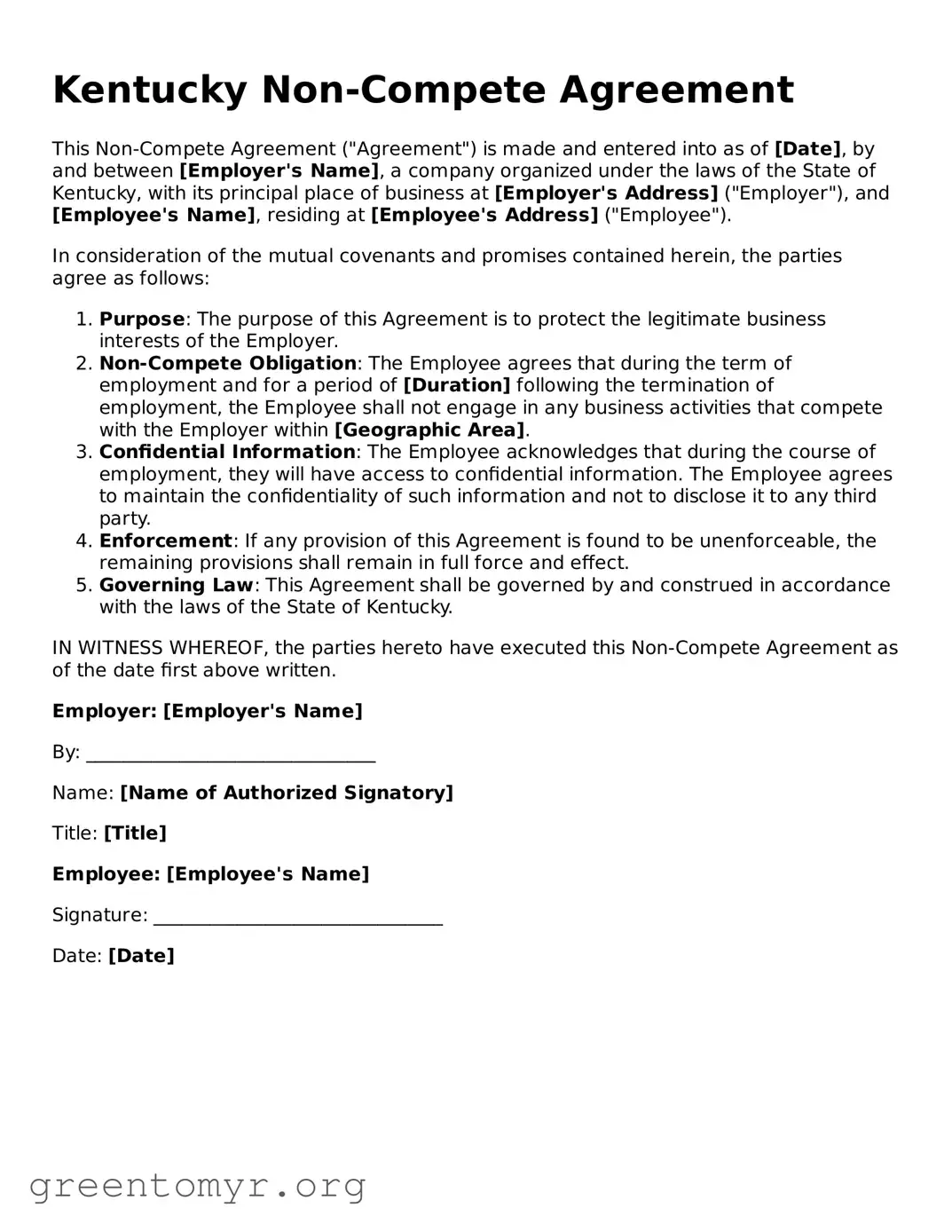
Kentucky Non-Compete Agreement
This Non-Compete Agreement ("Agreement") is made and entered into as of [Date], by and between [Employer's Name], a company organized under the laws of the State of Kentucky, with its principal place of business at [Employer's Address] ("Employer"), and [Employee's Name], residing at [Employee's Address] ("Employee").
In consideration of the mutual covenants and promises contained herein, the parties agree as follows:
IN WITNESS WHEREOF, the parties hereto have executed this Non-Compete Agreement as of the date first above written.
Employer: [Employer's Name]
By: _______________________________
Name: [Name of Authorized Signatory]
Title: [Title]
Employee: [Employee's Name]
Signature: _______________________________
Date: [Date]
| Fact Name | Description |
|---|---|
| Definition | A Kentucky Non-compete Agreement restricts an employee from competing with their employer for a specified time after leaving the company. |
| Duration | The agreement typically lasts for one to two years, but the duration can vary based on the industry and specific circumstances. |
| Enforceability | These agreements are enforceable in Kentucky if they are reasonable in scope and duration, and protect legitimate business interests. |
| Governing Law | Kentucky law governs Non-compete Agreements, specifically under KRS 336.030. |
| Consideration | For a non-compete to be valid, there must be consideration, such as a job offer or a promotion, provided to the employee. |
After obtaining the Kentucky Non-compete Agreement form, you will need to complete it carefully. This process involves providing specific information about the parties involved and the terms of the agreement. Once filled out, the form will require signatures from both parties to ensure it is legally binding.
A Non-compete Agreement is a legal contract between an employer and an employee. It restricts the employee from engaging in certain activities that compete with the employer’s business after the employment ends. In Kentucky, these agreements must be reasonable in scope and duration to be enforceable.
Yes, Non-compete Agreements can be enforceable in Kentucky, but they must meet specific criteria. The agreement must protect legitimate business interests, be reasonable in geographic area and duration, and not impose an undue hardship on the employee.
A well-drafted Non-compete Agreement typically includes:
The duration of a Non-compete Agreement in Kentucky should be reasonable. Generally, courts may enforce agreements lasting from six months to two years, depending on the circumstances. Each case is evaluated based on its specific facts.
If you violate a Non-compete Agreement, your former employer may seek legal action against you. This could result in an injunction to prevent you from working in a competing business, and you may also face monetary damages for any losses incurred by your employer.
Yes, you can negotiate the terms of a Non-compete Agreement before signing it. It is important to discuss any concerns you have with your employer. Modifications may include shortening the duration, limiting the geographic area, or clarifying the scope of restricted activities.
Yes, there is a difference. A Non-compete Agreement restricts an employee from working for competitors, while a Non-solicitation Agreement prevents an employee from soliciting clients or employees from their former employer. Both serve to protect business interests but address different concerns.
While it is not legally required to have an attorney draft a Non-compete Agreement, it is highly advisable. An attorney can ensure that the agreement complies with Kentucky law and adequately protects your interests, whether you are an employer or an employee.
Yes, Non-compete Agreements can be enforced against independent contractors in Kentucky. However, the same enforceability criteria apply. The agreement must be reasonable and protect legitimate business interests.
If you believe your Non-compete Agreement is unfair, consider consulting with an attorney. They can help you understand your rights and options. You may be able to negotiate better terms or challenge the agreement in court if it is deemed unreasonable.
Filling out the Kentucky Non-compete Agreement form can be a straightforward process, but many individuals make critical mistakes that can jeopardize the enforceability of the agreement. One common error is failing to provide clear definitions of key terms. When terms like "confidential information" or "competing business" are vague, it can lead to confusion and disputes later on.
Another frequent mistake is not specifying the duration of the non-compete clause. A non-compete agreement must outline how long the restrictions will be in place. Without a defined timeframe, the agreement may be considered overly broad and unenforceable.
People often overlook the importance of including geographic limitations. A non-compete agreement should clearly state the areas where the restrictions apply. If the geographic scope is too broad, it may be deemed unreasonable by a court.
Additionally, many individuals neglect to consider the consideration provided for the agreement. For a non-compete to be valid, there must be something of value exchanged, such as employment or training. Failing to mention this can weaken the agreement's validity.
Another mistake is not having the agreement signed by both parties. A signed document is essential for enforceability. Without signatures, the agreement may not hold up in court.
Some people forget to review the agreement for compliance with state laws. Each state has specific requirements for non-compete agreements, and Kentucky is no exception. Ignoring these laws can lead to the agreement being invalidated.
Moreover, individuals sometimes include overly restrictive clauses that limit an employee's ability to work in their field entirely. Such restrictions can be viewed as unreasonable and may lead to the agreement being thrown out.
Another common error is not consulting with a legal professional before finalizing the agreement. Legal advice can help ensure that the terms are fair and enforceable, preventing future complications.
Finally, failing to keep a copy of the signed agreement can lead to disputes about its terms. Both parties should retain a copy to avoid misunderstandings regarding the agreement's stipulations.
The Kentucky Non-compete Agreement is a crucial document for employers seeking to protect their business interests by restricting former employees from engaging in competitive activities. However, it is often accompanied by several other forms and documents that help clarify the terms of employment, protect intellectual property, and establish clear expectations between employers and employees. Below is a list of commonly used forms and documents that complement the Non-compete Agreement.
Understanding these additional documents is essential for both employers and employees. They work together to create a clear framework for the employment relationship, ensuring that both parties are aware of their rights and responsibilities. By utilizing these forms effectively, businesses can better protect their interests while providing clarity and fairness to their employees.
A Non-compete Agreement is a legal document that restricts an individual from engaging in certain competitive activities after leaving a job. While its primary purpose is to protect a business's interests, several other documents share similarities in function and intent. Below are four such documents:
When filling out the Kentucky Non-compete Agreement form, it is important to follow specific guidelines. Here are five things you should and shouldn't do:
Non-compete agreements are often misunderstood, leading to confusion for both employers and employees. Here are four common misconceptions regarding the Kentucky Non-compete Agreement form:
Understanding these misconceptions can help both employers and employees navigate the complexities of non-compete agreements more effectively.
Filling out and using the Kentucky Non-compete Agreement form can be a straightforward process if you keep certain key points in mind. Here are some essential takeaways to consider:
By keeping these points in mind, individuals and businesses can navigate the non-compete agreement process more effectively, ensuring that their rights and interests are protected.