The Kentucky Notary Acknowledgement form serves an important role in legal and official documents, ensuring that signatures are verified and authentic. This form is commonly used when a person signs a document in front of a notary public, who then confirms the identity of the signer. It includes essential details such as the name of the signer, the type of document being acknowledged, and the date of the acknowledgment. The notary public will also provide their signature and seal, which adds an extra layer of legitimacy to the document. This process helps prevent fraud and ensures that all parties involved understand the contents of the document being signed. Understanding how to properly complete and utilize the Notary Acknowledgement form is crucial for anyone involved in legal transactions in Kentucky.
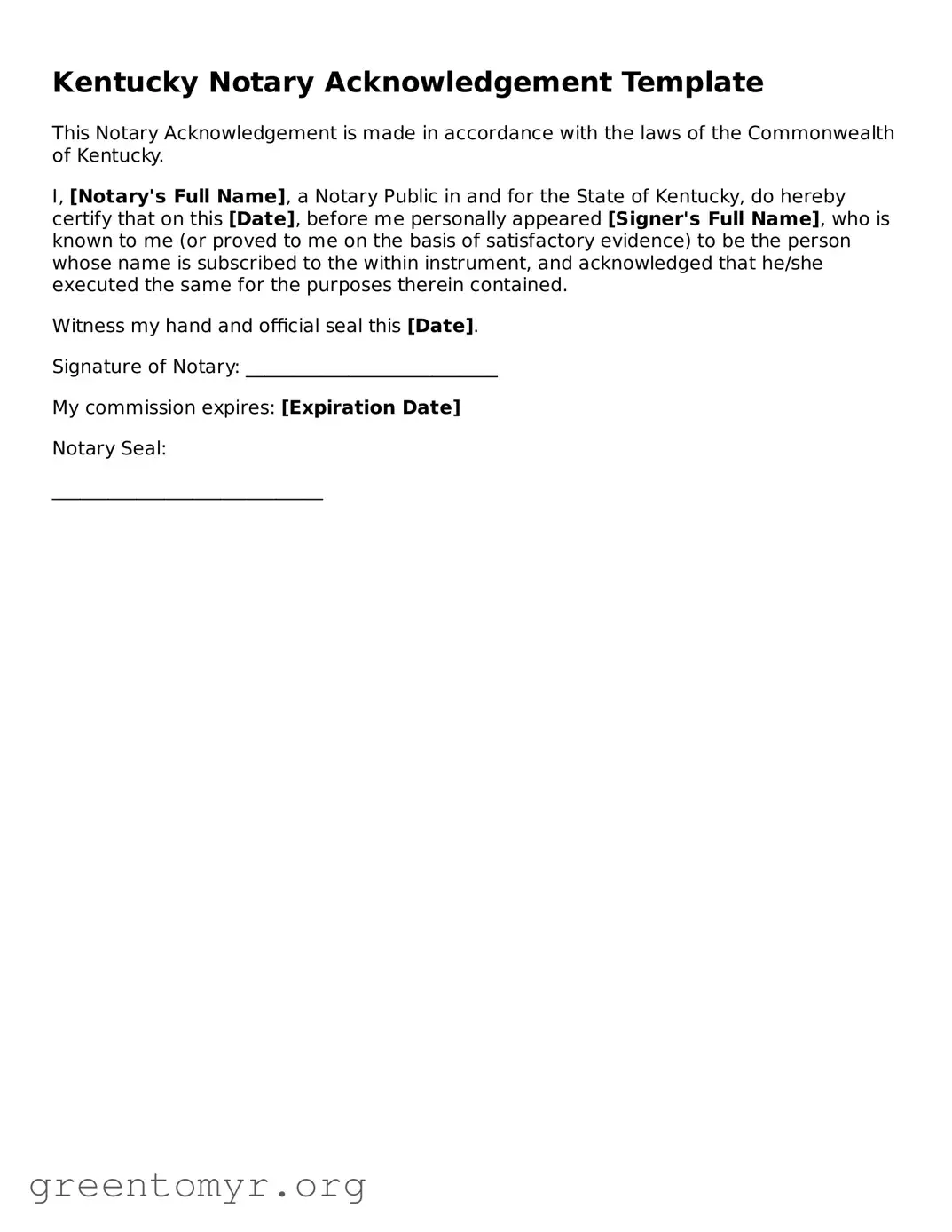
Kentucky Notary Acknowledgement Template
This Notary Acknowledgement is made in accordance with the laws of the Commonwealth of Kentucky.
I, [Notary's Full Name], a Notary Public in and for the State of Kentucky, do hereby certify that on this [Date], before me personally appeared [Signer's Full Name], who is known to me (or proved to me on the basis of satisfactory evidence) to be the person whose name is subscribed to the within instrument, and acknowledged that he/she executed the same for the purposes therein contained.
Witness my hand and official seal this [Date].
Signature of Notary: ___________________________
My commission expires: [Expiration Date]
Notary Seal:
_____________________________
| Fact Name | Details |
|---|---|
| Purpose | The Kentucky Notary Acknowledgement form is used to verify the identity of the signer and confirm that they signed the document willingly. |
| Governing Law | This form is governed by Kentucky Revised Statutes, specifically KRS 423.130. |
| Signature Requirement | The signer must appear in person before the notary public to complete the acknowledgement process. |
| Notary's Role | The notary public is responsible for ensuring that the signer understands the document and is signing it voluntarily. |
After gathering the necessary information, you are ready to fill out the Kentucky Notary Acknowledgement form. Make sure to have all required details on hand, as this will ensure a smooth process.
Once the form is completed, it will be ready for submission. Be sure to follow any additional instructions provided for the next steps in the process.
The Kentucky Notary Acknowledgment form is a legal document used to verify the identity of a signer. It confirms that the person who signed a document did so willingly and is who they claim to be. This form is often used in conjunction with various legal documents, such as contracts, deeds, and affidavits.
In Kentucky, a notary public must be at least 18 years old, a resident of the state, and able to read and write English. They must also pass a background check and complete any required training. Once appointed, notaries can perform their duties for a specified term, typically four years.
To complete the form, follow these steps:
Make sure all information is accurate to avoid any issues later.
No, a Notary Acknowledgment is not required for every document. However, many legal documents benefit from having an acknowledgment to ensure authenticity. It's often required for real estate transactions, court documents, and certain financial agreements. Always check the specific requirements for your document type.
If a Notary Acknowledgment is not completed correctly, it can lead to issues with the validity of the document. The document may be rejected by courts or other entities if the acknowledgment is missing or incorrect. It’s important to double-check all information and ensure that the notary follows the proper procedures.
When filling out the Kentucky Notary Acknowledgment form, many individuals unknowingly make mistakes that can lead to complications. Understanding these common errors can help ensure that the form is completed correctly, ultimately facilitating smoother transactions.
One frequent mistake is failing to include the correct date. The acknowledgment must clearly state when the notary performed the acknowledgment. If the date is missing or incorrect, it can cast doubt on the validity of the document.
Another common error is neglecting to identify the signer properly. It’s crucial that the name on the form matches the name on the identification presented to the notary. Discrepancies can lead to questions about the signer’s identity and the authenticity of the document.
Many people also overlook the requirement for the notary's signature and seal. Without these essential elements, the acknowledgment is incomplete. A missing signature or seal can render the document invalid, causing delays in its intended use.
Additionally, some individuals forget to indicate the type of identification used. The notary must record how they verified the identity of the signer, whether through a driver’s license, passport, or another form of ID. Omitting this information can create uncertainty about the acknowledgment process.
Another mistake involves using an outdated version of the form. Legal requirements can change, and it’s important to ensure that the most current version of the Kentucky Notary Acknowledgment form is being used. Using an outdated form can lead to rejection by courts or other institutions.
People sometimes confuse the acknowledgment with other notarial acts, such as jurats or oaths. Each type of notarial act serves a different purpose, and using the wrong one can have serious implications for the document's validity.
In some cases, individuals may fail to provide the appropriate context for the acknowledgment. It’s essential to include a brief description of the document being acknowledged. This helps clarify the purpose of the acknowledgment and can prevent misunderstandings later on.
Finally, some may rush through the process without reviewing the completed form for accuracy. Taking a moment to double-check all entries can save time and prevent issues down the road. A careful review can catch mistakes that might otherwise go unnoticed.
By being aware of these common mistakes, individuals can approach the Kentucky Notary Acknowledgment form with confidence. Ensuring accuracy and completeness not only facilitates smoother transactions but also upholds the integrity of the notarial process.
In Kentucky, the Notary Acknowledgment form is often used in conjunction with several other documents to ensure the validity and legality of various transactions. These documents serve different purposes but are commonly required in legal and financial processes. Below is a list of forms that are frequently associated with the Notary Acknowledgment form.
These documents play crucial roles in various legal transactions, and their relationship with the Notary Acknowledgment form underscores the importance of proper documentation in ensuring legal compliance and protecting the rights of all parties involved.
The Notary Acknowledgment form serves a specific purpose in the legal process, primarily to verify the identity of individuals signing documents. There are several other documents that share similarities with this form, often used in various legal contexts. Below is a list of eight documents that are similar to the Notary Acknowledgment form, along with a brief explanation of how they are alike.
When filling out the Kentucky Notary Acknowledgement form, it is essential to follow certain guidelines to ensure accuracy and compliance. Here are seven important dos and don'ts to keep in mind.
By adhering to these guidelines, you can help ensure that the Notary Acknowledgement form is filled out correctly and serves its intended purpose.
Understanding the Kentucky Notary Acknowledgement form can be challenging, and several misconceptions can lead to confusion. Here are five common misunderstandings about this important document:
This is incorrect. A notary's role is to verify the identity of the signer and ensure that they are signing willingly. A signature is essential for the notary to perform their duties effectively.
This is a misconception. Each state has its own requirements and forms. The Kentucky Notary Acknowledgement has specific elements that must be included, which may differ from those in other states.
While notaries do have discretion, they cannot refuse without a valid reason. If the signer is present and the document meets legal requirements, the notary should proceed with the acknowledgment.
This is not entirely true. While many legal documents require notarization, other types of documents, such as certain contracts or agreements, may also benefit from an acknowledgment to enhance their credibility.
This is misleading. While notarization provides assurance of the authenticity of the signature at a specific time, changes can still be made to the document. However, if significant changes occur, it may require a new notarization.
Being informed about these misconceptions can help individuals navigate the notary process more effectively and ensure that their documents are properly acknowledged.
When filling out and using the Kentucky Notary Acknowledgement form, there are several important points to keep in mind. Here are some key takeaways to ensure the process goes smoothly:
By following these guidelines, you can navigate the process of using the Kentucky Notary Acknowledgement form with confidence.