When starting a business in Kentucky, having a solid foundation is essential, and an Operating Agreement is a key component of that foundation. This important document outlines the internal workings of a limited liability company (LLC), detailing the roles and responsibilities of members, management structure, and decision-making processes. It provides clarity on how profits and losses will be distributed, ensuring that all members are on the same page. Additionally, the Operating Agreement can address procedures for adding new members, handling disputes, and dissolving the company if necessary. By clearly defining these aspects, the agreement helps protect the interests of all parties involved and can prevent misunderstandings down the line. Whether you are forming a single-member LLC or a multi-member entity, having a comprehensive Operating Agreement is crucial for smooth operations and long-term success.
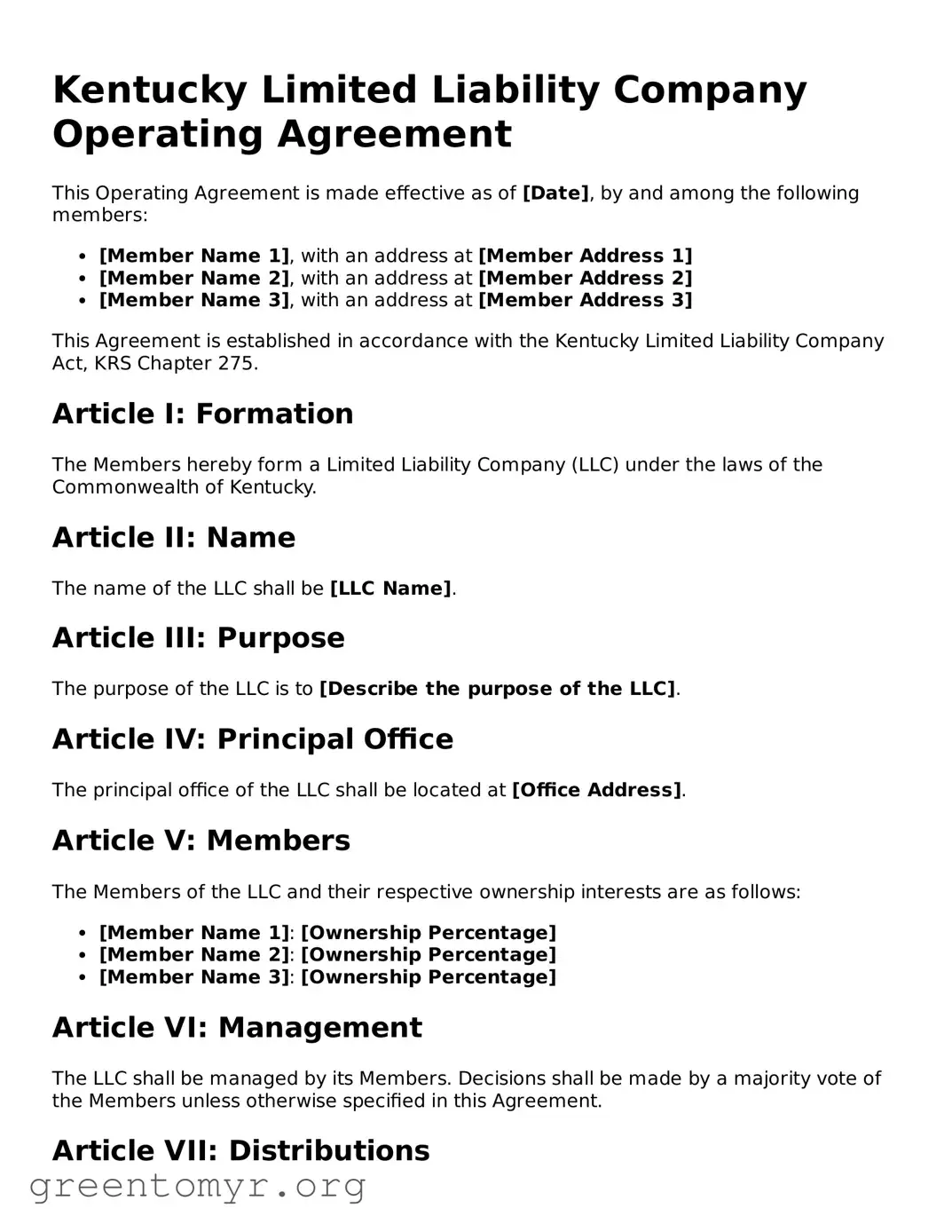
Kentucky Limited Liability Company Operating Agreement
This Operating Agreement is made effective as of [Date], by and among the following members:
This Agreement is established in accordance with the Kentucky Limited Liability Company Act, KRS Chapter 275.
Article I: Formation
The Members hereby form a Limited Liability Company (LLC) under the laws of the Commonwealth of Kentucky.
Article II: Name
The name of the LLC shall be [LLC Name].
Article III: Purpose
The purpose of the LLC is to [Describe the purpose of the LLC].
Article IV: Principal Office
The principal office of the LLC shall be located at [Office Address].
Article V: Members
The Members of the LLC and their respective ownership interests are as follows:
Article VI: Management
The LLC shall be managed by its Members. Decisions shall be made by a majority vote of the Members unless otherwise specified in this Agreement.
Article VII: Distributions
Distributions of profits and losses shall be allocated to the Members in proportion to their ownership interests.
Article VIII: Meetings
Meetings of the Members shall be held at least once a year. Notice of the meeting shall be given at least [Number of Days] days prior to the meeting.
Article IX: Amendments
This Agreement may be amended only by a written agreement signed by all Members.
Article X: Governing Law
This Agreement shall be governed by and construed in accordance with the laws of the Commonwealth of Kentucky.
IN WITNESS WHEREOF
The Members have executed this Operating Agreement as of the date first above written.
__________________________
[Member Name 1]
__________________________
[Member Name 2]
__________________________
[Member Name 3]
| Fact Name | Description |
|---|---|
| Purpose | The Kentucky Operating Agreement outlines the management structure and operating procedures of an LLC. |
| Governing Law | This form is governed by the Kentucky Revised Statutes, specifically KRS Chapter 275. |
| Members | The agreement can include details about the LLC members, their roles, and responsibilities. |
| Management Structure | It specifies whether the LLC is member-managed or manager-managed. |
| Profit Distribution | The agreement outlines how profits and losses will be distributed among members. |
| Amendments | It provides a process for making changes to the agreement in the future. |
| Dispute Resolution | The form may include provisions for resolving disputes between members. |
| Duration | The agreement can specify the duration of the LLC's existence, whether it is perpetual or for a set term. |
| Compliance | Having an operating agreement helps ensure compliance with state laws and regulations. |
| Not Mandatory | While not required by law, having an operating agreement is highly recommended for LLCs in Kentucky. |
After obtaining the Kentucky Operating Agreement form, you will need to fill it out carefully to ensure all necessary information is included. This document is important for outlining the management structure and operational procedures of your business. Follow the steps below to complete the form accurately.
A Kentucky Operating Agreement is a legal document used by limited liability companies (LLCs) to outline the management structure and operating procedures of the business. This agreement serves as an internal guideline for members, detailing how the LLC will function on a day-to-day basis. It addresses key issues such as ownership percentages, profit distribution, and decision-making processes.
Having an Operating Agreement is crucial for several reasons:
No, you do not need to file the Operating Agreement with the state of Kentucky. This document is kept internally within the LLC. However, it is advisable to have it readily available for reference and to present it when necessary, such as during legal proceedings or financial transactions.
Yes, you can modify the Operating Agreement at any time, as long as all members agree to the changes. It’s a good practice to document any amendments in writing and have all members sign the updated agreement. This ensures that everyone is on the same page and helps avoid future disputes regarding the terms of the agreement.
Filling out the Kentucky Operating Agreement form can seem straightforward, but many individuals make common mistakes that can lead to complications down the road. One frequent error is not including all members of the LLC in the agreement. Every member's rights and responsibilities should be clearly defined. If a member is omitted, it can create confusion and disputes later on.
Another mistake is failing to specify the management structure of the LLC. Whether it is member-managed or manager-managed, this detail is crucial. Without this specification, the operation of the business can become unclear, leading to potential conflicts among members.
People often overlook the importance of detailing capital contributions. It’s essential to outline what each member is contributing to the LLC, whether it’s cash, property, or services. Neglecting to document these contributions can lead to misunderstandings about ownership percentages and profit-sharing.
Additionally, many individuals forget to include provisions for the transfer of ownership. Life events such as death or retirement can impact an LLC. If the Operating Agreement does not address how ownership interests can be transferred, it may lead to complications and disputes among remaining members.
Another common oversight is not outlining the procedures for resolving disputes. Without a clear process in place, conflicts can escalate and disrupt the business. Including a dispute resolution clause can save time and money, ensuring that disagreements are handled smoothly.
Lastly, individuals sometimes fail to have the agreement reviewed by a legal professional. While it may seem like an unnecessary step, having an expert review the document can help catch mistakes and ensure compliance with Kentucky laws. Skipping this step can lead to costly errors that could have been avoided with proper guidance.
The Kentucky Operating Agreement is a key document for businesses operating as limited liability companies (LLCs) in Kentucky. However, several other forms and documents are often used in conjunction with the Operating Agreement to ensure proper business management and compliance with state regulations. Below is a list of these important documents.
These documents work together with the Kentucky Operating Agreement to provide a comprehensive framework for managing an LLC. Properly completing and maintaining these forms can help ensure compliance and smooth operations for the business.
When filling out the Kentucky Operating Agreement form, it's important to approach the task with care. Here are some key dos and don'ts to keep in mind:
Understanding the Kentucky Operating Agreement form is essential for anyone involved in a limited liability company (LLC) in the state. However, several misconceptions can lead to confusion. Here are ten common misunderstandings about this important document:
By clarifying these misconceptions, LLC members can better understand the importance of a Kentucky Operating Agreement and how it can serve their business effectively.
When filling out and using the Kentucky Operating Agreement form, consider the following key takeaways:
Following these guidelines will help ensure that the Operating Agreement is comprehensive and effective for the LLC's needs.