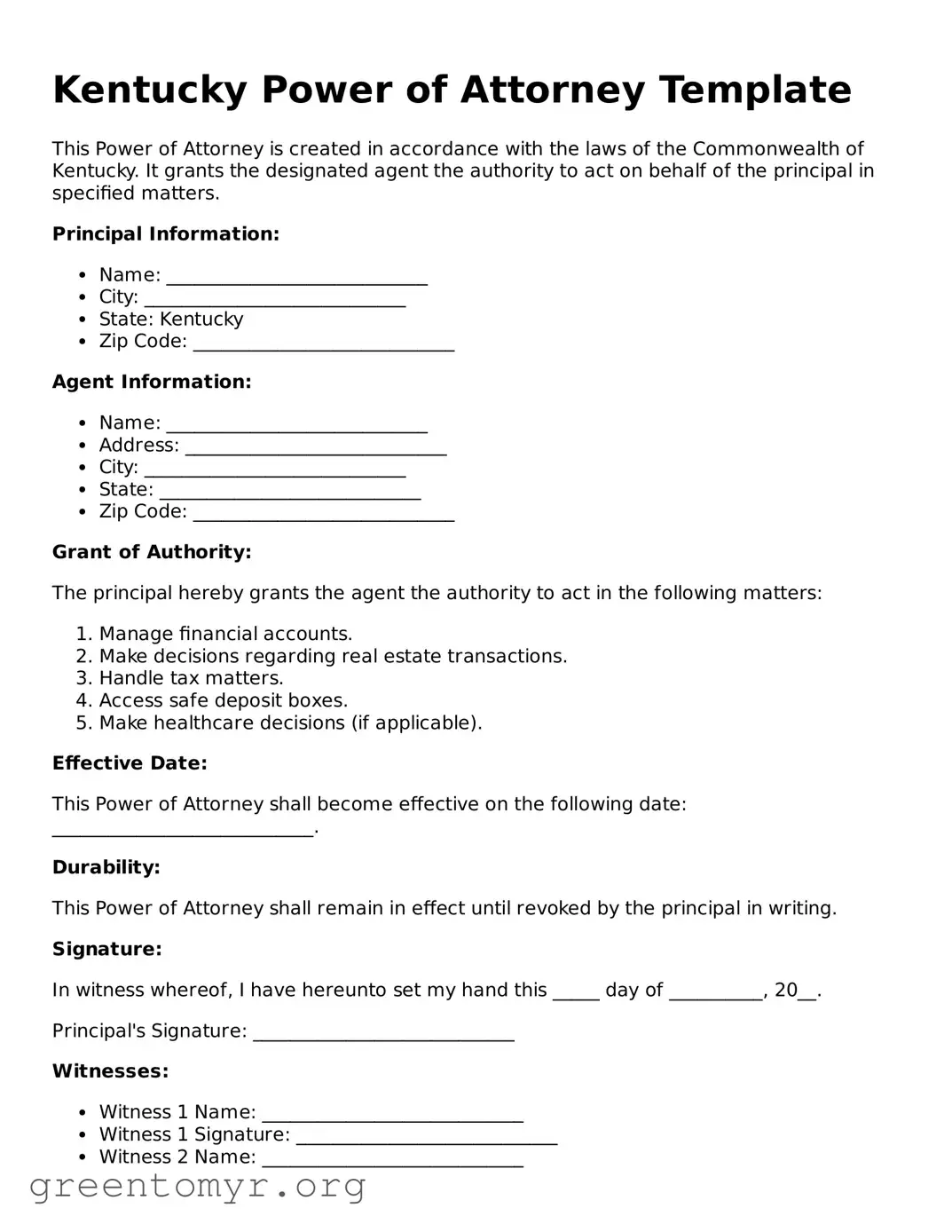
The Kentucky Power of Attorney form serves as a crucial legal document that allows individuals to appoint someone else to make decisions on their behalf, particularly in financial or medical matters. This form empowers a designated agent, often referred to as an attorney-in-fact, to act in the best interests of the principal, the person granting the authority. It encompasses various powers, which can be broad or limited, depending on the specific needs of the principal. For instance, the form can authorize the agent to handle financial transactions, manage real estate, or make healthcare decisions if the principal becomes incapacitated. Additionally, the Kentucky Power of Attorney form requires careful consideration regarding the selection of the agent, as trust and reliability are paramount. It is essential to ensure that the document is executed in accordance with state laws, including proper signatures and notarization, to ensure its validity. Understanding these aspects is vital for anyone considering this important legal tool, as it can significantly impact personal and financial well-being.
Kentucky Power of Attorney Template
This Power of Attorney is created in accordance with the laws of the Commonwealth of Kentucky. It grants the designated agent the authority to act on behalf of the principal in specified matters.
Principal Information:
Agent Information:
Grant of Authority:
The principal hereby grants the agent the authority to act in the following matters:
Effective Date:
This Power of Attorney shall become effective on the following date: ____________________________.
Durability:
This Power of Attorney shall remain in effect until revoked by the principal in writing.
Signature:
In witness whereof, I have hereunto set my hand this _____ day of __________, 20__.
Principal's Signature: ____________________________
Witnesses:
This document should be completed and signed in the presence of a notary public to ensure its validity.
| Fact Name | Description |
|---|---|
| Definition | A Power of Attorney (POA) in Kentucky is a legal document that allows one person to act on behalf of another in legal or financial matters. |
| Types of POA | There are several types of POA in Kentucky, including durable, non-durable, and springing, each serving different purposes. |
| Governing Laws | The Kentucky Power of Attorney is governed by Kentucky Revised Statutes (KRS) Chapter 457. |
| Durability | A durable POA remains effective even if the principal becomes incapacitated, provided it is explicitly stated in the document. |
| Signature Requirements | The principal must sign the POA in the presence of a notary public or two witnesses to make it valid. |
| Revocation | The principal can revoke a Power of Attorney at any time, as long as they are mentally competent to do so. |
| Agent's Responsibilities | The agent is required to act in the best interest of the principal and must keep accurate records of all transactions made on their behalf. |
After obtaining the Kentucky Power of Attorney form, it's essential to fill it out accurately to ensure it meets your needs. This document allows you to designate someone to act on your behalf in legal and financial matters. Follow the steps below to complete the form correctly.
Once you have completed these steps, review the form to confirm all information is accurate. Keeping a copy for your records is advisable. This ensures that you have access to the document whenever necessary.
A Power of Attorney (POA) is a legal document that allows one person to act on behalf of another in legal or financial matters. In Kentucky, this document can be tailored to grant specific powers or can be broad in scope, depending on the needs of the individual creating it.
Any competent adult can create a Power of Attorney in Kentucky. This means the individual must be at least 18 years old and have the mental capacity to understand the implications of the document. If someone is unable to make decisions due to incapacity, they cannot create a POA.
In Kentucky, there are several types of Powers of Attorney, including:
To create a Power of Attorney in Kentucky, follow these steps:
While it is not legally required to have a lawyer, consulting one is advisable. A lawyer can ensure that the document meets all legal requirements and accurately reflects your wishes. This can help prevent potential disputes or misunderstandings in the future.
Yes, you can revoke a Power of Attorney at any time, as long as you are still competent. To revoke, you should create a written revocation document and notify your agent and any institutions that may have relied on the original POA.
If the principal becomes incapacitated and has established a Durable Power of Attorney, the agent can continue to act on their behalf. If a non-durable POA was created, it would become void upon the principal's incapacity.
A Power of Attorney created in Kentucky may be recognized in other states, but this can vary. It is essential to check the laws of the state where the POA will be used. Some states may have specific requirements or forms that must be followed for the document to be valid.
Choosing an agent is a significant decision. Consider the following factors:
Filling out a Kentucky Power of Attorney form can be a straightforward process, but many people make common mistakes that can lead to complications down the line. One frequent error is failing to specify the powers granted. It's essential to clearly outline what decisions the agent can make on your behalf. Without this clarity, your agent may not have the authority to act in the ways you intended.
Another mistake involves not signing the form correctly. In Kentucky, the principal must sign the document in the presence of a notary public. If the signature is missing or improperly executed, the Power of Attorney may be deemed invalid. Always ensure that you follow the signing requirements closely to avoid this pitfall.
People often overlook the importance of choosing the right agent. Selecting someone who is not trustworthy or lacks the necessary judgment can lead to serious issues. Take the time to choose an individual who understands your values and can act in your best interest.
Many individuals also forget to update their Power of Attorney when life circumstances change. Whether it’s a change in health, relationships, or financial situations, keeping the document current is crucial. An outdated form may not reflect your current wishes, which can create confusion and conflict.
Additionally, some people neglect to discuss their decisions with their chosen agent. Open communication is vital. If your agent is unaware of your preferences or the scope of their authority, they may struggle to make the right decisions on your behalf.
Another common mistake is failing to provide copies of the Power of Attorney to relevant parties. Once the form is complete, share it with your agent, financial institutions, and healthcare providers as needed. Without copies, your agent may face challenges when trying to act on your behalf.
Finally, many individuals do not consider the implications of revoking a Power of Attorney. If you decide to change or cancel your Power of Attorney, you must do so formally. Failing to revoke an old document can lead to confusion and potential misuse of authority.
When creating a Power of Attorney in Kentucky, several other forms and documents may be useful to ensure comprehensive planning. Below is a list of common documents that often accompany the Power of Attorney form.
These documents can work together to ensure that an individual's wishes are respected and that their affairs are managed according to their preferences. It is important to consider each document's purpose and how they fit into overall estate planning.
The Power of Attorney (POA) form is a legal document that allows one person to act on behalf of another in various matters. While it serves a specific purpose, there are other documents that share similarities with it. Here are four such documents:
When filling out the Kentucky Power of Attorney form, it is crucial to approach the task with care. Here are some important dos and don'ts to keep in mind:
Understanding the Kentucky Power of Attorney form is crucial for anyone looking to manage their financial or medical affairs. However, several misconceptions can lead to confusion. Here are seven common misconceptions:
Many people think a Power of Attorney is solely for financial decisions. In Kentucky, it can also cover medical decisions, depending on how it is set up.
This is not true. You can revoke or modify a Power of Attorney at any time as long as you are mentally competent.
Some Power of Attorney forms can be set to activate only under specific conditions, such as incapacitation. This is known as a "springing" Power of Attorney.
While you can choose anyone you trust, they must be at least 18 years old and mentally competent to act on your behalf.
People of all ages can benefit from having a Power of Attorney, especially those with significant assets or health concerns.
In Kentucky, while notarization is recommended for added validity, it is not always required. Witnesses may suffice in some cases.
This is true; however, many people mistakenly believe it ends before that. A Power of Attorney is only valid while you are alive.
Being informed about these misconceptions can help you make better decisions regarding your Power of Attorney in Kentucky.
When filling out and using the Kentucky Power of Attorney form, consider the following key takeaways:
Review these points carefully to ensure that the Power of Attorney meets your needs and protects your interests.