Content Navigation

When considering marriage in Kentucky, many couples find it beneficial to discuss their financial future and personal assets before tying the knot. A Kentucky Prenuptial Agreement serves as a proactive tool for addressing these concerns. This legal document outlines how assets and debts will be handled in the event of divorce or separation, ensuring both parties have a clear understanding of their rights and responsibilities. It can cover a variety of topics, including property division, spousal support, and even the handling of debts incurred during the marriage. By establishing these terms in advance, couples can reduce potential conflicts and provide a sense of security as they embark on their new life together. Understanding the specific requirements and components of this agreement can help ensure that it is valid and enforceable in Kentucky courts, making it an essential consideration for many engaged couples.

Kentucky Prenuptial Agreement Example

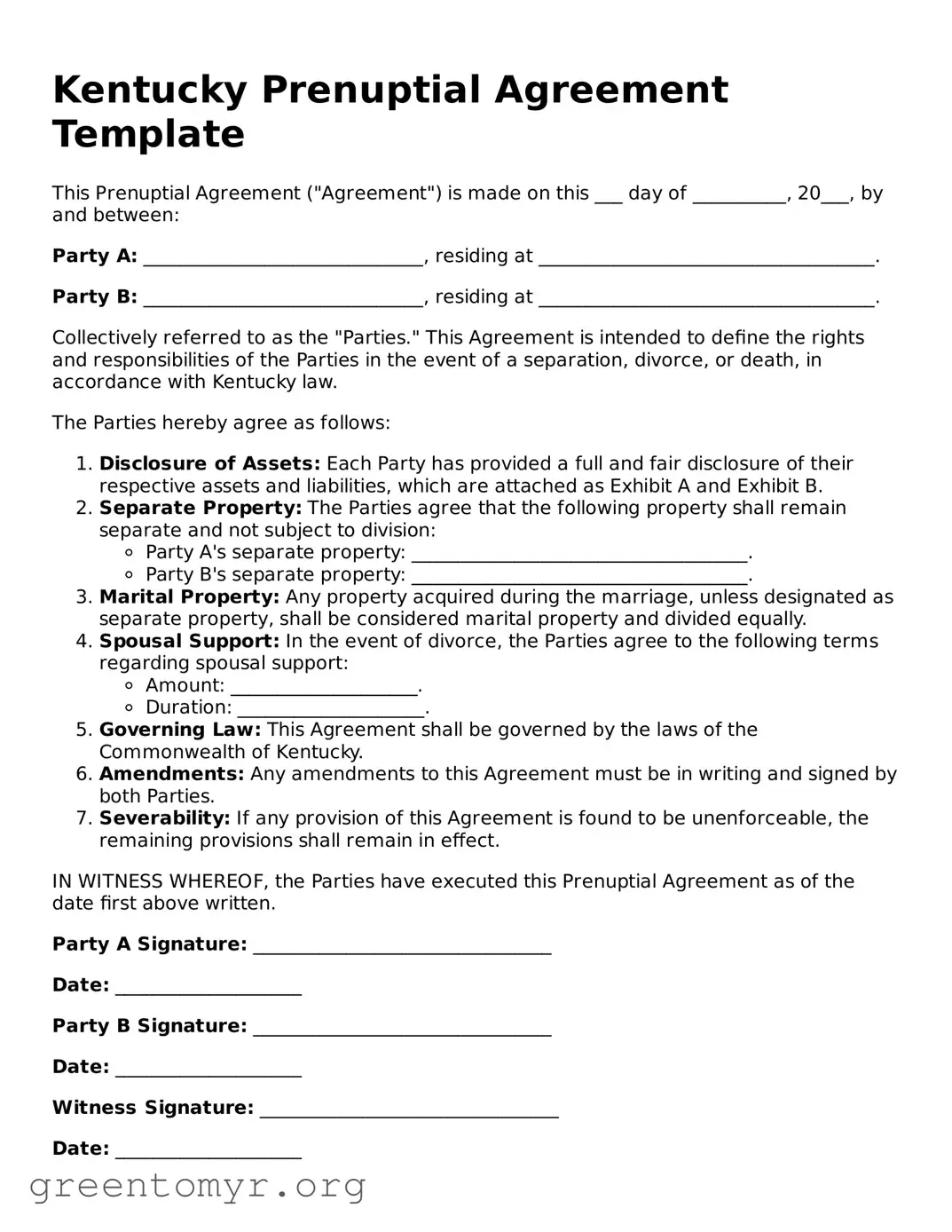
Kentucky Prenuptial Agreement Template

This Prenuptial Agreement ("Agreement") is made on this ___ day of __________, 20___, by and between:

Party A: ______________________________, residing at ____________________________________.

Party B: ______________________________, residing at ____________________________________.

Collectively referred to as the "Parties." This Agreement is intended to define the rights and responsibilities of the Parties in the event of a separation, divorce, or death, in accordance with Kentucky law.

The Parties hereby agree as follows:

  1. Disclosure of Assets: Each Party has provided a full and fair disclosure of their respective assets and liabilities, which are attached as Exhibit A and Exhibit B.
  2. Separate Property: The Parties agree that the following property shall remain separate and not subject to division:
    • Party A's separate property: ____________________________________.
    • Party B's separate property: ____________________________________.
  3. Marital Property: Any property acquired during the marriage, unless designated as separate property, shall be considered marital property and divided equally.
  4. Spousal Support: In the event of divorce, the Parties agree to the following terms regarding spousal support:
    • Amount: ____________________.
    • Duration: ____________________.
  5. Governing Law: This Agreement shall be governed by the laws of the Commonwealth of Kentucky.
  6. Amendments: Any amendments to this Agreement must be in writing and signed by both Parties.
  7. Severability: If any provision of this Agreement is found to be unenforceable, the remaining provisions shall remain in effect.

IN WITNESS WHEREOF, the Parties have executed this Prenuptial Agreement as of the date first above written.

Party A Signature: ________________________________

Date: ____________________

Party B Signature: ________________________________

Date: ____________________

Witness Signature: ________________________________

Date: ____________________

PDF Form Features

Fact Name Description
Definition A prenuptial agreement in Kentucky is a contract between two parties made before marriage that outlines the distribution of assets and responsibilities in the event of divorce or separation.
Governing Law Kentucky Revised Statutes, Chapter 403, governs prenuptial agreements in the state.
Enforceability For a prenuptial agreement to be enforceable, it must be in writing and signed by both parties.
Full Disclosure Both parties must provide full and fair disclosure of their financial situations for the agreement to be valid.
Legal Representation While not required, it is highly advisable for both parties to seek independent legal counsel before signing the agreement.

Guide to Using Kentucky Prenuptial Agreement

Filling out the Kentucky Prenuptial Agreement form requires careful attention to detail. Each section must be completed accurately to ensure that both parties' interests are represented. Follow these steps to complete the form effectively.

  1. Begin by gathering personal information for both parties, including full names, addresses, and contact details.
  2. Clearly state the purpose of the agreement at the top of the form.
  3. List all assets and liabilities for each party. This includes property, bank accounts, investments, and debts.
  4. Outline how assets and liabilities will be handled in the event of a divorce or separation.
  5. Include any provisions for spousal support or alimony, if applicable.
  6. Both parties should review the completed form to ensure accuracy and completeness.
  7. Sign and date the form in the presence of a notary public to validate the agreement.

Once the form is filled out and signed, both parties should keep a copy for their records. It is advisable to consult with a legal professional to ensure that the agreement meets all necessary legal requirements.

Get Answers on Kentucky Prenuptial Agreement

What is a prenuptial agreement in Kentucky?

A prenuptial agreement, often referred to as a "prenup," is a legal document that couples create before getting married. This agreement outlines how assets and debts will be divided in the event of a divorce or separation. In Kentucky, a prenup can also address issues such as spousal support and property rights, helping to clarify expectations and protect individual interests.

Why should couples consider a prenuptial agreement?

Couples may choose to enter into a prenuptial agreement for several reasons:

  • To protect individual assets acquired before marriage.
  • To clarify financial responsibilities during the marriage.
  • To simplify the divorce process by pre-determining asset division.
  • To protect family inheritance or business interests.

Ultimately, a prenup can provide peace of mind and foster open communication about finances.

What are the requirements for a valid prenuptial agreement in Kentucky?

For a prenuptial agreement to be considered valid in Kentucky, it must meet certain criteria:

  1. Both parties must voluntarily agree to the terms.
  2. The agreement must be in writing and signed by both individuals.
  3. Full disclosure of assets and liabilities is necessary.
  4. The terms must be fair and not unconscionable at the time of enforcement.

Meeting these requirements helps ensure that the agreement is enforceable in court.

Can a prenuptial agreement be modified or revoked?

Yes, a prenuptial agreement can be modified or revoked after marriage. Both parties must agree to the changes, and any modifications should be documented in writing and signed by both individuals. It is advisable to consult with a legal professional to ensure that any changes comply with Kentucky law.

What happens if a prenuptial agreement is challenged in court?

If a prenuptial agreement is challenged in court, the judge will evaluate its validity based on the aforementioned requirements. Factors such as lack of voluntary consent, inadequate disclosure, or unconscionable terms may lead to the agreement being set aside. Legal representation is crucial in these situations to navigate the complexities of family law.

Are there any limitations on what can be included in a prenuptial agreement?

Yes, while prenuptial agreements can cover a wide range of topics, there are limitations. For instance, agreements cannot include provisions regarding child custody or child support, as these matters are determined based on the best interests of the child at the time of divorce. Additionally, any terms that violate public policy or are illegal will not be enforceable.

How can couples ensure their prenuptial agreement is enforceable?

To increase the likelihood that a prenuptial agreement will be enforceable, couples should:

  • Seek independent legal advice to ensure understanding of the agreement.
  • Allow ample time for review before the wedding.
  • Disclose all relevant financial information.
  • Ensure that the terms are fair and reasonable.

Taking these steps can help prevent disputes and enhance the agreement's enforceability.

Where can couples find a Kentucky prenuptial agreement form?

Couples can find Kentucky prenuptial agreement forms through various sources, including legal websites, family law attorneys, and local courthouses. It is important to note that while templates can provide a starting point, customizing the agreement to fit individual circumstances is essential. Consulting with a legal professional can help ensure that the document meets all legal requirements and addresses specific needs.

Common mistakes

When filling out the Kentucky Prenuptial Agreement form, many individuals overlook important details. One common mistake is failing to provide complete information about assets. It’s crucial to list all property and debts accurately. Omitting even a single asset can lead to complications later on.

Another frequent error is not having both parties sign the agreement. Both partners must agree to the terms for the document to be valid. Without signatures from both individuals, the agreement may not hold up in court.

Some people neglect to seek legal advice before completing the form. While it may seem straightforward, the nuances of prenuptial agreements can be complex. Consulting with an attorney can help clarify any uncertainties and ensure that the agreement meets legal standards.

In addition, many individuals rush through the process. Taking the time to carefully review each section is vital. Errors made in haste can lead to misunderstandings or disputes in the future.

Another mistake involves using vague language. Clear and specific terms are essential in a prenuptial agreement. Ambiguities can create confusion and may result in disagreements later on.

Some couples also fail to update their agreements after significant life changes. Events like the birth of a child or a change in financial status should prompt a review and possible revision of the prenuptial agreement. Keeping the document current is important for it to remain relevant.

Additionally, individuals sometimes ignore the importance of full financial disclosure. Both parties should be transparent about their financial situations. Hiding assets or debts can lead to legal issues and may invalidate the agreement.

Lastly, many people underestimate the emotional aspect of discussing a prenuptial agreement. Open and honest communication is key. Addressing concerns and expectations can help build a stronger foundation for the marriage.

Documents used along the form

When preparing for marriage, many couples consider a prenuptial agreement to outline their financial rights and responsibilities. However, several other documents and forms may also be important to ensure a comprehensive understanding of both parties' interests. Below is a list of common forms that often accompany a Kentucky Prenuptial Agreement.

  • Postnuptial Agreement: Similar to a prenuptial agreement, this document is created after marriage. It outlines how assets and debts will be managed and divided in the event of divorce or separation.
  • Financial Disclosure Statement: This form requires both parties to disclose their assets, debts, income, and expenses. Transparency is key, as it helps ensure that both individuals are making informed decisions.
  • Property Settlement Agreement: This document details how property will be divided in the event of a divorce. It can be part of the divorce proceedings or a standalone agreement.
  • Will: A will outlines how a person's assets will be distributed after their death. Having a will in place can complement a prenuptial agreement by clarifying intentions regarding property ownership.
  • Power of Attorney: This document allows one person to make financial or medical decisions on behalf of another in case they become incapacitated. It is essential for ensuring that your wishes are respected during emergencies.
  • Living Will: A living will specifies an individual’s wishes regarding medical treatment in situations where they cannot communicate. This document is crucial for addressing healthcare decisions.
  • Separation Agreement: If a couple separates, this document outlines the terms of their separation, including child custody, support, and division of assets. It can help avoid disputes during the separation process.
  • Child Support Agreement: This form specifies the financial support one parent will provide to the other for their child's upbringing. It is particularly important for couples with children from previous relationships or those planning to have children.

Understanding these documents can help couples navigate their financial and legal responsibilities more effectively. Each form serves a unique purpose and can contribute to a clearer, more structured relationship, both during marriage and in the event of unforeseen circumstances.

Similar forms

  • Postnuptial Agreement: Similar to a prenuptial agreement, a postnuptial agreement is created after marriage. It outlines the division of assets and responsibilities in case of separation or divorce.
  • Separation Agreement: This document is used when a couple decides to live apart. It details the terms of their separation, including asset division, child custody, and support obligations.
  • Divorce Settlement Agreement: This agreement is reached during divorce proceedings. It specifies how property, debts, and child-related matters will be handled, much like a prenuptial agreement does before marriage.
  • Co-habitation Agreement: For couples living together without marriage, this document outlines how assets and responsibilities will be shared, similar to a prenuptial agreement for married couples.
  • Property Settlement Agreement: Often part of divorce proceedings, this document details the division of property and assets, mirroring the intentions of a prenuptial agreement.
  • Living Will: While not directly related to marriage, a living will expresses a person's wishes regarding medical treatment. It shares the same goal of ensuring that personal wishes are honored, like a prenuptial agreement for financial matters.
  • Durable Power of Attorney: This document allows someone to make financial decisions on behalf of another if they become incapacitated. It serves a similar protective function as a prenuptial agreement, ensuring that wishes are respected.
  • Trust Agreement: A trust agreement manages assets on behalf of beneficiaries. Like a prenuptial agreement, it can dictate how assets are handled and distributed, providing clarity and protection.

Dos and Don'ts

Filling out a prenuptial agreement form in Kentucky is an important step for couples considering marriage. This document can help clarify financial responsibilities and protect individual assets. Here are some essential dos and don'ts to keep in mind during this process.

  • Do be open and honest about your financial situation. Transparency lays the groundwork for trust.
  • Do discuss your intentions and expectations with your partner. Clear communication can prevent misunderstandings.
  • Do consult with a legal professional. Expert guidance ensures that the agreement meets all legal requirements.
  • Do ensure both parties have independent legal representation. This helps protect each person's interests.
  • Don't rush through the process. Take your time to understand each clause and its implications.
  • Don't use vague language. Be specific about assets, debts, and how they will be handled.

By following these guidelines, you can create a prenuptial agreement that serves both partners well, fostering a sense of security as you embark on your journey together.

Misconceptions

Many people hold misconceptions about prenuptial agreements in Kentucky. Understanding these myths can help couples make informed decisions. Here are eight common misconceptions:

  • Prenuptial agreements are only for the wealthy. Many believe that only rich individuals need a prenup. In reality, these agreements can protect anyone's assets, regardless of their financial status.
  • Prenups are only for divorce situations. Some think that prenuptial agreements are only useful if a marriage ends. However, they can also clarify financial responsibilities and expectations during the marriage.
  • A prenup is a sign of distrust. Many view a prenuptial agreement as a lack of faith in the relationship. In truth, it can foster open communication about finances and strengthen the partnership.
  • Once signed, a prenup cannot be changed. Some believe that prenuptial agreements are set in stone. In reality, couples can modify or revoke them if both parties agree.
  • Prenuptial agreements are difficult to enforce. There’s a misconception that courts often disregard prenups. However, when properly drafted and executed, they are generally upheld in court.
  • Only one party needs a lawyer. It’s common to think that only one partner requires legal representation. Both parties should have independent legal counsel to ensure fairness and understanding.
  • Prenups can cover any topic. Many believe that prenuptial agreements can address any issue. However, they are limited to financial matters and cannot dictate personal or child custody arrangements.
  • They are only necessary before marriage. Some think that prenuptial agreements must be signed before the wedding day. In fact, couples can create postnuptial agreements after marriage to address similar concerns.

By debunking these myths, couples can approach prenuptial agreements with clarity and confidence.

Key takeaways

When considering a prenuptial agreement in Kentucky, it’s essential to understand the key aspects of the process. Here are some important takeaways to keep in mind:

  • Purpose: A prenuptial agreement outlines how assets and debts will be divided in the event of a divorce or separation.
  • Voluntary Agreement: Both parties must enter into the agreement willingly, without any coercion or undue pressure.
  • Full Disclosure: Each party should provide a complete and honest disclosure of their financial situation, including assets, liabilities, and income.
  • Legal Representation: It is advisable for each party to seek independent legal advice to ensure that their rights are protected.
  • Written Format: The agreement must be in writing and signed by both parties to be enforceable in Kentucky.
  • Notarization: While notarization is not required, having the agreement notarized can add an extra layer of validity and protection.
  • Review and Update: It’s wise to review and possibly update the agreement periodically, especially after significant life changes such as the birth of a child or a major financial shift.
  • Enforceability: Courts in Kentucky will uphold prenuptial agreements as long as they are fair and were not created under duress.

Understanding these key points can help ensure that the prenuptial agreement serves its intended purpose and protects both parties’ interests.