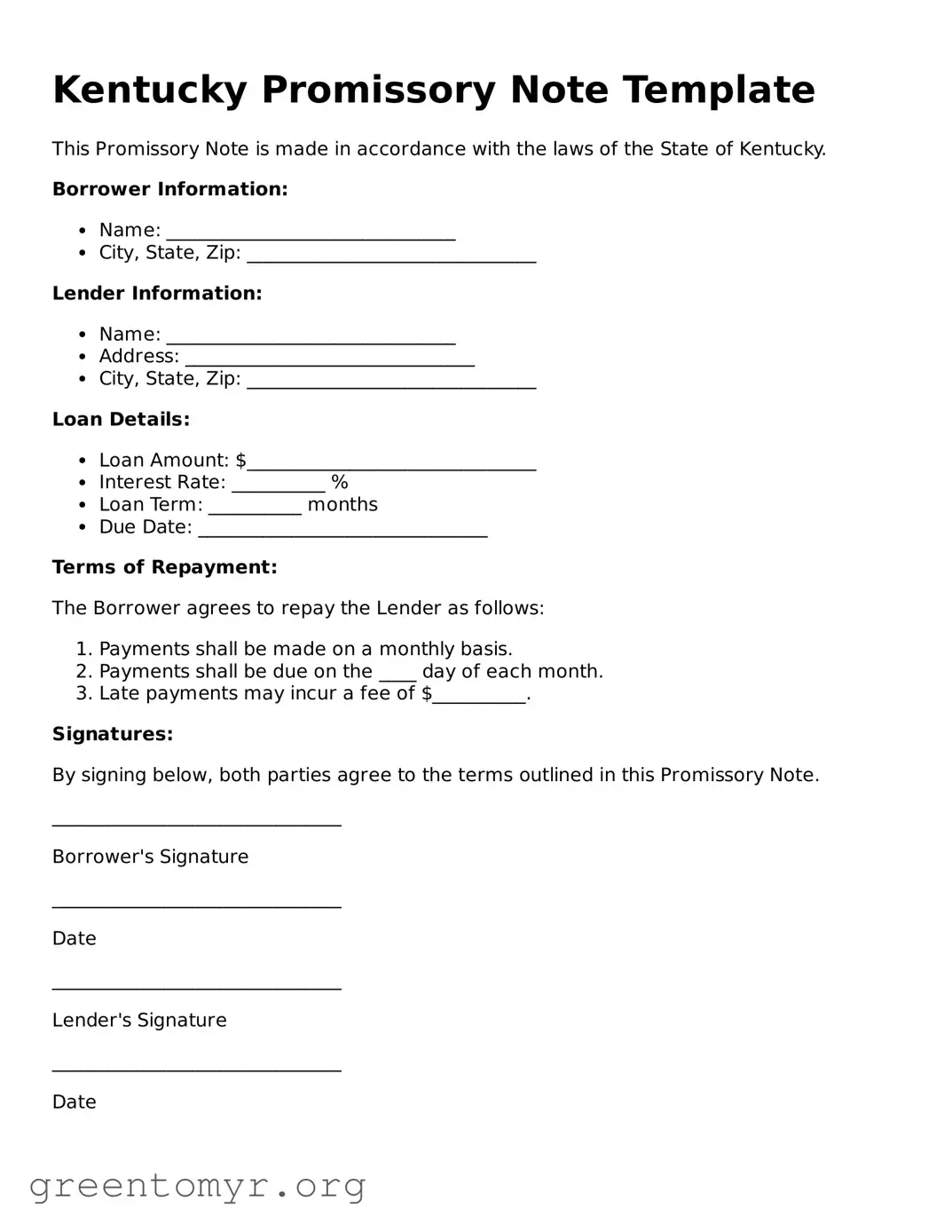
When entering into a loan agreement in Kentucky, a Promissory Note serves as a crucial document that outlines the terms of repayment between a borrower and a lender. This legal instrument is designed to provide clarity and security for both parties involved in the transaction. Typically, it includes essential details such as the loan amount, interest rate, repayment schedule, and any applicable penalties for late payments. Additionally, the Promissory Note may specify whether the loan is secured or unsecured, which can significantly impact the lender's rights in case of default. Both parties must understand their obligations, as this form not only protects the lender's investment but also helps the borrower clearly grasp their financial commitments. By using a Kentucky Promissory Note, individuals can ensure that their agreement is documented in a way that is legally enforceable, providing peace of mind as they navigate their financial responsibilities.
Kentucky Promissory Note Template
This Promissory Note is made in accordance with the laws of the State of Kentucky.
Borrower Information:
Lender Information:
Loan Details:
Terms of Repayment:
The Borrower agrees to repay the Lender as follows:
Signatures:
By signing below, both parties agree to the terms outlined in this Promissory Note.
_______________________________
Borrower's Signature
_______________________________
Date
_______________________________
Lender's Signature
_______________________________
Date
| Fact Name | Description |
|---|---|
| Definition | A Kentucky Promissory Note is a written promise to pay a specified amount of money to a designated person or entity at a specified time. |
| Governing Law | The Kentucky Promissory Note is governed by Kentucky Revised Statutes, Chapter 371. |
| Parties Involved | Typically, there are two parties: the borrower (maker) who promises to pay and the lender (payee) who receives the payment. |
| Interest Rate | The note can specify an interest rate, which must comply with Kentucky's usury laws. |
| Payment Terms | Payment terms, including the due date and payment schedule, must be clearly outlined in the note. |
| Signatures Required | For the note to be legally binding, it must be signed by the borrower. |
| Enforceability | A properly executed promissory note is enforceable in court, meaning the lender can seek legal remedies if the borrower defaults. |
| Transferability | The note can often be transferred to another party, allowing the new holder to collect the debt. |
| Secured vs. Unsecured | Promissory notes can be secured by collateral or unsecured, depending on the agreement between the parties. |
After obtaining the Kentucky Promissory Note form, it is essential to fill it out accurately. This ensures that all parties involved have a clear understanding of the terms and obligations. Following the steps below will help you complete the form correctly.
A Kentucky Promissory Note is a written agreement in which one party promises to pay a specific amount of money to another party at a designated time or on demand. This document outlines the terms of the loan, including the principal amount, interest rate, payment schedule, and any penalties for late payments. It serves as a legal record of the debt and can be enforced in a court of law if necessary.
Any individual or business can use a Kentucky Promissory Note. It is commonly used in various lending situations, such as:
Regardless of the situation, both parties should understand the terms before signing the document.
A Kentucky Promissory Note should include the following key elements:
Including these details helps prevent misunderstandings and provides clarity for both parties involved.
Yes, a Kentucky Promissory Note is legally binding as long as it meets certain requirements. Both parties must agree to the terms, and the document must be signed. In addition, the note should contain clear terms regarding the loan amount, repayment schedule, and any interest rates. If these conditions are met, the note can be enforced in a court of law if the borrower fails to repay the loan.
Yes, a Kentucky Promissory Note can be modified after it is signed, but both parties must agree to the changes. It is advisable to document any modifications in writing and have both parties sign the amended agreement. This helps ensure that all parties are aware of and agree to the new terms, which can prevent disputes in the future.
Filling out a Kentucky Promissory Note form can seem straightforward, but many people make common mistakes that can lead to complications down the line. One frequent error is not including all the necessary details. For instance, the borrower’s name, address, and the amount borrowed should be clearly stated. Omitting any of this information can create confusion and may even render the document invalid.
Another mistake involves the interest rate. It’s essential to specify whether the note carries an interest rate and, if so, to ensure it is clearly stated. Some individuals forget to mention this or write it incorrectly, which can lead to disputes later regarding how much is owed.
Additionally, people often overlook the repayment terms. The note should clearly outline how and when payments will be made. This includes specifying whether payments will be monthly, quarterly, or in a lump sum. Failing to detail these terms can lead to misunderstandings and potential legal issues.
Another common oversight is not signing the document. A promissory note is not legally binding unless it is signed by both the borrower and the lender. Some individuals mistakenly believe that simply filling out the form is sufficient, but without signatures, the note lacks enforceability.
Inaccurate dates can also cause problems. It’s important to include the correct date when the note is signed and when the loan is initiated. Errors in dating can complicate the timeline of payments and obligations, leading to disputes.
People sometimes forget to provide a clear description of the collateral, if any, backing the loan. If the loan is secured by an asset, this should be explicitly mentioned. Without this information, it may be difficult to enforce the note if the borrower defaults.
Another mistake is not including a clause for default. It’s wise to outline what happens if the borrower fails to make payments. This could include late fees or the right to accelerate the loan. Not having these terms can leave both parties unprotected.
Some individuals fail to consult state laws regarding promissory notes. While the form may seem standard, specific regulations can vary. Ignoring local laws can lead to issues with enforceability and compliance.
Lastly, many people neglect to keep copies of the signed note. Both parties should retain a copy for their records. This ensures that there is a clear reference point in case any disputes arise in the future.
When engaging in a loan agreement in Kentucky, the Promissory Note is a crucial document. However, several other forms and documents often accompany it to ensure clarity and legal protection for both parties involved. Understanding these documents can help you navigate the lending process more effectively.
Having these documents in place not only protects the interests of both the lender and borrower but also fosters a transparent lending relationship. It is essential to review and understand each document thoroughly to avoid potential disputes down the line.
When filling out the Kentucky Promissory Note form, it's important to ensure accuracy and clarity. Here are some essential dos and don'ts to keep in mind:
By following these guidelines, you can ensure that your Kentucky Promissory Note is filled out correctly and serves its intended purpose effectively.
Understanding the Kentucky Promissory Note form is essential for anyone engaging in lending or borrowing. However, several misconceptions can lead to confusion. Here are ten common misconceptions, along with clarifications to help clear up any misunderstandings.
By addressing these misconceptions, individuals can better navigate the complexities of the Kentucky Promissory Note form and make informed decisions in their lending or borrowing activities.
When filling out and using the Kentucky Promissory Note form, there are several important points to keep in mind. Here are some key takeaways: