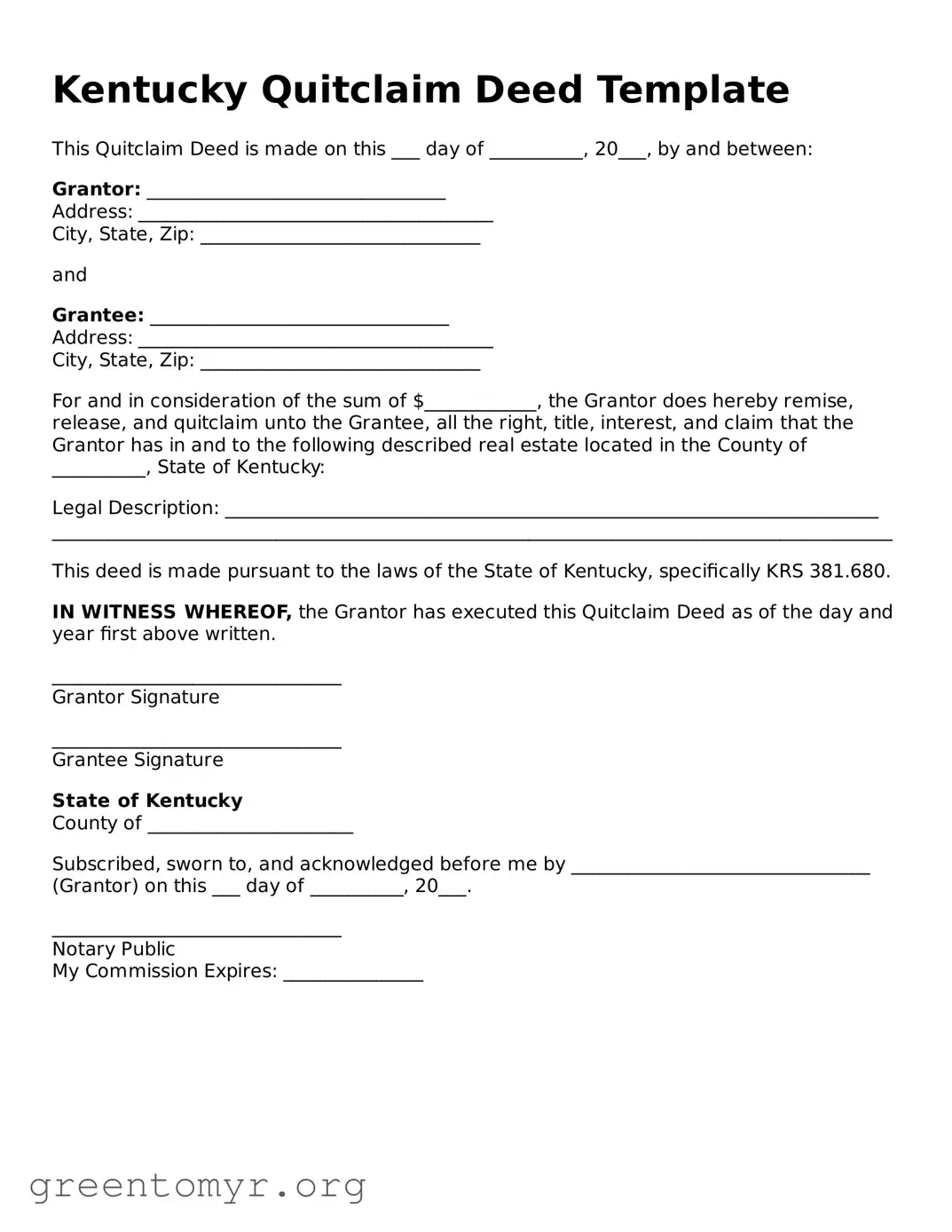
The Kentucky Quitclaim Deed form serves as a vital tool for property transfers, allowing individuals to convey their interest in real estate without making any guarantees about the title. This form is particularly useful in situations where the seller may not have complete knowledge of the property’s history or when the transfer occurs between family members or friends. By using a quitclaim deed, the grantor relinquishes any claim to the property, but the recipient receives no warranty regarding the title's validity. It's important to note that this type of deed does not clear any liens or encumbrances on the property. Instead, it simply transfers whatever interest the grantor holds, making it essential for the grantee to conduct thorough due diligence before accepting the deed. Additionally, the Kentucky Quitclaim Deed must meet specific state requirements to be legally binding, including proper execution, notarization, and recording with the county clerk. Understanding these aspects can help ensure a smooth property transfer process, safeguarding the interests of both parties involved.
Kentucky Quitclaim Deed Template
This Quitclaim Deed is made on this ___ day of __________, 20___, by and between:
Grantor: ________________________________
Address: ______________________________________
City, State, Zip: ______________________________
and
Grantee: ________________________________
Address: ______________________________________
City, State, Zip: ______________________________
For and in consideration of the sum of $____________, the Grantor does hereby remise, release, and quitclaim unto the Grantee, all the right, title, interest, and claim that the Grantor has in and to the following described real estate located in the County of __________, State of Kentucky:
Legal Description: ______________________________________________________________________
__________________________________________________________________________________________
This deed is made pursuant to the laws of the State of Kentucky, specifically KRS 381.680.
IN WITNESS WHEREOF, the Grantor has executed this Quitclaim Deed as of the day and year first above written.
_______________________________
Grantor Signature
_______________________________
Grantee Signature
State of Kentucky
County of ______________________
Subscribed, sworn to, and acknowledged before me by ________________________________ (Grantor) on this ___ day of __________, 20___.
_______________________________
Notary Public
My Commission Expires: _______________
| Fact Name | Description |
|---|---|
| Definition | A Kentucky Quitclaim Deed is a legal document used to transfer ownership of real estate without any warranties regarding the title. |
| Governing Law | The use of Quitclaim Deeds in Kentucky is governed by KRS Chapter 381. |
| Parties Involved | The deed involves two parties: the grantor (seller) and the grantee (buyer). |
| No Warranty | Unlike other deeds, a quitclaim deed provides no guarantee that the grantor has a valid title to the property. |
| Common Uses | Quitclaim deeds are often used among family members, in divorce settlements, or to clear up title issues. |
| Filing Requirements | To be effective, the deed must be signed by the grantor and notarized before being filed with the county clerk. |
| Tax Implications | While no transfer tax is usually applied, it’s important to check local regulations for any specific requirements. |
| Revocation | A quitclaim deed cannot be revoked once it has been executed and recorded. |
| Limitations | It is not advisable to use a quitclaim deed for property sales involving third parties, as it lacks the protections of a warranty deed. |
| Legal Assistance | Consulting with a legal professional is recommended to ensure that all aspects of the deed are handled correctly. |
Once you have the Kentucky Quitclaim Deed form in hand, it's time to fill it out carefully. This document will require specific information about the property and the parties involved. Make sure you have all necessary details at your fingertips to ensure a smooth process.
A Kentucky Quitclaim Deed is a legal document used to transfer ownership of real estate from one party to another. Unlike a warranty deed, a quitclaim deed does not guarantee that the person transferring the property has clear title to it. Instead, it simply conveys whatever interest the grantor has in the property, if any. This type of deed is often used in situations where the parties know each other, such as between family members or in divorce settlements.
There are several situations where a quitclaim deed may be the appropriate choice:
It's important to note that a quitclaim deed does not protect the grantee from any claims against the property, so it should be used with caution.
Completing a quitclaim deed in Kentucky involves several steps:
Yes, there can be tax implications when using a quitclaim deed. While transferring property via a quitclaim deed does not automatically trigger a tax event, it is essential to consider the following:
Consulting with a tax professional or attorney can help clarify any potential tax consequences related to the quitclaim deed.
Filling out a Kentucky Quitclaim Deed form can seem straightforward, but many people make common mistakes that can lead to complications. One frequent error is failing to include the correct legal description of the property. This description must be precise and should match what is recorded in the county clerk’s office. An incorrect or vague description can create confusion and lead to disputes later.
Another mistake is neglecting to include the names of all parties involved. Both the grantor (the person transferring the property) and the grantee (the person receiving the property) must be clearly identified. Omitting a name can invalidate the deed or complicate the transfer process.
People often forget to sign the deed. A Quitclaim Deed must be signed by the grantor to be valid. Without a signature, the document holds no legal weight, and the transfer of property will not occur.
Additionally, many individuals overlook the need for notarization. In Kentucky, a Quitclaim Deed must be notarized to be legally effective. Failing to have the deed notarized can result in rejection by the county clerk’s office.
Using the wrong date is another common error. The date on the Quitclaim Deed should reflect the actual date of signing. An incorrect date can create issues with property records and may lead to complications in the future.
People sometimes misinterpret the implications of a Quitclaim Deed. This type of deed transfers whatever interest the grantor has in the property but does not guarantee that the title is clear. It’s important to understand that the grantee may inherit any existing liens or claims against the property.
Another mistake is not checking for existing liens. Before executing a Quitclaim Deed, it’s wise to conduct a title search. This ensures that the property is free of liens or encumbrances that could affect ownership.
Some individuals fail to keep copies of the completed deed. After filing the Quitclaim Deed with the county clerk, it’s essential to retain a copy for personal records. This documentation can be crucial for future reference or in case of disputes.
Finally, people often underestimate the importance of consulting a legal professional. While it’s possible to fill out a Quitclaim Deed without assistance, seeking advice from an attorney can help avoid mistakes and ensure that the transfer is executed correctly.
A Quitclaim Deed is a legal document used to transfer ownership of real estate from one party to another without guaranteeing that the title is clear. While the Quitclaim Deed itself is essential for this process, several other forms and documents are often utilized in conjunction with it to ensure a smooth transaction. Below is a list of common documents that may accompany a Quitclaim Deed in Kentucky.
Utilizing these documents alongside the Quitclaim Deed can help clarify the terms of the property transfer and protect the interests of both parties. Proper documentation is crucial in real estate transactions to ensure legal compliance and minimize potential disputes.
A Quitclaim Deed is a legal document used to transfer ownership of real estate from one person to another. While it has its unique features, several other documents serve similar purposes in property transfer and ownership rights. Below is a list of nine documents that share similarities with the Quitclaim Deed:
Each of these documents plays a role in property transactions and ownership, reflecting various needs and circumstances in real estate law.
When filling out the Kentucky Quitclaim Deed form, it is important to follow certain guidelines to ensure accuracy and legality. Below are six essential do's and don'ts to consider:
When dealing with property transfers, the Kentucky Quitclaim Deed form often comes with several misconceptions. Understanding these can help clarify its purpose and limitations. Here are five common misconceptions:
Many believe that a quitclaim deed transfers ownership of the property without any issues. However, it only conveys whatever interest the grantor has at the time of the transfer. If the grantor has no ownership, the recipient receives nothing.
Some people think that using a quitclaim deed guarantees title insurance. In reality, it does not provide any warranty or guarantee regarding the property's title. Buyers should always seek title insurance separately for protection.
While quitclaim deeds are commonly used among family members, they are not limited to these situations. They can be used for any transfer of property interests, including between friends or business partners.
Many think that once a quitclaim deed is signed, it cannot be changed. However, the grantor can revoke the deed or create a new one, provided they follow the proper legal procedures.
Some individuals assume that a quitclaim deed removes all liabilities associated with the property. This is not true. Any existing liens or debts tied to the property may still affect the new owner.
Understanding these misconceptions can help individuals make informed decisions when using a Kentucky Quitclaim Deed. Always consider consulting a legal professional for personalized advice.
When dealing with the Kentucky Quitclaim Deed form, it is important to understand several key aspects to ensure proper completion and use. Below are essential takeaways:
By following these guidelines, individuals can navigate the quitclaim deed process more effectively and avoid potential pitfalls.