Content Navigation

In Kentucky, dealing with the estate of a loved one can feel overwhelming, especially during a time of grief. The Kentucky Small Estate Affidavit form offers a streamlined process for settling estates that fall below a certain value. This form allows individuals to bypass the lengthy probate process, making it easier to transfer assets. To qualify, the total value of the estate must be under a specific threshold, which can change, so it’s essential to check the current limits. This affidavit is typically used by heirs or beneficiaries to claim property, such as bank accounts or personal belongings, without needing formal probate proceedings. By filling out this form, you can assert your right to the deceased's assets, provided you meet the necessary requirements. Understanding how to properly complete and file this form can save time and reduce stress during a challenging period.

Kentucky Small Estate Affidavit Example

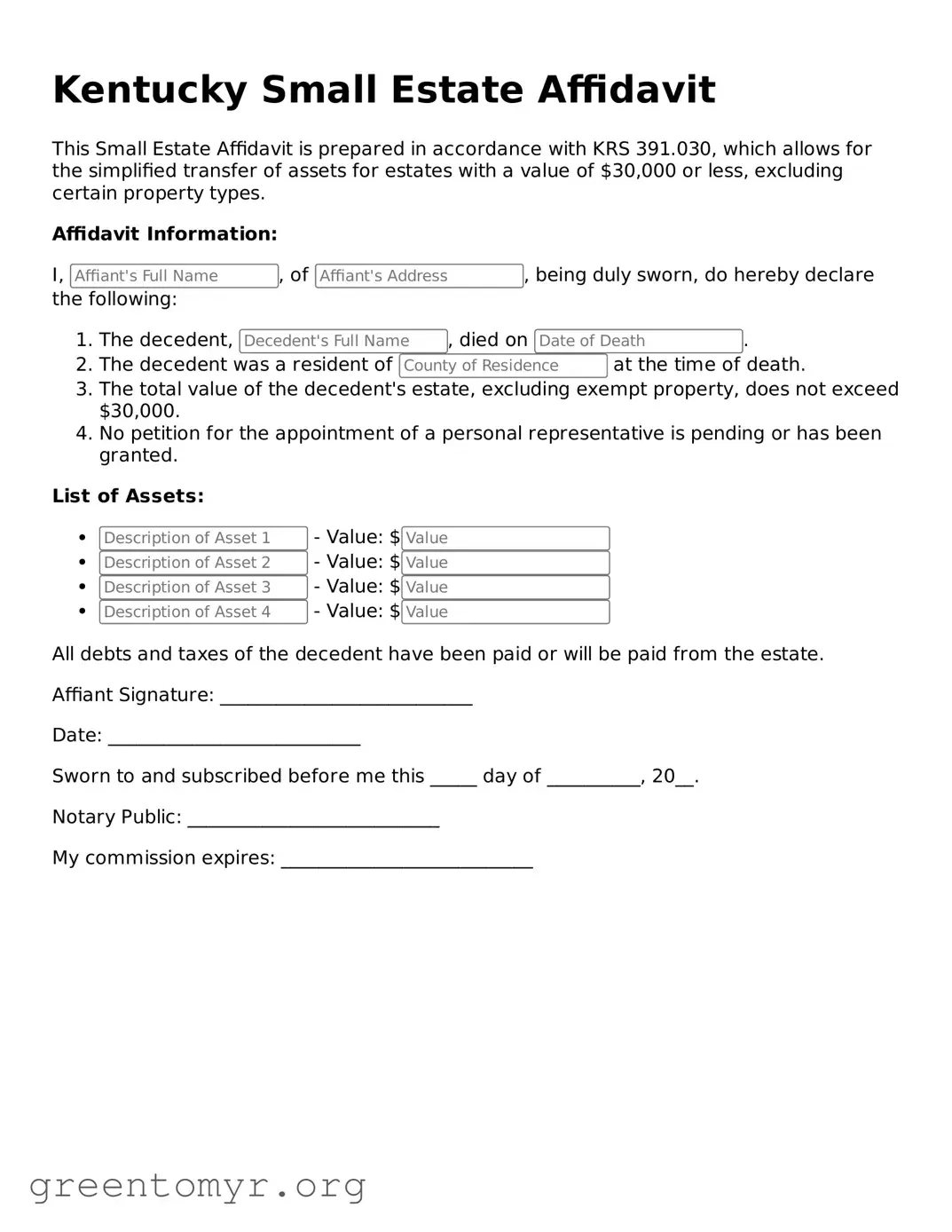
Kentucky Small Estate Affidavit

This Small Estate Affidavit is prepared in accordance with KRS 391.030, which allows for the simplified transfer of assets for estates with a value of $30,000 or less, excluding certain property types.

Affidavit Information:

I, , of , being duly sworn, do hereby declare the following:

  1. The decedent, , died on .
  2. The decedent was a resident of at the time of death.
  3. The total value of the decedent's estate, excluding exempt property, does not exceed $30,000.
  4. No petition for the appointment of a personal representative is pending or has been granted.

List of Assets:

  • - Value: $
  • - Value: $
  • - Value: $
  • - Value: $

All debts and taxes of the decedent have been paid or will be paid from the estate.

Affiant Signature: ___________________________

Date: ___________________________

Sworn to and subscribed before me this _____ day of __________, 20__.

Notary Public: ___________________________

My commission expires: ___________________________

PDF Form Features

Fact Name Details
Purpose The Kentucky Small Estate Affidavit allows heirs to claim property of a deceased person without going through a full probate process.
Eligibility To use this form, the total value of the estate must be $30,000 or less, excluding certain exempt assets.
Governing Law The Small Estate Affidavit is governed by Kentucky Revised Statutes (KRS) § 391.030.
Heir Requirements Only heirs or beneficiaries named in the will can use this affidavit to claim the estate's assets.
Filing Process The affidavit must be filed with the county clerk in the county where the deceased resided.
Asset Types Common assets that can be claimed include bank accounts, personal property, and certain vehicles.
Signature Requirement The affidavit must be signed by the heirs, affirming that they are entitled to the assets listed.
Exemptions Some assets, like life insurance proceeds and retirement accounts, may not be included in the estate's total value.
Time Limit There is no strict time limit for filing the Small Estate Affidavit, but it is advisable to do so promptly after death.

Guide to Using Kentucky Small Estate Affidavit

Filling out the Kentucky Small Estate Affidavit form is an important step in managing the estate of a deceased person. Once you have completed the form, you will submit it to the appropriate court to begin the process of settling the estate.

  1. Obtain the Kentucky Small Estate Affidavit form. You can find it online or at your local courthouse.
  2. Fill in the decedent's full name and date of death at the top of the form.
  3. Provide your full name and address as the affiant, the person making the affidavit.
  4. List the names and addresses of all heirs or beneficiaries entitled to the estate.
  5. Detail the assets of the estate, including real estate, bank accounts, and personal property.
  6. Indicate the total value of the estate's assets. Make sure this amount is under the Kentucky Small Estate limit.
  7. Sign and date the affidavit in front of a notary public. The notary will verify your identity and witness your signature.
  8. Make copies of the completed affidavit for your records and for the heirs.
  9. File the original affidavit with the appropriate court in the county where the decedent lived.

Get Answers on Kentucky Small Estate Affidavit

What is a Kentucky Small Estate Affidavit?

The Kentucky Small Estate Affidavit is a legal document that allows individuals to settle the estate of a deceased person without going through the full probate process. This form is particularly useful for smaller estates, typically those valued under a certain threshold, which is currently set at $30,000 for personal property and $60,000 for real property. By using this affidavit, heirs can claim assets directly from banks, financial institutions, and other entities without the need for a lengthy court procedure.

Who can use the Small Estate Affidavit?

Generally, the Small Estate Affidavit can be utilized by the surviving spouse, children, or other legal heirs of the deceased. However, there are specific eligibility requirements that must be met:

  • The total value of the estate must fall below the established limits.
  • The deceased must have been a resident of Kentucky at the time of death.
  • At least 30 days must have passed since the death.
  • No probate proceedings should have been initiated for the estate.

It’s essential for users to ensure that they meet these criteria before proceeding with the affidavit.

How do I complete the Small Estate Affidavit?

Completing the Small Estate Affidavit involves several steps:

  1. Gather necessary information, including the deceased’s full name, date of death, and a list of assets.
  2. Obtain the Small Estate Affidavit form, which can be found online or through local court offices.
  3. Fill out the form accurately, providing all required details about the estate and its heirs.
  4. Sign the affidavit in the presence of a notary public to ensure its validity.
  5. Submit the completed affidavit to the appropriate institutions, such as banks or property offices, to claim the assets.

Attention to detail is crucial, as any errors or omissions could delay the process or lead to complications.

What happens after I submit the Small Estate Affidavit?

After submitting the Small Estate Affidavit, the institutions holding the deceased’s assets will review the document. They may require additional information or documentation to verify the claims. Once everything is confirmed, the assets will be transferred to the heirs as specified in the affidavit. It is important to keep copies of all submitted documents for personal records. If any issues arise during this process, it may be beneficial to consult with a legal professional to ensure compliance with Kentucky laws.

Common mistakes

Filling out the Kentucky Small Estate Affidavit form can be a straightforward process, but many individuals make common mistakes that can lead to delays or complications. One frequent error is failing to accurately identify the decedent. It is crucial to provide the full legal name of the deceased, along with their date of birth and date of death. Omitting or misspelling any of this information can result in the affidavit being rejected.

Another mistake often encountered is not including all necessary assets. The Small Estate Affidavit allows for the transfer of certain assets without going through probate, but individuals sometimes overlook items such as bank accounts, personal property, or real estate. It is important to list all assets that fall within the estate’s value limit to ensure a smooth process.

People frequently forget to sign the affidavit in the appropriate places. Signatures must be provided by the affiant, who is typically a close relative of the deceased. Additionally, the affidavit may require notarization. Neglecting to have the document notarized can render it invalid, causing further delays in asset distribution.

Providing incorrect information about the heirs can also lead to issues. The affidavit requires a clear declaration of all heirs, including their names and relationships to the decedent. If someone is left out or inaccurately described, it could result in disputes among family members or legal challenges down the line.

Finally, individuals often overlook the requirement to attach supporting documents. The Small Estate Affidavit should be accompanied by a copy of the decedent's death certificate and any other relevant documents that verify the estate's value and the identity of the heirs. Failing to include these documents can lead to rejection of the affidavit, prolonging the process of settling the estate.

Documents used along the form

The Kentucky Small Estate Affidavit is a valuable tool for settling the estates of deceased individuals with limited assets. However, it is often accompanied by other important forms and documents that facilitate the process. Below is a list of these documents, each serving a specific purpose in the estate administration process.

  • Death Certificate: This official document confirms the death of the individual and is necessary for initiating the estate settlement process.
  • Will: If available, the deceased's last will and testament outlines their wishes regarding asset distribution and may impact the use of the Small Estate Affidavit.
  • Affidavit of Heirship: This document is used to establish the heirs of the deceased when no will exists, providing a clear chain of inheritance.
  • Inventory of Assets: A detailed list of the deceased's assets, this inventory helps clarify what is included in the small estate and supports the affidavit's claims.
  • Creditor Claims: Any claims from creditors must be documented to ensure that debts are settled before distributing assets to heirs.
  • Tax Returns: The deceased's final tax returns may need to be filed or reviewed to ensure compliance with tax obligations during the estate settlement process.
  • Notice to Creditors: This formal notice informs creditors of the estate's opening and provides them an opportunity to present any claims against the estate.

Using these documents in conjunction with the Kentucky Small Estate Affidavit can streamline the process of estate administration. It is crucial to ensure that all paperwork is accurate and complete to avoid delays and complications in settling the estate.

Similar forms

  • Will: A will outlines how a person's assets should be distributed after their death. Like the Small Estate Affidavit, it serves to transfer property, but a will typically requires probate, while a Small Estate Affidavit can simplify the process for smaller estates.
  • Probate Petition: A probate petition initiates the legal process to validate a will and distribute assets. Similar to the Small Estate Affidavit, it addresses asset distribution but is often more complex and time-consuming.
  • Trust: A trust allows a person to manage their assets during their lifetime and after death. Both a trust and a Small Estate Affidavit facilitate the transfer of property, but a trust often provides more control and can avoid probate altogether.
  • Letters Testamentary: These documents grant an executor the authority to manage a deceased person's estate. Like the Small Estate Affidavit, they help in the distribution of assets, but Letters Testamentary are issued after probate is opened.
  • Affidavit of Heirship: This document establishes the heirs of a deceased person when no will exists. Similar to the Small Estate Affidavit, it helps in transferring assets, but it is specifically used to identify heirs rather than simplify the estate process.

Dos and Don'ts

When filling out the Kentucky Small Estate Affidavit form, it is crucial to follow certain guidelines to ensure a smooth process. Here are five things you should and shouldn't do:

  • Do ensure that you meet the eligibility requirements for using the Small Estate Affidavit.
  • Do provide accurate information about the deceased and their assets.
  • Do have all necessary documents ready, such as the death certificate and any relevant financial statements.
  • Don't forget to sign the affidavit in the presence of a notary public.
  • Don't attempt to use the Small Estate Affidavit if the estate exceeds the specified value limit.

Misconceptions

The Kentucky Small Estate Affidavit is a useful tool for settling the estates of individuals who have passed away, but several misconceptions surround its use. Here are six common misconceptions:

  • Only wealthy individuals can use the Small Estate Affidavit. Many people believe that this affidavit is only for estates with significant assets. In reality, it can be used for estates valued at less than $30,000, making it accessible for a wide range of individuals.
  • The Small Estate Affidavit is the same as a will. Some people confuse the Small Estate Affidavit with a will. While both documents are related to estate matters, a will is a legal document that outlines how a person's assets should be distributed upon their death, whereas the Small Estate Affidavit is a simplified process for transferring assets without going through probate.
  • All debts must be paid before using the Small Estate Affidavit. It is a common belief that all outstanding debts must be settled before utilizing the Small Estate Affidavit. However, the affidavit allows for the transfer of assets even if there are debts, but it does not absolve the estate of its obligations.
  • The Small Estate Affidavit can only be used by immediate family members. While immediate family members often use this affidavit, it is not limited to them. Any individual who has an interest in the estate may file the affidavit, provided they meet the necessary requirements.
  • The process is complicated and time-consuming. Many individuals think that filing a Small Estate Affidavit involves a lengthy and complex process. In fact, it is designed to be straightforward and can often be completed without the need for legal representation.
  • The Small Estate Affidavit is not legally binding. Some people assume that the Small Estate Affidavit lacks legal weight. This is incorrect; when properly executed, it is a legally binding document that facilitates the transfer of assets.

Understanding these misconceptions can help individuals navigate the process more effectively and utilize the Small Estate Affidavit to settle estates in Kentucky.

Key takeaways

When dealing with the Kentucky Small Estate Affidavit form, it is essential to understand the key points to ensure a smooth process. Below are some important takeaways to consider.

  • The Small Estate Affidavit is designed for estates with a total value of $30,000 or less, excluding certain assets.
  • All heirs must agree to use the Small Estate Affidavit; their signatures are required on the form.
  • Gather all necessary information, including the decedent's details, asset descriptions, and the names of the heirs.
  • File the completed affidavit with the appropriate county court to initiate the process of transferring assets.
  • Once approved, the affidavit serves as a legal document that allows heirs to claim the decedent's assets without going through probate.
  • It is advisable to keep copies of the filed affidavit and any supporting documents for future reference.