In Kentucky, individuals seeking a straightforward way to transfer property upon their death can utilize the Transfer-on-Death (TOD) Deed form. This legal instrument allows property owners to designate one or more beneficiaries who will automatically receive ownership of the property without the need for probate. By completing and recording this deed, property owners can maintain full control during their lifetime, while ensuring a smooth transition of ownership after their passing. The form requires specific information, including the names of the property owner and beneficiaries, a legal description of the property, and the signatures of the parties involved. Importantly, the TOD Deed can be revoked or modified at any time before the owner’s death, providing flexibility and peace of mind. Understanding the nuances of this form is essential for anyone looking to simplify their estate planning process and secure their assets for loved ones in Kentucky.
Kentucky Transfer-on-Death Deed Template
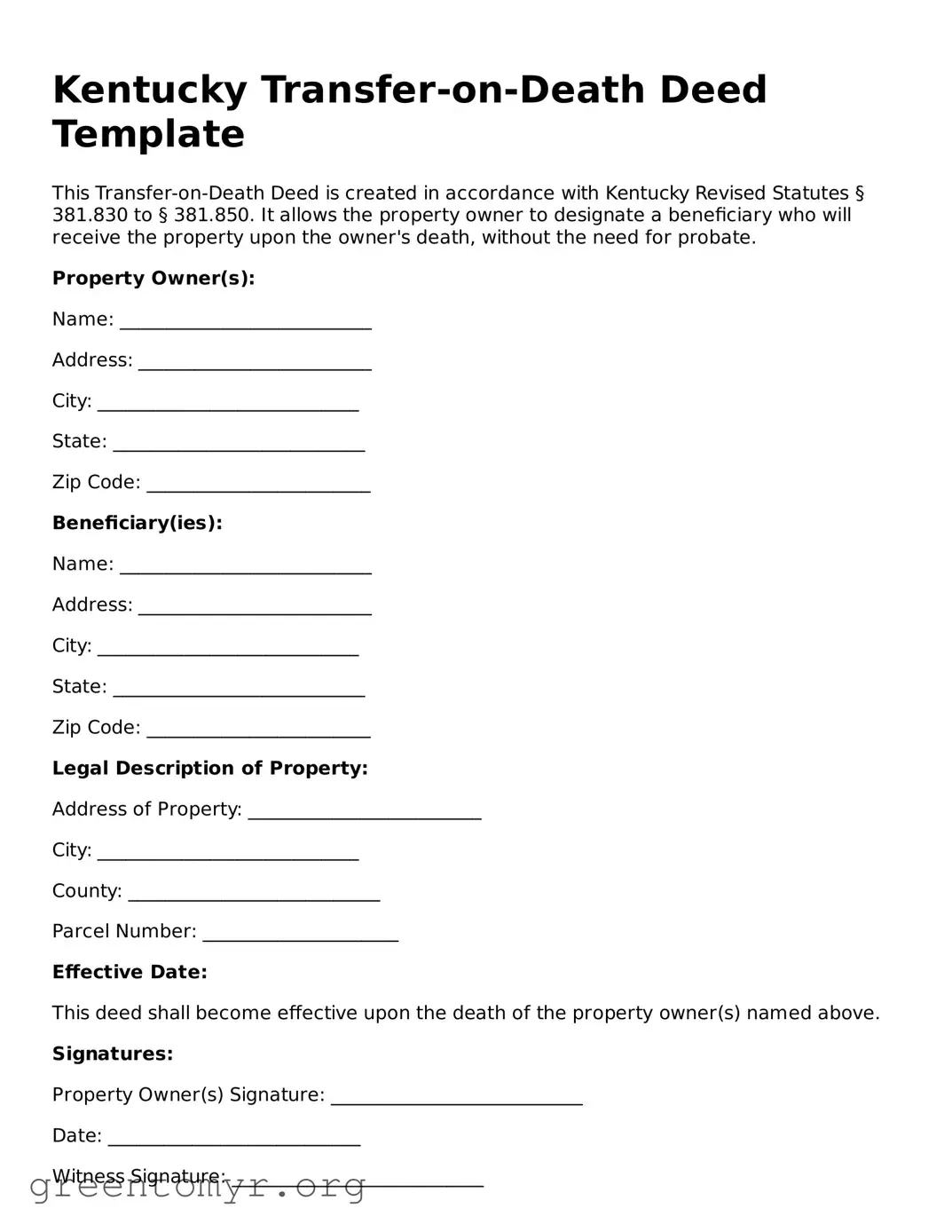
This Transfer-on-Death Deed is created in accordance with Kentucky Revised Statutes § 381.830 to § 381.850. It allows the property owner to designate a beneficiary who will receive the property upon the owner's death, without the need for probate.
Property Owner(s):
Name: ___________________________
Address: _________________________
City: ____________________________
State: ___________________________
Zip Code: ________________________
Beneficiary(ies):
Name: ___________________________
Address: _________________________
City: ____________________________
State: ___________________________
Zip Code: ________________________
Legal Description of Property:
Address of Property: _________________________
City: ____________________________
County: ___________________________
Parcel Number: _____________________
Effective Date:
This deed shall become effective upon the death of the property owner(s) named above.
Signatures:
Property Owner(s) Signature: ___________________________
Date: ___________________________
Witness Signature: ___________________________
Date: ___________________________
Notary Public Signature: ___________________________
Date: ___________________________
Important Notes:
By signing this document, the property owner(s) affirm that they understand the implications of this Transfer-on-Death Deed.
| Fact Name | Description |
|---|---|
| Definition | A Transfer-on-Death Deed (TOD) allows property owners in Kentucky to transfer real estate to beneficiaries upon their death without going through probate. |
| Governing Law | The Kentucky Transfer-on-Death Deed is governed by KRS 381.830 to 381.850. |
| Eligibility | Any individual who owns real property in Kentucky can create a TOD deed, provided they are of sound mind. |
| Beneficiaries | Property owners can name one or more beneficiaries in the deed, allowing for flexible estate planning. |
| Revocability | The deed can be revoked or changed by the property owner at any time before their death, offering control over the transfer process. |
| Execution Requirements | The TOD deed must be signed by the property owner and notarized to be valid in Kentucky. |
| Filing | To be effective, the deed must be recorded in the county where the property is located before the owner's death. |
| Tax Implications | There are no immediate tax consequences for the transfer of property via a TOD deed; taxes may apply upon the beneficiary's sale of the property. |
| Limitations | Transfer-on-Death Deeds cannot be used for all types of property, such as jointly owned property or property subject to a mortgage. |
| Advantages | Using a TOD deed can simplify the transfer process, avoid probate, and maintain privacy regarding the estate's distribution. |
Filling out the Kentucky Transfer-on-Death Deed form is a crucial step in ensuring that your property is passed on to your chosen beneficiaries without going through probate. Once completed, the form must be filed with the appropriate county clerk's office to be legally effective. Follow these steps carefully to ensure accuracy.
A Transfer-on-Death Deed (TODD) in Kentucky allows an individual to transfer real property to a designated beneficiary upon their death. This deed enables property owners to pass their assets without the need for probate, simplifying the transfer process for heirs.
Any individual who owns real property in Kentucky can create a Transfer-on-Death Deed. The property owner must be of legal age and mentally competent at the time of signing the deed. There are no restrictions on the type of property that can be transferred using this deed.
To complete a Transfer-on-Death Deed, follow these steps:
While it is not legally required to notify the beneficiary about the Transfer-on-Death Deed, it is advisable to do so. Informing the beneficiary can help avoid confusion and ensure that they are aware of their inheritance plans.
Yes, a Transfer-on-Death Deed can be changed or revoked at any time before the property owner's death. To revoke the deed, the property owner must execute a new deed that explicitly states the revocation or record a formal revocation document with the county clerk's office.
Generally, there are no immediate tax implications for the property owner when creating a Transfer-on-Death Deed. However, the beneficiary may be subject to property taxes once the transfer occurs. It is advisable to consult a tax professional for specific guidance based on individual circumstances.
If the designated beneficiary dies before the property owner, the Transfer-on-Death Deed typically becomes void. The property owner can then choose to designate a new beneficiary or allow the property to pass according to their will or Kentucky intestacy laws.
While it is not legally required to seek assistance, consulting with a legal professional can be beneficial. An attorney can provide guidance on the process, ensure that the deed is properly executed, and help avoid potential issues in the future.
Filling out the Kentucky Transfer-on-Death Deed form can be a straightforward process, but mistakes can easily occur. One common error is failing to include all required information. The form asks for specific details about the property and the beneficiaries. Missing even a small piece of information can lead to delays or complications in the transfer process. It's crucial to double-check that all fields are filled out completely and accurately.
Another frequent mistake is not properly identifying the property. The deed must clearly describe the property being transferred, including its legal description. Relying solely on a street address can lead to confusion or disputes. To avoid this issue, ensure that the legal description is accurate and matches the property records. This step is essential for a smooth transfer.
People often overlook the need for signatures. Both the property owner and a witness must sign the deed for it to be valid. Skipping this step can render the document ineffective. It’s advisable to have a notary public present during the signing process. This adds an extra layer of validation and can prevent potential challenges in the future.
In addition, some individuals forget to record the deed after completing it. Simply filling out the form does not complete the process. The deed must be filed with the appropriate county clerk’s office where the property is located. Failing to do this can lead to confusion about the property’s ownership, especially after the owner's death. Recording the deed ensures that it is part of the public record.
Lastly, misunderstanding the implications of the Transfer-on-Death Deed can lead to significant issues. This type of deed allows property to pass directly to the beneficiaries without going through probate, but it is essential to understand how this affects the overall estate plan. Consulting with a legal professional can provide clarity and ensure that this decision aligns with broader estate planning goals.
The Kentucky Transfer-on-Death Deed is a valuable tool for individuals looking to transfer property upon their death without going through probate. However, several other forms and documents may be necessary to ensure a smooth transfer process. Below is a list of commonly used documents that complement the Transfer-on-Death Deed.
Utilizing these documents alongside the Kentucky Transfer-on-Death Deed can facilitate a more efficient transfer process and help avoid potential legal complications. It is advisable to consult with a legal professional to ensure all necessary forms are completed accurately and in accordance with state laws.
The Transfer-on-Death Deed (TOD) form allows individuals to transfer property to a beneficiary upon their death without going through probate. Several other documents serve similar purposes in estate planning. Here are four documents that share similarities with the TOD deed:
When filling out the Kentucky Transfer-on-Death Deed form, it's essential to follow specific guidelines to ensure the process goes smoothly. Here are nine important dos and don'ts to keep in mind:
The Kentucky Transfer-on-Death Deed (TODD) form is a useful estate planning tool, but several misconceptions often arise regarding its use and implications. Below is a list of common misunderstandings.
This is incorrect. The transfer does not occur until the owner passes away. Until that time, the owner retains full control over the property.
Not all properties are eligible. The TODD is typically limited to real estate and does not apply to personal property or financial accounts.
This is a misconception. While a TODD can simplify the transfer of specific properties, it does not replace the need for a comprehensive estate plan, including a will.
In reality, the property owner can revoke or modify the TODD at any time before their death, as long as they follow the proper procedures.
While a TODD can help avoid probate for the property it covers, other assets may still require probate, depending on how they are titled or designated.
The property will transfer to the named beneficiaries as specified in the TODD. If multiple beneficiaries are listed, it is essential to clarify how shares will be divided.
This is not true. The TODD can be advantageous for anyone who wishes to simplify the transfer of property and ensure it goes to specific individuals without the complications of probate.
Filling out and using the Kentucky Transfer-on-Death Deed form can be straightforward if you keep these key points in mind: