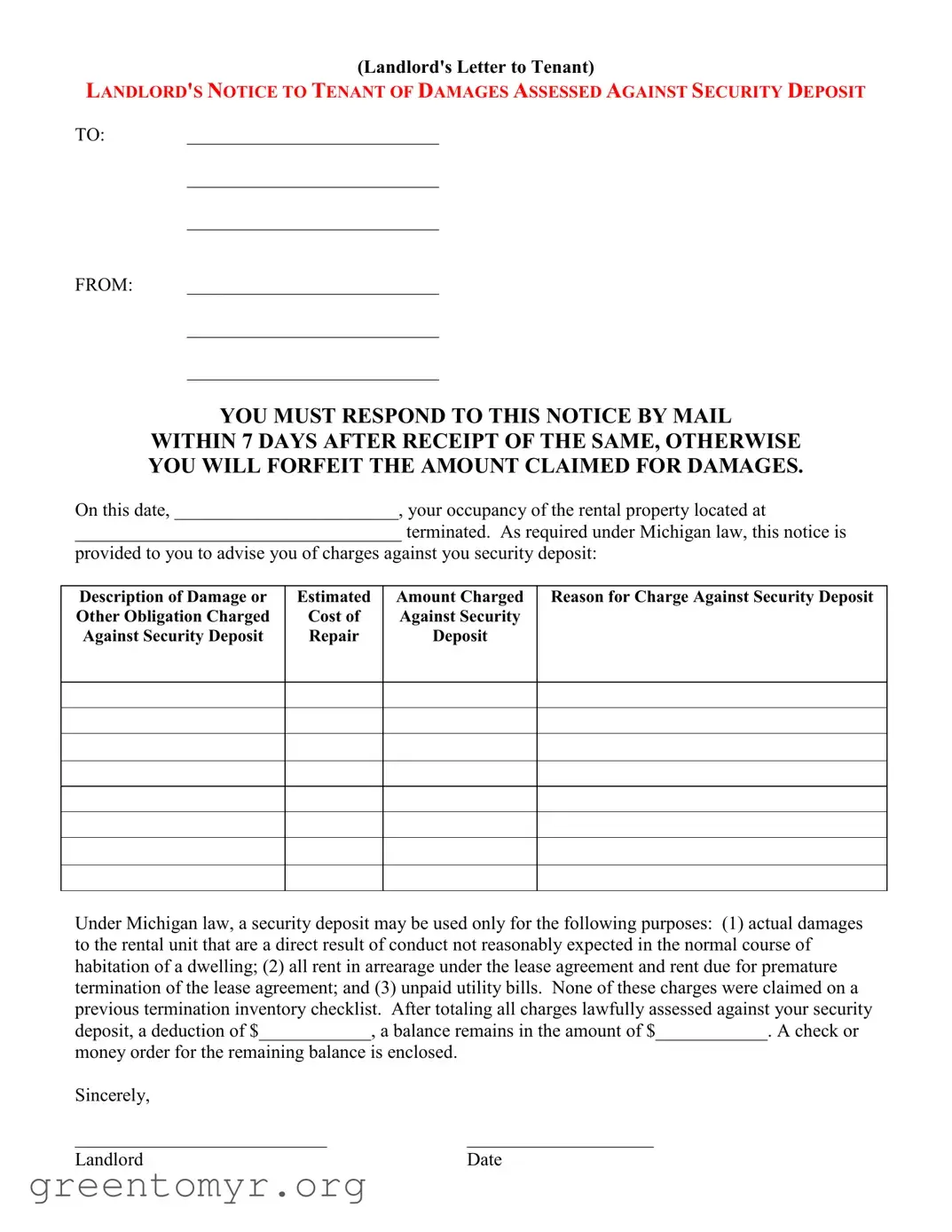
When a tenant moves out of a rental property, the transition can be a stressful time for both parties involved. One critical aspect of this process is the Landlord Damages Letter form, which serves as a formal notice to tenants regarding any deductions from their security deposit. This document outlines the specific damages assessed, providing a clear description of each issue along with the estimated costs associated with repairs. It is crucial for tenants to understand that they have a limited timeframe—just seven days—to respond to this notice. Failure to do so may result in the forfeiture of the claimed amount for damages. Under Michigan law, the use of a security deposit is strictly regulated, allowing deductions only for actual damages, unpaid rent, and unpaid utility bills. The letter also emphasizes that these charges must not have been previously claimed on a termination inventory checklist. By clearly presenting the charges and the remaining balance of the security deposit, this form ensures transparency and helps facilitate a smoother resolution for both landlords and tenants.

(Landlord's Letter to Tenant)
LANDLORD'S NOTICE TO TENANT OF DAMAGES ASSESSED AGAINST SECURITY DEPOSIT
TO: ___________________________
___________________________
___________________________
FROM: ___________________________
___________________________
___________________________
YOU MUST RESPOND TO THIS NOTICE BY MAIL
WITHIN 7 DAYS AFTER RECEIPT OF THE SAME, OTHERWISE YOU WILL FORFEIT THE AMOUNT CLAIMED FOR DAMAGES.
On this date, ________________________, your occupancy of the rental property located at
___________________________________ terminated. As required under Michigan law, this notice is
provided to you to advise you of charges against you security deposit:
Description of Damage or |
Estimated |
Amount Charged |
Reason for Charge Against Security Deposit |
Other Obligation Charged |
Cost of |
Against Security |
|
Against Security Deposit |
Repair |
Deposit |
|
|
|
|
|
|
|
|
|
|
|
|
|
|
|
|
|
|
|
|
|
|
|
|
|
|
|
|
|
|
|
|
|
|
|
|
|
Under Michigan law, a security deposit may be used only for the following purposes: (1) actual damages to the rental unit that are a direct result of conduct not reasonably expected in the normal course of habitation of a dwelling; (2) all rent in arrearage under the lease agreement and rent due for premature termination of the lease agreement; and (3) unpaid utility bills. None of these charges were claimed on a previous termination inventory checklist. After totaling all charges lawfully assessed against your security deposit, a deduction of $____________, a balance remains in the amount of $____________. A check or
money order for the remaining balance is enclosed.
Sincerely, |
|
___________________________ |
____________________ |
Landlord |
Date |
| Fact Name | Description |
|---|---|
| Purpose | The Landlord Damages Letter informs the tenant of damages assessed against their security deposit. |
| Response Time | The tenant must respond by mail within 7 days of receiving the notice. |
| Legal Requirement | This notice is required under Michigan law to inform tenants of charges against their security deposit. |
| Termination Date | The letter specifies the date on which the tenant's occupancy of the rental property terminated. |
| Damage Description | The form includes a section for detailing the description of damage and the estimated amount charged. |
| Allowed Charges | Charges against the security deposit may include actual damages, unpaid rent, and unpaid utility bills. |
| Previous Charges | No charges may be claimed that were listed on a previous termination inventory checklist. |
| Balance Calculation | The letter states the total charges assessed and the remaining balance of the security deposit. |
| Enclosure | A check or money order for the remaining balance is enclosed with the letter. |
After you have the Landlord Damages Letter form, you will need to fill it out carefully to ensure all necessary information is included. This form is important for communicating any damages assessed against a security deposit. Follow the steps below to complete the form accurately.
Once you have filled out the form, make sure to send it to the tenant by mail. They will need to respond within seven days to avoid forfeiting the amount claimed for damages.
A Landlord Damages Letter is a formal communication from a landlord to a tenant. It informs the tenant of any damages assessed against their security deposit after the termination of their lease. The letter outlines the specific damages, the costs associated, and any remaining balance of the security deposit.
This letter is crucial for both landlords and tenants. It serves as a legal notice that details the financial responsibilities of the tenant concerning damages. For tenants, it provides an opportunity to respond to the charges within a specified timeframe. For landlords, it helps ensure compliance with state laws regarding security deposits.
The letter includes the following information:
A tenant must respond to the Landlord Damages Letter within 7 days of receiving it. Failure to respond within this timeframe may result in the forfeiture of the amount claimed for damages.
If a tenant disagrees with the charges, they should respond in writing, clearly stating their objections. This response should be sent by mail within the 7-day period. It is advisable to keep a copy of the response for personal records.
No, landlords cannot charge tenants for normal wear and tear. Michigan law allows deductions only for damages that exceed what would be expected from ordinary use of the property. This distinction is important for both parties to understand.
If a tenant does not receive the Landlord Damages Letter after their lease has ended, they should contact their landlord for clarification. It is the landlord's responsibility to send this notice, and tenants have the right to inquire about any potential charges against their security deposit.
The enclosed check or money order represents the remaining balance of the tenant's security deposit after deductions for damages. This amount is returned to the tenant, provided that all charges are lawfully assessed and documented.
Yes, landlords must comply with Michigan law when sending a Landlord Damages Letter. This includes providing a detailed account of damages and allowing tenants the opportunity to respond within the specified timeframe.
Tenants should be aware that their security deposit can be used for specific purposes, such as covering unpaid rent, utility bills, and actual damages beyond normal wear and tear. Understanding these provisions helps tenants protect their rights and manage their expectations regarding their security deposit.
Filling out the Landlord Damages Letter form can be a straightforward process, but many people make common mistakes that can lead to confusion or disputes. Understanding these pitfalls can help ensure the letter is completed correctly and effectively.
One frequent mistake is failing to provide complete and accurate information. Landlords often overlook the importance of including the tenant's full name and address, as well as their own. Incomplete details can lead to delays in communication or even disputes about whether the notice was received. Always double-check that all fields are filled out completely before sending the letter.
Another common error is not specifying the damages clearly. The form requires a description of the damage and the estimated cost associated with it. Landlords sometimes use vague language or fail to provide sufficient details. This lack of clarity can confuse tenants and make it difficult for them to understand the charges against their security deposit. Clear, specific descriptions help avoid misunderstandings and facilitate a smoother resolution.
Additionally, many landlords neglect to adhere to the required timeline for sending the notice. The form states that tenants must respond within seven days of receiving the notice. If landlords send the letter late or do not keep track of when it was sent, they risk losing their right to claim damages. Keeping accurate records of when the letter is sent and ensuring it is mailed promptly is crucial.
Lastly, landlords often forget to include the final balance of the security deposit after deductions. The form specifies that a total amount should be calculated, showing what was deducted and what remains. Omitting this information can lead to confusion and disputes over the amount owed. Including a clear breakdown of charges helps to maintain transparency and trust between landlords and tenants.
When dealing with landlord-tenant disputes, various forms and documents may accompany the Landlord Damages Letter. Each document serves a specific purpose in ensuring clarity and compliance with legal requirements. Here is a list of common forms used in conjunction with the Landlord Damages Letter:
These documents collectively help establish a clear understanding of the responsibilities and obligations of both parties. Proper documentation is essential for resolving disputes effectively and ensuring compliance with applicable laws.
The Landlord Damages Letter form is similar to several other documents related to tenant-landlord relationships. Here’s how they compare:
When filling out the Landlord Damages Letter form, there are several important actions to consider. Below is a list of what you should and shouldn't do:
Understanding the Landlord Damages Letter form is essential for both landlords and tenants. However, several misconceptions can lead to confusion. Here are four common misunderstandings:
This is not true. Landlords can only charge for actual damages that are directly related to the tenant's actions. Charges must be reasonable and justified according to Michigan law.
In fact, tenants must respond within 7 days of receiving the notice. Failing to do so may result in forfeiting the amount claimed for damages.
This is incorrect. A security deposit can only be used for specific purposes, such as actual damages, unpaid rent, or unpaid utility bills. Other charges are not permissible.
Landlords are required to provide a detailed breakdown of damages and charges against the security deposit. This ensures transparency and allows tenants to understand what they are being charged for.
When filling out and using the Landlord Damages Letter form, it is essential to follow specific guidelines to ensure clarity and compliance. Here are key takeaways:
By adhering to these guidelines, landlords can effectively communicate the necessary information to tenants, fostering transparency and compliance.