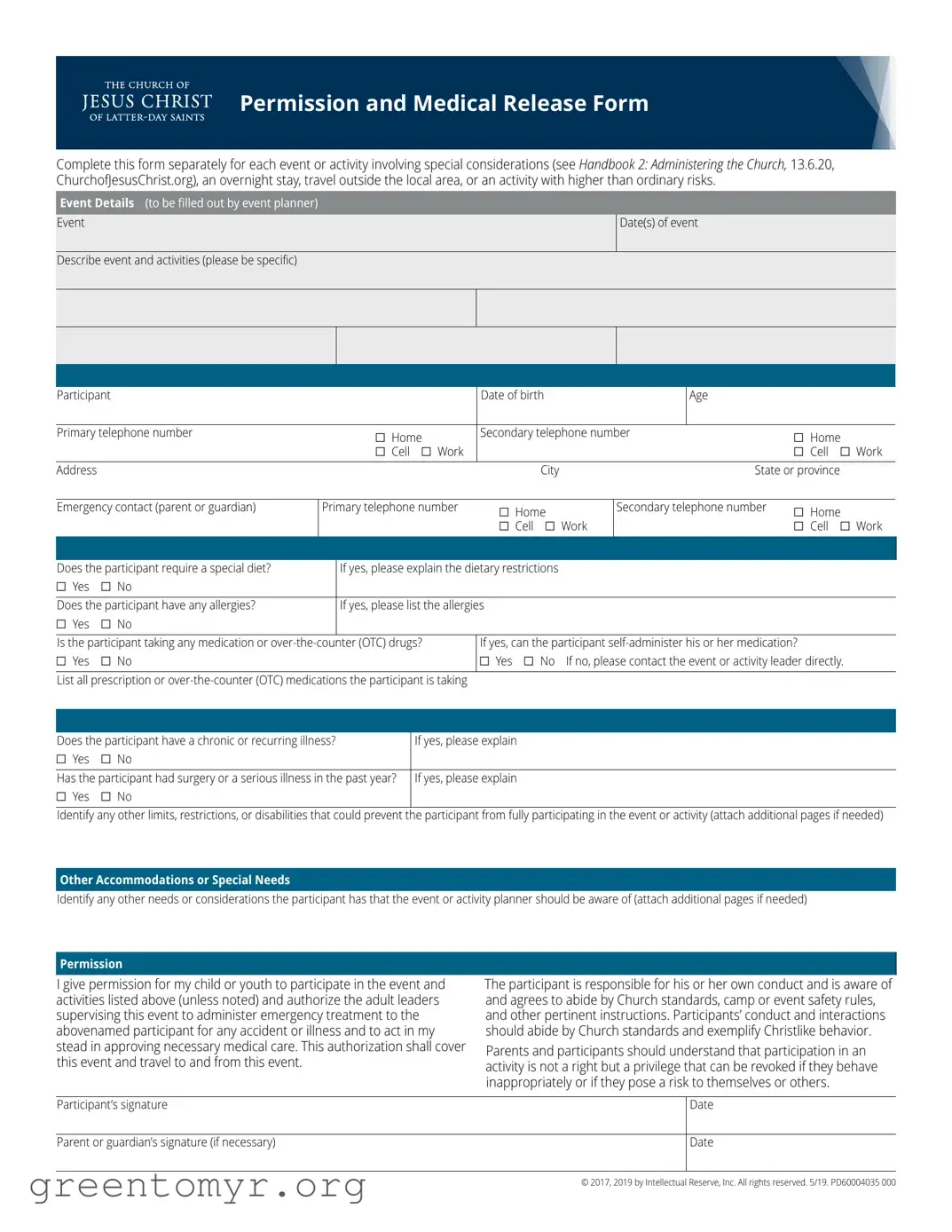
When planning events within the Church of Jesus Christ of Latter-day Saints, ensuring the safety and well-being of all participants is paramount. The LDS Permission and Medical Release Form serves as a crucial tool for event organizers, providing a structured way to gather essential information about participants. This form must be completed for each event that involves special considerations, such as overnight stays, travel outside the local area, or activities that carry higher-than-average risks. Key sections of the form include details about the event, participant information, and any medical or dietary needs that may affect participation. Parents or guardians must grant permission for minors to attend, while also authorizing adult leaders to administer emergency medical treatment if necessary. By outlining expectations for behavior and adherence to Church standards, this form not only facilitates a smooth event but also fosters a safe and respectful environment for all involved.

THE CHURCH OF |
|
Permission and Medical Release Form |
I |
OF |
|
||
JESUS CHRIST |
|
|
|
l
Complete this form separately for each event or activity involving special considerations (see Handbook 2: Administering the Church, 13.6.20, ChurchofJesusChrist.org), an overnight stay, travel outside the local area, or an activity with higher than ordinary risks.
Event Details (to be filled out by event planner) |
|
|
|
|
|
|
|
|
Event |
|
|
|
|
Date(s) of event |
|
|
|
|
|
|
|
|
|
|
|
|
Describe event and activities (please be specific) |
|
|
|
|
|
|
|
|
|
|
|
|
|
|
|
|
|
Ward |
|
|
|
Stake |
|
|
|
|
|
|
|
|
|
|
|
|
|
Event or activity leader |
|
Event or activity leader’s phone number |
Event or activity leader’s email |
|
|
|||
|
|
|
|
|
|
|
|
|
|
|
|
|
|
|
|
|
|
Participant |
|
|
|
Date of birth |
|
Age |
|
|
|
|
|
|
|
|
|
|
|
Primary telephone number |
|
□ Home |
Secondary telephone number |
|
□ Home |
|
||
|
|
□ Cell □ Work |
|
|
|
□ Cell □ Work |
|
|
Address |
|
|
|
City |
|
State or province |
|
|
|
|
|
|
|
|
|
|
|
Emergency contact (parent or guardian) |
Primary telephone number |
□ Home |
Secondary telephone number |
□ Home |
|
|||
|
|
|
|
□ Cell □ Work |
|
|
□ Cell □ Work |
|
|
|
|
|
|
|
|
|
|
Does the participant require a special diet? |
|
If yes, please explain the dietary restrictions |
|
|
|
|
||
□ Yes □ No |
|
|
|
|
|
|
|
|
Does the participant have any allergies? |
|
If yes, please list the allergies |
|
|
|
|
||
□ Yes □ No |
|
|
|
|
|
|
|
|
Is the participant taking any medication or |
If yes, can the participant |
|
||||||
□ Yes □ No |
|
|
|
□ Yes □ No If no, please contact the event or activity leader directly. |
|
|||
List all prescription or |
|
|
|
|
|
|||
|
|
|
|
|
|
|
||
|
|
|
|
|
|
|
||
Does the participant have a chronic or recurring illness? |
|
If yes, please explain |
|
|
|
|
||
□ Yes □ No |
|
|
|
|
|
|
|
|
Has the participant had surgery or a serious illness in the past year? |
If yes, please explain |
|
|
|
|
|||
□ Yes □ No |
|
|
|
|
|
|
|
|
Identify any other limits, restrictions, or disabilities that could prevent the participant from fully participating in the event or activity (attach additional pages if needed) |
|
|||||||
Other Accommodations or Special Needs
Identify any other needs or considerations the participant has that the event or activity planner should be aware of (attach additional pages if needed)
Permission
I give permission for my child or youth to participate in the event and activities listed above (unless noted) and authorize the adult leaders supervising this event to administer emergency treatment to the abovenamed participant for any accident or illness and to act in my stead in approving necessary medical care. This authorization shall cover this event and travel to and from this event.
The participant is responsible for his or her own conduct and is aware of and agrees to abide by Church standards, camp or event safety rules, and other pertinent instructions. Participants’ conduct and interactions should abide by Church standards and exemplify Christlike behavior. Parents and participants should understand that participation in an activity is not a right but a privilege that can be revoked if they behave inappropriately or if they pose a risk to themselves or others.
Participant’s signature
Parent or guardian’s signature (if necessary)
Date
Date
© 2017, 2019 by Intellectual Reserve, Inc. All rights reserved. 5/19. PD60004035 000
| Fact Name | Details |
|---|---|
| Purpose | This form is used to obtain permission and medical release for participants in events organized by the Church of Jesus Christ of Latter-day Saints. |
| Event Specificity | Each form must be completed separately for each event or activity, especially those involving special considerations. |
| Emergency Contact | The form requires an emergency contact, usually a parent or guardian, to ensure safety during the event. |
| Dietary Restrictions | Participants can indicate any special dietary needs, which helps organizers accommodate them appropriately. |
| Allergies | Participants must disclose any allergies, ensuring that leaders are aware of potential health risks. |
| Medication Disclosure | The form asks if participants are taking any medications, allowing for proper management during the event. |
| Chronic Illness | Participants are prompted to disclose chronic illnesses, which helps in planning for any necessary accommodations. |
| Conduct Expectations | The form emphasizes that participation is a privilege, and adherence to Church standards is required. |
| Signature Requirement | Both the participant and, if necessary, the parent or guardian must sign the form to validate permission. |
| Governing Law | The form is subject to state laws regarding medical consent and liability, which can vary by location. |
Filling out the LDS Permission Form is straightforward. This form is necessary for events that may involve special considerations, such as overnight stays or activities with higher risks. Once you have completed the form, it will be submitted to the event planner for review and processing.
The LDS Permission Form is a document that allows parents or guardians to grant permission for their children or youth to participate in church-related events and activities. It includes important medical and emergency information to ensure the safety and well-being of participants.
This form should be completed for each event or activity that involves special considerations. This includes:
Make sure to fill it out separately for each event to ensure that all details are accurate and current.
The form requires various details, including:
Providing accurate information is crucial for the safety of all participants.
No, the form must be completed separately for each child or youth participating in the event. This ensures that each participant's specific needs and circumstances are addressed appropriately.
If your child has special dietary needs or allergies, it's essential to indicate this on the form. You should provide detailed information about any restrictions or allergies to ensure that appropriate accommodations can be made during the event.
By signing the form, you authorize the adult leaders supervising the event to administer emergency treatment if necessary. This includes acting on your behalf to approve any required medical care. It's important to ensure that the event leaders have the necessary information to handle emergencies effectively.
Participants are expected to abide by Church standards and follow camp or event safety rules. Their conduct should exemplify Christlike behavior. It's important to understand that participation is a privilege, and inappropriate behavior can lead to revocation of that privilege.
Once you have completed the form, you should submit it to the event or activity leader. They will ensure that all necessary information is collected and that your child is properly registered for the event.
While specific deadlines may vary by event, it is advisable to submit the form as early as possible. This allows event planners to make necessary arrangements based on the information provided. Always check with the event leader for any specific deadlines.
Filling out the LDS Permission Form correctly is crucial for ensuring a smooth experience during events. One common mistake is not providing complete contact information. Participants often leave out essential details like the secondary telephone number or email address for the event leader. This omission can lead to difficulties in communication, especially in emergencies.
Another frequent error is neglecting to disclose medical conditions or dietary restrictions. Participants may assume that minor allergies or dietary needs are not significant enough to mention. However, failing to provide this information can result in inadequate care during the event, potentially putting the participant's health at risk.
Some individuals also forget to sign the form or provide the necessary signatures from parents or guardians. This oversight can delay participation and may even prevent a child from attending the event altogether. It is important to double-check that all required signatures are present before submitting the form.
Lastly, not reviewing the entire form for accuracy can lead to misunderstandings. Participants may misinterpret questions or provide incorrect information about medications or health conditions. Taking the time to carefully read and verify all entries can help avoid complications and ensure that the participant's needs are met effectively.
When planning events or activities within the Church of Jesus Christ of Latter-day Saints, various forms and documents are essential to ensure safety and compliance. Among these, the LDS Permission and Medical Release Form stands out as a critical tool. However, several other forms often accompany it, each serving a unique purpose to facilitate a smooth and secure experience for participants.
In summary, these forms work in tandem with the LDS Permission and Medical Release Form to create a comprehensive framework for safe and enjoyable participation in church activities. By utilizing these documents, event leaders can better manage health, safety, and behavior expectations, ultimately fostering a positive environment for all involved.
The LDS Permission and Medical Release Form shares similarities with several other documents commonly used for events involving minors or individuals requiring special considerations. Here are nine documents that are similar, along with explanations of how they relate to the LDS form:
When filling out the LDS Permission form, keep the following tips in mind to ensure a smooth process:
When it comes to the LDS Permission Form, several misconceptions can lead to confusion. Understanding the facts can help ensure that participants and their guardians are well-informed. Here are seven common misconceptions:
By clarifying these misconceptions, participants and their guardians can approach the LDS Permission Form with confidence and understanding, ensuring a smooth experience during events.
When filling out and using the LDS Permission and Medical Release Form, consider the following key takeaways: