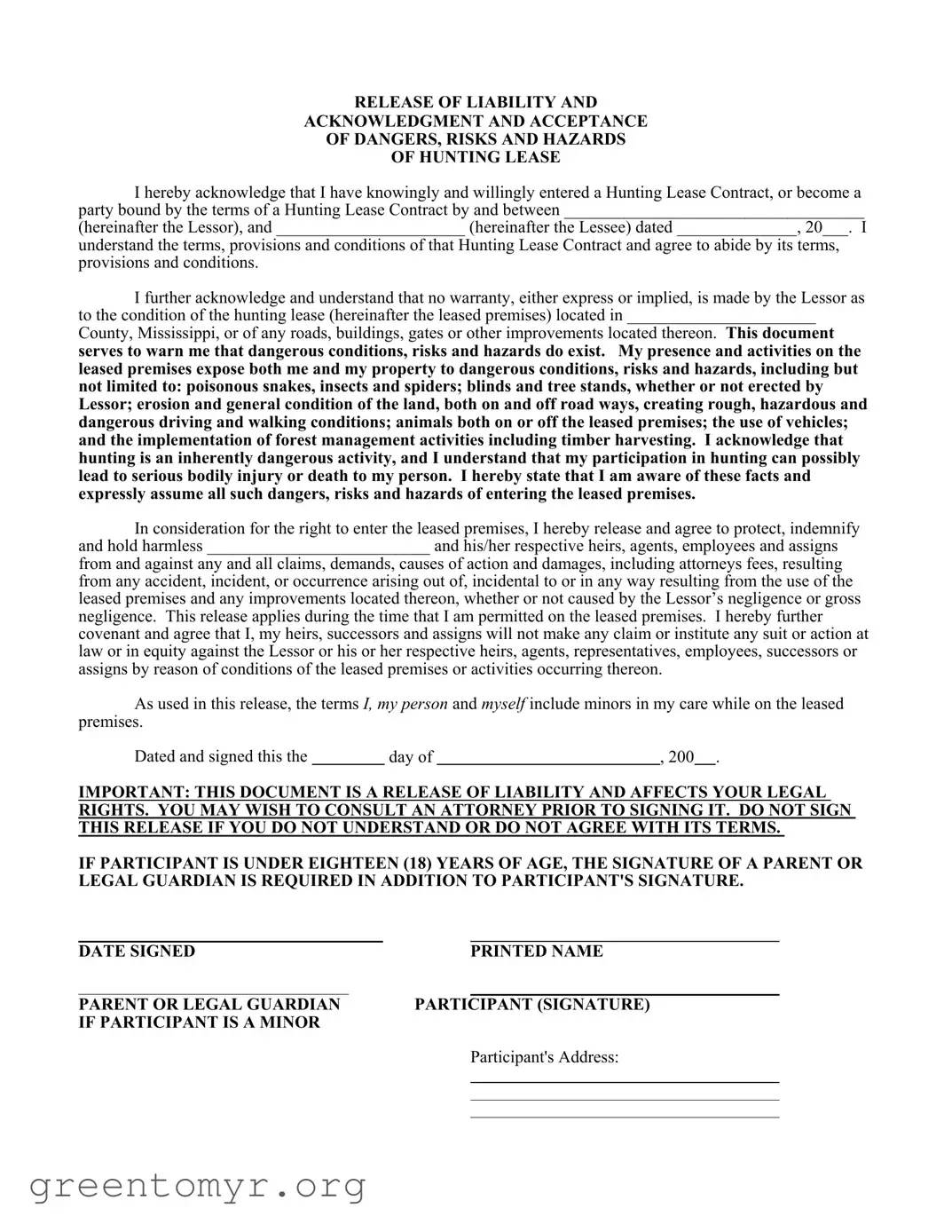
When venturing into the great outdoors for a hunting expedition, safety and awareness of potential risks are paramount. The Liability Hunting form serves as a crucial document that outlines the responsibilities and risks associated with engaging in hunting activities on leased land. This form is not just a mere formality; it emphasizes the importance of understanding the inherent dangers involved in hunting. By signing this document, individuals acknowledge their acceptance of the terms of the Hunting Lease Contract, which details the agreement between the landowner (the Lessor) and the hunter (the Lessee). It is essential to recognize that the Lessor does not guarantee the safety of the leased premises, which may include various hazards such as rough terrain, wildlife encounters, and potential structural dangers. The form explicitly states that hunting can lead to serious injuries or even fatalities, urging participants to be fully aware of these risks. Furthermore, it includes a release of liability clause, protecting the Lessor from any claims or damages that may arise during the hunting activities. This document not only safeguards the interests of the landowner but also encourages hunters to take personal responsibility for their safety and the safety of those they bring along. Understanding the implications of this form is vital for anyone looking to enjoy a hunting lease responsibly.

RELEASE OF LIABILITY AND
ACKNOWLEDGMENT AND ACCEPTANCE
OF DANGERS, RISKS AND HAZARDS
OF HUNTING LEASE
I hereby acknowledge that I have knowingly and willingly entered a Hunting Lease Contract, or become a party bound by the terms of a Hunting Lease Contract by and between ___________________________________
(hereinafter the Lessor), and ______________________ (hereinafter the Lessee) dated ______________, 20___. I
understand the terms, provisions and conditions of that Hunting Lease Contract and agree to abide by its terms, provisions and conditions.
I further acknowledge and understand that no warranty, either express or implied, is made by the Lessor as to the condition of the hunting lease (hereinafter the leased premises) located in ______________________
County, Mississippi, or of any roads, buildings, gates or other improvements located thereon. This document serves to warn me that dangerous conditions, risks and hazards do exist. My presence and activities on the leased premises expose both me and my property to dangerous conditions, risks and hazards, including but not limited to: poisonous snakes, insects and spiders; blinds and tree stands, whether or not erected by Lessor; erosion and general condition of the land, both on and off road ways, creating rough, hazardous and dangerous driving and walking conditions; animals both on or off the leased premises; the use of vehicles; and the implementation of forest management activities including timber harvesting. I acknowledge that hunting is an inherently dangerous activity, and I understand that my participation in hunting can possibly lead to serious bodily injury or death to my person. I hereby state that I am aware of these facts and expressly assume all such dangers, risks and hazards of entering the leased premises.
In consideration for the right to enter the leased premises, I hereby release and agree to protect, indemnify and hold harmless __________________________ and his/her respective heirs, agents, employees and assigns
from and against any and all claims, demands, causes of action and damages, including attorneys fees, resulting from any accident, incident, or occurrence arising out of, incidental to or in any way resulting from the use of the leased premises and any improvements located thereon, whether or not caused by the Lessor’s negligence or gross negligence. This release applies during the time that I am permitted on the leased premises. I hereby further covenant and agree that I, my heirs, successors and assigns will not make any claim or institute any suit or action at law or in equity against the Lessor or his or her respective heirs, agents, representatives, employees, successors or assigns by reason of conditions of the leased premises or activities occurring thereon.
As used in this release, the terms I, my person and myself include minors in my care while on the leased premises.
Dated and signed this the |
|
day of |
|
, 200 . |
||
|
|
|
|
|
|
|
IMPORTANT: THIS DOCUMENT IS A RELEASE OF LIABILITY AND AFFECTS YOUR LEGAL RIGHTS. YOU MAY WISH TO CONSULT AN ATTORNEY PRIOR TO SIGNING IT. DO NOT SIGN THIS RELEASE IF YOU DO NOT UNDERSTAND OR DO NOT AGREE WITH ITS TERMS.
IF PARTICIPANT IS UNDER EIGHTEEN (18) YEARS OF AGE, THE SIGNATURE OF A PARENT OR LEGAL GUARDIAN IS REQUIRED IN ADDITION TO PARTICIPANT'S SIGNATURE.
DATE SIGNED |
|
PRINTED NAME |
|
|
|
PARENT OR LEGAL GUARDIAN |
PARTICIPANT (SIGNATURE) |
|
IF PARTICIPANT IS A MINOR |
|
|
|
|
Participant's Address: |
|
|
|
|
|
|
|
|
|
| Fact Name | Description |
|---|---|
| Purpose | This form serves as a release of liability for individuals participating in hunting activities on a leased property. |
| Informed Consent | By signing, participants acknowledge their understanding of the risks associated with hunting, including potential injury or death. |
| Indemnification | Participants agree to protect and hold harmless the lessor and their representatives from any claims arising from the use of the leased premises. |
| Governing Law | This form is governed by the laws of Mississippi, which dictate the enforceability of liability waivers. |
| Minor Participation | If a participant is under 18 years of age, a parent or legal guardian must also sign the form to provide consent. |
| Risks Acknowledged | Participants must recognize various hazards, including wildlife, terrain conditions, and potential vehicle accidents. |
| Legal Rights | This document affects legal rights, and individuals are encouraged to consult an attorney before signing. |
Filling out the Liability Hunting form is an important step in ensuring that all parties understand the risks associated with hunting on a leased property. This form requires specific information to be filled out accurately to protect both the Lessor and the Lessee. Below are the steps to complete the form correctly.
The Liability Hunting form is designed to inform participants about the inherent risks associated with hunting and to protect the lessor from legal claims. By signing this form, individuals acknowledge that they understand these risks and agree to release the lessor from liability for any injuries or damages that may occur while they are on the leased premises. This document serves as a legal agreement between the lessor and the lessee, outlining responsibilities and expectations.
The form outlines several risks that hunters may encounter, including:
By acknowledging these risks, participants are made aware of the dangers involved in hunting and the conditions they may face while on the property.
To release and indemnify the lessor means that the participant agrees not to hold the lessor responsible for any accidents or injuries that may occur while on the leased premises. This includes incidents that could arise from the lessor's negligence. By signing the form, the participant accepts full responsibility for their actions and agrees to protect the lessor from any legal claims that may arise as a result of their presence or activities on the property.
Yes, minors can participate in hunting activities on the leased premises. However, the form requires the signature of a parent or legal guardian in addition to the minor's signature. This ensures that the adult understands the risks involved and consents to the minor's participation. It is crucial for guardians to read and comprehend the terms of the form before signing, as it affects the legal rights of both the minor and the guardian.
If you do not understand the terms of the Liability Hunting form, it is strongly recommended that you consult with an attorney before signing. This document is a legal release that can significantly impact your rights and responsibilities. Taking the time to clarify any uncertainties can help ensure that you are fully informed about what you are agreeing to and the potential consequences of your participation in hunting activities.
Filling out the Liability Hunting form requires attention to detail. One common mistake is failing to complete all required fields. This includes not only the names of the Lessor and Lessee but also the date of the contract. Leaving any section blank can lead to confusion and potential legal issues later.
Another frequent error is misunderstanding the implications of the release of liability. Many individuals may not fully grasp that by signing this document, they are waiving their right to sue the Lessor for injuries sustained on the property. It is crucial to read and understand the entire document before signing.
People often overlook the importance of listing accurate contact information. Providing incorrect addresses or phone numbers can hinder communication in case of an emergency or legal matter. Ensure that all contact details are up to date and accurate.
Many signers forget to include the signature of a parent or legal guardian if the participant is under eighteen years old. This is a mandatory requirement. Without this signature, the form may be considered invalid.
Some individuals neglect to date the form properly. The date is essential as it marks the beginning of the agreement and can affect the legal standing of the document. Be sure to fill in the date clearly and correctly.
Another mistake is failing to acknowledge the inherent risks associated with hunting. The form emphasizes that hunting is dangerous. Acknowledging this risk is vital to understanding the purpose of the release. Ignoring this aspect can lead to misunderstandings about the responsibilities involved.
Individuals may also misinterpret the terms of indemnification. This section outlines that the signer agrees to protect the Lessor from any claims resulting from accidents on the leased premises. Misunderstanding this clause can lead to unexpected liabilities.
Some people rush through the form without reading the fine print. Important warnings and conditions are often included in smaller text. Taking the time to read every part of the document can prevent future complications.
Lastly, failing to keep a copy of the signed form is a common oversight. After signing, it is advisable to retain a copy for personal records. This can be useful for reference in case of any disputes or questions regarding the agreement.
When engaging in hunting activities, it is essential to have a variety of documents in place to ensure safety and legal compliance. Along with the Liability Hunting form, several other forms and documents are commonly used. Each serves a specific purpose in protecting both the lessor and lessee involved in the hunting lease. Below is a list of these important documents.
Having these documents in place not only helps protect the rights of all parties involved but also enhances safety and accountability during hunting activities. It is always advisable to review these forms carefully and seek legal counsel if there are any uncertainties before signing.
When filling out the Liability Hunting form, there are important things to keep in mind. Here’s a list of what you should and shouldn’t do:
Misconceptions about the Liability Hunting form can lead to misunderstandings about rights and responsibilities. Here are nine common misconceptions explained:
Understanding these misconceptions can help individuals make informed decisions when entering into a Hunting Lease Contract.
Here are some important points to consider when filling out and using the Liability Hunting form: