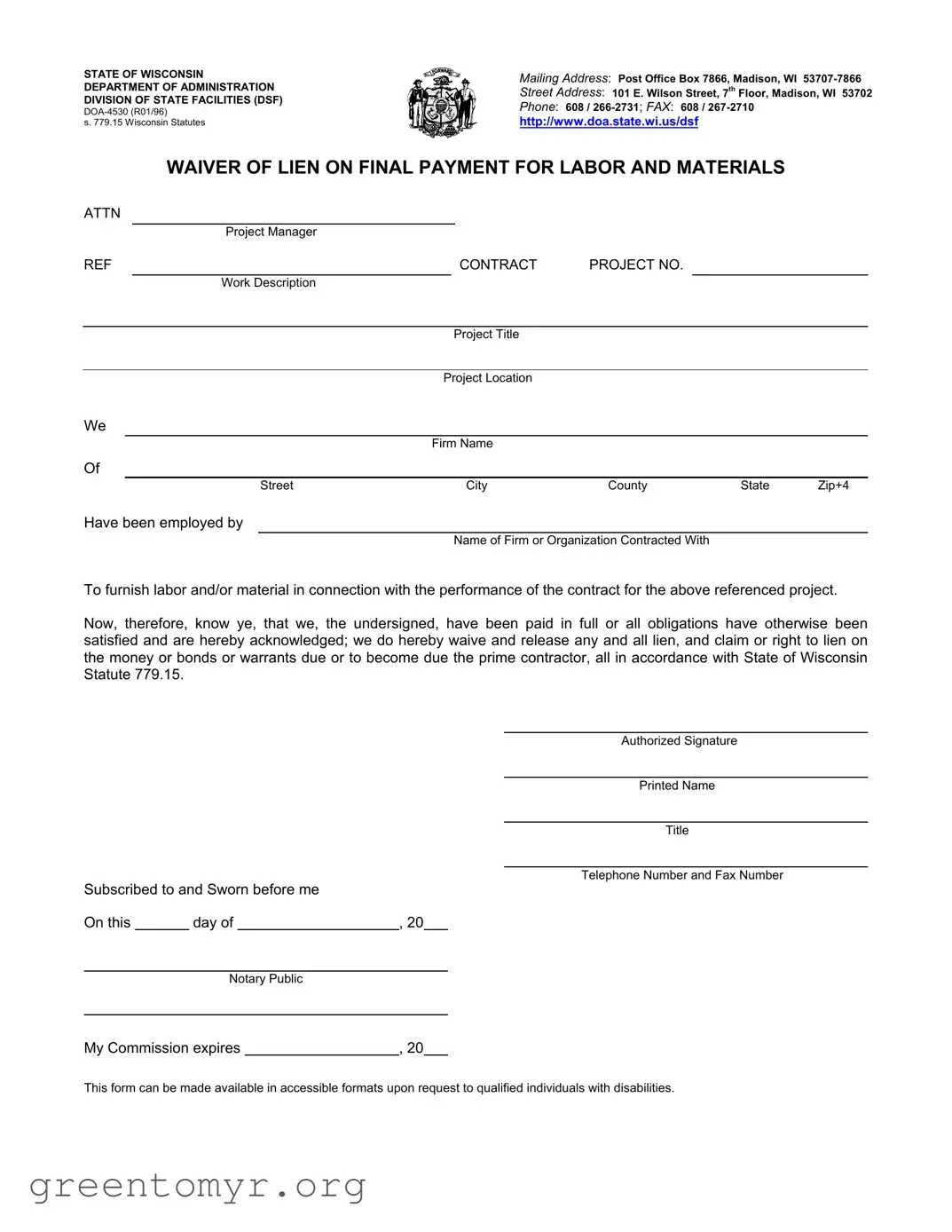
The Lien Waiver Wisconsin form serves a crucial purpose in the construction industry, ensuring that all parties involved in a project are protected from potential disputes over payments. This form is specifically designed for use in the state of Wisconsin and adheres to the requirements set forth in Wisconsin Statute 779.15. It functions as a formal declaration by contractors or subcontractors, affirming that they have received full payment for their services or materials provided on a particular project. By signing this document, the undersigned waives any future claims or liens against the property in question, thereby providing peace of mind to the prime contractor and the property owner. The form includes essential details such as the project title, location, and the names of the firms involved, along with spaces for authorized signatures and notary acknowledgment. Additionally, it ensures accessibility for individuals with disabilities, reflecting a commitment to inclusivity. Understanding the nuances of this form is vital for anyone engaged in construction or contracting work in Wisconsin, as it plays a key role in safeguarding financial interests and maintaining clear communication among all parties.

STATE OF WISCONSIN DEPARTMENT OF ADMINISTRATION DIVISION OF STATE FACILITIES (DSF)
s. 779.15 Wisconsin Statutes
Mailing Address: Post Office Box 7866, Madison, WI
Street Address: 101 E. Wilson Street, 7th Floor, Madison, WI 53702
Phone: 608 /
http://www.doa.state.wi.us/dsf
WAIVER OF LIEN ON FINAL PAYMENT FOR LABOR AND MATERIALS
ATTN
Project Manager
REF |
CONTRACT |
PROJECT NO. |
Work Description
Project Title
Project Location
We
Firm Name
Of
Street |
City |
County |
State |
Zip+4 |
Have been employed by
Name of Firm or Organization Contracted With
To furnish labor and/or material in connection with the performance of the contract for the above referenced project.
Now, therefore, know ye, that we, the undersigned, have been paid in full or all obligations have otherwise been satisfied and are hereby acknowledged; we do hereby waive and release any and all lien, and claim or right to lien on the money or bonds or warrants due or to become due the prime contractor, all in accordance with State of Wisconsin Statute 779.15.
Authorized Signature
Printed Name
Title
Telephone Number and Fax Number
Subscribed to and Sworn before me
On this |
|
day of |
|
, 20 |
Notary Public
My Commission expires |
|
, 20 |
This form can be made available in accessible formats upon request to qualified individuals with disabilities.
| Fact Name | Details |
|---|---|
| Governing Law | This form is governed by Wisconsin Statute s. 779.15. |
| Purpose | The Lien Waiver Wisconsin form is used to waive and release any lien rights for labor and materials upon final payment. |
| Required Information | It requires details such as project title, work description, firm name, and authorized signatures. |
| Accessibility | The form can be provided in accessible formats upon request for individuals with disabilities. |
Filling out the Lien Waiver form in Wisconsin requires careful attention to detail. Follow these steps to ensure that all necessary information is accurately provided. Once completed, the form will need to be signed and notarized to be valid.
The Lien Waiver Wisconsin form is a legal document used to relinquish any claim to a lien for labor or materials provided on a construction project. By signing this form, contractors or suppliers confirm that they have been paid in full for their services, thereby waiving their right to place a lien on the property associated with the project.
This form is typically used by contractors, subcontractors, and suppliers who have provided labor or materials for a construction project in Wisconsin. It is essential for those who wish to ensure that they have received payment before relinquishing their rights to file a lien.
The form includes several important sections, such as:
Each section must be completed accurately to ensure the waiver is valid.
This form should be submitted upon completion of the project or when the contractor or supplier has received full payment for their services. It is advisable to submit the waiver at the time of final payment to avoid any potential disputes regarding outstanding payments.
If the form is not used, contractors and suppliers retain the right to file a lien against the property for unpaid labor or materials. This could lead to legal disputes and complications in receiving payment, making it essential to utilize the waiver when appropriate.
Yes, once signed and notarized, the Lien Waiver Wisconsin form is a legally binding document. It serves as proof that the undersigned has been compensated and relinquishes their right to file a lien on the property for the specified project.
While the form itself should remain intact, certain details such as project information and payment amounts can be customized. However, any modifications should be made carefully to ensure the document remains legally valid.
The Lien Waiver Wisconsin form can typically be downloaded from the Wisconsin Department of Administration's website or requested directly from their office. Additionally, it may be available in accessible formats upon request for individuals with disabilities.
Filling out the Lien Waiver form in Wisconsin is a crucial step in ensuring that all parties involved in a construction project are protected. However, many people make common mistakes that can lead to complications down the line. Understanding these pitfalls can save time and prevent potential disputes.
One frequent error is failing to include all necessary information. Each section of the form needs to be completed accurately. Missing details such as the project title, location, or the firm name can invalidate the waiver. It’s essential to double-check that all fields are filled out completely before submission.
Another mistake often encountered is not obtaining the required signatures. The waiver must be signed by the appropriate authorized person. If the signature is missing or if the wrong individual signs, it could raise questions about the legitimacy of the waiver. Always ensure that the right person is signing off on the document.
People sometimes overlook the importance of notarization. A notary public must witness the signing of the waiver for it to be legally binding. Skipping this step can render the waiver ineffective. Make sure to schedule time with a notary to complete this important requirement.
In addition, incorrectly stating payment status can lead to significant issues. The form requires a clear indication of whether all obligations have been satisfied. Misrepresenting the payment status can expose you to legal consequences and could lead to disputes with contractors or subcontractors. Always be honest and thorough when stating payment details.
Lastly, not keeping a copy of the completed waiver is a mistake many make. After filling out the form and obtaining signatures and notarization, it’s vital to keep a copy for your records. This documentation can be crucial if any disputes arise in the future. Always file your paperwork carefully to avoid any issues later on.
The Lien Waiver Wisconsin form is a crucial document in the construction industry, designed to protect both contractors and property owners. When used correctly, it ensures that all parties are clear about payment obligations and helps prevent disputes over unpaid work. However, this form is often accompanied by several other important documents that serve various purposes in the construction process. Below is a list of these related forms and documents.
Understanding these documents and their roles in the construction process is essential for anyone involved in a project. By familiarizing oneself with these forms, stakeholders can ensure smoother transactions and minimize the risk of disputes, ultimately leading to successful project completion.
Mechanic's Lien Release: Similar to the Lien Waiver Wisconsin form, a Mechanic's Lien Release serves to confirm that a contractor or subcontractor has been paid for their services. It protects property owners by ensuring that no further claims can be made against their property for unpaid work.
Conditional Lien Waiver: This document is often used before payment is made. It allows a contractor to waive their right to file a lien, but only if they receive payment. Like the Lien Waiver Wisconsin form, it provides assurance to property owners while also protecting the contractor's interests.
Unconditional Lien Waiver: Once payment is received, an Unconditional Lien Waiver releases all claims to a lien without any conditions. This document is similar to the Lien Waiver Wisconsin form in that it confirms full payment has been made and protects the property owner from future claims.
Release of Lien: A Release of Lien is a formal statement that a lien has been removed from a property. This document is akin to the Lien Waiver Wisconsin form as it signifies that the contractor has been compensated and no longer has any claims against the property.
Subordination Agreement: This document allows a lender to have priority over a lien. While it serves a different purpose, it shares similarities with the Lien Waiver Wisconsin form in that both documents deal with the rights of lienholders and their claims on property.
When filling out the Lien Waiver Wisconsin form, it’s important to follow certain guidelines to ensure accuracy and compliance. Here are four things you should and shouldn't do:
Understanding the Lien Waiver Wisconsin form is crucial for anyone involved in construction or contracting. However, several misconceptions can lead to confusion. Here are nine common misconceptions:
Being informed about these misconceptions can help you navigate the complexities of lien waivers effectively. Always consult with a legal expert if you have specific questions or concerns.
When filling out and using the Lien Waiver Wisconsin form, keep these key takeaways in mind: