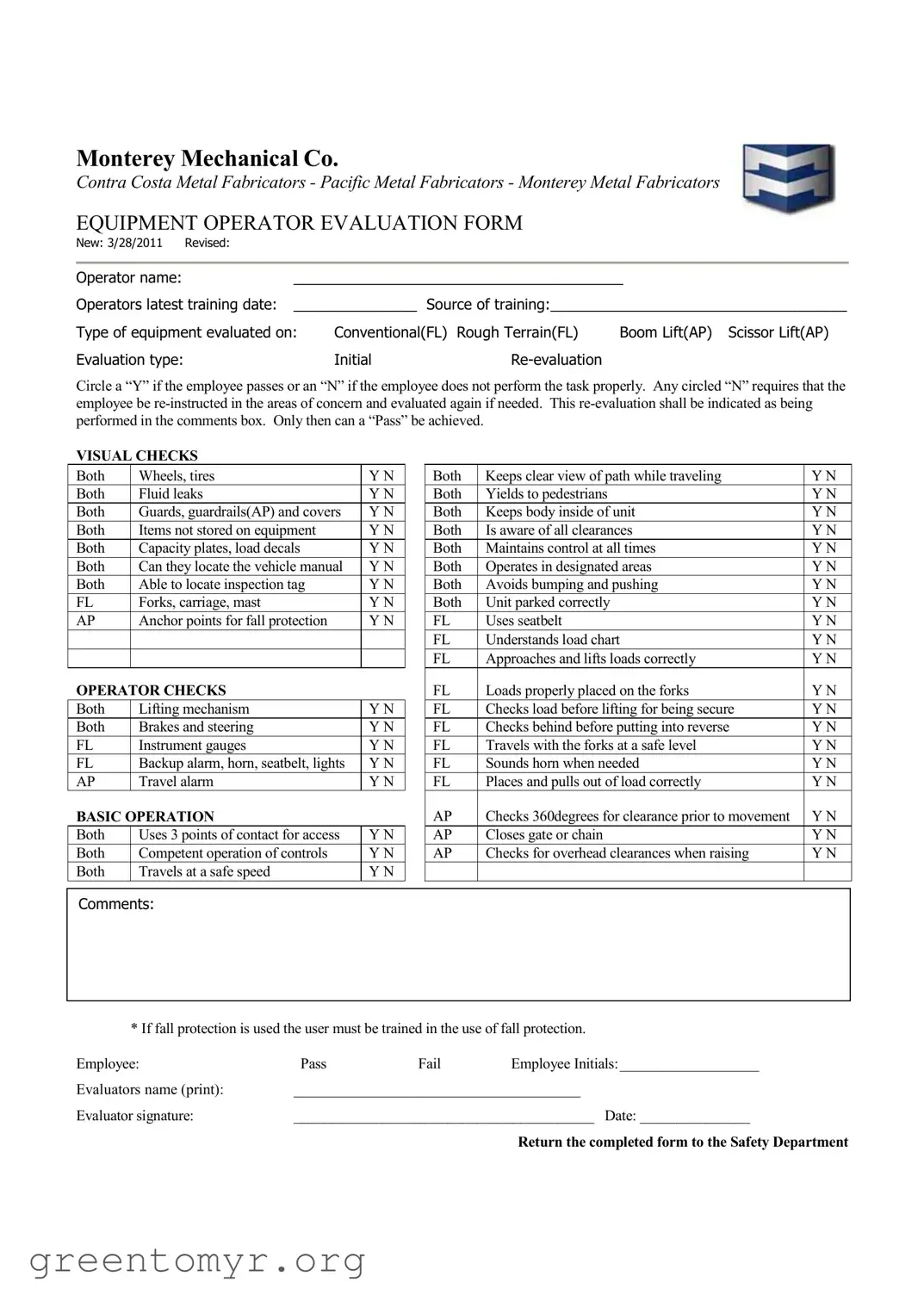
The Liftap form serves as a critical tool for evaluating equipment operators in various industrial settings, ensuring that safety and competency standards are met. This evaluation form, introduced in 2011 and revised subsequently, is designed to assess operators on different types of equipment, including conventional forklifts, rough terrain forklifts, boom lifts, and scissor lifts. The form requires the evaluator to document the operator's name, training date, and the source of that training, which emphasizes the importance of ongoing education in equipment operation. Each evaluation consists of a series of visual checks and operational checks, where evaluators circle “Y” for a pass or “N” for a fail on specific tasks. If an operator fails to meet the required standards, the form mandates re-instruction and a subsequent evaluation, ensuring that any deficiencies are addressed before the operator can be deemed competent. The form includes detailed criteria such as checks for fluid leaks, proper load handling, and adherence to safety protocols like the use of seatbelts and fall protection measures. The structured format not only facilitates a comprehensive assessment but also reinforces the commitment to maintaining a safe working environment.

Monterey Mechanical Co.
Contra Costa Metal Fabricators - Pacific Metal Fabricators - Monterey Metal Fabricators
EQUIPMENT OPERATOR EVALUATION FORM
New: 3/28/2011 Revised:
Operator name: |
________________________________________ |
|||
Operators latest training date: |
_______________ |
Source of training:____________________________________ |
||
Type of equipment evaluated on: |
Conventional(FL) Rough Terrain(FL) |
Boom Lift(AP) Scissor Lift(AP) |
||
Evaluation type: |
|
Initial |
|
|
Circle a “Y” if the employee passes or an “N” if the employee does not perform the task properly. Any circled “N” requires that the employee be
VISUAL CHECKS |
|
|
|
|
|
|
Both |
Wheels, tires |
Y N |
|
Both |
Keeps clear view of path while traveling |
Y N |
Both |
Fluid leaks |
Y N |
|
Both |
Yields to pedestrians |
Y N |
Both |
Guards, guardrails(AP) and covers |
Y N |
|
Both |
Keeps body inside of unit |
Y N |
Both |
Items not stored on equipment |
Y N |
|
Both |
Is aware of all clearances |
Y N |
Both |
Capacity plates, load decals |
Y N |
|
Both |
Maintains control at all times |
Y N |
Both |
Can they locate the vehicle manual |
Y N |
|
Both |
Operates in designated areas |
Y N |
Both |
Able to locate inspection tag |
Y N |
|
Both |
Avoids bumping and pushing |
Y N |
FL |
Forks, carriage, mast |
Y N |
|
Both |
Unit parked correctly |
Y N |
AP |
Anchor points for fall protection |
Y N |
|
FL |
Uses seatbelt |
Y N |
|
|
|
|
FL |
Understands load chart |
Y N |
|
|
|
|
FL |
Approaches and lifts loads correctly |
Y N |
OPERATOR CHECKS |
|
|
FL |
Loads properly placed on the forks |
Y N |
|
Both |
Lifting mechanism |
Y N |
|
FL |
Checks load before lifting for being secure |
Y N |
Both |
Brakes and steering |
Y N |
|
FL |
Checks behind before putting into reverse |
Y N |
FL |
Instrument gauges |
Y N |
|
FL |
Travels with the forks at a safe level |
Y N |
FL |
Backup alarm, horn, seatbelt, lights |
Y N |
|
FL |
Sounds horn when needed |
Y N |
AP |
Travel alarm |
Y N |
|
FL |
Places and pulls out of load correctly |
Y N |
BASIC OPERATION |
|
|
AP |
Checks 360degrees for clearance prior to movement |
Y N |
|
Both |
Uses 3 points of contact for access |
Y N |
|
AP |
Closes gate or chain |
Y N |
Both |
Competent operation of controls |
Y N |
|
AP |
Checks for overhead clearances when raising |
Y N |
Both |
Travels at a safe speed |
Y N |
|
|
|
|
Comments:
* If fall protection is used the user must be trained in the use of fall protection.
Employee: |
Pass |
Fail |
Employee Initials:___________________ |
Evaluators name (print): |
______________________________________ |
||
Evaluator signature: |
_________________________________________ Date: _______________ |
||
Return the completed form to the Safety Department
| Fact Name | Description |
|---|---|
| Form Purpose | The Liftap form is used to evaluate the performance of equipment operators. It assesses their ability to operate various types of machinery safely and effectively. |
| Evaluation Types | The form allows for two types of evaluations: Initial and Re-evaluation. Each evaluation type requires a clear assessment of the operator's skills. |
| Training Requirement | Operators must have received training before being evaluated. The source and date of the latest training must be documented on the form. |
| Governing Law | In California, the governing laws include Title 8 of the California Code of Regulations, which outlines safety standards for equipment operation. |
After completing the Liftap form, it is important to submit it to the Safety Department for review. Make sure all sections are filled out accurately to ensure a smooth evaluation process.
The Liftap form is designed to evaluate the performance and safety compliance of equipment operators. It assesses their ability to operate various types of lifts safely and effectively, ensuring they meet safety standards and are competent in their roles.
All equipment operators must complete the Liftap form during their initial evaluation and any subsequent re-evaluations. This includes operators of conventional lifts, rough terrain lifts, boom lifts, and scissor lifts.
The form requires the following information:
The evaluation is conducted by circling “Y” for a pass or “N” for a fail for each item listed on the form. If any item is marked “N,” the operator must receive re-instruction in that area and be evaluated again. The evaluator will document this in the comments section.
If an operator fails, they must be re-instructed on the specific areas of concern. A re-evaluation will be conducted afterward. Only after successfully passing the re-evaluation can the operator be deemed competent.
The comments section should detail any areas where the operator did not pass, along with notes on the re-instruction provided. This helps track progress and ensures all safety concerns are addressed.
Once completed, the Liftap form must be returned to the Safety Department. This ensures that all evaluations are documented and that any necessary follow-up actions are taken.
The Liftap form should be used for initial evaluations and re-evaluations as needed. Regular assessments help maintain safety standards and ensure operators remain competent in their skills.
Yes, operators must undergo training relevant to the type of equipment they will be evaluated on. This training ensures they understand safety protocols and operational procedures before being assessed.
Filling out the Liftap form accurately is crucial for ensuring the safety and compliance of equipment operators. However, several common mistakes can occur during this process. One frequent error is failing to provide the operator's name. This information is essential for identifying the individual being evaluated and should be clearly written at the top of the form.
Another common mistake is not including the latest training date. This date is important as it reflects the operator's most recent qualifications. Without it, the evaluation may not align with the operator's current training status, leading to potential safety issues.
Some individuals may overlook the source of training. This detail is necessary to verify the legitimacy of the operator’s training. If the source is not documented, it can create confusion regarding the operator's qualifications.
When it comes to the evaluation type, some users forget to circle either Initial or Re-evaluation. This selection is critical, as it indicates whether the assessment is a first-time evaluation or a follow-up. Missing this can lead to misunderstandings about the operator's training history.
During the visual checks section, evaluators may mistakenly circle "N" without providing adequate comments. If any item is marked as a failure, it is necessary to explain the reason for the failure in the comments box. This provides context for re-instruction and helps track areas needing improvement.
Another error occurs when evaluators do not ensure that the employee initials are present. This signature confirms that the operator has acknowledged the evaluation results. Omitting this can lead to disputes regarding the assessment.
Some users may also neglect to fill out the evaluator's name and signature. These details are vital for accountability and verification. Without them, the evaluation may lack credibility.
In the comments section, vague or incomplete notes can be a significant mistake. Providing specific feedback is essential for effective re-instruction. Evaluators should aim to be as detailed as possible to ensure the operator understands the areas that need improvement.
Lastly, failing to return the completed form to the Safety Department is a common oversight. This step is crucial for maintaining accurate records and ensuring that all evaluations are properly documented. Not submitting the form can result in a lack of compliance and oversight.
By being aware of these common mistakes, individuals can enhance the accuracy and effectiveness of the Liftap form, ultimately contributing to a safer work environment.
The Liftap form is an important document used to evaluate the competency of equipment operators. Alongside this form, several other documents often accompany it to ensure comprehensive safety and compliance measures are met. Below is a list of related forms and documents that are commonly utilized in conjunction with the Liftap form.
These documents collectively support the safe operation of equipment and enhance overall workplace safety. Ensuring that each form is completed accurately and stored properly contributes to a safer working environment for all employees.
The Liftap form serves as an essential tool for evaluating equipment operators, ensuring they possess the necessary skills and knowledge to operate machinery safely. Several other documents share similar purposes or structures, focusing on training, evaluation, or safety compliance. Here are eight documents that align closely with the Liftap form:
When filling out the Liftap form, attention to detail is crucial. Here are six key dos and don'ts to keep in mind:
Here are five common misconceptions about the Liftap form, along with explanations to clarify each point.
This is not true. The form can be used for both initial evaluations and re-evaluations. It is important for all operators to be assessed regularly to ensure ongoing safety and compliance.
In reality, if an operator does not pass, they can receive re-instruction in the areas of concern. After this, they can be evaluated again, which allows them the opportunity to demonstrate improvement.
The comments section is crucial. It provides space to note any issues or areas that need attention. This information is essential for the operator's development and for future evaluations.
This is misleading. Operators must be trained in the use of the equipment being evaluated. Additionally, if fall protection is used, training in that area is also necessary.
The Liftap form assesses a range of factors, including safety practices and awareness. It is designed to ensure that operators are not only skilled but also mindful of their surroundings and the safety of others.
Here are some key takeaways about filling out and using the Liftap form:
Completing the Liftap form accurately contributes to workplace safety and ensures that operators are properly trained and evaluated.