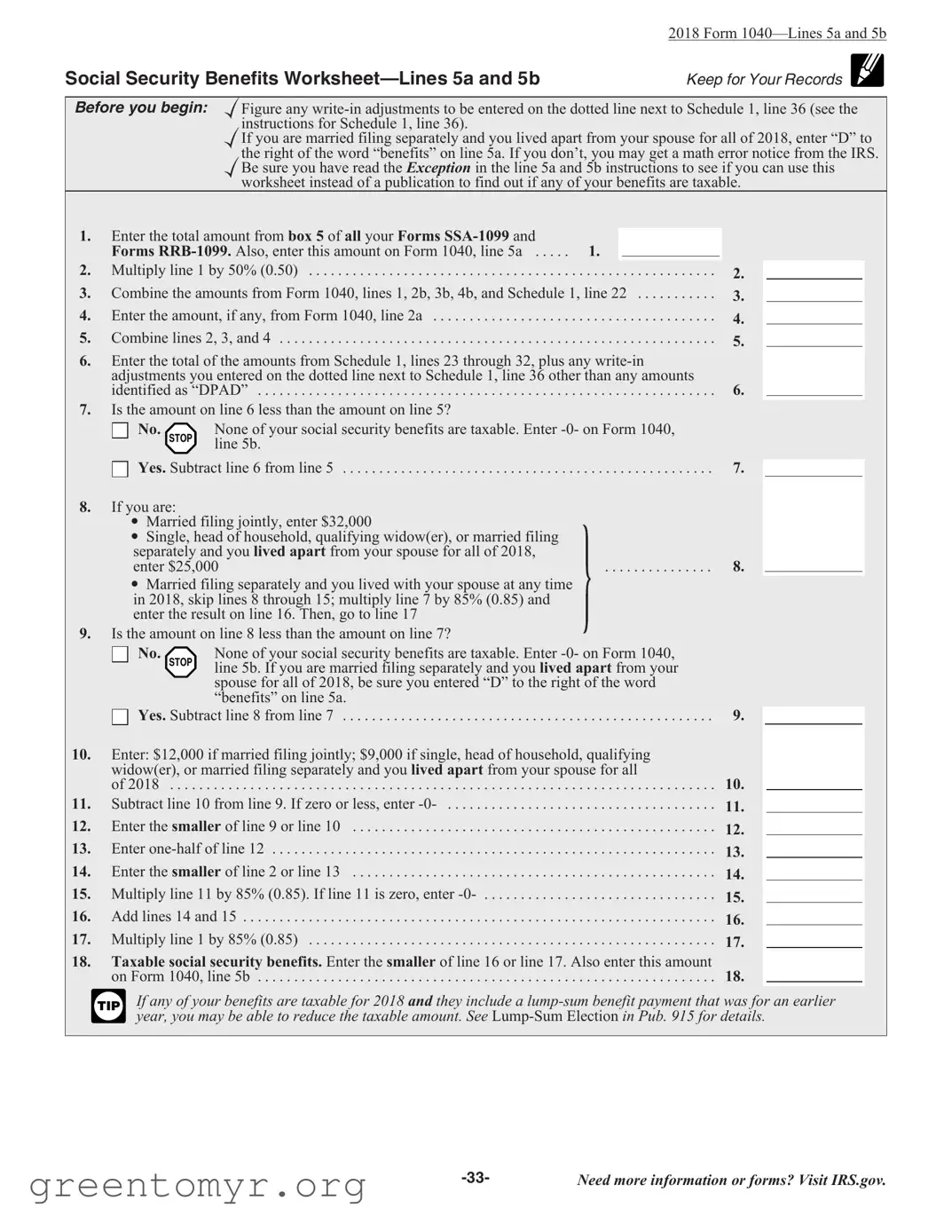
The Lines 20A and 20B form, also known as the Social Security Benefits Worksheet, plays a crucial role in determining the taxability of Social Security benefits for individuals filing their taxes. This worksheet is particularly important for taxpayers who receive benefits from Social Security Administration forms, such as SSA-1099 or RRB-1099. It guides users through a series of calculations to assess whether their benefits are taxable based on their total income and filing status. For example, if you are married and filing separately but lived apart from your spouse for the entire tax year, specific instructions apply to ensure accurate reporting. The form requires the entry of various amounts, including the total benefits received and other income sources, to arrive at a final taxable amount. Understanding the nuances of this worksheet can prevent costly errors and ensure compliance with IRS regulations. Additionally, there are provisions for those who may have received lump-sum payments, which can further complicate the tax situation. This article will delve deeper into the Lines 20A and 20B form, breaking down each step to make the process clearer and more manageable for taxpayers.
Social Security Benefits
2018 Form
Keep for Your Records
Before you begin: Figure any
If you are married filing separately and you lived apart from your spouse for all of 2018, enter “D” to the right of the word “benefits” on line 5a. If you don’t, you may get a math error notice from the IRS. Be sure you have read the Exception in the line 5a and 5b instructions to see if you can use this worksheet instead of a publication to find out if any of your benefits are taxable.
1.Enter the total amount from box 5 of all your Forms
2. |
Forms |
|
||||
Multiply line 1 by 50% (0.50) |
||||||
3. |
Combine the amounts from Form 1040, lines 1, 2b, 3b, 4b, and Schedule 1, line 22 |
|||||
4. |
Enter the amount, if any, from Form 1040, line 2a |
|||||
5. |
Combine lines 2, 3, and 4 |
|||||
6. |
Enter the total of the amounts from Schedule 1, lines 23 through 32, plus any |
|||||
|
adjustments you entered on the dotted line next to Schedule 1, line 36 other than any amounts |
|||||
7. |
identified as “DPAD” |
|||||
Is the amount on line 6 less than the amount on line 5? |
||||||
|
|
|
No. |
None of your social security benefits are taxable. Enter |
||
|
|
|
||||
|
|
|
|
STOP |
line 5b. |
|
|
|
|
|
|||
|
|
|
|
|
||
8. |
|
|
Yes. Subtract line 6 from line 5 |
|||
|
|
|||||
If you are: |
|
|
||||
|
|
|
• |
Married filing jointly, enter $32,000 |
||
|
|
|
• |
Single, head of household, qualifying widow(er), or married filing |
||
|
|
|
separately and you lived apart from your spouse for all of 2018, |
|||
|
|
|
enter $25,000 |
|||
|
|
|
• |
Married filing separately and you lived with your spouse at any time |
||
|
|
|
in 2018, skip lines 8 through 15; multiply line 7 by 85% (0.85) and |
|||
9. |
|
|
enter the result on line 16. Then, go to line 17 |
|||
Is the amount on line 8 less than the amount on line 7? |
||||||
|
|
|
No. |
None of your social security benefits are taxable. Enter |
||
|
|
|
||||
|
|
|
|
STOP |
line 5b. If you are married filing separately and you lived apart from your |
|
|
|
|
|
|||
spouse for all of 2018, be sure you entered “D” to the right of the word “benefits” on line 5a.
Yes. Subtract line 8 from line 7 . . . . . . . . . . . . . . . . . . . . . . . . . . . . . . . . . . . . . . . . . . . . . . . . . . .
2.
3.
4.
5.
6.
7.
8.
9.
10.Enter: $12,000 if married filing jointly; $9,000 if single, head of household, qualifying
|
widow(er), or married filing separately and you lived apart from your spouse for all |
10. |
11. |
of 2018 |
|
Subtract line 10 from line 9. If zero or less, enter |
11. |
|
12. |
Enter the smaller of line 9 or line 10 |
12. |
13. |
Enter |
13. |
14. |
Enter the smaller of line 2 or line 13 |
14. |
15. |
Multiply line 11 by 85% (0.85). If line 11 is zero, enter |
15. |
16. |
Add lines 14 and 15 |
16. |
17. |
Multiply line 1 by 85% (0.85) |
17. |
18.Taxable social security benefits. Enter the smaller of line 16 or line 17. Also enter this amount
on Form 1040, line 5b . . . . . . . . . . . . . . . . . . . . . . . . . . . . . . . . . . . . . . . . . . . . . . . . . . . . . . . . . . . . . . . 18.
TIP |
If any of your benefits are taxable for 2018 and they include a |
|
year, you may be able to reduce the taxable amount. See |
|
|
Need more information or forms? Visit IRS.gov. |
| Fact Name | Details |
|---|---|
| Purpose | The Lines 20A and 20B form is used to determine the taxable amount of Social Security benefits for individuals filing their federal income tax returns. |
| Eligibility | This form is applicable to individuals who receive Social Security benefits and must report them on their Form 1040. |
| Calculation Method | Taxable benefits are calculated based on a series of steps, including total income and specific thresholds depending on filing status. |
| Thresholds | For 2018, the income thresholds are $32,000 for married filing jointly and $25,000 for single filers or those married filing separately living apart. |
| State-Specific Forms | While the federal form is standardized, states may have their own forms and governing laws regarding the taxation of Social Security benefits. |
| IRS Guidance | The IRS provides additional instructions and resources, including Publication 915, to help individuals understand how to report their benefits accurately. |
Completing the Lines 20A and 20B form requires careful attention to detail. This worksheet will guide you through the necessary calculations to determine the taxability of your Social Security benefits. Follow these steps to ensure accuracy.
After completing these steps, ensure all calculations are accurate. If any of your benefits are taxable and include a lump-sum payment for an earlier year, you may want to explore options to reduce the taxable amount. For further assistance, consult IRS resources or a tax professional.
The Lines 20A 20B form is a worksheet used to determine the taxable amount of Social Security benefits for the tax year 2018. It helps taxpayers figure out how much of their Social Security income is subject to taxation. By following the instructions, individuals can accurately report their benefits on their Form 1040.
This worksheet is primarily for individuals who receive Social Security benefits and need to determine if any portion of those benefits is taxable. It is especially important for those who are married filing separately and lived apart from their spouse all year, as specific instructions apply to them. Taxpayers should read the instructions carefully to see if they qualify to use this worksheet instead of other publications.
Each step must be completed accurately to ensure correct reporting of your taxable benefits.
If your calculations show that some of your Social Security benefits are taxable, you will need to report that amount on your Form 1040. The worksheet provides a clear method for determining the taxable portion. If you receive a lump-sum benefit payment that covers prior years, you might be eligible for a reduction in the taxable amount. Detailed information on this can be found in Publication 915. It is crucial to consult these resources to ensure compliance and accuracy in your tax reporting.
When completing the Lines 20A and 20B form, many individuals make common mistakes that can lead to errors in their tax filings. One frequent error is failing to accurately report the total amount from box 5 of Forms SSA-1099 and RRB-1099. This total is crucial as it serves as the starting point for calculating taxable social security benefits. If this amount is entered incorrectly, it can skew the entire calculation and potentially result in a tax liability that is either too high or too low.
Another mistake involves misunderstanding the filing status requirements. For those who are married filing separately and lived apart from their spouse for all of the tax year, it is essential to enter "D" next to the word "benefits" on line 5a. Neglecting to do this can trigger a math error notice from the IRS, leading to unnecessary complications and delays in processing the tax return.
Additionally, many filers overlook the importance of combining the amounts from various lines accurately. Specifically, when calculating the total on line 5, individuals must combine amounts from Form 1040 lines 1, 2b, 3b, 4b, and Schedule 1, line 22. Failing to include all relevant lines can result in an incorrect total, affecting the taxable benefits calculation.
Lastly, confusion often arises when determining whether social security benefits are taxable based on the income thresholds. The thresholds differ depending on filing status, and incorrectly interpreting these can lead to errors. For instance, if someone is married filing jointly, the threshold is $32,000, while for single filers, it is $25,000. Misunderstanding these limits can result in mistakenly reporting benefits as taxable when they are not, or vice versa.
The Lines 20A and 20B forms are essential for reporting specific income and adjustments related to Social Security benefits. However, they are often accompanied by other important documents that aid in accurately completing tax returns. Below is a list of additional forms that are frequently used in conjunction with the Lines 20A and 20B forms.
Understanding these forms and their purposes is vital for ensuring accurate tax reporting and compliance. Each document plays a significant role in determining the tax implications of Social Security benefits and helps taxpayers navigate their obligations effectively.
The Lines 20A and 20B form is similar to several other tax documents that deal with income reporting and tax calculations. Here’s a list of ten documents that share similarities:
When filling out the Lines 20A and 20B form, it's essential to follow specific guidelines to avoid errors and ensure accurate reporting. Here are six critical do's and don'ts:
Taking these steps seriously will help in accurately completing your form and avoiding potential issues with the IRS.
Understanding the Lines 20A and 20B form can be challenging, and misconceptions often lead to confusion. Here are seven common misunderstandings about this form, along with clarifications to help you navigate it more easily.
This form applies to anyone receiving Social Security benefits, regardless of age. Whether you are retired, disabled, or a survivor, you need to consider this form when filing your taxes.
Not all Social Security benefits are taxable. The amount of your benefits that is taxable depends on your overall income. If your combined income is below certain thresholds, you may not owe any taxes on your benefits.
The worksheet is beneficial for everyone receiving Social Security benefits. It helps clarify how much of your benefits may be taxable, regardless of the complexity of your overall tax situation.
Even if you have just one SSA-1099 form, you should still complete the worksheet. It ensures that you accurately calculate the taxable portion of your benefits.
The Lines 20A and 20B form can change annually based on tax law updates. Always check the current year's instructions to ensure you are using the correct form and guidelines.
Even if your Social Security benefits are not taxable, you still need to report them on your tax return. Failure to report can lead to issues with the IRS.
While the form helps determine how much of your benefits are taxable, it does not guarantee a refund. Your overall tax situation, including deductions and credits, will affect your final tax outcome.
By clearing up these misconceptions, you can approach the Lines 20A and 20B form with confidence. Always refer to the latest IRS guidelines or consult a tax professional if you have specific questions.
When filling out and using the Lines 20A and 20B form, it is important to keep several key points in mind:
By keeping these takeaways in mind, you can navigate the Lines 20A and 20B form more effectively and ensure compliance with IRS requirements.