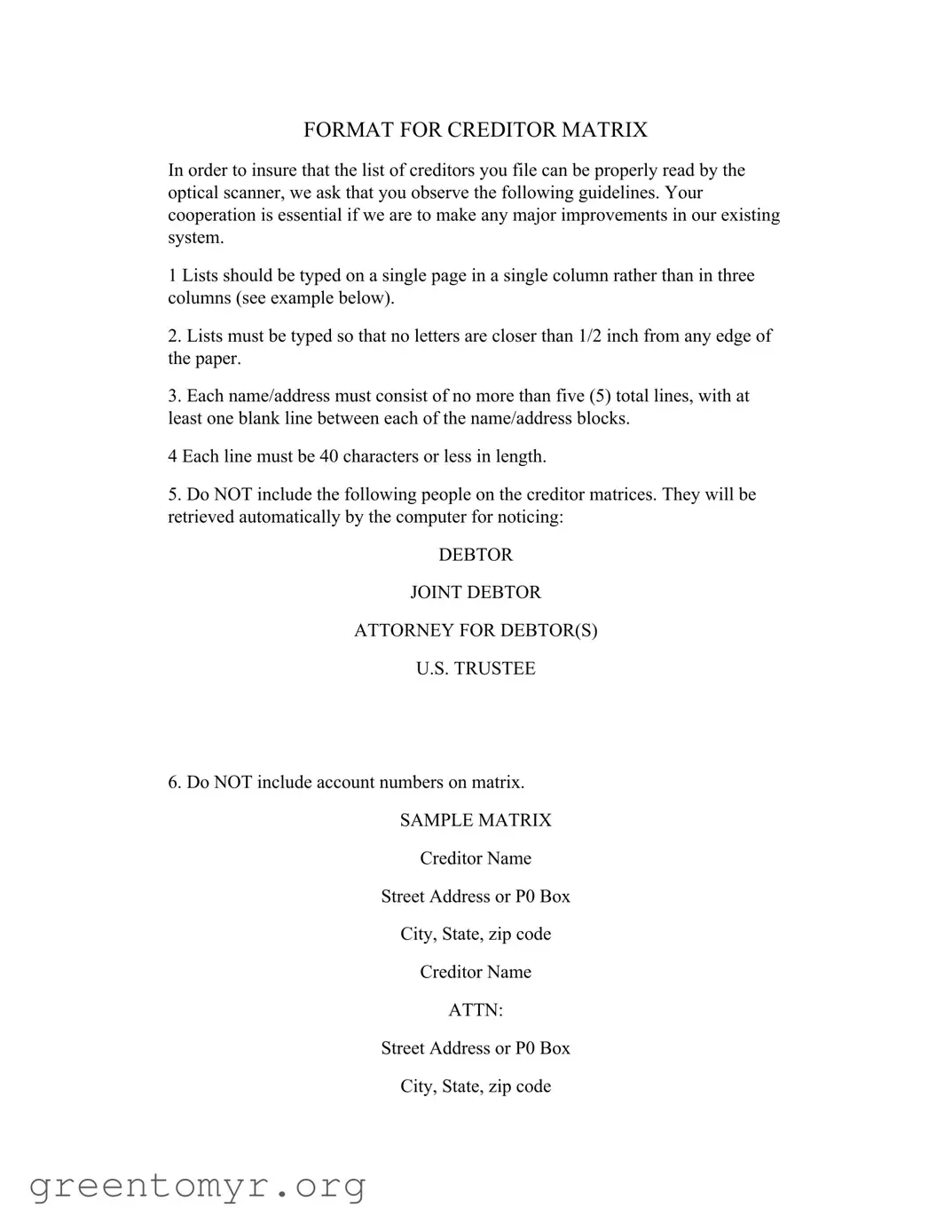
When filing for bankruptcy, one of the essential documents to prepare is the List of Creditors form. This form serves as a comprehensive record of all individuals and entities to whom the debtor owes money. It is crucial to follow specific formatting guidelines to ensure that the information is accurately processed by the court's optical scanning system. For instance, lists should be typed on a single page in a single column, avoiding any extra marks or non-standard paper types. Each creditor's name and address must be neatly organized, with no more than five lines per entry and a blank line separating each creditor. Additionally, it is important to note that certain individuals, such as the debtor and their attorney, should not be included on this list, as their information is automatically retrieved by the court. Adhering to these guidelines not only helps prevent delays in processing but also ensures that all creditors receive the necessary notices in a timely manner. By following the specified rules, debtors can facilitate a smoother bankruptcy process, allowing them to focus on their financial recovery.
FORMAT FOR CREDITOR MATRIX
In order to insure that the list of creditors you file can be properly read by the optical scanner, we ask that you observe the following guidelines. Your cooperation is essential if we are to make any major improvements in our existing system.
1 Lists should be typed on a single page in a single column rather than in three columns (see example below).
2.Lists must be typed so that no letters are closer than 1/2 inch from any edge of the paper.
3.Each name/address must consist of no more than five (5) total lines, with at least one blank line between each of the name/address blocks.
4 Each line must be 40 characters or less in length.
5.Do NOT include the following people on the creditor matrices. They will be retrieved automatically by the computer for noticing:
DEBTOR
JOINT DEBTOR
ATTORNEY FOR DEBTOR(S)
U.S. TRUSTEE
6.Do NOT include account numbers on matrix.
SAMPLE MATRIX
Creditor Name
Street Address or P0 Box
City, State, zip code
Creditor Name
ATTN:
Street Address or P0 Box
City, State, zip code
UNITED STATES BANKRUPTCY COURT
DISTRICT OF NEW HAMPSHIRE
THINGS TO AVOID ON CREDITOR MATRIX
Although the court is using sophisticated equipment and software to insure accuracy in creditor list reading, certain problems still occur. By following these guidelines, the court will avoid delays or additional effort in mailing notices.
The following problems can prevent your lists from being read by the optical scanner, requiring you to
AVOID:
1.Extra marks on the list - such as letterhead, dates, debtor names, coffee stains, handwritten marks.
2.
8 1/2 x 11 standard paper.
3.Poor quality type caused by submitting a photocopy or carbon.
4.Stray marks should be avoided. Do not type lines, debtor names, page numbers, or anything else on the front of the creditor list Any identifying marks you choose to add can be typed on the back of the list.
5.Upper case only (all capital letters) should be avoided. Type in upper and lower case as you would on a letter.
6.Zip code must be on the last line. Nine digit zip code should be typed with a hyphen separating the two groups of digits. Do NOT type attention lines or account numbers on the last line. If you must use an attention line, it should be the second line of the name/address. (The zip code must be at the end for the zip code sorting equipment to find it.)
| Fact Name | Description |
|---|---|
| Formatting Requirements | The List of Creditors must be typed on a single page in one column. Each name/address block should have at least one blank line between them. |
| Character Limits | Each line in the creditor list must contain no more than 40 characters. Additionally, the total number of lines for each name/address should not exceed five. |
| Exclusions | Do not include the debtor, joint debtor, attorney for debtor(s), or U.S. trustee in the creditor matrix. These will be automatically retrieved. |
| Governing Law | This form follows the guidelines set by the U.S. Bankruptcy Code, specifically under Title 11 of the United States Code. |
Filling out the List Of Creditors form is an important step in the bankruptcy process. After completing the form, you will need to submit it to the appropriate court. This ensures that your creditors are properly notified of your bankruptcy filing. Follow these steps carefully to complete the form correctly.
Once you have completed the List Of Creditors form, double-check your entries for accuracy. Proper completion of this form is crucial for the timely processing of your bankruptcy case.
The List of Creditors form is a document that individuals must file when declaring bankruptcy. It contains a comprehensive list of all creditors to whom the debtor owes money. This list is crucial for ensuring that creditors receive proper notification of the bankruptcy proceedings.
Following the formatting guidelines is essential for ensuring that the List of Creditors can be accurately processed by the court's optical scanning system. If the form is not formatted correctly, it may lead to delays in the bankruptcy process or require the debtor to resubmit the list, which can be time-consuming and frustrating.
The key formatting requirements include:
Do not include the following individuals in your List of Creditors, as they will be automatically retrieved by the court's system:
To ensure your List of Creditors is accepted, avoid the following:
Zip codes should always be placed on the last line of the address block. If using a nine-digit zip code, include a hyphen to separate the two groups of digits. Remember, attention lines or account numbers should not be included on the last line.
No, handwritten lists are not acceptable. The List of Creditors must be typed to ensure clarity and accuracy. Handwritten entries can lead to misinterpretation and processing delays.
If the List of Creditors is not formatted according to the guidelines, the court may not be able to read it properly. This could result in the need to resubmit the form, causing delays in your bankruptcy case.
Yes, a sample matrix is provided in the guidelines. It typically includes the creditor's name, street address or P.O. Box, city, state, and zip code. Following the sample format can help ensure compliance with the requirements.
For more information, you can visit the official website of the U.S. Bankruptcy Court or consult with a legal professional who specializes in bankruptcy. They can provide guidance and answer any specific questions you may have.
Filling out the List of Creditors form can be straightforward, but many people make common mistakes that can lead to delays. One frequent error is using the wrong format for the list. It is essential to type the list on a single page in one column. Some individuals mistakenly create a multi-column layout, which can confuse the optical scanner.
Another common mistake involves not adhering to the spacing guidelines. Each name and address must consist of no more than five lines, with at least one blank line between each entry. People often overlook this requirement, leading to a cluttered appearance that the scanner may struggle to read.
Additionally, the character limit for each line is 40 characters. Many individuals exceed this limit, which can cause information to be cut off or misread. It’s important to keep entries concise to ensure clarity.
Many people also forget to exclude specific individuals from the creditor list. The form specifically instructs not to include the debtor, joint debtor, attorney for the debtors, or the U.S. Trustee. Including these names can complicate the process and result in unnecessary delays.
Another mistake is the inclusion of account numbers. The guidelines clearly state that account numbers should not be added to the matrix. This oversight can lead to confusion and complicate the processing of the list.
Finally, using non-standard paper or poor-quality typing can create significant issues. Avoid using colored paper, onion skin, or half-sized sheets. The court requires standard 8 1/2 x 11 paper for optimal scanning. Poor-quality typesetting, such as photocopies or carbon copies, can also hinder readability.
When filing for bankruptcy, several forms and documents accompany the List of Creditors form. Each of these documents serves a specific purpose in the bankruptcy process, ensuring that all necessary information is accurately presented to the court. Below is a list of commonly used forms that you may need to complete alongside the List of Creditors.
Each of these forms plays a crucial role in the bankruptcy process, helping to ensure that everything is organized and presented clearly to the court. Properly completing and submitting these documents can make a significant difference in the outcome of your bankruptcy case.
Creditor Matrix: The List of Creditors form is similar to a creditor matrix, which is also used in bankruptcy filings. Both documents require a structured format to ensure clarity and compliance with court requirements. They typically list the names and addresses of all creditors in a manner that allows for easy reading and processing by the court's systems.
Proof of Claim: This document is filed by creditors to assert their right to receive a distribution from the bankruptcy estate. Like the List of Creditors, it must clearly identify the creditor and provide specific information about the claim, ensuring that it can be processed efficiently.
Schedule F: This schedule lists unsecured claims against the debtor. It shares similarities with the List of Creditors in that both documents must include detailed information about each creditor, including names and addresses, and adhere to formatting guidelines set by the court.
Bankruptcy Petition: The bankruptcy petition initiates the bankruptcy process and includes essential information about the debtor's financial situation. Both the petition and the List of Creditors require accurate and complete information to facilitate the court's understanding of the case.
Statement of Financial Affairs: This document outlines the debtor's financial history and transactions. Similar to the List of Creditors, it requires thoroughness and clarity, as it provides the court with necessary context about the debtor's financial dealings.
Notice of Commencement: This document informs creditors of the bankruptcy filing and includes important details about the case. Like the List of Creditors, it aims to ensure that all parties are properly notified and have access to the relevant information they need to participate in the proceedings.
When filling out the List of Creditors form, it's important to follow specific guidelines to ensure your submission is processed smoothly. Here are ten things you should and shouldn't do:
By adhering to these guidelines, you can help ensure that your List of Creditors is accepted without unnecessary delays. Take the time to double-check your work, and your submission process will be much smoother.
Misconceptions about the List of Creditors form can lead to confusion and potential delays in your bankruptcy process. Here are five common misconceptions clarified:
Understanding these misconceptions can help ensure that your List of Creditors is submitted correctly, minimizing the risk of delays in your bankruptcy proceedings.
When filling out and using the List of Creditors form, there are several important guidelines to follow to ensure that your submission is processed smoothly. Here are key takeaways to keep in mind:
By adhering to these guidelines, you can help prevent delays in processing your creditor list and ensure that your submission meets the court's requirements.