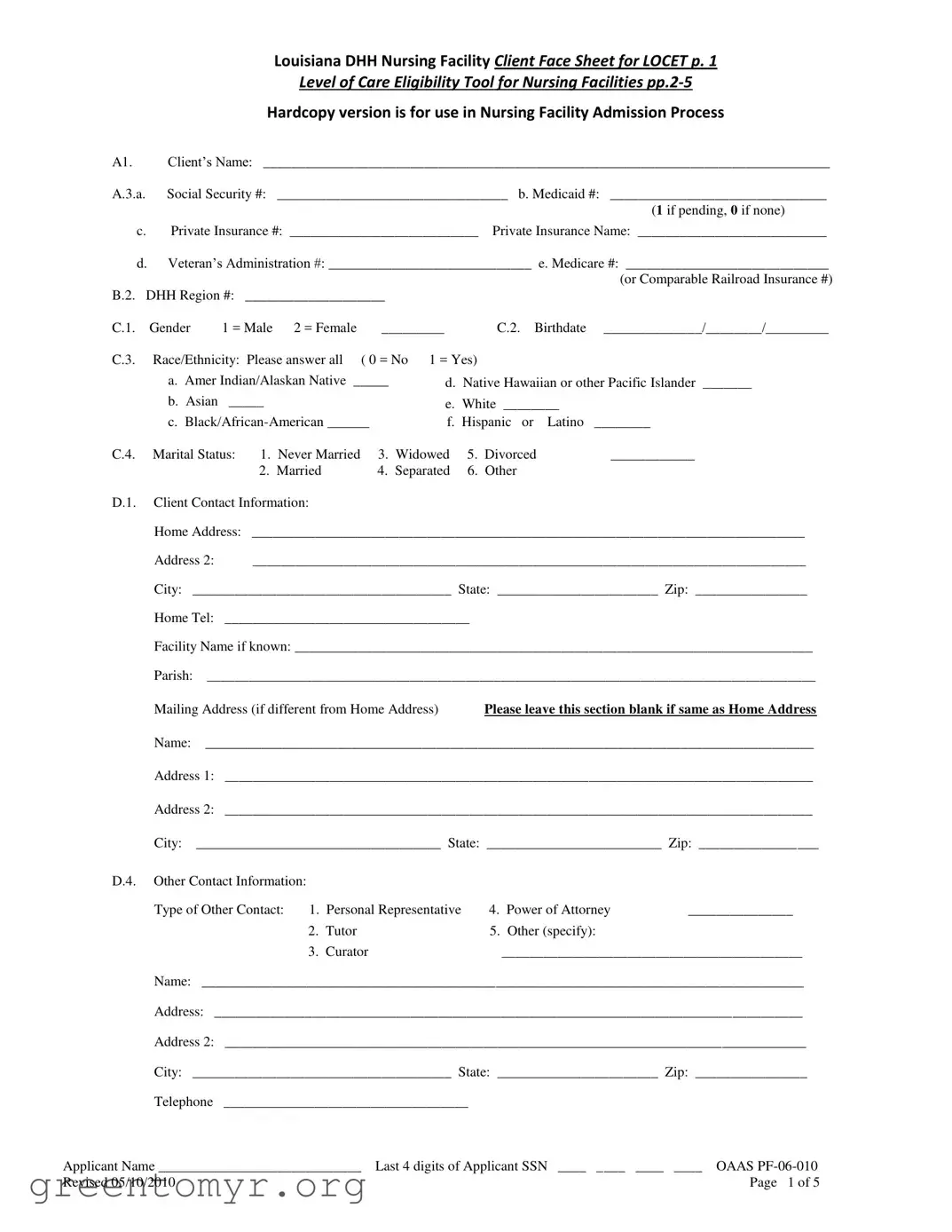
The LOCET form, officially known as the Louisiana DHH Nursing Facility Client Face Sheet for the Level of Care Eligibility Tool, plays a crucial role in the nursing facility admission process. This comprehensive document collects essential information about the applicant, including personal details such as name, Social Security number, and contact information. It also gathers demographic data, including gender, birthdate, and race or ethnicity, to ensure a thorough understanding of the individual seeking care. The form is designed to assess the medical eligibility for long-term care services funded by the Louisiana Department of Health and Hospitals. It outlines the responsibilities of the informant, who provides objective information about the applicant's condition and needs. The LOCET includes sections that evaluate the applicant's physical and cognitive abilities, detailing their performance in daily activities and any medical treatments received. Additionally, it addresses behavioral health issues, service dependency, and the involvement of healthcare professionals. Each component of the LOCET is structured to facilitate a clear and accurate assessment, ensuring that applicants receive the appropriate level of care they require.
|
Louisiana DHH Nursing Facility Client Face Sheet for LOCET p. 1 |
|
Level of Care Eligibility Tool for Nursing Facilities |
|
Hardcopy version is for use in Nursing Facility Admission Process |
A1. |
Client’s Name: _________________________________________________________________________________ |
A.3.a. |
Social Security #: _________________________________ b. Medicaid #: _______________________________ |
|
(1 if pending, 0 if none) |
c. |
Private Insurance #: ___________________________ Private Insurance Name: ___________________________ |
d.Veteran’s Administration #: _____________________________ e. Medicare #: _____________________________
(or Comparable Railroad Insurance #)
B.2. |
DHH Region #: ____________________ |
|
|||
C.1. |
Gender |
1 = Male |
2 = Female |
_________ |
C.2. Birthdate ______________/________/_________ |
C.3. Race/Ethnicity: Please answer all ( 0 = No
a.Amer Indian/Alaskan Native _____
b.Asian _____
c.
1 = Yes)
d. Native Hawaiian or other Pacific Islander _______
e. White ________
f. Hispanic or Latino ________
C.4. |
Marital Status: |
1. |
Never Married |
3. Widowed |
5. Divorced |
____________ |
||||
|
|
|
|
2. |
Married |
4. Separated |
6. Other |
|
|
|
D.1. |
Client Contact Information: |
|
|
|
|
|||||
|
Home Address: |
_______________________________________________________________________________ |
||||||||
|
Address 2: |
|
_______________________________________________________________________________ |
|||||||
|
City: _____________________________________ State: _______________________ Zip: ________________ |
|||||||||
|
Home Tel: |
___________________________________ |
|
|
||||||
|
Facility Name if known: __________________________________________________________________________ |
|||||||||
|
Parish: |
_______________________________________________________________________________________ |
||||||||
|
Mailing Address (if different from Home Address) |
Please leave this section blank if same as Home Address |
||||||||
|
Name: |
_______________________________________________________________________________________ |
||||||||
|
Address 1: |
____________________________________________________________________________________ |
||||||||
|
Address 2: |
____________________________________________________________________________________ |
||||||||
|
City: ___________________________________ State: _________________________ Zip: _________________ |
|||||||||
D.4. |
Other Contact Information: |
|
|
|
|
|
||||
|
Type of Other Contact: |
1. Personal Representative |
4. Power of Attorney |
_______________ |
||||||
|
|
|
|
|
|
2. Tutor |
|
5. Other (specify): |
|
|
|
|
|
|
|
|
3. Curator |
|
___________________________________________ |
||
|
Name: |
______________________________________________________________________________________ |
||||||||
|
Address: |
____________________________________________________________________________________ |
||||||||
|
Address 2: |
___________________________________________________________________________________ |
||||||||
|
City: _____________________________________ State: _______________________ Zip: ________________ |
|||||||||
|
Telephone |
___________________________________ |
|
|
||||||
Applicant Name _____________________________ |
Last 4 digits of Applicant SSN ____ |
____ |
____ ____ OAAS |
|||||||
Revised 05/10/2010 |
|
|
|
|
|
|
|
|
Page 1 of 5 |
|
Louisiana DHH Nursing Facility Client Face Sheet for LOCET p. 1
Level of Care Eligibility Tool for Nursing Facilities pp.
Hardcopy version is for use in Nursing Facility Admission Process
SECTION A. SETTING THE STAGE
1.The intake analyst will discuss the eligibility determination process/issues generally with the informant, then read the statement to the informant and ask if he/she understands, clarify any misunderstandings, and finally, select the answer given.
―I (informant) understand that the purpose of this interview is to determine if the person being assessed (applicant) meets medical
eligibility criteria for publicly funded
2.―The following issued have been explained to me:
b. The information I provide will be used to determine medical eligibility for
0. No 1. Yes
c. The results of this interview, and information about how to appeal the results, will be provided in writing to the applicant.
0. No |
1. Yes |
d.The Louisiana Department of Health and Hospitals will conduct
0. No 1. Yes
e. All program requirements must be met for eligibility to any particular program.‖
0. No |
1. Yes |
3. Informant indicates that eligibility determination process/issues have been adequately explained:
0. No |
1. Yes |
Signature of |
|
Applicant / Informant:_______________________ |
____________________________________ |
|
Date |
**ACS/RO Users – SKIP TO SECTION EE SECTION EE. Initial Call and LOCET Type
1. LOCET Initiated by: |
1 = Applicant |
1
2. Date/Time LOCET Initiated:
|
|
|
|
|
|
|
|
|
|
|
|
|
|
|
|
|
|
|
|
|
|
|
|
|
|
|
|
|
|
Y |
Y |
Y |
Y |
|
M |
M |
|
D |
D |
|
|
||||||||
|
|
|
|
|
|
|
|
|
|
3.Type of LOCET :
1.Initial Determination
SECTION FF. Program Choice |
|
|
1.h. Client chooses Nursing Facility Admission: |
0=NO 1=YES |
|
SECTION GG. Diagnoses: |
|
|
a. Primary Diagnosis: |
________________________ |
|
b. Secondary Diagnosis: |
________________________ |
|
:
(Military Time)
1
(If available)
1
.
.
SECTION B. Items/information to collect at beginning of interview process |
|
|
||
4. Relationship of informant to applicant (select only one): |
|
|
||
|
|
|||
0. |
Self (Skip to Item B.7) |
5. Hospital discharge planner |
|
|
1. |
Spouse |
6. Nursing Home admissions staff |
|
|
2. |
Child or |
7. Other health care professional. |
Specify.________________________ |
|
|
||||
3. |
Other relative |
|
|
|
4. |
Friend/neighbor |
8. Other. Please specify. __________________________________________ |
||
Applicant Name _____________________________ Last 4 digits of Applicant SSN |
____ ____ ____ ____ OAAS |
|||
Revised 05/10/2010 |
|
Page 2 of 5 |
||
5.Informant’s information sources regarding the status/abilities of applicant.
(select all that apply):
0=NO |
1=YES |
0=NO 1=YES |
||||
a. Direct observation of the applicant ……… |
|
|
d. Review of agency records, care |
|
|
|
|
|
|
|
|
||
b. From paid care providers…………… |
|
|
provider status reports, etc……… |
|
|
|
|
|
|
|
|
||
|
|
|
||||
c. From family or other informal caregivers |
|
|
e. Other (specify) _______________ |
|
|
|
|
|
|
|
|
|
|
|
|
|
|
|
|
|
If the only source of information in B.5. is Direct Observation of the applicant, answer B.6. Otherwise, skip B6.
6. |
If information source is from direct observation of applicant, indicate how recently observation occurred: |
|
||
|
1. within last three days |
3. within last month |
|
|
|
2. within last week |
4. more than one month ago |
|
|
|
|
|||
7. |
Current location of applicant |
(select only one): |
|
|
|
0. Private home/apt |
4. Group Home or ICF/DD |
|
|
|
1. |
Hospital |
5. Shelter (for homeless, disaster |
|
|
2. |
Adult Residential Center (Assisted living)/board & care |
|
|
|
|
|||
|
3. |
Nursing home |
6. Other, please specify____________________________ _ |
|
Pathway 1. Activities of Daily Living
*** Please use the following to describe each activity:
a. Independent: |
No help or oversight |
|
b. Supervision: |
Oversight, encouragement or cueing provided 3 or more times during last 7 days, |
|
|
Supervision 3 or more times plus physical assistance provided only 1 or 2 times during last 7 days. |
|
c. Limited assistance: |
Applicant highly involved in activity; received physical help in guided maneuvering of |
|
|
|
limbs or other |
1 or 2 times during last 7 days.
d. Extensive assistance: While applicant performed part of activity over last
-Full performance by another during part (but not all) of last 7 days
e.Total Dependence: Full performance by another during all of last 7 days.
f.Activity did not occur during entire 7 days (regardless of ability).
g.Unknown to Informant
12A. Locomotion. Describe how the applicant moves between locations inside his/her place of residence. (If the applicant uses a wheelchair, code
days:
__________________ |
A through G only |
|
12B Eating. Describe how the applicant eats and drinks (regardless of skill). (Includes intake of nourishment by other means, e.g., tube feeding...) Use the above codes to describe the applicant’s
__________________ |
A through G only |
|
12C. Transfer. Describe how the applicant moves to and from surfaces, e.g., bed, chair, wheelchair, standing position. (EXCLUDE transferring to/from bath/toilet.) Use the above codes to describe the applicant’s
___________________
|
A through G only |
12D. Bed Mobility. Describe how the applicant moves to and from a lying position, turns side to side, and positions body while |
|
in bed. Use the above codes to describe the applicant’s |
|
___________________ |
A through G only |
|
|
12E. Toilet Use. Describe how the applicant uses the toilet (or commode, bedpan, urinal). (Includes transfer on/off toilet, cleaning self, changing pad, managing ostomy or catheter, adjusting clothes.) Use the above codes to describe the applicant’s
___________________ A through G only
12F. Dressing. Describe how the applicant dresses and undresses him/herself, including prostheses, orthotics, fasteners, belts, shoes, and underwear. Use the above codes to describe the applicant’s
___________________
A through G only
Applicant Name _____________________________ |
Last 4 digits of Applicant SSN ____ ____ ____ ____ OAAS |
Revised 05/10/2010 |
Page 3 of 5 |
12G. Personal Hygiene. Describe how the applicant grooms him/herself, including combing hair, brushing teeth, washing/drying face/hands, shaving. (EXCLUDE baths and showers.) Use the above codes to describe the applicant’s
last 7 days:
_____________________
A through G only
12H. Bathing. Describe how the applicant takes a
_____________________
A through G only
Pathway 2. Cognitive Performance
13A.
0 = Memory OK |
1 = Memory problem |
2 = Unknown to Informant |
0 or 1 or 2 only
13C. Cognitive Skills for Daily
a. Independent – decisions consistent/reasonable
b. Minimally impaired – some difficulty in new situations or decisions poor and requires cueing/supervision in specific situations only
c. Moderately impaired – decisions consistently poor or unsafe; cues or supervision required at all times d. Severely impaired – never/rarely made decisions
e. Unknown to Informant
13D. Making Self Understood. How clearly is the applicant able to express or communicate his/her needs/requests? (Includes speech, writing, sign language, or word boards.)
a.
b. Usually understood – difficulty finding words or finishing thoughts; prompting may be required c. Sometimes understood – ability is limited to making concrete requests
d. Rarely/never understood e. Unknown to Informant
Pathway 3. Physician Involvement
14A. Physician visits. In the last 14 days, how many days has a physician (or authorized assistant or practitioner) examined the |
|
applicant? (Do not count emergency room exams or hospital |
|
0 1 2 3 4 5 6 7+ |
0 through 15 only |
14B. Physician orders. In the last 14 days, how many times has a physician (or authorized assistant or practitioner) changed the |
|
applicant’s orders? (Do not include order renewals without change; do not count hospital |
|
0 1 2 3 4 5 6 7+ |
0 through 15 only |
Pathway 4. Treatments and Conditions
15A. Has the applicant received any of the following health treatments, or been diagnosed with any of the following health
conditions? |
0. No |
1. Yes |
2. Unknown to Informant |
|||
|
|
|
|
|
||
a. Stage |
|
e. Pneumonia in the last 14 days…………………0 |
||||
b. Intravenous feedings in the last 7 days………………... |
|
f. Daily respiratory therapy in the last 14 days…. |
|
|||
|
|
|||||
c. Intravenous medications in the last 14 days…………… |
|
g. Daily insulin injections with 2 or more |
|
|||
|
|
|||||
|
||||||
d. Tracheostomy care, ventilator/respirator, |
|
|
|
order changes last 14 day s……………………. |
||
suctioning in last 14 days………………………………… |
|
h. Peritoneal or hemodialysis in the last 14 days |
|
|||
|
|
|
|
|
|
|
0 or 1 or 2 only
Pathway 5: Skilled Rehabilitation Therapies
16A. Record the total minutes each of the following therapies was administered or scheduled (for at least 15 minutes a day).
Enter ―0‖ if none or less that 15 minutes daily.
a = Total number of minutes provided in last 7 days
b = Total number of minutes scheduled for next 7 days but not yet administered
1. |
Speech Therapy |
a = |
_____ |
b = |
_____ |
2. |
Occupational Therapy |
a = |
____ |
b = |
____ |
3. |
Physical Therapy |
a = |
_____ |
b = |
_____ |
0 through 999 only
Applicant Name _____________________________ |
Last 4 digits of Applicant SSN ____ ____ ____ ____ OAAS |
Revised 05/10/2010 |
Page 4 of 5 |
Pathway 6. Behavior
****Please use the following codes for behavior symptom frequency in last 7 days:
a. Behavior not exhibited in last 7 days |
d. Behavior of this type occurre d daily |
b. Behavior of this type occurred 1 to 3 days in last 7 days |
e. Unknown to Informant |
c. Behavior of this type occurred 4 to 6 days, but less than daily |
|
17A. Wandering. In the last seven days, did the applicant wander, that is, move around with no rational purpose, seemingly
oblivious to his/her needs or safety? |
___________ |
|
|
A through E only |
|||
|
|
||
|
|
|
17B. Verbally abusive behavior. In the last seven days, did the applicant threaten or scream at others? Code for behavior
symptom frequency in last 7 days: |
___________ |
|
|
A through E only |
|||
|
|
||
|
|
|
17C. Physically abusive behavior. In the last seven days, did the applicant hit, shove, scratch, or otherwise act physically abusive or sexually abusive toward other people? Code for behavior symptom frequency in last 7 days:
___________
A through E only
17D. Socially inappropriate/disruptive behavior. In the last seven days, did the applicant make noise, engage in
days:
___________
A through E only
17E. Mental Health Problem/Condition.
Applicants who need long term care may experience delusions and hallucinations that impact the applicant’s ability to live independently in the community. If present at any point in last 7 days, code:
0 = NO This applicant DID NOT experience delusions or hallucinations which impacted his/her ability to function in the community within the last 7 days.
1 = YES This applicant DID experience delusions or hallucinations which impacted his/her ability to function in the community within the last 7 days.
2 = Unknown to informant
a. Delusions
b. Hallucinations
0 or 1 or 2 only
Pathway 7: Service Dependency
18.Code if the applicant is currently being served by EDA Waiver, ADHC Waiver services, LT PCS or is currently in a nursing home.
a = |
Not approved for or receiving |
these services before 12/01/2006. |
|
|
|
|
|
|
||||||||
b = |
Was approved for these services prior to 12/01/2006, has had no break in service since |
|
|
|||||||||||||
|
12/01/2006, and requires ongoing services |
|
|
|
|
|
|
|
|
|
|
|
||||
|
|
|
|
|
|
|
|
|
|
|
|
|||||
|
to maintain current functional |
status. |
|
|
|
|
|
|
|
|
|
|
|
|||
|
|
|
|
|
|
|
|
|
A or B only |
|||||||
|
|
|
|
|
|
|
|
|
|
|
|
|
|
|||
Items to be filled out by intake analyst after completing LOCET form: |
|
|
|
|
|
|
||||||||||
|
|
|
|
|
|
|||||||||||
J19A. How many minutes did this contact and interview take? ________________ |
|
|
|
|
|
|
||||||||||
J19B. Date LOCET completed |
|
|
|
|
|
|
|
|
|
|
|
|
|
|
|
|
|
|
|
|
|
|
|
|
|
|
|
|
|
|
|
||
|
|
|
|
|
|
|
|
|
|
|
|
|
|
|
|
|
|
|
Y |
Y |
Y |
Y |
|
M |
M |
|
|
D |
D |
|
|
|
|
J19C.a. Signature of Intake Analyst
My signature below indicates that I attest to the fact that I have conducted the LOCET interview recorded within this document, and that the Intake Analyst Registration number shown below in Item J19.C.c. has been issued to me by the Office of Aging and Adult Services.
Signature |
Print ed Name |
J19C.b. Date of Intake Analyst Signature
Y
Y
Y
Y
M
M
D
D
Telephone Number of Intake Analyst _________________________________________
J19C.c. LOCET Intake Analyst Registration Number |
___________________________________________ |
|
Applicant Name _____________________________ |
Last 4 digits of Applicant SSN ____ ____ ____ ____ OAAS |
|
Revised 05/10/2010 |
|
Page 5 of 5 |
| Fact Name | Description |
|---|---|
| Form Purpose | The LOCET form is designed to determine the medical eligibility of applicants for long-term care services funded by the Louisiana Department of Health and Hospitals. |
| Governing Law | This form is governed by Louisiana state law, specifically the regulations set forth by the Louisiana Department of Health and Hospitals. |
| Client Information | It collects essential personal information about the client, including their name, Social Security number, Medicaid number, and insurance details. |
| Demographic Data | The form includes sections for demographic data such as gender, birthdate, race/ethnicity, and marital status to ensure comprehensive assessment. |
| Informant Role | The informant, who provides information about the applicant, can be a family member, healthcare professional, or the applicant themselves. |
| Assessment of Daily Living | Pathways within the form assess the applicant's abilities in activities of daily living, cognitive performance, and treatment needs. |
Filling out the LOCET form is an essential step in the nursing facility admission process. The information collected will help determine the applicant's eligibility for long-term care services. It’s important to provide accurate and complete information to ensure a smooth evaluation process.
The LOCET, or Level of Care Eligibility Tool, is primarily used to determine if an individual qualifies for publicly funded long-term care services in Louisiana. It collects essential information about the applicant's medical condition, living situation, and support needs to assess their eligibility for nursing facility admission.
The LOCET form is typically filled out by an informant, who may be a family member, friend, caregiver, or a healthcare professional. This person provides objective information about the applicant’s needs and abilities. In some cases, the applicant themselves may fill out the form if they are capable of doing so.
The LOCET form requires various pieces of information, including:
The process begins with an intake analyst who discusses the eligibility criteria with the informant. They explain the purpose of the interview and the importance of providing accurate information. After collecting the necessary details, the analyst will determine if the applicant meets the medical eligibility criteria for long-term care services. The results will be communicated in writing, along with information on how to appeal the decision if necessary.
Currently, the LOCET form is primarily a hardcopy document used during the nursing facility admission process. However, some facilities may have electronic versions or online systems for submission. It's best to check with the specific nursing facility or the Louisiana Department of Health and Hospitals for their preferred submission method.
If the applicant does not meet the eligibility criteria, they will receive a written notification detailing the reasons for ineligibility. The applicant or their representative will also be informed about the appeals process, allowing them to contest the decision if they believe it is incorrect. It's important to review the reasons carefully and gather any additional information that may support the appeal.
Filling out the LOCET form can be daunting, and mistakes can lead to delays or complications in the eligibility determination process. One common error is leaving out essential information. For instance, if the applicant’s name or Social Security number is missing, it can create confusion and result in a rejection of the application. Ensure that every field is filled out completely, as missing details can lead to unnecessary back-and-forth.
Another frequent mistake involves incorrect coding or selection of answers. The form often requires specific codes for responses, especially regarding the applicant's condition and needs. Misunderstanding these codes can lead to inaccuracies in the assessment. Double-checking the selections can help avoid this pitfall.
People sometimes rush through the form, leading to careless errors. This haste can result in typos or incorrect entries, which may seem minor but can significantly impact the outcome. Taking the time to review each section carefully before submission is crucial.
In addition, individuals filling out the form might not provide sufficient detail in descriptive sections. For example, when describing the applicant’s ability to perform daily activities, vague responses can lead to misunderstandings about their needs. Clear and thorough descriptions are vital for an accurate assessment.
Another common oversight is failing to update information. If there have been recent changes in the applicant’s health status or living situation, these should be reflected on the form. Outdated information can mislead the reviewers and affect eligibility.
Some people also neglect to include all relevant contacts. If there are multiple caregivers or family members involved, their information should be provided. This ensures that the right people can be contacted for further clarification or information.
Moreover, misunderstanding the role of the informant can lead to mistakes. The informant should be someone who knows the applicant well and can provide accurate information. If the wrong person fills out the form, it may lead to incomplete or inaccurate details.
Another mistake is not following the instructions regarding signatures. The applicant or informant must sign the form to validate the information provided. A missing signature can delay the process significantly.
Lastly, some individuals may not be aware of the importance of keeping a copy of the completed form. Having a record is essential for reference and can be helpful in case any issues arise later. Keeping a copy ensures that everyone involved has access to the same information.
The LOCET form is an essential document in the nursing facility admission process, specifically designed to assess a client's eligibility for long-term care services. Alongside this form, several other documents are commonly used to ensure a comprehensive evaluation of the applicant's needs and circumstances. Below is a list of these additional forms and documents, each serving a specific purpose in the admission process.
These forms work together with the LOCET to create a complete picture of the applicant's health, financial status, and legal considerations. Properly completing these documents can significantly streamline the admission process and ensure that the applicant receives the appropriate level of care.
When filling out the LOCET form, it's important to be careful and thorough. Here’s a list of things you should and shouldn’t do to ensure the process goes smoothly.
Understanding the LOCET form can be challenging, and misconceptions can lead to confusion during the nursing facility admission process. Here are ten common misconceptions about the LOCET form, clarified for better understanding.
While the LOCET is often associated with Medicaid, it is also used for individuals with private insurance or those who may qualify for other types of assistance.
Filling out the LOCET form does not automatically ensure that an applicant will be admitted. It is just one step in the eligibility determination process.
Anyone with knowledge of the applicant's condition can assist in completing the form, including family members and caregivers.
In addition to medical details, the LOCET form collects demographic information, cognitive abilities, and social circumstances that are crucial for determining eligibility.
While some parts may seem simple, the process can be complex and time-consuming, requiring careful attention to detail and thorough responses.
Applicants can update or correct information on the LOCET form if new information arises or if there were errors in the initial submission.
The LOCET can be used for individuals of any age who require long-term care, not just seniors.
This form is also relevant for other long-term care options, such as assisted living facilities or in-home care services.
Signatures from the applicant or informant are essential, as they confirm understanding and agreement with the information provided.
The LOCET form is part of a larger process. After submission, additional evaluations and decisions will determine the applicant's eligibility for services.
By addressing these misconceptions, individuals can better navigate the LOCET process and ensure they provide accurate information for the best possible outcomes.
Filling out and utilizing the LOCET form is a critical process for determining eligibility for nursing facility services. Here are key takeaways to ensure accurate and effective completion:
Adhering to these guidelines will facilitate a smoother application process and help ensure that the applicant receives the necessary support and services.