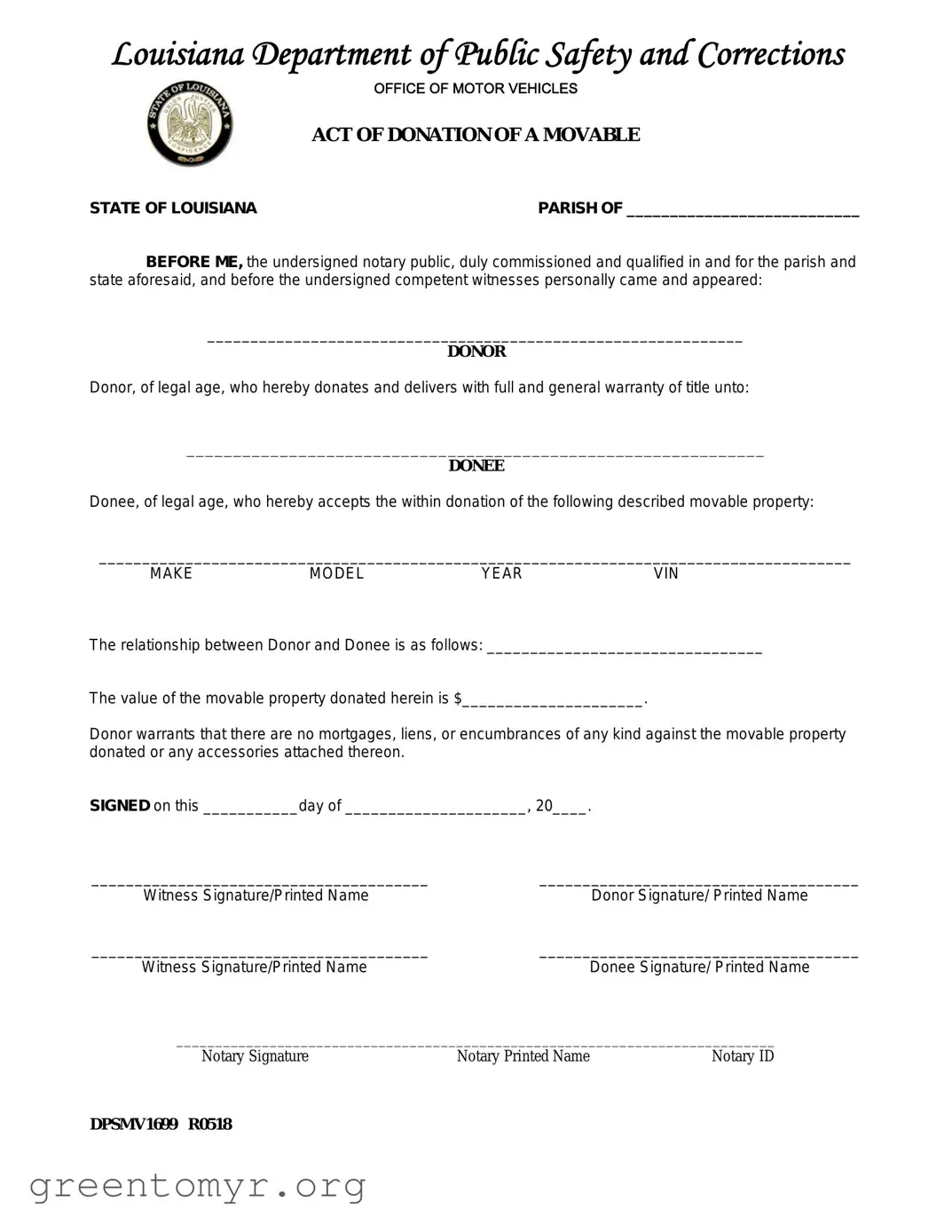
The Louisiana Act of Donation Form serves as a vital legal document for individuals wishing to transfer ownership of property or assets to another party without any expectation of payment in return. This form is particularly significant in Louisiana, where civil law principles guide property transactions. It outlines the essential details of the donation, including the identities of both the donor and the donee, a clear description of the property being donated, and any conditions or stipulations attached to the donation. Additionally, the form requires signatures from both parties, along with the presence of a notary public to validate the transaction. By utilizing this form, donors can ensure that their intentions are legally recognized, providing peace of mind that their gifts will be handled according to their wishes. Understanding the nuances of the Act of Donation can empower individuals to make informed decisions about their assets and foster a sense of generosity within their communities.

Louisiana Department of Public Safety and Corrections
OFFICE OF MOTOR VEHICLES
ACT OF DONATION OF A MOVABLE
STATE OF LOUISIANA |
PARISH OF ___________________________ |
BEFORE ME, the undersigned notary public, duly commissioned and qualified in and for the parish and state aforesaid, and before the undersigned competent witnesses personally came and appeared:
______________________________________________________________
DONOR
Donor, of legal age, who hereby donates and delivers with full and general warranty of title unto:
______________________________________________________________
DONEE
Donee, of legal age, who hereby accepts the within donation of the following described movable property:
_______________________________________________________________________________________
MAKEMODELYEARVIN
The relationship between Donor and Donee is as follows: ________________________________
The value of the movable property donated herein is $_____________________.
Donor warrants that there are no mortgages, liens, or encumbrances of any kind against the movable property donated or any accessories attached thereon.
SIGNED on this ___________day of _____________________, 20____.
_______________________________________ |
_____________________________________ |
|
Witness Signature/Printed Name |
|
Donor Signature/ Printed Name |
_______________________________________ |
_____________________________________ |
|
Witness Signature/Printed Name |
|
Donee Signature/ Printed Name |
_____________________________________________________________________________ |
||
Notary Signature |
Notary Printed Name |
Notary ID |
DPSMV1699 R0518
| Fact Name | Description |
|---|---|
| Definition | The Louisiana Act of Donation is a legal document used to transfer ownership of property from one person to another, typically as a gift. |
| Governing Law | This act is governed by the Louisiana Civil Code, specifically Articles 1468 to 1500. |
| Types of Donations | Donations can be inter vivos (between living persons) or mortis causa (effective upon death). |
| Requirements | The act must be in writing and signed by the donor. If it involves immovable property, it must also be notarized. |
| Revocability | Donations can be revocable unless explicitly stated as irrevocable in the act. |
| Tax Implications | Donations may have tax implications for both the donor and the recipient, including potential gift tax liabilities. |
| Legal Capacity | The donor must have the legal capacity to make a donation, meaning they must be of sound mind and at least 18 years old. |
Filling out the Louisiana Act of Donation form is a straightforward process. Once you have completed the form, you will be ready to formalize the transfer of property or assets to another individual. Ensure that all required information is accurate and clearly written to avoid any issues in the future.
The Louisiana Act of Donation Form is a legal document used to formally donate property or assets from one individual to another. This form is essential in transferring ownership and ensuring that the donation is recognized by law. It provides a clear record of the intent to give and the specifics of the donation.
Anyone who wishes to donate property or assets in Louisiana can use this form. This includes individuals, couples, and even organizations. However, both the donor (the person giving the property) and the donee (the person receiving the property) must be of sound mind and legal age to enter into a contract.
The Act of Donation Form can be used for various types of property, including:
It's important to specify the type of property being donated in the form to avoid any confusion later on.
Yes, the Act of Donation Form must be notarized to be legally binding. This means that a notary public will need to witness the signing of the document. Notarization adds an extra layer of authenticity and helps prevent disputes about the validity of the donation.
Yes, there may be tax implications when making a donation. In the United States, the IRS allows individuals to gift a certain amount each year without incurring gift tax. However, if the value of the donation exceeds this limit, the donor may need to file a gift tax return. It's advisable to consult with a tax professional to understand the specific implications based on your situation.
Once the Act of Donation Form is signed and notarized, the donation is generally considered final. However, if there are specific conditions outlined in the document or if the donee does not accept the donation, there may be grounds for revocation. Legal advice should be sought if you are considering revoking a donation.
The Act of Donation Form is specifically tailored for Louisiana law. While other states may have similar forms, the rules and requirements can vary. If you are considering a donation in another state, it's best to check that state's laws or consult with a legal professional familiar with that jurisdiction.
If the donor passes away before the donation is finalized, the property may revert to the donor's estate unless the donation was completed and accepted by the donee. This situation can complicate matters, so it’s crucial to ensure that the donation is properly executed while the donor is still alive.
The Act of Donation Form should be filed with the appropriate local government office, typically the parish clerk of court, where the property is located. Filing the form ensures that the donation is officially recorded and recognized by the state.
Yes, many resources are available to assist you in filling out the Act of Donation Form. You can seek help from legal professionals, document preparers, or online services that specialize in legal forms. It's important to ensure that the form is filled out correctly to avoid any issues later on.
Filling out the Louisiana Act of Donation form can be a straightforward process, but several common mistakes can lead to complications. Understanding these pitfalls is essential for ensuring that the donation is valid and legally recognized.
One frequent mistake is failing to include all required information. The form requires specific details about both the donor and the recipient, such as names, addresses, and the property being donated. Omitting any of this information can result in delays or even rejection of the form.
Another common error is not having the document properly notarized. In Louisiana, the Act of Donation must be signed in front of a notary public. If the signature is not notarized, the document may not hold up in legal situations, which can lead to disputes down the line.
People often overlook the importance of witnesses. Depending on the nature of the donation, witnesses may be required to sign the document as well. Failing to include witnesses when necessary can invalidate the donation.
Additionally, individuals may misinterpret the terms of the donation. It’s crucial to understand what is being donated and any conditions attached to the donation. Misunderstanding these terms can lead to confusion and potential legal issues in the future.
Another mistake is not keeping copies of the completed form. After submitting the Act of Donation, it’s important to retain a copy for personal records. This can be useful for future reference or in case any disputes arise regarding the donation.
Finally, waiting too long to submit the form can create problems. There are deadlines for filing the Act of Donation, and delays can lead to complications. Timely submission ensures that the donation is recognized and protected under the law.
The Louisiana Act of Donation form is a crucial document for transferring ownership of property as a gift. However, several other forms and documents often accompany it to ensure the process is clear and legally sound. Below is a list of these essential documents, each serving a specific purpose in the donation process.
These documents work together with the Louisiana Act of Donation form to create a comprehensive framework for property donations. Each plays a vital role in protecting the interests of both the donor and the recipient, ensuring a smooth and legally compliant transfer of ownership.
The Louisiana Act of Donation form is a legal document used to transfer ownership of property without any exchange of money. This form is essential for ensuring that the donation is legally recognized and can be enforced. There are several other legal documents that serve similar purposes in various contexts. Here’s a list of ten documents that share similarities with the Louisiana Act of Donation form:
Understanding these documents can help individuals navigate the complexities of property transfer and ensure that their intentions are clearly communicated and legally recognized.
When filling out the Louisiana Act of Donation form, it is crucial to follow certain guidelines to ensure the process goes smoothly. Here’s a list of things you should and shouldn’t do:
Taking these steps will help ensure that your Act of Donation is processed efficiently and correctly.
Understanding the Louisiana act of donation form is crucial for anyone involved in property transfers. Here are seven common misconceptions about this form, along with clarifications to help you navigate the process more effectively.
Many believe that the act of donation form applies solely to real estate. In reality, it can also be used for personal property, such as vehicles or valuable items.
While it is possible to revoke a donation, doing so can be complicated. Once the act is executed and accepted, the donor typically cannot simply change their mind without legal implications.
Some people think that a witness is unnecessary for the act of donation form. However, having a witness can provide additional legal protection and validation of the transaction.
This is not true. Anyone can act as a donor, regardless of their relationship to the recipient. Friends, organizations, and even businesses can make donations.
Many assume that donations are tax-free. However, depending on the value of the donation, there may be tax consequences for both the donor and the recipient that should be considered.
This misconception can lead to confusion. An act of donation is a gift, while a sale involves an exchange of money or services. The legal implications of each are different.
Some think that simply filing the act of donation form is enough. In reality, additional steps, such as recording the donation with the appropriate authorities, may be necessary to ensure the transfer is legally recognized.
Being informed about these misconceptions can help you make better decisions regarding property donations in Louisiana. Always consider seeking professional guidance to navigate the process effectively.
The Louisiana act of donation form is a legal document used for the transfer of ownership of property. Understanding its key aspects is essential for both donors and recipients.
By following these guidelines, individuals can ensure a smoother process when utilizing the Louisiana act of donation form.