Content Navigation

The Louisiana Affidavit of Correction form serves as a crucial tool for individuals seeking to amend errors in public records, ensuring that vital information remains accurate and up to date. This form addresses various types of inaccuracies, including misspellings, incorrect dates, and other factual errors that may appear in official documents. By utilizing this form, individuals can formally request corrections, thereby enhancing the reliability of public records. The process typically involves providing specific details about the error, as well as the correct information that should replace it. Additionally, the affidavit must be signed and notarized, confirming the accuracy of the information provided. Understanding the significance of this form is essential for anyone looking to rectify mistakes in legal documents, as it ultimately helps maintain the integrity of public records in Louisiana.

Louisiana Affidavit of Correction Example

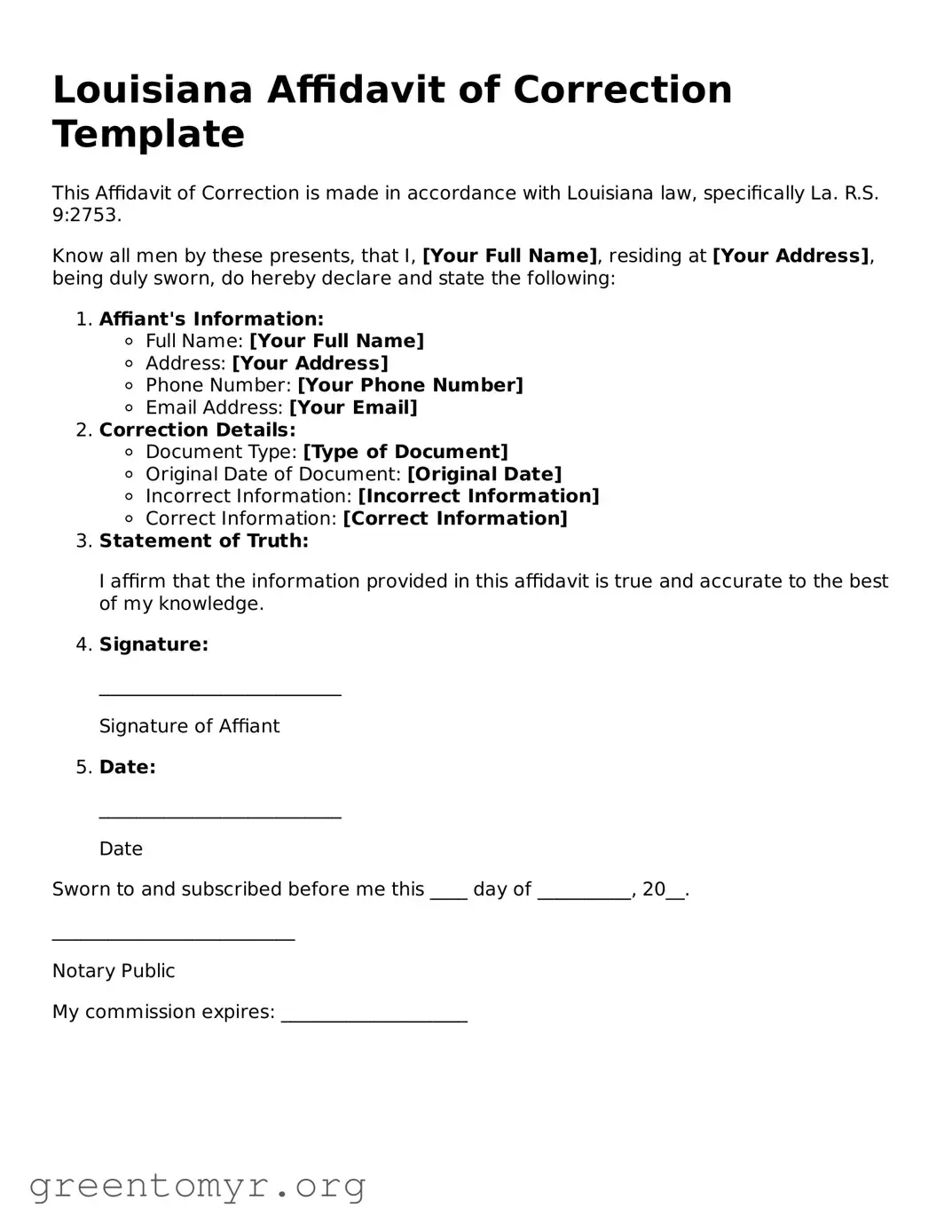
Louisiana Affidavit of Correction Template

This Affidavit of Correction is made in accordance with Louisiana law, specifically La. R.S. 9:2753.

Know all men by these presents, that I, [Your Full Name], residing at [Your Address], being duly sworn, do hereby declare and state the following:

  1. Affiant's Information:
    • Full Name: [Your Full Name]
    • Address: [Your Address]
    • Phone Number: [Your Phone Number]
    • Email Address: [Your Email]
  2. Correction Details:
    • Document Type: [Type of Document]
    • Original Date of Document: [Original Date]
    • Incorrect Information: [Incorrect Information]
    • Correct Information: [Correct Information]
  3. Statement of Truth:
  4. I affirm that the information provided in this affidavit is true and accurate to the best of my knowledge.

  5. Signature:
  6. __________________________

    Signature of Affiant

  7. Date:
  8. __________________________

    Date

Sworn to and subscribed before me this ____ day of __________, 20__.

__________________________

Notary Public

My commission expires: ____________________

PDF Form Features

Fact Name Description
Purpose The Louisiana Affidavit of Correction is used to correct errors in public records, such as deeds or mortgages.
Governing Law This form is governed by Louisiana Civil Code Article 1839.
Filing Requirement The affidavit must be filed with the appropriate parish clerk of court.
Signatures It requires the signature of the individual making the correction and may need a notary public.
Types of Errors Common errors corrected include typographical mistakes, incorrect names, or wrong property descriptions.
Effectiveness Once filed, the correction is effective as of the original date of the document being corrected.
Record Keeping A copy of the affidavit should be kept with the original document for future reference.
Public Access The affidavit becomes part of the public record and can be accessed by anyone.
Limitations This form cannot be used to make substantive changes to the original document; it is strictly for corrections.

Guide to Using Louisiana Affidavit of Correction

Filling out the Louisiana Affidavit of Correction form is a straightforward process. Once completed, you will submit the form to the appropriate authority to address any discrepancies in official documents. Follow these steps to ensure accuracy and compliance.

  1. Begin by downloading the Louisiana Affidavit of Correction form from the official website or obtain a hard copy from your local office.
  2. Read the instructions carefully to understand the required information.
  3. In the first section, provide your full name and contact information, including your address and phone number.
  4. Next, identify the document that needs correction. Include details such as the title of the document, the date it was issued, and any reference numbers.
  5. Clearly state the specific errors that need to be corrected. Be precise and concise in your description.
  6. In the designated area, provide the correct information that should replace the erroneous data.
  7. Sign and date the affidavit at the bottom of the form. Ensure your signature matches the name provided at the beginning.
  8. If required, have the affidavit notarized. This may be necessary for the form to be accepted.
  9. Make copies of the completed form for your records before submission.
  10. Submit the affidavit to the appropriate authority, either in person or by mail, as instructed.

Get Answers on Louisiana Affidavit of Correction

What is the Louisiana Affidavit of Correction form?

The Louisiana Affidavit of Correction form is a legal document used to correct errors in public records. This may include mistakes in property deeds, marriage licenses, or other official documents. The form allows individuals to provide a sworn statement that clarifies or rectifies inaccuracies, ensuring that the public record accurately reflects the intended information.

Who can file an Affidavit of Correction?

Any individual or entity that identifies an error in a public record can file an Affidavit of Correction. This includes property owners, spouses, or legal representatives. It is essential that the person filing the affidavit has a direct interest in the record being corrected, as they must provide accurate information and attest to the truthfulness of the claims made in the affidavit.

What information is required to complete the form?

To complete the Louisiana Affidavit of Correction form, you will need to provide the following information:

  1. Your full name and contact information.
  2. A description of the document that contains the error.
  3. The specific error that needs to be corrected.
  4. The correct information that should replace the erroneous data.
  5. A statement affirming the truth of the information provided, along with your signature.

It is crucial to ensure that all details are accurate and complete to avoid further complications.

How do I file the Affidavit of Correction?

Filing the Affidavit of Correction involves several steps:

  • Complete the form with accurate information.
  • Sign the affidavit in the presence of a notary public.
  • Submit the completed form to the appropriate government office, such as the parish clerk of court or recorder of mortgages.
  • Pay any required filing fees.

After submission, keep a copy of the filed affidavit for your records. This document serves as proof of the correction made to the public record.

Common mistakes

Filling out the Louisiana Affidavit of Correction form can be a straightforward process, but many individuals make common mistakes that can lead to delays or complications. One frequent error is failing to provide accurate personal information. It’s crucial to ensure that names, addresses, and other identifying details are correct. Even a small typo can result in significant issues down the line.

Another common mistake is neglecting to sign the form. A signature is not just a formality; it validates the document. Without it, the affidavit may be considered incomplete and could be rejected. Additionally, some individuals forget to date the form, which can also lead to confusion regarding when the affidavit was completed.

Many people also overlook the requirement for witnesses. In Louisiana, certain affidavits must be signed in the presence of a notary public and witnessed by a third party. Failing to include a witness can invalidate the affidavit, so it’s essential to follow this step carefully.

Inaccurate descriptions of the corrections being made is another mistake. The affidavit should clearly outline what information is being corrected and why. Vague or unclear explanations can lead to misunderstandings and may require additional documentation to clarify the intent.

Some individuals mistakenly believe that they can submit the affidavit without any supporting documents. It is often necessary to attach relevant paperwork that substantiates the correction being made. This could include copies of previous documents or evidence that supports the need for correction.

Another pitfall is not checking for consistency across all documents. If the information on the affidavit does not match other official records, it can raise red flags. Ensure that all records reflect the same information to avoid complications.

People sometimes fail to keep copies of the completed affidavit. Having a copy for personal records is important, as it can serve as proof of the corrections made. In case of future disputes or questions, this documentation can be invaluable.

Additionally, submitting the affidavit to the wrong office or agency is a mistake that can delay the process. It’s vital to know where the affidavit needs to be filed and to ensure it reaches the correct destination.

Lastly, individuals often underestimate the time it takes for the corrections to be processed. After submission, it may take several weeks for the changes to be officially recognized. Being patient and following up if necessary can help keep the process on track.

Documents used along the form

When dealing with the Louisiana Affidavit of Correction, several other forms and documents may also be necessary to ensure that your corrections are properly filed and recognized. Below is a list of these documents, along with a brief description of each.

  • Affidavit of Identity: This document verifies the identity of the individual making the correction. It may be required to confirm that the person signing the affidavit is indeed who they claim to be.
  • Certificate of Correction: This form is used to officially document the changes made to a previously filed document. It serves as a formal acknowledgment of the corrections made.
  • Notice of Intent: This notice informs relevant parties about the intention to correct a document. It is often required to ensure that all interested parties are aware of the changes being made.
  • Declaration of Facts: This document outlines the specific facts surrounding the need for correction. It provides context and details that support the request for changes.
  • Supporting Affidavit: This is a sworn statement that provides additional evidence or testimony related to the correction. It may be used to bolster the claims made in the Affidavit of Correction.
  • Cover Letter: A cover letter accompanies the Affidavit of Correction and other documents. It summarizes the purpose of the submission and lists the enclosed forms for clarity.

Having these documents prepared and organized can help streamline the process of making corrections in Louisiana. Each form plays a crucial role in ensuring that your corrections are valid and recognized by the appropriate authorities.

Similar forms

  • Affidavit of Identity: This document verifies an individual's identity, similar to how the Affidavit of Correction verifies the accuracy of information. Both serve to clarify or correct details in official records.
  • Affidavit of Support: Used primarily in immigration cases, this affidavit confirms that a sponsor can financially support an immigrant. Like the Affidavit of Correction, it requires a sworn statement to affirm the truth of the information provided.
  • Affidavit of Heirship: This document establishes the heirs of a deceased person. It serves a similar purpose of clarifying legal relationships and correcting any misconceptions about inheritance.
  • Affidavit of Service: This document confirms that legal documents have been delivered to the appropriate parties. It parallels the Affidavit of Correction in that both provide sworn evidence regarding procedural accuracy.
  • Declaration of Domicile: This document declares an individual’s primary residence. Like the Affidavit of Correction, it aims to clarify important personal information for legal purposes.
  • Affidavit of Marriage: This document serves as proof of a marriage. It is similar to the Affidavit of Correction in that it is a sworn statement used to affirm the truth of personal circumstances.
  • Affidavit of Loss: This document is used to declare that a specific item, such as a title or document, has been lost. It shares a commonality with the Affidavit of Correction in that both address the need to rectify a situation based on factual inaccuracies.
  • Affidavit of Title: This document certifies that a person holds clear title to a property. It is akin to the Affidavit of Correction as both involve affirming the accuracy of information related to ownership.
  • Affidavit of Consent: This document is often used in situations where parental consent is required, such as for minors traveling. Like the Affidavit of Correction, it ensures that all parties are informed and in agreement regarding specific information.
  • Affidavit of Truth: This document is a sworn statement asserting the truth of certain facts. It is similar to the Affidavit of Correction in that both require a declaration of accuracy to rectify or clarify details.

Dos and Don'ts

When filling out the Louisiana Affidavit of Correction form, it is essential to follow specific guidelines to ensure accuracy and compliance. Here are some important dos and don'ts:

  • Do read the instructions carefully before starting.
  • Do provide accurate and complete information.
  • Do sign and date the affidavit where required.
  • Do keep a copy of the completed form for your records.
  • Do submit the form to the correct office or authority.
  • Don't use white-out or correction fluid on the form.
  • Don't leave any required fields blank.
  • Don't submit the affidavit without verifying all information.
  • Don't ignore deadlines for submission.

By adhering to these guidelines, you can help ensure that your Affidavit of Correction is processed smoothly and effectively.

Misconceptions

The Louisiana Affidavit of Correction form is often misunderstood. Here are eight common misconceptions about this important document:

  1. It can be used for any type of error. Many believe that the affidavit can correct any mistake. However, it is specifically designed for correcting clerical errors or mistakes in public records, not substantive errors.
  2. It requires a lawyer to file. Some think that legal representation is mandatory for submitting the affidavit. In reality, individuals can file the form themselves, although consulting a lawyer can be beneficial.
  3. It is only for property records. While often associated with property documents, the affidavit can also be used for other public records, such as marriage certificates or birth records.
  4. Once filed, it cannot be changed. A common belief is that the affidavit is final and cannot be modified. In truth, if new errors are discovered, a subsequent affidavit can be filed to address them.
  5. It eliminates the original error completely. Some think that filing the affidavit erases the original mistake. Instead, the affidavit serves to clarify the record, not to erase past errors.
  6. It has no legal standing. Many people assume that the affidavit is not a legally binding document. However, once filed and accepted, it holds legal weight and can be used to support claims regarding the corrected information.
  7. It can be filed at any time. Some believe that there are no time limits for filing the affidavit. In fact, there may be specific timeframes within which corrections must be made, depending on the type of record.
  8. All corrections require notarization. While notarization is often recommended, not all corrections necessitate it. The requirements may vary based on the specific type of document being corrected.

Understanding these misconceptions can help individuals navigate the process of filing a Louisiana Affidavit of Correction more effectively.

Key takeaways

When filling out and using the Louisiana Affidavit of Correction form, consider the following key takeaways:

  • Purpose: This form is designed to correct errors in public records, such as property deeds or vital records.
  • Eligibility: Ensure that you are eligible to file this affidavit. Typically, the person who made the error or an authorized representative can submit it.
  • Details Required: Provide accurate information regarding the original document, including names, dates, and specific errors that need correction.
  • Notarization: The affidavit must be signed in the presence of a notary public to be considered valid.
  • Filing Process: After completing the form, file it with the appropriate government office, such as the parish clerk of court, to officially record the correction.