Content Navigation

The Louisiana Affidavit of Residency form serves as a vital document for individuals seeking to establish their residency within the state. This form is often required for various purposes, including enrolling children in public schools, obtaining certain government benefits, or even securing a driver's license. By completing the affidavit, individuals affirm their physical presence in Louisiana and their intent to make it their permanent home. The form typically requires personal information, such as the applicant's name, address, and the duration of residency. Additionally, it may need to be notarized to ensure authenticity and compliance with state regulations. Understanding the significance of this document is crucial for anyone navigating the complexities of residency requirements in Louisiana, as it plays a key role in accessing essential services and rights within the state.

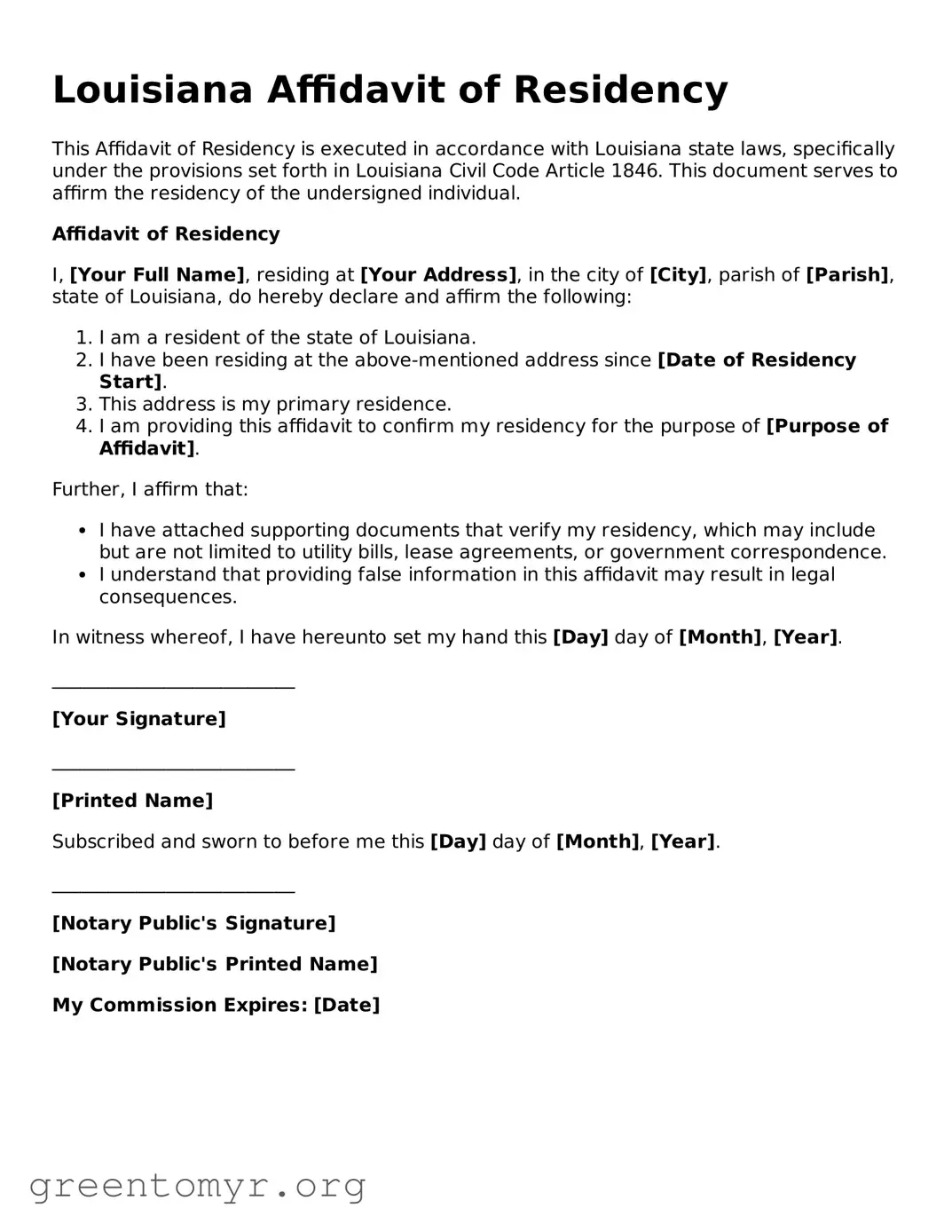
Louisiana Affidavit of Residency Example

Louisiana Affidavit of Residency

This Affidavit of Residency is executed in accordance with Louisiana state laws, specifically under the provisions set forth in Louisiana Civil Code Article 1846. This document serves to affirm the residency of the undersigned individual.

Affidavit of Residency

I, [Your Full Name], residing at [Your Address], in the city of [City], parish of [Parish], state of Louisiana, do hereby declare and affirm the following:

  1. I am a resident of the state of Louisiana.
  2. I have been residing at the above-mentioned address since [Date of Residency Start].
  3. This address is my primary residence.
  4. I am providing this affidavit to confirm my residency for the purpose of [Purpose of Affidavit].

Further, I affirm that:

  • I have attached supporting documents that verify my residency, which may include but are not limited to utility bills, lease agreements, or government correspondence.
  • I understand that providing false information in this affidavit may result in legal consequences.

In witness whereof, I have hereunto set my hand this [Day] day of [Month], [Year].

__________________________

[Your Signature]

__________________________

[Printed Name]

Subscribed and sworn to before me this [Day] day of [Month], [Year].

__________________________

[Notary Public's Signature]

[Notary Public's Printed Name]

My Commission Expires: [Date]

PDF Form Features

Fact Name Description
Purpose The Louisiana Affidavit of Residency form is used to verify an individual's residency in the state of Louisiana.
Governing Law This form is governed by Louisiana Revised Statutes, particularly under Title 9, which addresses affidavits and declarations.
Usage It is commonly required for various legal processes, including school enrollment and certain government applications.
Signature Requirement The form must be signed in the presence of a notary public to be considered valid.

Guide to Using Louisiana Affidavit of Residency

Completing the Louisiana Affidavit of Residency form is a straightforward process that requires attention to detail. After filling out the form, you will need to submit it to the appropriate authority to verify your residency status.

  1. Begin by downloading the Louisiana Affidavit of Residency form from the official state website or obtain a physical copy from a local office.
  2. At the top of the form, fill in your full name as it appears on your identification.
  3. Provide your current residential address, including the street number, street name, city, state, and zip code.
  4. Include your date of birth in the designated section, ensuring the format is correct.
  5. Indicate the duration of your residency at the provided address, specifying the month and year you moved in.
  6. In the section for additional information, you may need to list any other addresses where you have resided in the past.
  7. Sign the affidavit in the space provided, confirming that the information you provided is accurate and true to the best of your knowledge.
  8. Date the form in the designated area below your signature.
  9. Finally, review the entire form for any errors or omissions before submitting it.

Get Answers on Louisiana Affidavit of Residency

What is the Louisiana Affidavit of Residency form?

The Louisiana Affidavit of Residency form is a legal document that verifies a person's residence in Louisiana. This form is often used for various purposes, such as enrolling children in school, applying for certain benefits, or proving residency for legal matters. By signing this affidavit, an individual declares that they live at a specific address within the state.

Who needs to complete the Affidavit of Residency?

Anyone who needs to confirm their residency in Louisiana may need to complete this form. Common situations include:

  • Parents enrolling their children in local schools.
  • Individuals applying for state benefits or services.
  • Residents needing to prove their address for legal proceedings.

In each case, the affidavit serves as a formal declaration of where a person resides.

How do I fill out the Affidavit of Residency form?

Filling out the Louisiana Affidavit of Residency form is straightforward. Follow these steps:

  1. Start by providing your full name and the address where you reside.
  2. Include any additional information required, such as the length of time you have lived at that address.
  3. Sign and date the form in the designated area.
  4. Consider having the affidavit notarized to add an extra layer of verification.

Ensure that all information is accurate and complete before submitting the form.

Where do I submit the completed Affidavit of Residency?

The submission process for the Affidavit of Residency can vary based on its purpose. Typically, you may need to submit the completed form to:

  • Your child's school if enrolling them.
  • A government agency if applying for benefits.
  • The court if used for legal matters.

Always check with the specific entity to confirm their submission requirements and any additional documentation they may need.

Common mistakes

Filling out the Louisiana Affidavit of Residency form requires attention to detail. One common mistake is failing to provide accurate personal information. This includes the full name, address, and date of birth. Inaccuracies can lead to delays or rejections of the application.

Another frequent error involves the omission of required signatures. Both the affiant and the notary must sign the document. If either signature is missing, the affidavit will not be considered valid.

Some individuals neglect to include supporting documentation. Proof of residency, such as utility bills or lease agreements, is often necessary. Without this documentation, the affidavit may not fulfill its intended purpose.

Many applicants also misinterpret the residency requirements. It is crucial to understand what constitutes residency in Louisiana. Misunderstanding these terms can result in incorrect information being submitted.

Another mistake is using outdated forms. The Louisiana Department of Revenue periodically updates its forms. Using an old version may lead to complications or rejection of the affidavit.

Inconsistent information is a significant issue. If the information on the affidavit does not match other official documents, it can raise red flags. Consistency is key to ensuring the affidavit is accepted.

Some individuals rush through the form, leading to typographical errors. Simple mistakes in spelling or numbers can undermine the credibility of the affidavit. Taking the time to review the form can prevent these issues.

Failing to check the submission guidelines is another common oversight. Each agency may have specific requirements for how the affidavit should be submitted. Adhering to these guidelines is essential for timely processing.

Additionally, some applicants do not keep copies of their submitted forms. Retaining a copy can be beneficial for future reference or in case of disputes. This simple step can save time and confusion later on.

Finally, misunderstanding the notary process can lead to complications. Notaries must be properly commissioned and authorized to perform their duties. If the notary is not legitimate, the affidavit may not hold up in legal situations.

Documents used along the form

The Louisiana Affidavit of Residency form serves as a crucial document for verifying a person's residency status in the state. However, it is often accompanied by other forms and documents that support the residency claim or fulfill additional legal requirements. Below is a list of commonly used documents alongside the affidavit.

  • Proof of Identity: This document, such as a driver's license or state ID, confirms the individual's identity and is often required to validate the information provided in the affidavit.
  • Utility Bill: A recent utility bill in the individual's name can serve as evidence of residency, showing that the person resides at the stated address.
  • Lease Agreement: A signed lease agreement demonstrates a legal commitment to reside at a specific location, further supporting the claim of residency.
  • Bank Statement: A bank statement with the individual's name and address can provide additional proof of residency, particularly when dated within the last few months.
  • Voter Registration Card: This card indicates that the individual is registered to vote at the given address, reinforcing their residency status.
  • Employment Verification Letter: A letter from an employer confirming the individual's employment and address can serve as supporting documentation for residency claims.
  • Government Correspondence: Any official correspondence from a government agency addressed to the individual at their claimed residence can help substantiate their residency.
  • Affidavit from a Witness: A sworn statement from a person who can attest to the individual's residency may be necessary in certain situations to provide additional validation.

Each of these documents plays a vital role in establishing and verifying residency in Louisiana. Together with the Affidavit of Residency, they create a comprehensive picture of an individual's living situation, ensuring compliance with legal requirements and facilitating various administrative processes.

Similar forms

The Affidavit of Residency form serves a specific purpose, but it shares similarities with several other documents. Each of these documents may be used to verify residency or provide proof of identity and address. Here are six documents that are similar to the Affidavit of Residency:

  • Lease Agreement: This document outlines the terms of renting a property and includes the tenant's name and the address of the rental unit, serving as proof of residency.
  • Utility Bill: A recent utility bill can show the name and address of the resident. It acts as evidence of where a person lives, similar to the Affidavit of Residency.
  • Voter Registration Card: This card contains the voter's name and address, confirming their residency in a particular jurisdiction. It serves a similar purpose in establishing residency.
  • Bank Statement: A bank statement with the individual's name and address can be used to verify residency. It provides a financial record that indicates where a person resides.
  • Government-Issued ID: An ID such as a driver's license or state ID includes the holder's address, serving as an official confirmation of residency.
  • Tax Return: A tax return filed with the government typically lists the taxpayer's address, which can be used to confirm residency for various purposes.

Dos and Don'ts

When filling out the Louisiana Affidavit of Residency form, it is important to follow certain guidelines to ensure accuracy and compliance. Here is a list of things you should and shouldn't do:

  • Do read the entire form carefully before starting.
  • Do provide accurate and truthful information.
  • Do include all required signatures and dates.
  • Do use clear and legible handwriting if filling out the form by hand.
  • Do double-check your contact information for any errors.
  • Don't leave any required fields blank.
  • Don't use abbreviations unless specified on the form.
  • Don't submit the form without reviewing it for accuracy.
  • Don't forget to keep a copy of the completed form for your records.
  • Don't hesitate to seek assistance if you have questions about the form.

Misconceptions

The Louisiana Affidavit of Residency form is often misunderstood. Here are eight common misconceptions:

  • Only homeowners can use the form. Many believe that only those who own property can fill out the affidavit. However, renters and individuals living with family or friends can also use it to verify their residency.
  • The form is only for legal purposes. While the affidavit can serve legal functions, it is also used for various administrative purposes, such as obtaining a driver's license or enrolling in school.
  • Residency must be established for a certain period. Some think that you must live in Louisiana for a specific amount of time before completing the form. In reality, the affidavit can be completed as soon as you establish residency.
  • Notarization is optional. A common misconception is that notarization is not necessary. In fact, the form must be notarized to be considered valid.
  • Only Louisiana residents can fill out the form. While the affidavit is for those claiming residency in Louisiana, individuals who have recently moved to the state can also complete it.
  • The form is complicated and difficult to understand. Many feel intimidated by the process. However, the affidavit is straightforward and typically requires basic information about the individual and their residence.
  • It can be submitted online. Some believe that the affidavit can be filed electronically. However, it generally must be submitted in person or via mail with the necessary signatures.
  • Once submitted, the affidavit cannot be changed. There is a belief that the information on the affidavit is permanent. In reality, individuals can amend or update their affidavit if their residency status changes.

Understanding these misconceptions can help ensure that the Louisiana Affidavit of Residency form is used correctly and effectively.

Key takeaways

When filling out and using the Louisiana Affidavit of Residency form, consider the following key takeaways:

  • The affidavit is a legal document used to verify your residency in Louisiana.
  • Ensure that all information provided is accurate and truthful to avoid potential legal issues.
  • The form must be signed in the presence of a notary public.
  • Keep a copy of the completed affidavit for your records.
  • Use the affidavit when applying for services or benefits that require proof of residency.
  • Be aware of any deadlines for submitting the affidavit, as these may vary by agency.
  • Check if additional documentation is needed to support your residency claim.
  • If you have questions, seek assistance from a legal professional or the relevant agency.