Content Navigation

The Louisiana Bill of Sale form is an essential document for anyone involved in the buying or selling of personal property within the state. This form serves as a legal record of the transaction, ensuring both parties have a clear understanding of the terms involved. It includes critical information such as the names and addresses of the buyer and seller, a detailed description of the item being sold, and the sale price. Additionally, the form may outline any warranties or guarantees related to the item, protecting the interests of both parties. Notably, the Bill of Sale can be used for various types of property, including vehicles, boats, and equipment, making it a versatile tool for different transactions. By documenting the sale, this form helps prevent future disputes and provides a clear trail of ownership, which can be particularly important for items that require registration or licensing. Understanding the components of the Louisiana Bill of Sale is crucial for ensuring a smooth and legally compliant transfer of property.

Louisiana Bill of Sale Example

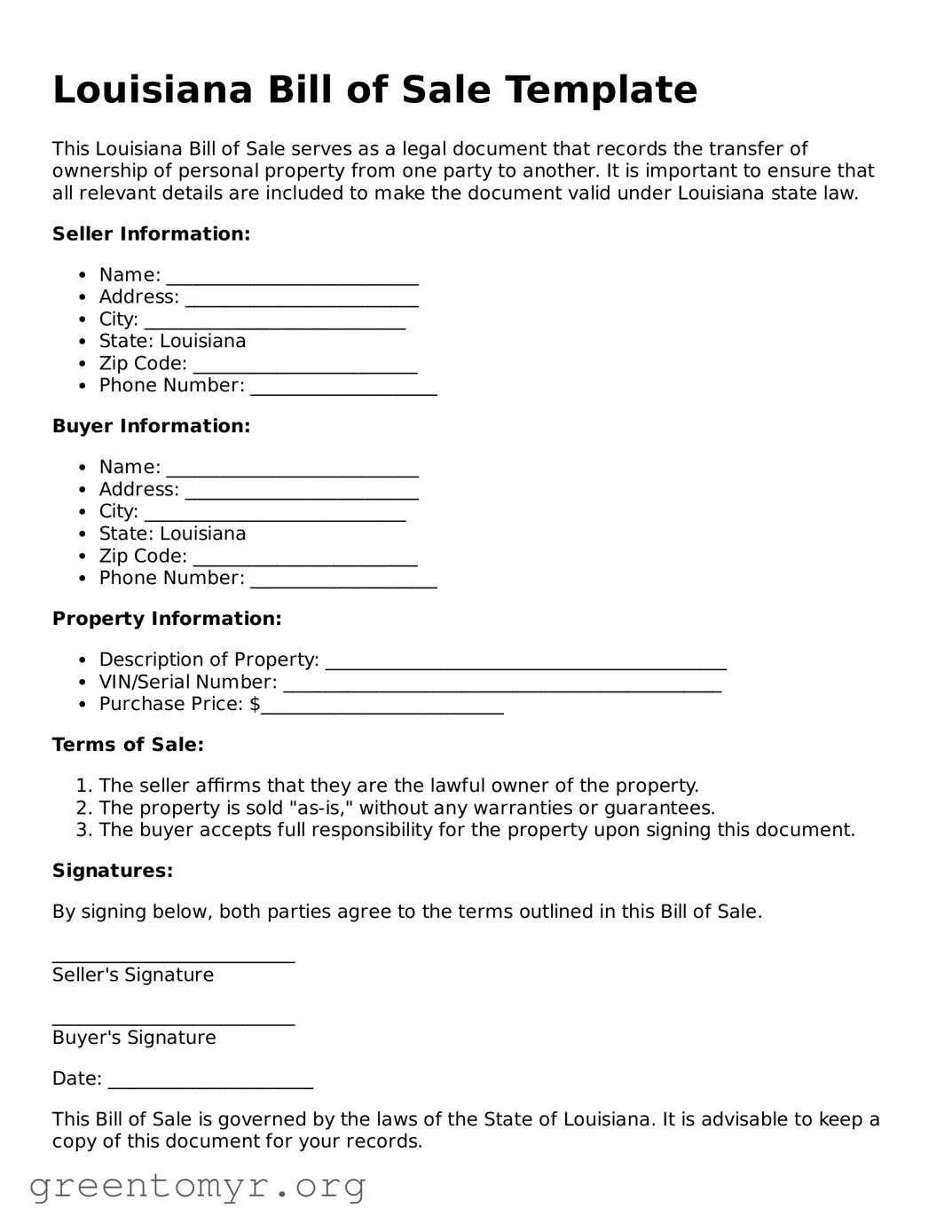
Louisiana Bill of Sale Template

This Louisiana Bill of Sale serves as a legal document that records the transfer of ownership of personal property from one party to another. It is important to ensure that all relevant details are included to make the document valid under Louisiana state law.

Seller Information:

  • Name: ___________________________
  • Address: _________________________
  • City: ____________________________
  • State: Louisiana
  • Zip Code: ________________________
  • Phone Number: ____________________

Buyer Information:

  • Name: ___________________________
  • Address: _________________________
  • City: ____________________________
  • State: Louisiana
  • Zip Code: ________________________
  • Phone Number: ____________________

Property Information:

  • Description of Property: ___________________________________________
  • VIN/Serial Number: _______________________________________________
  • Purchase Price: $__________________________

Terms of Sale:

  1. The seller affirms that they are the lawful owner of the property.
  2. The property is sold "as-is," without any warranties or guarantees.
  3. The buyer accepts full responsibility for the property upon signing this document.

Signatures:

By signing below, both parties agree to the terms outlined in this Bill of Sale.

__________________________
Seller's Signature

__________________________
Buyer's Signature

Date: ______________________

This Bill of Sale is governed by the laws of the State of Louisiana. It is advisable to keep a copy of this document for your records.

PDF Form Features

Fact Name Description
Purpose The Louisiana Bill of Sale form is used to transfer ownership of personal property from one person to another.
Governing Law This form is governed by Louisiana Civil Code, particularly Article 2440 and Article 2441.
Types of Property It can be used for various types of personal property, including vehicles, boats, and equipment.
Notarization While notarization is not always required, it is recommended for added legal protection.
Buyer and Seller Information Both the buyer and seller must provide their names, addresses, and signatures on the form.
Consideration The form should state the purchase price or other consideration for the property being sold.
Record Keeping Both parties should keep a copy of the Bill of Sale for their records, as it serves as proof of the transaction.

Guide to Using Louisiana Bill of Sale

Completing the Louisiana Bill of Sale form is an essential step in documenting the transfer of ownership for a vehicle or personal property. Once the form is filled out correctly, it should be signed by both the seller and the buyer. This ensures that both parties have a clear record of the transaction.

  1. Begin by entering the date of the sale at the top of the form.
  2. Provide the full name and address of the seller in the designated fields.
  3. Next, enter the buyer's full name and address in the appropriate sections.
  4. Clearly describe the item being sold. Include details such as the make, model, year, and Vehicle Identification Number (VIN) if applicable.
  5. Indicate the purchase price of the item in the specified area.
  6. Include any additional terms or conditions of the sale, if necessary.
  7. Both the seller and buyer should sign and date the form at the bottom.
  8. Make copies of the completed Bill of Sale for both parties' records.

Get Answers on Louisiana Bill of Sale

What is a Louisiana Bill of Sale?

A Louisiana Bill of Sale is a legal document that serves as proof of the transfer of ownership of personal property from one party to another. This document outlines the details of the transaction, including the description of the item being sold, the purchase price, and the names and addresses of both the buyer and the seller. It is commonly used for vehicles, boats, and other valuable items. Having a Bill of Sale can protect both parties by providing a record of the transaction.

Do I need a Bill of Sale for every transaction in Louisiana?

While a Bill of Sale is not required for every transaction, it is highly recommended for significant purchases or sales. For items like vehicles or boats, a Bill of Sale is often necessary for registration and titling purposes. Even for smaller items, having a written record can help resolve disputes and clarify ownership. It is always wise to document any sale, especially if the item has considerable value.

What information should be included in a Louisiana Bill of Sale?

A comprehensive Louisiana Bill of Sale should include the following information:

  • The names and addresses of both the buyer and the seller.
  • A detailed description of the item being sold, including make, model, year, and VIN for vehicles.
  • The purchase price of the item.
  • The date of the transaction.
  • Any warranties or guarantees provided by the seller.
  • Signatures of both parties to acknowledge the agreement.

Including these details can help ensure that the document serves its purpose effectively.

Is a Bill of Sale legally binding in Louisiana?

Yes, a Bill of Sale is legally binding in Louisiana as long as it meets certain requirements. Both parties must voluntarily agree to the terms outlined in the document, and it should be signed by both the buyer and the seller. While notarization is not mandatory, having the document notarized can add an extra layer of authenticity and may be beneficial in case of disputes. Always keep a copy of the signed Bill of Sale for your records.

Common mistakes

Filling out a Louisiana Bill of Sale form can seem straightforward, but many individuals make common mistakes that can lead to complications down the line. One frequent error is failing to include all necessary details about the item being sold. It’s essential to provide a clear description, including make, model, year, and any identifying numbers, such as a Vehicle Identification Number (VIN) for vehicles. Without this information, the document may not serve its purpose effectively.

Another common mistake is neglecting to include the full names and addresses of both the buyer and the seller. Providing incomplete or inaccurate contact information can create confusion and make it difficult to reach either party if needed. Always double-check that all names are spelled correctly and that addresses are complete, including city and zip code.

Some people forget to specify the sale price. Leaving this blank can lead to misunderstandings about the transaction. It’s vital to clearly state the amount agreed upon to avoid any disputes later. Additionally, it’s a good practice to indicate the method of payment, whether cash, check, or another form, to provide clarity.

Signing the document is another crucial step that some overlook. Both parties must sign the Bill of Sale to validate the transaction. Without signatures, the document may not be recognized legally. Furthermore, it’s advisable to have the signatures dated to provide a timeline for the transaction.

Another mistake is not having witnesses or notarization when required. While not always necessary, certain transactions may benefit from having a witness or being notarized to enhance the document's legitimacy. Check local requirements to determine if this step is needed for your specific situation.

People often forget to keep copies of the completed Bill of Sale. After all parties have signed, it’s essential to retain a copy for your records. This document serves as proof of the transaction and can be important for future reference, especially if any disputes arise.

Some individuals also fail to review the form for any errors before submitting it. Typos or incorrect information can lead to issues down the line. Taking a moment to carefully review the document can save time and trouble later.

Finally, not understanding the specific laws and regulations regarding Bill of Sale forms in Louisiana can lead to mistakes. Each state has its own requirements, so it’s important to familiarize yourself with local laws to ensure compliance. This knowledge can help avoid potential pitfalls and ensure a smooth transaction.

Documents used along the form

When engaging in a transaction that involves the sale of personal property in Louisiana, the Bill of Sale form is a crucial document. However, it is often accompanied by other forms and documents that help ensure the transaction is complete and legally sound. Below is a list of commonly used documents that complement the Louisiana Bill of Sale.

  • Title Transfer Document: This document is essential for transferring ownership of vehicles or boats. It provides proof that the seller has relinquished their rights to the property and that the buyer is now the rightful owner.
  • Vehicle Registration Application: For motor vehicles, this application must be completed and submitted to the Louisiana Department of Motor Vehicles. It allows the new owner to register the vehicle in their name and obtain new license plates.
  • Affidavit of Ownership: In some cases, especially with used items or vehicles, this sworn statement may be necessary. It asserts that the seller is the rightful owner and has the authority to sell the item.
  • Sales Tax Form: Depending on the nature of the sale, a sales tax form may be required. This form documents the sales tax collected on the transaction, ensuring compliance with state tax regulations.
  • Inspection Certificate: For certain types of vehicles, an inspection certificate is often needed. This certificate verifies that the vehicle meets safety and emissions standards, providing peace of mind to the buyer.

These documents work together with the Louisiana Bill of Sale to facilitate a smooth and legally compliant transaction. It is advisable to gather all necessary paperwork to avoid complications and ensure a seamless transfer of ownership.

Similar forms

The Bill of Sale form serves a specific purpose in documenting the transfer of ownership of personal property. However, there are several other documents that share similarities with it in terms of function and usage. Below is a list of these documents, each explained in relation to the Bill of Sale.

  • Purchase Agreement: This document outlines the terms and conditions of a sale between a buyer and a seller. Like a Bill of Sale, it serves to confirm the agreement on the transfer of ownership, but it often includes more detailed terms, such as payment schedules and contingencies.
  • Lease Agreement: A lease agreement is used to outline the terms under which one party can use property owned by another party. Similar to a Bill of Sale, it formalizes the relationship between the parties involved, though it typically involves temporary possession rather than a permanent transfer of ownership.
  • Title Transfer Document: This document specifically transfers the title of a vehicle from one person to another. Like a Bill of Sale, it is essential for proving ownership and is often required for registration purposes.
  • Gift Deed: A gift deed is used when property is given as a gift rather than sold. It shares the Bill of Sale's purpose of documenting the transfer of ownership, but it does not involve any exchange of money.
  • Warranty Deed: This legal document transfers real estate ownership and guarantees that the property is free of any liens or claims. While a Bill of Sale is typically used for personal property, a warranty deed serves a similar function for real estate transactions.
  • Quitclaim Deed: This document allows a person to transfer their interest in a property to another person without any warranties. Like a Bill of Sale, it provides a record of the transfer, but it does not guarantee that the property is free of encumbrances.
  • Sales Receipt: A sales receipt is a document that confirms a purchase transaction. It serves a similar purpose to a Bill of Sale in that it provides proof of the exchange, but it is often less formal and may not include detailed terms of the sale.

Dos and Don'ts

When filling out the Louisiana Bill of Sale form, it’s important to get it right. Here are some dos and don’ts to keep in mind:

  • Do provide accurate information about the buyer and seller.
  • Do include a detailed description of the item being sold.
  • Do specify the purchase price clearly.
  • Do sign and date the form to make it official.
  • Don't leave any sections blank; fill in all required fields.
  • Don't use vague language; be specific in your descriptions.
  • Don't forget to provide both parties' contact information.
  • Don't skip the witness signature if required for your transaction.

Misconceptions

The Louisiana Bill of Sale form is often misunderstood. Here are ten common misconceptions about it:

  1. It is only for vehicles. Many believe the Bill of Sale is limited to vehicle transactions. In reality, it can be used for various personal property sales, including boats, furniture, and equipment.
  2. It does not need to be notarized. Some people think that a Bill of Sale is valid without a notary. While notarization is not always required, having it notarized can provide additional legal protection.
  3. It is the same as a receipt. A receipt confirms payment, but a Bill of Sale serves as a legal document transferring ownership. It includes more detailed information about the transaction.
  4. All sales require a Bill of Sale. Not every sale requires this document. For example, informal gifts or transactions under a certain value may not need a Bill of Sale.
  5. It protects the seller only. Many think that the Bill of Sale only benefits the seller. In fact, it protects both parties by documenting the terms of the sale.
  6. It must be filed with the state. Some believe the Bill of Sale must be submitted to a state office. This is not true; it is typically kept by the buyer and seller for their records.
  7. It can be handwritten. While a Bill of Sale can be handwritten, using a template or printed form is advisable to ensure all necessary information is included.
  8. It is only valid if completed on the sale date. Although it is best practice to complete it at the time of sale, a Bill of Sale can be dated later as long as both parties agree.
  9. It is only necessary for large transactions. Some people think a Bill of Sale is only needed for high-value items. However, it is wise to use one for any significant transaction to avoid disputes.
  10. Once signed, it cannot be changed. Many believe that a Bill of Sale is final and unchangeable. In truth, both parties can agree to amend the document if necessary, as long as changes are documented.

Key takeaways

When dealing with the Louisiana Bill of Sale form, it is important to understand its purpose and how to fill it out correctly. Here are some key takeaways to keep in mind:

  • Purpose of the Bill of Sale: This document serves as a legal record of the transfer of ownership for personal property, such as vehicles, boats, or other items.
  • Information Required: The form requires specific details, including the names and addresses of both the seller and buyer, a description of the item being sold, and the sale price.
  • Signatures: Both parties must sign the Bill of Sale to validate the transaction. This signature confirms that both the seller and buyer agree to the terms outlined in the document.
  • Notarization: While notarization is not always required, having the Bill of Sale notarized can provide an additional layer of security and authenticity to the transaction.
  • Record Keeping: It is advisable for both parties to keep a copy of the completed Bill of Sale for their records. This can be useful for future reference or in case of disputes.
  • State-Specific Regulations: Always check for any specific regulations or requirements in Louisiana that may affect the Bill of Sale, especially for certain types of property like vehicles.

By following these guidelines, individuals can ensure that their transactions are smooth and legally sound.