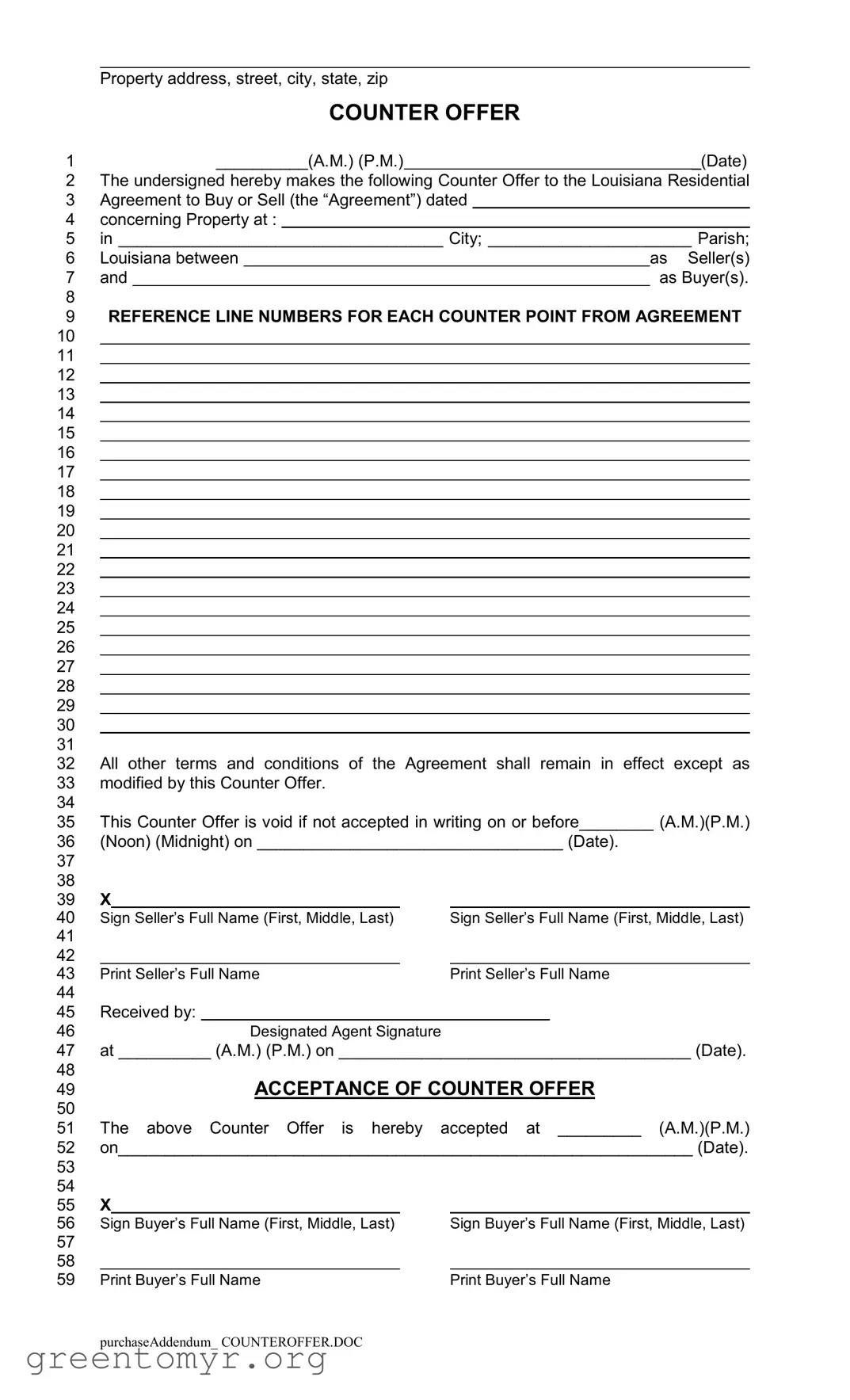
The Louisiana Counter Offer form serves as a crucial document in real estate transactions, allowing buyers and sellers to negotiate terms after an initial offer has been made. This form outlines specific changes to the original agreement, providing a structured way to communicate new terms. It includes essential details such as the property address, names of the parties involved, and reference line numbers for clarity on each counter point. The form also stipulates that all other terms and conditions of the original agreement remain in effect unless modified by this counter offer. A key aspect is the time-sensitive nature of the counter offer; it becomes void if not accepted in writing by a specified deadline. Signatures from both sellers and buyers are required to formalize the acceptance, ensuring all parties are in agreement. The clear organization of this form helps facilitate smooth negotiations and protect the interests of everyone involved.

Property address, street, city, state, zip
COUNTER OFFER
1 |
__________(A.M.) (P.M.) |
_(Date) |
|
|
|
|
|
2The undersigned hereby makes the following Counter Offer to the Louisiana Residential
3 Agreement to Buy or Sell (the “Agreement”) dated
4 concerning Property at :
5 in ___________________________________ City; ______________________ Parish;
6 |
Louisiana between |
|
as Seller(s) |
|
7 |
and |
|
as Buyer(s). |
|
8 |
|
|
|
|
9REFERENCE LINE NUMBERS FOR EACH COUNTER POINT FROM AGREEMENT
10
11
12
13
14
15
16
17
18
19
20
21
22
23
24
25
26
27
28
29
30
31
32 All other terms and conditions of the Agreement shall remain in effect except as 33 modified by this Counter Offer.
34
35 This Counter Offer is void if not accepted in writing on or before________ (A.M.)(P.M.) 36 (Noon) (Midnight) on _________________________________ (Date).
37
38
39 X
40 |
Sign Seller’s Full Name (First, Middle, Last) |
Sign Seller’s Full Name (First, Middle, Last) |
|||
41 |
|
|
|
|
|
42 |
|
|
|
|
|
43 |
Print Seller’s Full Name |
Print Seller’s Full Name |
|||
44 |
|
|
|
|
|
45 |
Received by: |
|
|
||
46 |
|
Designated Agent Signature |
|
|
|
47at __________ (A.M.) (P.M.) on ______________________________________ (Date).
49
50
51 The above Counter Offer is hereby accepted at _________ (A.M.)(P.M.)
52on______________________________________________________________ (Date).
55X
56 |
Sign Buyer’s Full Name (First, Middle, Last) |
|
Sign Buyer’s Full Name (First, Middle, Last) |
57 |
|
|
|
58 |
|
|
|
59 |
Print Buyer’s Full Name |
|
Print Buyer’s Full Name |
purchaseAddendum_ COUNTEROFFER.DOC
| Fact Name | Description |
|---|---|
| Purpose | The Louisiana Counter Offer form is used to propose changes to the terms of a residential property purchase agreement, allowing sellers and buyers to negotiate specific points before finalizing the sale. |
| Governing Law | This form is governed by the laws of the State of Louisiana, which outlines the legal framework for real estate transactions in the state. |
| Acceptance Deadline | The counter offer is only valid if accepted in writing by a specified deadline, ensuring that both parties are clear on the timeline for negotiations. |
| Modification of Terms | All other terms of the original purchase agreement remain effective unless explicitly modified by the counter offer, maintaining the integrity of the original contract. |
After completing the Louisiana Counter Offer form, you will need to ensure that all parties involved receive copies of the signed document. This will help maintain clarity and ensure that everyone is on the same page regarding the terms of the counter offer.
The Louisiana Counter Offer form is a document used in real estate transactions. It allows a seller or buyer to propose changes to the terms of an existing purchase agreement. This form is essential when the original offer does not meet the expectations of one party, enabling negotiation to continue.
You should use a Counter Offer form when you want to change specific terms of a purchase agreement. For example, if the buyer wants to offer a lower price or request repairs, they would submit a counter offer. It’s a way to communicate your needs while keeping the negotiation process alive.
When completing the Counter Offer form, you need to provide:
A Counter Offer is valid until a specified time stated on the form. This could be a specific date and time, such as noon or midnight. If the other party does not accept the counter offer by that deadline, it becomes void.
Once you submit a Counter Offer, the other party can either accept, reject, or counter your offer again. If they accept it, both parties will sign the document, and the agreement will move forward. If they reject it, you may need to consider other options or adjustments.
Yes, you can make multiple Counter Offers. Each time you propose a change, you will need to fill out a new Counter Offer form. Keep in mind that each offer should be clear and address the specific terms you wish to negotiate.
Completing the Louisiana Counter Offer form requires careful attention to detail. One common mistake occurs when individuals fail to include the property address accurately. The address should specify the street, city, state, and zip code. Omitting or misspelling any part of this information can lead to confusion and potential disputes regarding the property in question.
Another frequent error is neglecting to fill in the date and time fields for acceptance. The form stipulates that the counter offer is void if not accepted by a specific time and date. Leaving these fields blank or providing incorrect information can invalidate the offer, leaving both parties in a state of uncertainty.
In addition, individuals often overlook the reference line numbers for each counter point from the original agreement. This section is crucial for clarity, as it links the counter offer to specific terms in the original agreement. Failing to reference these lines can result in misunderstandings about what is being countered, potentially complicating negotiations.
Another mistake involves the signatures. Both sellers and buyers must sign the form for it to be valid. Sometimes, one party may forget to sign, or they may use initials instead of their full names. This omission can render the counter offer unenforceable, leading to further complications in the transaction.
Lastly, individuals sometimes neglect to specify the acceptance deadline clearly. While the form requires a specific time for acceptance, failing to state this explicitly or providing vague terms can lead to disputes over whether the counter offer was accepted in a timely manner. Clarity in this area is essential to avoid misunderstandings between the parties involved.
When navigating real estate transactions in Louisiana, understanding the documents that accompany a Counter Offer is essential. Each document plays a specific role in ensuring that both buyers and sellers are clear on the terms of the agreement. Here’s a brief overview of five important forms often used alongside the Louisiana Counter Offer form.
Understanding these documents can empower both buyers and sellers in their real estate journey. By being informed, you can navigate negotiations with confidence and clarity, ensuring a smoother transaction process.
The Louisiana Counter Offer form serves a specific purpose in real estate transactions, but it shares similarities with several other important documents. Each of these documents plays a role in negotiating terms and conditions between parties. Below is a list of six documents that are similar to the Louisiana Counter Offer form, along with explanations of their similarities.
Understanding these documents can help clarify the negotiation process in real estate transactions. Each plays a vital role in ensuring that both parties are on the same page and that their interests are protected.
When filling out the Louisiana Counter Offer form, attention to detail is crucial. Here are some important do's and don'ts to keep in mind:
Understanding the Louisiana Counter Offer form is essential for anyone involved in real estate transactions in the state. Here are some common misconceptions about this important document:
Being aware of these misconceptions can lead to more informed decisions during the negotiation process. Always consult with a professional if you have questions about the Louisiana Counter Offer form.
The Louisiana Counter Offer form is a crucial document in real estate transactions. Understanding its components can facilitate smoother negotiations between buyers and sellers. Here are key takeaways regarding the use of this form: