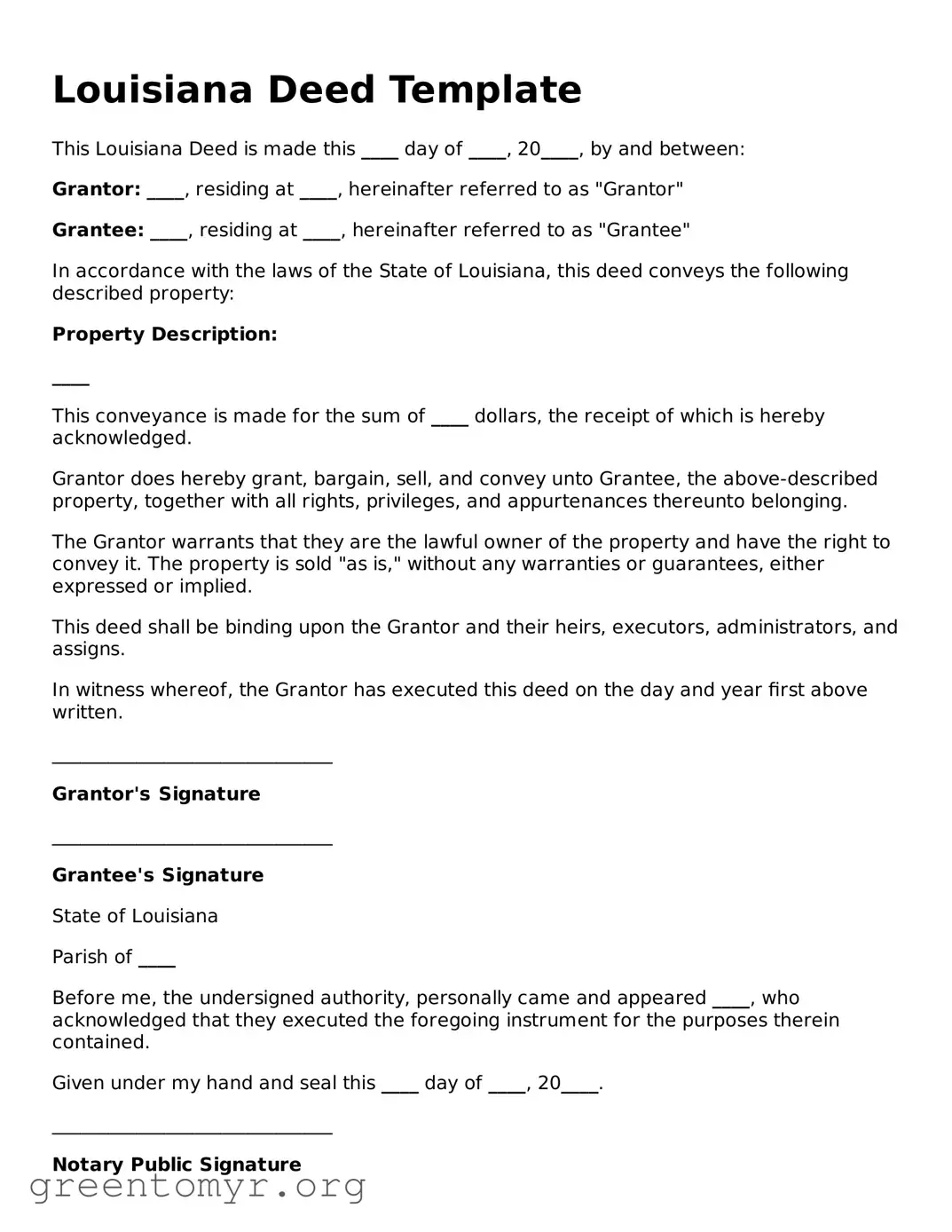
The Louisiana Deed form serves as a crucial legal instrument in real estate transactions, facilitating the transfer of property ownership between parties. This document outlines essential details such as the names of the buyer and seller, a clear description of the property being transferred, and the terms of the sale. It is vital for ensuring that the transfer complies with Louisiana state laws and protects the rights of both the grantor and grantee. Additionally, the deed may specify any encumbrances or liens attached to the property, providing transparency in the transaction. Understanding the components of the Louisiana Deed form is essential for anyone involved in buying or selling real estate in the state, as it lays the groundwork for a legally binding agreement and helps prevent future disputes over property ownership.
Louisiana Deed Template
This Louisiana Deed is made this ____ day of ____, 20____, by and between:
Grantor: ____, residing at ____, hereinafter referred to as "Grantor"
Grantee: ____, residing at ____, hereinafter referred to as "Grantee"
In accordance with the laws of the State of Louisiana, this deed conveys the following described property:
Property Description:
____
This conveyance is made for the sum of ____ dollars, the receipt of which is hereby acknowledged.
Grantor does hereby grant, bargain, sell, and convey unto Grantee, the above-described property, together with all rights, privileges, and appurtenances thereunto belonging.
The Grantor warrants that they are the lawful owner of the property and have the right to convey it. The property is sold "as is," without any warranties or guarantees, either expressed or implied.
This deed shall be binding upon the Grantor and their heirs, executors, administrators, and assigns.
In witness whereof, the Grantor has executed this deed on the day and year first above written.
______________________________
Grantor's Signature
______________________________
Grantee's Signature
State of Louisiana
Parish of ____
Before me, the undersigned authority, personally came and appeared ____, who acknowledged that they executed the foregoing instrument for the purposes therein contained.
Given under my hand and seal this ____ day of ____, 20____.
______________________________
Notary Public Signature
My commission expires: ____
| Fact Name | Description |
|---|---|
| Governing Law | The Louisiana Deed form is governed by the Louisiana Civil Code, specifically Articles 477 to 485. |
| Types of Deeds | Common types of deeds in Louisiana include Act of Sale, Warranty Deed, and Quitclaim Deed. |
| Required Signatures | The deed must be signed by the seller (grantor) and the buyer (grantee) to be valid. |
| Notarization | A Louisiana Deed must be notarized to be legally enforceable. |
| Recording | To protect the buyer’s interest, the deed should be recorded in the parish where the property is located. |
| Consideration | The deed must state the consideration, which is the price paid for the property. |
| Property Description | A clear and accurate description of the property being transferred is required in the deed. |
| Legal Capacity | All parties involved in the deed must have the legal capacity to enter into a contract. |
After you complete the Louisiana Deed form, you will need to file it with the appropriate parish clerk's office. This ensures that the transfer of property is officially recorded and recognized by local authorities.
A Louisiana Deed form is a legal document used to transfer ownership of real property from one party to another. This form outlines the details of the transaction, including the names of the buyer and seller, a description of the property, and any terms associated with the transfer. It is essential for ensuring that the transfer is recognized by the state and is legally binding.
In Louisiana, there are several types of deeds, including:
To fill out a Louisiana Deed form, follow these steps:
Yes, notarization is required for a Louisiana Deed to be legally valid. Both the seller and buyer must sign the deed in front of a notary public. The notary will then affix their seal to the document, confirming that the signatures are authentic.
To record a Louisiana Deed, take the following steps:
Recording fees for a Louisiana Deed vary by parish. Generally, fees are based on the number of pages in the document. Additionally, there may be transfer taxes or other charges depending on the specifics of the transaction. It is advisable to check with the local clerk of court for the exact fee schedule.
While it is possible to create your own Louisiana Deed form, it is recommended to use a standardized form to ensure that all necessary legal elements are included. Consulting with a legal professional can help avoid potential issues that may arise from improperly drafted documents.
If a Louisiana Deed is not recorded, the transfer of ownership may not be recognized by third parties. This can lead to complications, especially if disputes arise over property rights. Recording the deed provides public notice of the ownership transfer and helps protect the buyer's interests.
Louisiana Deed forms can be obtained from various sources, including:
Ensure that any form used complies with Louisiana state law to avoid issues during the transfer process.
Filling out a Louisiana Deed form can be a straightforward process, but many people make common mistakes that can lead to complications down the line. Understanding these pitfalls can save time, money, and frustration. Here are nine frequent errors to avoid.
One of the most common mistakes is failing to include all necessary parties. Every individual or entity involved in the transaction must be listed. Omitting a co-owner or a spouse can invalidate the deed and create legal issues later on.
Another frequent error is inaccurate property description. The deed must contain a precise description of the property being transferred. This includes the correct address and any relevant parcel numbers. Without this information, the deed may not be enforceable.
People often neglect to sign the deed properly. All parties involved must sign the document in the appropriate places. If a signature is missing or not notarized correctly, the deed may be considered invalid.
Additionally, some individuals fail to check for existing liens or encumbrances on the property. Before completing the deed, it’s essential to ensure that there are no outstanding debts or claims against the property. This oversight can lead to significant financial repercussions.
Misunderstanding the type of deed being used is another common mistake. Different types of deeds, such as warranty deeds or quitclaim deeds, serve different purposes. Selecting the wrong type can affect the rights and obligations of the parties involved.
Another issue arises when people forget to record the deed with the appropriate parish clerk. Recording the deed is crucial for establishing public notice of the property transfer. Failing to do so can lead to disputes over ownership.
Some individuals also make the mistake of not considering tax implications. Property transfers can have tax consequences, and it’s important to understand these before finalizing the deed. Consulting with a tax professional can provide clarity.
Moreover, using outdated forms can create problems. Laws and regulations change, and using an old version of the deed form may result in noncompliance. Always ensure you have the most current form.
Lastly, many people overlook the importance of seeking legal advice. While it may seem like a simple task, the implications of a poorly completed deed can be significant. Consulting with a legal expert can help ensure that everything is done correctly.
When completing a property transaction in Louisiana, the Deed form is just one of several important documents that may be required. Each document plays a specific role in ensuring that the transfer of property is legally sound and properly recorded. Here are six other forms and documents that are often used in conjunction with the Louisiana Deed form:
Each of these documents plays a crucial role in the property transaction process. Ensuring that all necessary forms are completed accurately can help prevent legal issues down the line and facilitate a smooth transfer of ownership.
The Deed form is a critical document in real estate and legal transactions. It shares similarities with several other documents that serve various purposes in property and contractual agreements. Below is a list of eight documents that are comparable to the Deed form, along with an explanation of how they relate:
Understanding these documents can greatly aid in navigating property transactions effectively. Each document has its own specific use, but they all share the common goal of defining ownership and rights related to property.
When filling out the Louisiana Deed form, it's important to be careful and thorough. Here’s a list of things you should and shouldn't do:
Misconceptions about the Louisiana Deed form can lead to confusion and potential legal issues. Here are four common misunderstandings:
This is not true. Louisiana recognizes various types of deeds, such as warranty deeds and quitclaim deeds. Each type serves different purposes and offers varying levels of protection for the parties involved.
While notarization is important for certain deeds in Louisiana, not all deeds require a notary. For instance, some deeds may be valid without notarization if they meet specific criteria established by state law.
This misconception can lead to significant challenges. In fact, deeds can be amended or revoked under certain conditions, provided that the appropriate legal procedures are followed.
Not every deed form will be accepted in every jurisdiction. Local laws and regulations may impose additional requirements, so it’s crucial to ensure that the deed complies with local standards.
When filling out and using the Louisiana Deed form, there are several important points to keep in mind. Here are the key takeaways:
Following these guidelines will help ensure that the deed is filled out correctly and serves its intended purpose in the property transfer process.