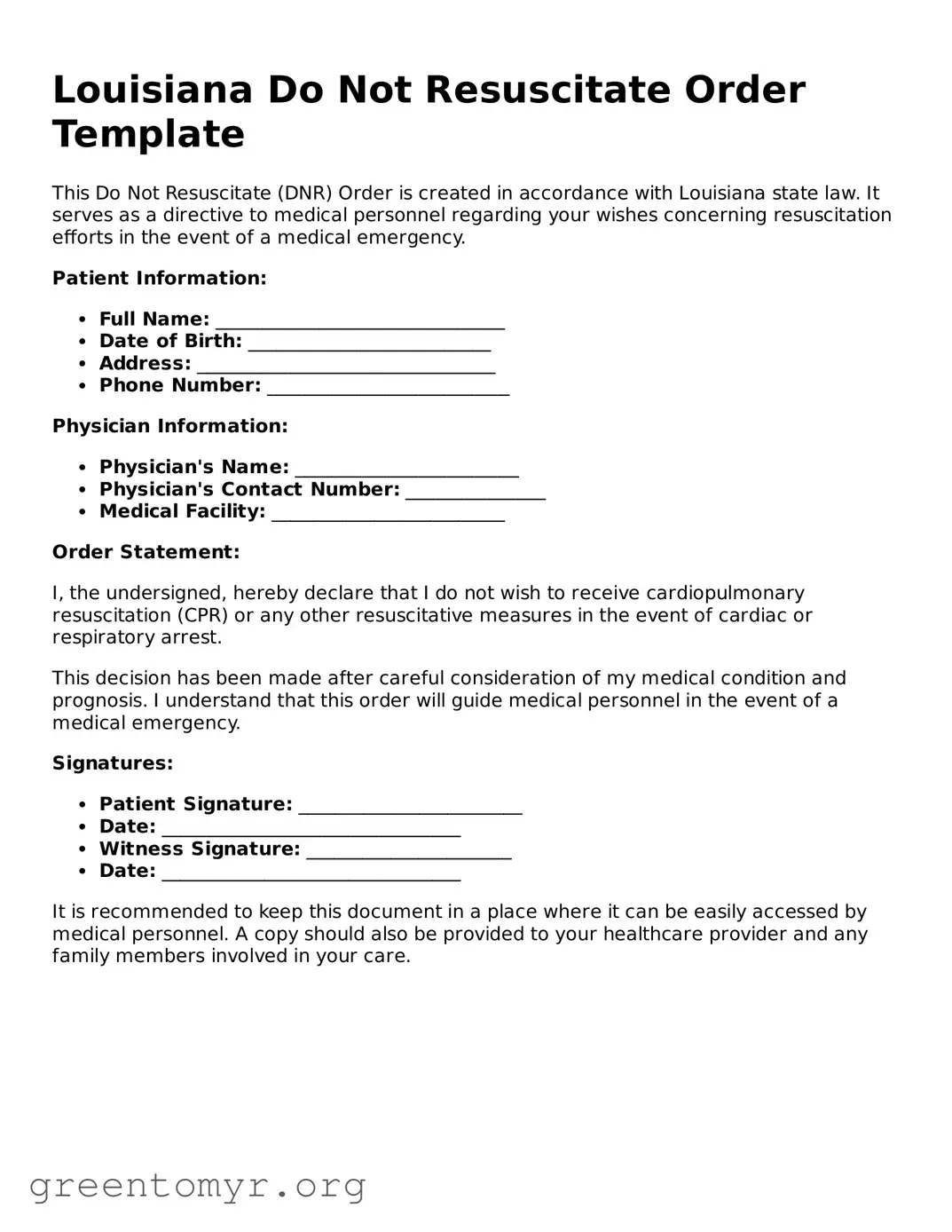
In Louisiana, the Do Not Resuscitate (DNR) Order form serves as an essential tool for individuals who wish to express their preferences regarding medical interventions in the event of a life-threatening situation. This form allows patients to communicate their desire not to receive cardiopulmonary resuscitation (CPR) or other life-sustaining treatments if their heart stops or they stop breathing. It is crucial for ensuring that healthcare providers respect the wishes of patients and their families during critical moments. The DNR form must be completed and signed by a physician, reflecting a conversation about the patient’s health status and end-of-life wishes. Importantly, this document should be readily accessible, as it needs to be presented to medical personnel in emergencies. Understanding the implications of a DNR order can empower individuals to make informed decisions about their healthcare, ensuring that their values and preferences are honored when they can no longer speak for themselves.
Louisiana Do Not Resuscitate Order Template
This Do Not Resuscitate (DNR) Order is created in accordance with Louisiana state law. It serves as a directive to medical personnel regarding your wishes concerning resuscitation efforts in the event of a medical emergency.
Patient Information:
Physician Information:
Order Statement:
I, the undersigned, hereby declare that I do not wish to receive cardiopulmonary resuscitation (CPR) or any other resuscitative measures in the event of cardiac or respiratory arrest.
This decision has been made after careful consideration of my medical condition and prognosis. I understand that this order will guide medical personnel in the event of a medical emergency.
Signatures:
It is recommended to keep this document in a place where it can be easily accessed by medical personnel. A copy should also be provided to your healthcare provider and any family members involved in your care.
| Fact Name | Description |
|---|---|
| Definition | The Louisiana Do Not Resuscitate Order (DNR) form allows individuals to refuse resuscitation efforts in the event of a medical emergency. |
| Eligibility | Any adult who is capable of making their own medical decisions can complete a DNR order in Louisiana. |
| Governing Laws | The DNR order in Louisiana is governed by Louisiana Revised Statutes, Title 40, Section 1157.1 through 1157.7. |
| Signature Requirement | The form must be signed by the individual or their legal representative, along with a physician's signature to be valid. |
| Distribution | Once completed, copies of the DNR order should be provided to the individual's healthcare providers and kept in a prominent location. |
Filling out the Louisiana Do Not Resuscitate Order form is an important step in expressing your healthcare wishes. After completing the form, it should be signed and dated, then kept in an accessible location for medical personnel to find in case of an emergency.
A Louisiana Do Not Resuscitate Order is a legal document that allows individuals to refuse resuscitation efforts in the event of cardiac arrest or respiratory failure. This order is intended for patients who wish to avoid aggressive life-saving measures, such as CPR or advanced airway management, in situations where they are unable to communicate their wishes.
In Louisiana, a DNR can be created by any adult who is capable of making their own medical decisions. This includes individuals who are 18 years or older and have the mental capacity to understand the implications of the order. Additionally, a legal guardian may create a DNR for a minor or an incapacitated adult.
To obtain a DNR order, follow these steps:
Yes, your DNR order should be honored by healthcare providers in emergencies where resuscitation efforts are typically initiated. However, it is essential to ensure that the order is readily available and accessible to medical personnel. In non-emergency situations, your healthcare team will continue to provide appropriate care in line with your wishes.
Yes, you have the right to change or revoke your DNR order at any time. To do so, simply notify your healthcare provider and remove any copies of the existing DNR from your records. You may then create a new DNR order if you wish to establish different preferences regarding resuscitation.
No, a DNR order and an advance directive are not the same. An advance directive is a broader legal document that outlines your preferences for medical treatment and appoints someone to make decisions on your behalf if you become incapacitated. A DNR order specifically addresses your wishes regarding resuscitation efforts. It is advisable to have both documents in place to ensure that your healthcare preferences are clearly communicated.
Completing the Louisiana Do Not Resuscitate (DNR) Order form requires careful attention to detail. One common mistake is failing to provide accurate personal information. Individuals often overlook entering their full name, date of birth, or address. This can lead to confusion and may hinder the enforcement of the DNR wishes during a medical emergency.
Another frequent error involves not having the form signed appropriately. The DNR Order must be signed by the patient or their legal representative. In some cases, individuals neglect to include the signature of a witness, which is necessary for the document to be valid. Without these signatures, the form may be deemed unenforceable.
People also tend to misunderstand the scope of the DNR order. Some individuals mistakenly believe that a DNR order applies to all medical treatments, when in fact, it only pertains to resuscitation efforts. This misconception can lead to unintended consequences and may affect the quality of care received.
Another mistake is using outdated forms. The Louisiana DNR Order form may change over time, and using an old version can create legal complications. It is crucial to ensure that the most current form is being utilized to avoid any issues with enforcement.
Many individuals fail to discuss their DNR wishes with family members or healthcare providers. This lack of communication can lead to confusion during a medical crisis. It is essential that loved ones understand the patient's wishes to ensure they are honored.
Additionally, people sometimes forget to keep copies of the completed DNR form in accessible locations. Without easy access to the document, healthcare providers may not be aware of the patient's wishes when it matters most. Keeping copies in multiple locations, such as with family members and at healthcare facilities, is advisable.
Finally, individuals often neglect to review and update their DNR orders regularly. Life circumstances can change, and so can a person's preferences regarding resuscitation. Regularly revisiting the DNR order ensures that it reflects current wishes and legal requirements.
The Louisiana Do Not Resuscitate Order (DNR) form is an important document for individuals who wish to express their preferences regarding resuscitation in medical emergencies. Alongside this form, several other documents can provide additional clarity and support for patients and their families. Below is a list of five commonly used forms and documents that complement the DNR order.
These documents work together to provide a comprehensive approach to healthcare decision-making. They help ensure that a patient's wishes are respected and followed, particularly in critical situations. It is advisable for individuals to discuss these forms with their families and healthcare providers to ensure clarity and understanding.
The Do Not Resuscitate (DNR) Order form is an important document in healthcare that outlines a patient's wishes regarding resuscitation efforts. Several other documents share similarities with the DNR in terms of purpose and intent. Here are seven such documents:
Each of these documents plays a crucial role in ensuring that healthcare providers understand and honor the wishes of patients, especially during critical moments.
When filling out the Louisiana Do Not Resuscitate (DNR) Order form, it's essential to approach the process with care and clarity. Here are some important dos and don'ts to consider:
Understanding the Louisiana Do Not Resuscitate (DNR) Order form is crucial for making informed healthcare decisions. However, several misconceptions often arise. Here’s a list of common misunderstandings:
Being informed helps in making the right choices regarding healthcare preferences. Understanding these misconceptions is a step toward clarity and confidence in decision-making.
The Louisiana Do Not Resuscitate (DNR) Order form is a crucial document for individuals who wish to express their preferences regarding resuscitation efforts in medical emergencies. Here are key takeaways about filling out and using this form:
Understanding these key points can help ensure that the DNR order reflects your wishes and is respected in medical situations.