Content Navigation

Creating a comprehensive employee handbook is an essential step for any business in Louisiana, serving as a foundational document that outlines workplace policies, procedures, and expectations. The Louisiana Employee Handbook form helps employers provide clear guidelines on topics such as employee rights, workplace conduct, and benefits. This form typically includes sections on equal employment opportunities, anti-discrimination policies, and harassment prevention, ensuring a safe and respectful work environment for all. Additionally, it covers important information about time off, including vacation and sick leave policies, as well as procedures for requesting time off. By addressing these critical areas, the handbook not only protects the rights of employees but also helps employers establish a positive workplace culture and mitigate potential legal issues. Understanding the components of this form is vital for both employers and employees to foster a harmonious and productive work environment.

Louisiana Employee Handbook Example

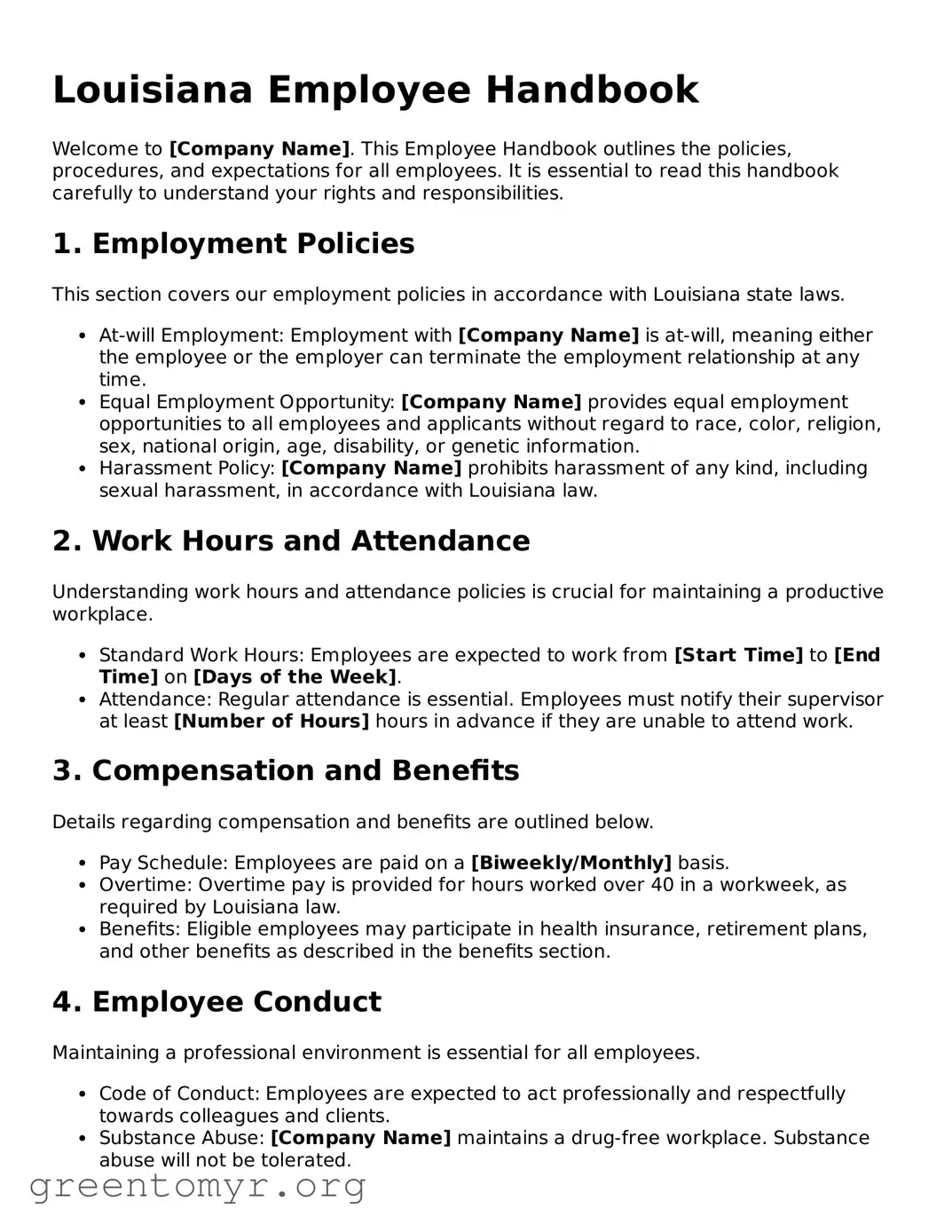
Louisiana Employee Handbook

Welcome to [Company Name]. This Employee Handbook outlines the policies, procedures, and expectations for all employees. It is essential to read this handbook carefully to understand your rights and responsibilities.

1. Employment Policies

This section covers our employment policies in accordance with Louisiana state laws.

  • At-will Employment: Employment with [Company Name] is at-will, meaning either the employee or the employer can terminate the employment relationship at any time.
  • Equal Employment Opportunity: [Company Name] provides equal employment opportunities to all employees and applicants without regard to race, color, religion, sex, national origin, age, disability, or genetic information.
  • Harassment Policy: [Company Name] prohibits harassment of any kind, including sexual harassment, in accordance with Louisiana law.

2. Work Hours and Attendance

Understanding work hours and attendance policies is crucial for maintaining a productive workplace.

  • Standard Work Hours: Employees are expected to work from [Start Time] to [End Time] on [Days of the Week].
  • Attendance: Regular attendance is essential. Employees must notify their supervisor at least [Number of Hours] hours in advance if they are unable to attend work.

3. Compensation and Benefits

Details regarding compensation and benefits are outlined below.

  • Pay Schedule: Employees are paid on a [Biweekly/Monthly] basis.
  • Overtime: Overtime pay is provided for hours worked over 40 in a workweek, as required by Louisiana law.
  • Benefits: Eligible employees may participate in health insurance, retirement plans, and other benefits as described in the benefits section.

4. Employee Conduct

Maintaining a professional environment is essential for all employees.

  • Code of Conduct: Employees are expected to act professionally and respectfully towards colleagues and clients.
  • Substance Abuse: [Company Name] maintains a drug-free workplace. Substance abuse will not be tolerated.

5. Safety and Health

Employee safety is a top priority at [Company Name].

  • Workplace Safety: Employees must follow all safety guidelines and report any unsafe conditions to management immediately.
  • Emergency Procedures: Familiarize yourself with emergency exits and procedures.

6. Acknowledgment of Receipt

By signing below, you acknowledge that you have received and read the Employee Handbook.

Employee Name: [Employee Name]

Signature: ____________________________

Date: [Date]

For any questions regarding this handbook, please contact [HR Contact Name] at [HR Contact Email].

PDF Form Features

Fact Name Description
Purpose The Louisiana Employee Handbook serves as a guide for employees, outlining workplace policies, procedures, and expectations.
Legal Requirement While not legally mandated, having an employee handbook is highly recommended for clarity and compliance with state laws.
Governing Laws The handbook should comply with Louisiana employment laws, including the Louisiana Employment Security Law and the Louisiana Wage Payment Act.
Content Guidelines It should include sections on company policies, employee rights, benefits, and disciplinary procedures.
At-Will Employment Louisiana is an at-will employment state, meaning employees can be terminated for any reason not prohibited by law.
Updates Regular updates are essential to keep the handbook current with changes in laws or company policies.
Distribution Employers should distribute the handbook to all employees and obtain signed acknowledgments of receipt.
Non-Discrimination Policy It must include a clear non-discrimination policy to comply with federal and state anti-discrimination laws.
Employee Acknowledgment An acknowledgment form should be included, ensuring employees understand the policies outlined in the handbook.

Guide to Using Louisiana Employee Handbook

Completing the Louisiana Employee Handbook form is a straightforward process that ensures you have all the necessary information in one place. By following these steps, you'll be able to fill out the form accurately and efficiently.

  1. Begin by gathering all relevant personal information, such as your full name, address, and contact details.
  2. Locate the section for your employment details. This includes your job title, department, and start date.
  3. Review any company policies that you need to acknowledge. These may cover topics like attendance, dress code, and workplace behavior.
  4. Fill out any required signatures or initials where indicated. This typically shows that you understand and agree to the policies outlined in the handbook.
  5. Double-check all information for accuracy. Ensure there are no typos or missing details.
  6. Submit the completed form to your HR department or the designated person as instructed.

Once you have filled out the form, keep a copy for your records. This will help you stay informed about your rights and responsibilities as an employee.

Get Answers on Louisiana Employee Handbook

What is the Louisiana Employee Handbook form?

The Louisiana Employee Handbook form serves as a crucial document for employers in the state of Louisiana. It outlines the rights and responsibilities of both the employer and the employees. The handbook typically includes policies on workplace conduct, benefits, and procedures, ensuring that all parties understand what is expected in the workplace.

Why is it important to have an Employee Handbook?

An Employee Handbook is important for several reasons:

  • Clarity: It provides clear guidelines on workplace policies, helping to prevent misunderstandings.
  • Legal Protection: Having a well-documented handbook can protect employers from potential legal issues by demonstrating that they have communicated their policies effectively.
  • Consistency: It ensures that all employees are treated fairly and consistently, which can improve morale and productivity.

What should be included in the Louisiana Employee Handbook?

While the specific contents can vary, a comprehensive Louisiana Employee Handbook typically includes:

  1. Company mission and values
  2. Employment policies (e.g., at-will employment, equal opportunity)
  3. Code of conduct and disciplinary procedures
  4. Compensation and benefits information
  5. Leave policies (e.g., sick leave, family leave)
  6. Health and safety guidelines

How often should the Employee Handbook be updated?

Regular updates to the Employee Handbook are essential. Employers should review the handbook at least annually or whenever there are significant changes in laws or company policies. This ensures that the handbook remains relevant and compliant with current regulations.

Is it necessary to have employees sign the Employee Handbook?

While it is not legally required to have employees sign the handbook, obtaining a signed acknowledgment can be beneficial. This signature serves as proof that employees have received and understood the policies outlined in the handbook. It can also help mitigate disputes related to workplace policies in the future.

Yes, an Employee Handbook can play a significant role in legal disputes. If a conflict arises, the handbook can be referenced to clarify the company's policies and procedures. Courts often look at the handbook to determine whether an employer acted fairly and in accordance with their stated policies. However, it is important that the handbook is well-drafted and accurately reflects the company’s practices.

Common mistakes

Filling out the Louisiana Employee Handbook form can seem straightforward, but many people make common mistakes that can lead to confusion later on. One frequent error is neglecting to read the entire document before signing. Employees often rush through the process, missing important details that outline their rights and responsibilities. This oversight can create misunderstandings about workplace policies.

Another mistake is failing to provide accurate personal information. Employees might forget to double-check their names, addresses, or contact numbers. Incorrect information can cause issues with payroll and communication. It is essential to ensure that all details are correct to avoid complications down the line.

Some individuals overlook the importance of understanding the policies outlined in the handbook. They may sign the form without fully comprehending the implications of the policies. This can lead to conflicts or disciplinary actions later, as employees may find themselves unaware of the rules they are expected to follow.

Additionally, many people forget to ask questions if they are unclear about specific policies. Instead of seeking clarification, they may assume they understand. This lack of communication can lead to misinterpretations and potential problems in the workplace.

Another common mistake involves not keeping a copy of the signed form. Employees should always retain a copy for their records. Without it, they may struggle to reference the handbook's contents or prove their acknowledgment of the policies.

Finally, some individuals fail to update their information when changes occur. Life events, such as a change of address or marital status, may affect the information on the form. Keeping the form current is vital for ensuring that the employee remains informed about their rights and responsibilities.

Documents used along the form

When creating or updating an employee handbook in Louisiana, several other forms and documents may be useful. These documents can help ensure compliance with state and federal laws, as well as clarify policies and procedures for employees. Below are some key forms often used alongside the Louisiana Employee Handbook.

  • Job Description Form: This document outlines the responsibilities, requirements, and expectations for specific positions within the organization. Clear job descriptions help employees understand their roles and can assist in performance evaluations.
  • Employee Acknowledgment Form: This form is used to confirm that employees have received, read, and understood the employee handbook. It serves as a record that employees are aware of company policies and procedures.
  • Incident Report Form: This document is essential for documenting any workplace incidents or accidents. It helps maintain safety standards and can be used for insurance and legal purposes.
  • Leave of Absence Request Form: Employees use this form to formally request time off for various reasons, such as medical issues or personal matters. It helps employers manage staffing and ensures that leave policies are followed.

These documents work together to create a comprehensive framework for employee management. They provide clarity and structure, ensuring that both employees and employers understand their rights and responsibilities in the workplace.

Similar forms

  • Policy Manual: Similar to the Employee Handbook, a policy manual outlines the organization's rules and procedures. It serves as a guide for employees, detailing expectations and standards of behavior.
  • Onboarding Guide: An onboarding guide assists new hires in understanding their roles and responsibilities. Like the Employee Handbook, it provides essential information about company culture and operational procedures.
  • Code of Conduct: This document specifies the ethical standards and behavioral expectations for employees. Both the Code of Conduct and the Employee Handbook aim to create a positive workplace environment.
  • Safety Manual: A safety manual focuses on workplace safety protocols and emergency procedures. It complements the Employee Handbook by ensuring that employees are aware of safety measures and their importance.
  • Job Descriptions: Job descriptions detail the specific responsibilities and qualifications for each role within the organization. They align with the Employee Handbook by clarifying expectations for performance.
  • Training Materials: Training materials provide information and resources for employee development. Like the Employee Handbook, they help employees understand their roles and the skills needed for success.
  • Performance Evaluation Forms: These forms outline the criteria for assessing employee performance. They are similar to the Employee Handbook in that they help establish clear expectations for job performance.
  • Employee Agreement: An employee agreement is a contract that outlines the terms of employment. This document, like the Employee Handbook, helps to clarify the rights and responsibilities of both the employee and the employer.
  • Benefit Summary: A benefit summary provides details about employee benefits, such as health insurance and retirement plans. This document works in conjunction with the Employee Handbook to inform employees about their entitlements.
  • Grievance Procedure: This document outlines the process for employees to report issues or concerns. It is similar to the Employee Handbook, as both aim to promote a fair and transparent workplace.

Dos and Don'ts

When filling out the Louisiana Employee Handbook form, it’s important to approach the task with care. Here are some key dos and don’ts to keep in mind:

  • Do read the entire handbook thoroughly. Understanding the policies and procedures will help you fill out the form accurately.
  • Do provide accurate and complete information. Ensure that all sections of the form are filled out correctly to avoid any misunderstandings later.
  • Do ask questions if you're unsure. If any part of the handbook or the form is unclear, don’t hesitate to seek clarification from your HR department.
  • Do keep a copy of the completed form. Having a record of your submission can be helpful for future reference.
  • Don't rush through the form. Taking your time can help prevent mistakes that may need to be corrected later.
  • Don't leave any sections blank. Incomplete forms can lead to delays or issues with your employment status.
  • Don't ignore the deadlines. Ensure that you submit the form by the specified date to remain compliant with company policies.
  • Don't hesitate to express concerns. If you have any issues with the handbook or the form, it’s important to voice them to your employer.

Misconceptions

Many people have misunderstandings about the Louisiana Employee Handbook form. Here are four common misconceptions:

  • It is mandatory for all businesses to have an employee handbook. While having an employee handbook is beneficial, it is not legally required for every business in Louisiana. However, it can help clarify company policies and expectations.
  • All employee handbooks must follow a specific template. There is no one-size-fits-all template for employee handbooks. Each handbook should be tailored to fit the unique needs and culture of the business.
  • Once created, the employee handbook cannot be changed. This is not true. Handbooks should be reviewed and updated regularly to reflect changes in laws, policies, or company structure.
  • The employee handbook is a legally binding contract. While the handbook outlines policies and procedures, it is typically not considered a contract unless explicitly stated. Employers can often modify policies at their discretion.

Key takeaways

When filling out and utilizing the Louisiana Employee Handbook form, consider the following key takeaways:

  • Ensure that the handbook is tailored to your specific organization’s policies and culture.
  • Include essential topics such as workplace conduct, benefits, and disciplinary procedures.
  • Review state and federal laws to ensure compliance with employment regulations.
  • Clearly outline the process for employees to report grievances or seek clarification on policies.
  • Make the handbook accessible to all employees, both in print and digital formats.
  • Regularly update the handbook to reflect changes in laws or company policies.
  • Require employees to sign an acknowledgment form to confirm they have received and understood the handbook.
  • Use clear and straightforward language to avoid confusion and misinterpretation.

By following these guidelines, you can create an effective employee handbook that serves as a valuable resource for both management and staff.