In Louisiana, the General Power of Attorney form serves as a crucial legal document that empowers an individual, known as the agent or attorney-in-fact, to act on behalf of another person, referred to as the principal, in a wide range of financial and legal matters. This form is designed to grant broad authority, allowing the agent to make decisions regarding property, finances, and other important affairs, which can be particularly beneficial in situations where the principal is unable to manage their own affairs due to illness, absence, or other circumstances. The document must be executed with specific formalities, including the signature of the principal and, in some cases, witnesses or a notary public, to ensure its validity. Understanding the nuances of this form is essential, as it outlines the scope of the agent's powers, which can be tailored to fit the principal's unique needs. Additionally, the Louisiana General Power of Attorney can be revoked at any time by the principal, provided they are still competent to do so, offering a level of control and flexibility that is vital for both parties involved. This article will delve into the key elements of the form, its implications, and the steps necessary for proper execution, ensuring that individuals can make informed decisions about their legal and financial futures.
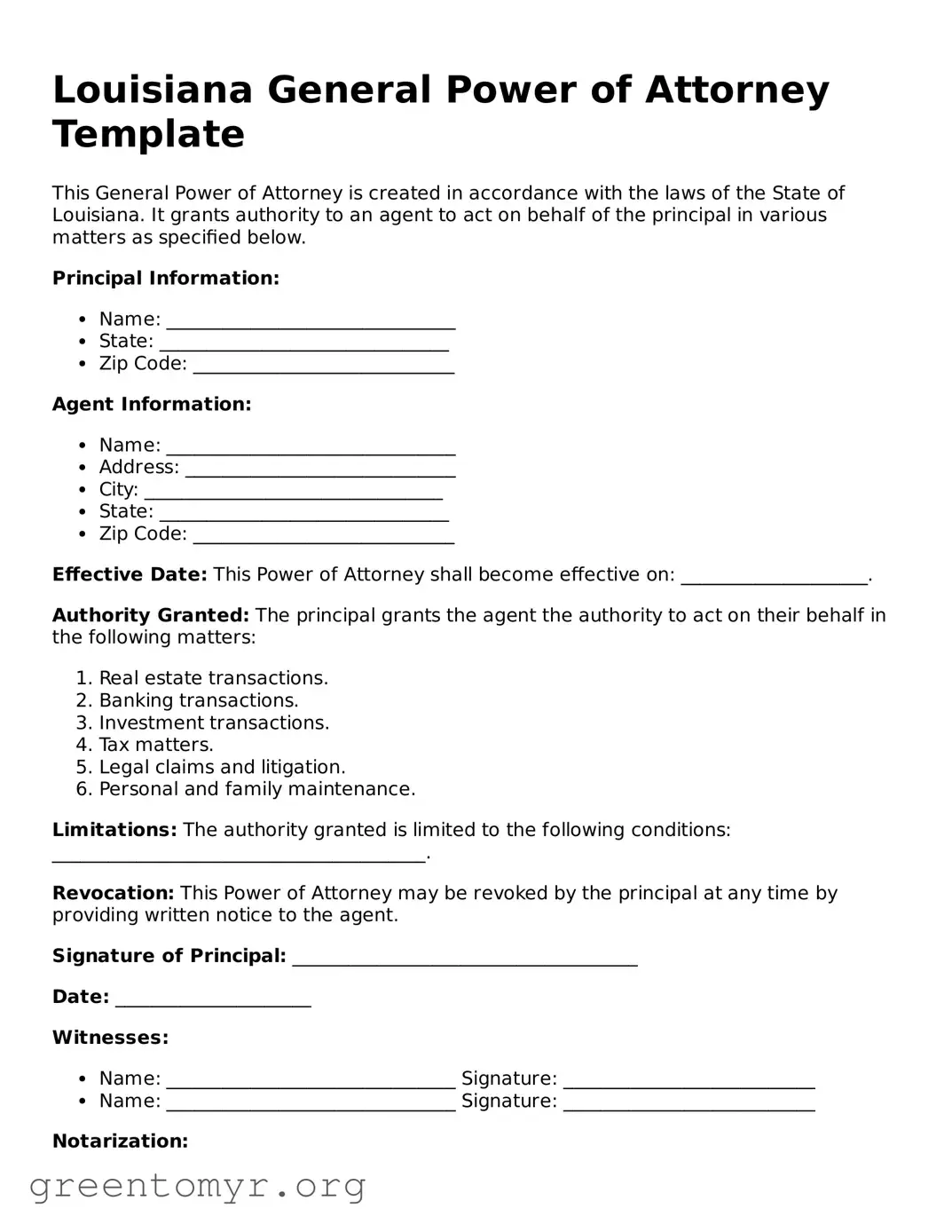
Louisiana General Power of Attorney Template
This General Power of Attorney is created in accordance with the laws of the State of Louisiana. It grants authority to an agent to act on behalf of the principal in various matters as specified below.
Principal Information:
Agent Information:
Effective Date: This Power of Attorney shall become effective on: ____________________.
Authority Granted: The principal grants the agent the authority to act on their behalf in the following matters:
Limitations: The authority granted is limited to the following conditions: ________________________________________.
Revocation: This Power of Attorney may be revoked by the principal at any time by providing written notice to the agent.
Signature of Principal: _____________________________________
Date: _____________________
Witnesses:
Notarization:
State of Louisiana, Parish of ____________________.
Subscribed and sworn to before me this _____ day of __________, 20__.
Notary Public Signature: ____________________________
My commission expires: ____________________________
| Fact Name | Details |
|---|---|
| Definition | A General Power of Attorney in Louisiana allows an individual (the principal) to appoint another person (the agent) to make decisions on their behalf. |
| Governing Law | The Louisiana General Power of Attorney is governed by Louisiana Civil Code, specifically Articles 2991 to 3020. |
| Durability | This type of power of attorney can be durable, meaning it remains effective even if the principal becomes incapacitated, provided it is explicitly stated. |
| Agent's Authority | The agent can perform a wide range of actions, including managing finances, handling real estate transactions, and making healthcare decisions. |
| Revocation | The principal can revoke the General Power of Attorney at any time, as long as they are mentally competent to do so. |
| Notarization | For the document to be valid, it must be signed by the principal in the presence of a notary public and two witnesses. |
| Limitations | Some actions, such as creating or modifying a will, cannot be granted through a General Power of Attorney. |
| Use Cases | This form is often used for financial management, real estate transactions, and healthcare decisions when the principal is unable to act on their own. |
Filling out the Louisiana General Power of Attorney form is a straightforward process. Once completed, this document allows you to appoint someone to make decisions on your behalf. Follow these steps carefully to ensure the form is filled out correctly.
After completing these steps, keep a copy for your records and provide a copy to your agent. Ensure that your agent understands their responsibilities and the powers granted to them.
A Louisiana General Power of Attorney is a legal document that allows one person, known as the principal, to designate another person, called the agent or attorney-in-fact, to act on their behalf. This authority can cover a wide range of financial and legal matters, including managing bank accounts, signing contracts, and making decisions regarding property. It's important to note that the powers granted can be broad or limited, depending on the principal's wishes.
Consider a General Power of Attorney if you anticipate needing someone to manage your affairs while you are unavailable or unable to do so yourself. Common situations include:
Having this document in place can provide peace of mind, knowing that your affairs will be handled by someone you trust.
To create a General Power of Attorney in Louisiana, follow these steps:
Always keep the original document in a safe place, and review it periodically to ensure it still reflects your wishes.
Yes, you can revoke a General Power of Attorney in Louisiana at any time, as long as you are mentally competent. To do this, you should:
Revoking the document ensures that your previous agent no longer has authority to act on your behalf, allowing you to appoint a new agent if necessary.
Filling out the Louisiana General Power of Attorney form can be a straightforward process, but many individuals make common mistakes that can lead to complications. One frequent error is failing to clearly identify the agent. The agent is the person who will act on behalf of the principal. If the agent's name is misspelled or if there is any ambiguity regarding their identity, it could lead to legal challenges later on.
Another common mistake is not specifying the powers granted. The form allows for a range of powers, from managing finances to making healthcare decisions. If the powers are not clearly defined, the agent may not have the authority to perform necessary actions. This lack of clarity can create confusion and hinder the agent's ability to act effectively.
People often overlook the importance of signatures. Both the principal and the agent must sign the document for it to be valid. If either party neglects to sign, the form may be deemed invalid. Additionally, some individuals forget to have the document notarized, which is a requirement in Louisiana. Without a notary's signature, the power of attorney may not be recognized by financial institutions or healthcare providers.
Another mistake involves not keeping the document updated. Life circumstances change, and so do relationships. If the principal wishes to revoke the power of attorney or appoint a new agent, they must fill out a new form. Failing to update the document can lead to confusion and potential disputes about who has the authority to act on behalf of the principal.
Lastly, many individuals do not consider the implications of granting broad powers. While it may seem convenient to give the agent extensive authority, it can also lead to misuse. It is crucial to carefully consider the level of trust in the chosen agent and to outline any limitations on their powers within the document. Taking these precautions can help ensure that the power of attorney serves its intended purpose without leading to unintended consequences.
When considering a Louisiana General Power of Attorney, it's essential to understand that this document often works in tandem with several other forms. Each of these documents serves a unique purpose and can help ensure that your financial and personal affairs are managed according to your wishes. Here are six common forms that are frequently used alongside the General Power of Attorney:
Understanding these documents can empower you to make informed decisions about your future. Each form plays a critical role in ensuring that your wishes are respected and that your affairs are managed effectively. Take the time to review each option and consult with a professional to determine what best suits your needs.
The General Power of Attorney form is a versatile legal document that shares similarities with several other documents. Here’s a list of eight documents that are comparable and how they relate to the General Power of Attorney:
When filling out the Louisiana General Power of Attorney form, it's important to approach the process carefully. Here are some key dos and don'ts to keep in mind:
By following these guidelines, you can help ensure that your General Power of Attorney form is completed correctly and meets your needs.
The Louisiana General Power of Attorney form is a crucial legal document that allows individuals to designate someone to act on their behalf in various matters. However, several misconceptions surround this form. Below are four common misunderstandings:
Many people believe that a General Power of Attorney is limited strictly to financial decisions. In reality, this document can grant authority over a wide range of matters, including healthcare decisions, real estate transactions, and legal affairs.
This is a common belief, but it is not entirely accurate. A General Power of Attorney remains effective even if the principal becomes incapacitated, unless it is specifically stated to terminate upon such an event. However, if a durable power of attorney is desired, it should be explicitly indicated in the document.
While it is true that most adults can serve as agents, there are exceptions. For instance, individuals who are legally incapacitated or those who have been convicted of certain crimes may not be eligible to act as an agent. It is essential to choose someone trustworthy and capable.
This misconception suggests that the General Power of Attorney is a permanent arrangement. In fact, the principal has the right to revoke or modify the document at any time, as long as they are mentally competent. Proper procedures should be followed to ensure that the revocation is legally binding.
Filling out and using the Louisiana General Power of Attorney form is a critical step in ensuring that your financial and legal matters are handled according to your wishes. Here are key takeaways to consider:
Taking these steps can help prevent confusion and ensure your wishes are respected. Act promptly to secure your interests.