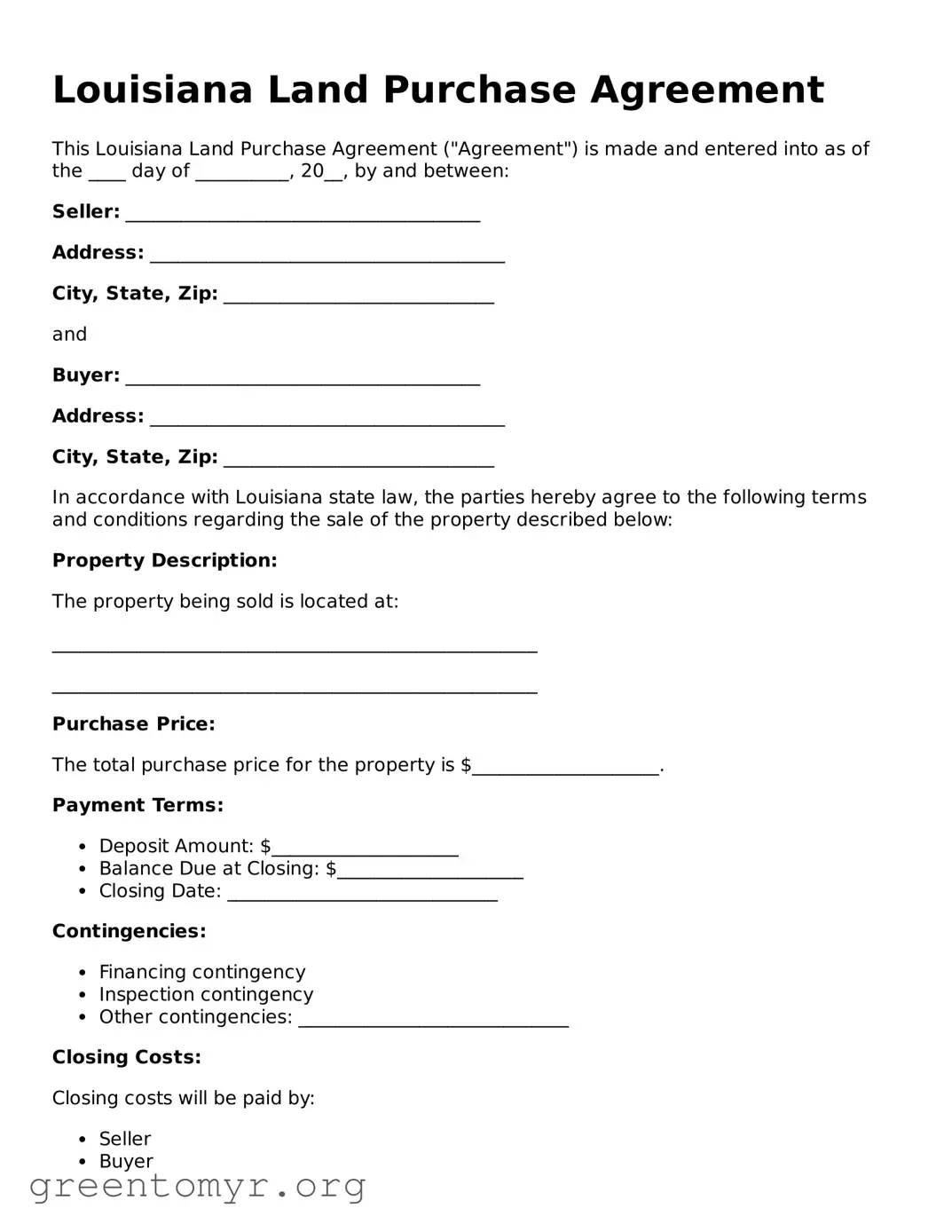
The Louisiana Land Purchase Agreement form plays a crucial role in real estate transactions within the state of Louisiana. This document outlines the terms and conditions under which a buyer agrees to purchase land from a seller. Key components of the form include the legal description of the property, purchase price, payment terms, and any contingencies that may apply. Additionally, it specifies the responsibilities of both parties, including disclosures about the property and any existing liens or encumbrances. By detailing these aspects, the agreement helps protect the interests of both buyers and sellers, ensuring a clear understanding of the transaction. Understanding this form is essential for anyone looking to navigate the complexities of land purchases in Louisiana, as it sets the foundation for a successful deal.
Louisiana Land Purchase Agreement
This Louisiana Land Purchase Agreement ("Agreement") is made and entered into as of the ____ day of __________, 20__, by and between:
Seller: ______________________________________
Address: ______________________________________
City, State, Zip: _____________________________
and
Buyer: ______________________________________
Address: ______________________________________
City, State, Zip: _____________________________
In accordance with Louisiana state law, the parties hereby agree to the following terms and conditions regarding the sale of the property described below:
Property Description:
The property being sold is located at:
____________________________________________________
____________________________________________________
Purchase Price:
The total purchase price for the property is $____________________.
Payment Terms:
Contingencies:
Closing Costs:
Closing costs will be paid by:
Governing Law:
This Agreement shall be governed by the laws of the State of Louisiana.
Signatures:
By signing below, both parties agree to the terms outlined in this Agreement.
______________________________
Seller's Signature
______________________________
Date
______________________________
Buyer's Signature
______________________________
Date
| Fact Name | Description |
|---|---|
| Historical Significance | The Louisiana Land Purchase Agreement is a key document that facilitated the acquisition of a vast territory by the United States from France in 1803, doubling the size of the nation. |
| Governing Laws | The agreement is governed by federal laws, as well as state-specific laws pertaining to real estate transactions in Louisiana. |
| Parties Involved | The main parties typically include the buyer (often the state or federal government) and the seller (the current landowner or the government of France in the historical context). |
| Purpose | This agreement outlines the terms and conditions under which the land is transferred, including price, boundaries, and any encumbrances on the property. |
| Legal Framework | The Louisiana Land Purchase Agreement must comply with both state and federal real estate laws, ensuring that the transaction is valid and enforceable. |
| Impact on Expansion | The purchase played a crucial role in westward expansion, enabling settlers to move into new territories and promoting economic growth. |
| Modern Relevance | While the original agreement is historical, it continues to influence land acquisition processes and property laws in Louisiana today. |
Once you have the Louisiana Land Purchase Agreement form in front of you, it's time to get started on filling it out. This document will require specific information about both the buyer and the seller, as well as details about the property being purchased. Make sure to have all necessary information at hand before you begin.
Once the form is filled out and signed, it will be ready for submission or further processing as required. Keep a copy for your records and ensure all parties have their own copies as well.
The Louisiana Land Purchase Agreement form is a legal document that outlines the terms and conditions under which a buyer agrees to purchase land from a seller in the state of Louisiana. This form serves as a binding contract that details the responsibilities and rights of both parties involved in the transaction. It typically includes information such as the purchase price, property description, and any contingencies that may apply.
A comprehensive Louisiana Land Purchase Agreement should include several essential components:
The Louisiana Land Purchase Agreement is designed to protect both parties by clearly outlining their rights and obligations. For the buyer, the agreement ensures that they receive the property as described and protects them from undisclosed issues. For the seller, the agreement provides assurance that they will receive payment as agreed. Additionally, including contingencies allows both parties to address potential issues before the transaction is finalized.
If either party fails to meet their obligations under the Louisiana Land Purchase Agreement, it can lead to legal consequences. The non-breaching party may have the right to seek remedies, which could include:
Filling out the Louisiana Land Purchase Agreement form can be a daunting task. Many individuals overlook important details, leading to mistakes that could complicate the transaction. One common error is failing to provide accurate property descriptions. The agreement requires a precise legal description of the property being purchased. Omitting this information or providing vague details can create confusion and disputes later on.
Another frequent mistake involves the buyer's and seller's information. People often forget to include full names, addresses, and contact details. This information is crucial for communication and legal purposes. If any party's information is incomplete or incorrect, it could delay the transaction or lead to misunderstandings.
Additionally, many individuals neglect to specify the purchase price clearly. While it may seem straightforward, ambiguity in the pricing section can lead to serious issues. Buyers and sellers must agree on a clear amount, including any deposits or contingencies. Without this clarity, the agreement may not hold up if disputes arise.
Another area where mistakes commonly occur is in the terms of the sale. Buyers sometimes fail to understand or outline important conditions, such as financing contingencies or inspection periods. These terms protect both parties and ensure a smooth transaction. If these are not clearly stated, one party may find themselves at a disadvantage.
Finally, signatures and dates are often overlooked. It may seem simple, but failing to sign the agreement or provide the correct date can invalidate the document. Both parties must ensure that they sign and date the form correctly. Without these essential elements, the agreement may not be enforceable, leading to potential legal complications.
The Louisiana Land Purchase Agreement is a crucial document for those looking to buy or sell property in Louisiana. However, several other forms and documents often accompany this agreement to ensure a smooth transaction. Below is a list of commonly used documents that may be required during the process.
Understanding these documents is essential for anyone involved in a real estate transaction in Louisiana. Each plays a vital role in protecting the interests of both buyers and sellers, ensuring a clear and fair process for all parties involved.
The Land Purchase Agreement form is similar to several other legal documents that facilitate property transactions. Here are four documents that share similarities with the Land Purchase Agreement:
When filling out the Louisiana Land Purchase Agreement form, it’s crucial to follow certain guidelines to ensure accuracy and compliance. Here’s a list of dos and don’ts to help you navigate the process.
Following these guidelines will help ensure that your Louisiana Land Purchase Agreement is filled out correctly and efficiently.
The Louisiana Land Purchase Agreement is a significant historical document, but there are several misconceptions surrounding it. Here are nine common misunderstandings:
Many people think the agreement solely involved land transfer. However, it also included various rights and obligations related to the land, such as property usage and governance.
Some believe that the entire state of Louisiana was acquired in this agreement. In reality, the purchase included a vast area that extended beyond the current state boundaries, covering parts of 15 present-day states.
Many assume the agreement was finalized in a matter of days. In fact, negotiations took several months, and the complexities of the deal required careful consideration.
Some think the process was simple, but it involved intricate discussions and multiple stakeholders, including the French government and American diplomats.
While the United States gained significant territory, France also benefited financially from the sale, which helped fund its military endeavors.
People often believe that all landowners in the purchased territory received fair treatment. However, many indigenous peoples and settlers faced displacement and loss of rights.
Some think everyone welcomed the purchase. In reality, there was opposition from various groups, including those who preferred French governance or were concerned about American expansion.
Many assume that the agreement resolved all land disputes. However, disputes continued for years, as the complexities of land ownership and rights persisted.
Some believe the purchase was made without public input. In truth, there was a significant amount of public interest and debate regarding the implications of the acquisition.
Understanding these misconceptions can provide a clearer picture of the Louisiana Land Purchase Agreement and its lasting impact on American history.
When filling out and using the Louisiana Land Purchase Agreement form, it is essential to keep several important points in mind. Below are key takeaways that can guide you through the process.
By keeping these takeaways in mind, you can navigate the Louisiana Land Purchase Agreement process with greater confidence and clarity.