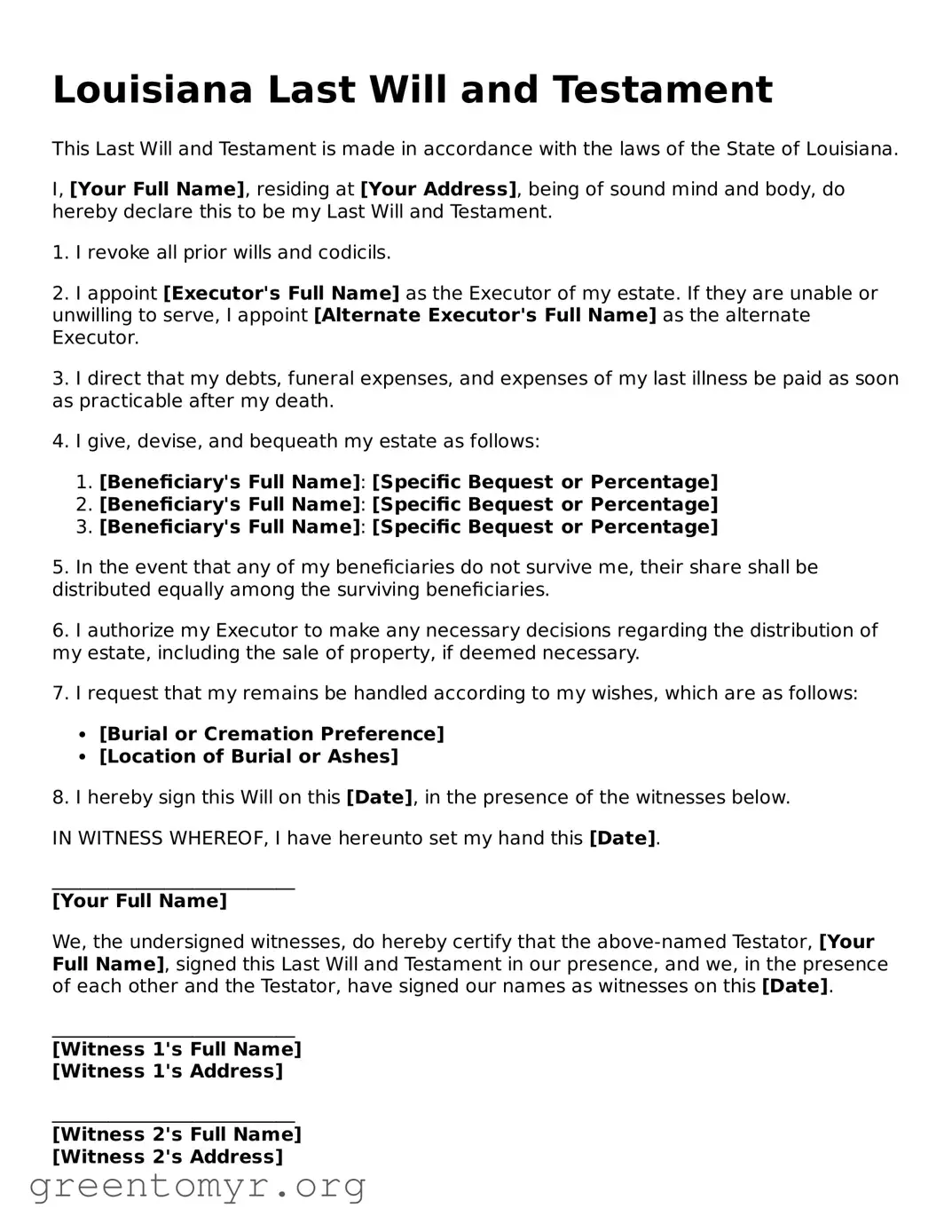
In the heart of Louisiana's legal framework lies the Last Will and Testament form, a crucial document that empowers individuals to dictate the distribution of their assets after passing. This form serves as a legal declaration of one’s wishes, ensuring that personal belongings, property, and financial matters are handled according to the deceased's desires. It typically includes essential components such as the appointment of an executor, who will oversee the execution of the will, and the designation of beneficiaries, who will inherit the estate. Additionally, the form may outline specific bequests, allowing individuals to leave particular items to chosen heirs. Louisiana's unique legal landscape, influenced by its civil law tradition, also requires certain formalities for the will to be valid, such as the necessity of signatures and, in some cases, witnesses. Understanding these elements is vital for anyone looking to create a will that accurately reflects their intentions and provides peace of mind for loved ones left behind.
Louisiana Last Will and Testament
This Last Will and Testament is made in accordance with the laws of the State of Louisiana.
I, [Your Full Name], residing at [Your Address], being of sound mind and body, do hereby declare this to be my Last Will and Testament.
1. I revoke all prior wills and codicils.
2. I appoint [Executor's Full Name] as the Executor of my estate. If they are unable or unwilling to serve, I appoint [Alternate Executor's Full Name] as the alternate Executor.
3. I direct that my debts, funeral expenses, and expenses of my last illness be paid as soon as practicable after my death.
4. I give, devise, and bequeath my estate as follows:
5. In the event that any of my beneficiaries do not survive me, their share shall be distributed equally among the surviving beneficiaries.
6. I authorize my Executor to make any necessary decisions regarding the distribution of my estate, including the sale of property, if deemed necessary.
7. I request that my remains be handled according to my wishes, which are as follows:
8. I hereby sign this Will on this [Date], in the presence of the witnesses below.
IN WITNESS WHEREOF, I have hereunto set my hand this [Date].
__________________________
[Your Full Name]
We, the undersigned witnesses, do hereby certify that the above-named Testator, [Your Full Name], signed this Last Will and Testament in our presence, and we, in the presence of each other and the Testator, have signed our names as witnesses on this [Date].
__________________________
[Witness 1's Full Name]
[Witness 1's Address]
__________________________
[Witness 2's Full Name]
[Witness 2's Address]
| Fact Name | Description |
|---|---|
| Governing Law | The Louisiana Last Will and Testament is governed by the Louisiana Civil Code, specifically Articles 1570-1600. |
| Age Requirement | Individuals must be at least 18 years old to create a valid will in Louisiana. |
| Witness Requirement | Two witnesses must sign the will for it to be considered valid. |
| Notarization | While notarization is not required, a notary can help ensure the will's validity. |
| Revocation | A will can be revoked by creating a new will or by physically destroying the existing one. |
| Holographic Wills | Holographic wills are allowed in Louisiana, provided they are written entirely in the testator's handwriting. |
| No Minimum Formalities | Louisiana allows for less formal wills, but certain requirements must still be met to ensure validity. |
| Probate Process | All wills must go through the probate process to be recognized and executed in Louisiana. |
After gathering the necessary information, you are ready to fill out the Louisiana Last Will and Testament form. This document will help ensure your wishes are carried out regarding your assets and how they should be distributed after your passing. Follow the steps below to complete the form accurately.
Once you have completed the form, consider storing it in a safe place. Inform your executor and beneficiaries of its location. This will help ensure your wishes are honored when the time comes.
A Last Will and Testament is a legal document that outlines an individual’s wishes regarding the distribution of their assets after their death. In Louisiana, this document also allows individuals to appoint an executor, who will be responsible for managing the estate and ensuring that the deceased's wishes are carried out. It is important to note that Louisiana has specific laws regarding wills, including the requirement for certain formalities to ensure the document is valid.
To create a valid Last Will and Testament in Louisiana, several key requirements must be met:
Following these requirements helps to ensure that the will is legally enforceable and reflects the true intentions of the testator.
Yes, individuals have the right to change or revoke their Last Will and Testament at any time while they are still alive. To make changes, a codicil can be added, which is an amendment to the original will. This codicil must also meet the same formal requirements as the original will. Alternatively, an individual may choose to create an entirely new will, which automatically revokes any previous wills. It is advisable to clearly state the revocation of prior wills within the new document to avoid any confusion.
If an individual passes away without a valid Last Will and Testament, they are considered to have died "intestate." In this case, Louisiana's intestacy laws will determine how the deceased's assets are distributed. Generally, assets will be divided among the surviving spouse and children, but the specific distribution can vary based on the family structure and other factors. Dying intestate can lead to complications and delays in the distribution process, as the court may need to appoint an administrator to manage the estate.
Filling out a Last Will and Testament form in Louisiana is a critical task that requires attention to detail. One common mistake people make is failing to properly identify themselves. It's essential to include your full legal name, address, and any other identifying information. Omitting this information can lead to confusion about the testator's identity, potentially invalidating the will.
Another frequent error is neglecting to name an executor. The executor is responsible for managing the estate after death. Without appointing someone to this role, there may be disputes among family members or delays in the probate process. Ensure that the chosen executor is willing to take on this responsibility and is aware of their duties.
People often overlook the importance of clearly outlining their wishes regarding asset distribution. Vague language can lead to misinterpretation. It is crucial to specify who receives what, including any personal belongings, real estate, or financial assets. This clarity helps prevent potential conflicts among heirs.
Additionally, many individuals forget to consider guardianship for minor children. If applicable, it is vital to name a guardian in the will. Failing to do so can result in a lengthy court process to determine guardianship, which may not align with your wishes.
Another mistake involves not signing the will correctly. Louisiana law requires that the will be signed in the presence of witnesses. If the signature is missing or the witnesses are not present, the will may not be considered valid. Ensure that the signing process is conducted according to legal requirements.
Some people mistakenly think that a handwritten will is acceptable without proper formalities. While Louisiana does recognize holographic wills, they must still meet specific criteria. If the will is not in the correct format, it may be deemed invalid, leaving your estate in limbo.
Lastly, individuals often fail to update their wills after significant life changes, such as marriage, divorce, or the birth of a child. An outdated will can lead to unintended consequences, such as excluding a new family member or not reflecting current wishes. Regularly reviewing and updating the will is essential to ensure it remains valid and reflective of your intentions.
When preparing a Last Will and Testament in Louisiana, it's essential to consider several additional documents that can help ensure your estate is managed according to your wishes. Each of these documents serves a specific purpose and can complement your will in various ways. Below are some commonly used forms and documents that you may find helpful.
Understanding these documents and their roles can help you create a comprehensive estate plan that reflects your wishes and protects your loved ones. Taking the time to consider these additional forms ensures that your intentions are clear and that your estate is managed smoothly after your passing.
The Last Will and Testament is a crucial legal document that outlines how an individual's assets and affairs should be handled after their death. However, it shares similarities with several other important documents in the realm of estate planning and legal directives. Here are seven documents that are akin to a Last Will and Testament:
Understanding these documents and their similarities to a Last Will can empower individuals to create a comprehensive estate plan that reflects their wishes and provides for their loved ones.
When filling out the Louisiana Last Will and Testament form, it is essential to follow certain guidelines to ensure the document is valid and reflects your intentions. Below are four important do's and don'ts.
Understanding the Louisiana Last Will and Testament can be challenging. Many people hold misconceptions that can lead to confusion or even legal issues. Here are six common misconceptions explained:
While notarization can help establish the authenticity of a will, it is not a requirement in Louisiana. A will can be valid even without a notary, provided it meets other legal criteria.
This is not true. Individuals can draft their own wills in Louisiana, as long as they follow the state's legal requirements. However, seeking legal advice can ensure that all aspects are properly addressed.
In Louisiana, handwritten wills, also known as holographic wills, can be valid if they are signed and dated by the testator. However, certain conditions must be met, so caution is advised.
This is a misconception. Wills can be amended or revoked at any time before the testator's death. Making changes can be done through a codicil or by drafting a new will.
Not all assets are subject to probate in Louisiana. Certain assets, such as those held in a trust or joint accounts, may bypass the probate process, simplifying the distribution of your estate.
This is incorrect. Even after a will is filed, interested parties can contest it under specific circumstances, such as proving that the testator lacked capacity or was under undue influence.
Being informed about these misconceptions can help individuals better navigate the process of creating a Last Will and Testament in Louisiana. Proper understanding ensures that your wishes are honored and your loved ones are protected.
When filling out and using the Louisiana Last Will and Testament form, consider these key takeaways:
These points can help ensure that your wishes are honored and that the process goes smoothly for your loved ones.