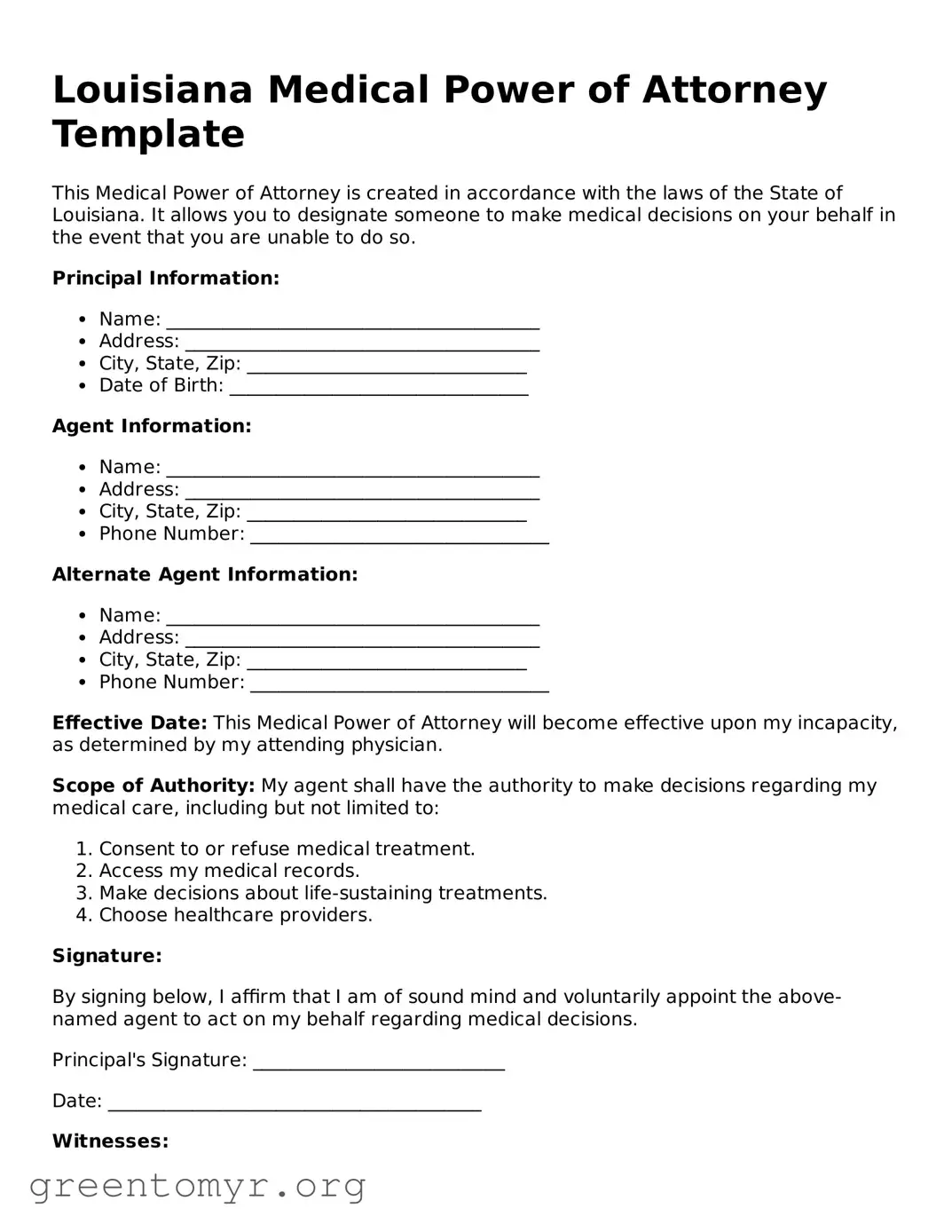
In the state of Louisiana, having a Medical Power of Attorney (MPOA) is essential for individuals who wish to ensure their healthcare preferences are honored when they are unable to communicate those wishes themselves. This important legal document empowers a designated person, often referred to as an agent or proxy, to make medical decisions on behalf of the individual. The MPOA covers a variety of healthcare decisions, ranging from consent to medical treatment and procedures to end-of-life care options. It is crucial for the appointed agent to understand the individual’s values and preferences, as they will be responsible for making decisions that align with those beliefs. Furthermore, the form requires specific information, including the name of the principal, the agent, and any alternate agents, along with clear instructions regarding the scope of authority granted. By completing this form, individuals can gain peace of mind, knowing that their health care will be managed according to their wishes, even in times of medical crisis.
Louisiana Medical Power of Attorney Template
This Medical Power of Attorney is created in accordance with the laws of the State of Louisiana. It allows you to designate someone to make medical decisions on your behalf in the event that you are unable to do so.
Principal Information:
Agent Information:
Alternate Agent Information:
Effective Date: This Medical Power of Attorney will become effective upon my incapacity, as determined by my attending physician.
Scope of Authority: My agent shall have the authority to make decisions regarding my medical care, including but not limited to:
Signature:
By signing below, I affirm that I am of sound mind and voluntarily appoint the above-named agent to act on my behalf regarding medical decisions.
Principal's Signature: ___________________________
Date: ________________________________________
Witnesses:
This document must be signed in the presence of two witnesses who are not related to the principal or the agent.
Notary Public:
This document may also be notarized to enhance its validity.
Notary Signature: ________________________________
Date: ________________________________________
| Fact Name | Description |
|---|---|
| Purpose | The Louisiana Medical Power of Attorney form allows individuals to designate someone to make healthcare decisions on their behalf if they become unable to do so. |
| Governing Law | This form is governed by Louisiana Revised Statutes, specifically Title 40, Chapter 11, which outlines the laws regarding medical powers of attorney in the state. |
| Requirements | To be valid, the form must be signed by the principal (the person granting authority) and two witnesses or a notary public. |
| Revocation | The principal can revoke the Medical Power of Attorney at any time, as long as they are mentally competent to do so. |
Filling out the Louisiana Medical Power of Attorney form is an important step in ensuring your healthcare decisions are made according to your wishes. This document allows you to appoint someone to make medical decisions on your behalf if you are unable to do so. Following the steps below will help you complete the form accurately.
A Louisiana Medical Power of Attorney is a legal document that allows you to appoint someone you trust to make healthcare decisions on your behalf if you become unable to do so. This person, known as your agent or proxy, can make choices regarding your medical treatment, surgical procedures, and end-of-life care based on your wishes.
In Louisiana, you can choose any competent adult to serve as your agent. This can be a family member, friend, or anyone you trust to make decisions that align with your values and preferences. However, it is important to note that certain individuals, such as your healthcare provider or an employee of your healthcare facility, may not be eligible to act as your agent unless they are related to you.
Creating a Medical Power of Attorney in Louisiana involves a few straightforward steps:
Once completed, keep the original document in a safe place and provide copies to your agent, healthcare providers, and family members.
Yes, you have the right to change or revoke your Medical Power of Attorney at any time, as long as you are competent to do so. To revoke the document, you can simply create a new Medical Power of Attorney or provide a written notice to your agent and any healthcare providers who have a copy of the original document. It’s a good practice to inform your agent and relevant parties about any changes to ensure clarity regarding your wishes.
If you do not have a Medical Power of Attorney in place and become incapacitated, healthcare decisions may be made by family members or, in some cases, by the court. This can lead to disagreements among family members or result in decisions that may not reflect your personal wishes. Having a Medical Power of Attorney ensures that your preferences are honored and that someone you trust is making those critical decisions on your behalf.
Yes, there is a key difference between a Medical Power of Attorney and a Living Will. A Medical Power of Attorney appoints someone to make healthcare decisions for you when you cannot make them yourself. In contrast, a Living Will outlines your specific wishes regarding medical treatment and end-of-life care in situations where you are terminally ill or in a persistent vegetative state. Both documents serve important roles in healthcare planning, and it is often advisable to have both in place for comprehensive coverage of your medical preferences.
Filling out a Louisiana Medical Power of Attorney form can be a straightforward process, but mistakes can lead to significant issues down the line. One common error is failing to select the right agent. The person chosen should be someone trustworthy and capable of making medical decisions on your behalf. Choosing a family member or friend without considering their ability to handle such responsibilities can create complications.
Another frequent mistake is not being specific about the powers granted. The form allows you to specify which medical decisions your agent can make. If these powers are too vague, it may lead to confusion during critical moments. Clarity is essential to ensure your wishes are followed.
Many people overlook the importance of signing the form correctly. In Louisiana, the document must be signed in the presence of a notary or two witnesses. Failing to meet these requirements can render the document invalid. It’s crucial to ensure that all signatures are in place and properly witnessed.
Additionally, some individuals neglect to discuss their wishes with their designated agent. This conversation is vital for ensuring that the agent understands your preferences regarding medical treatment. Without this discussion, the agent may make decisions that do not align with your values or desires.
Another mistake is not updating the document when circumstances change. Life events, such as a divorce or the death of a chosen agent, can impact your decisions. Regularly reviewing and updating the Medical Power of Attorney ensures it reflects your current wishes.
People also sometimes forget to provide copies of the completed form to relevant parties. It’s important to share the document with your healthcare provider, family members, and the designated agent. This ensures that everyone is aware of your choices and can act accordingly when needed.
Finally, some individuals may assume that the Medical Power of Attorney is the same as a living will. While both documents are important, they serve different purposes. A Medical Power of Attorney appoints someone to make decisions for you, while a living will outlines your wishes regarding end-of-life care. Understanding these differences is key to effective planning.
When creating a Louisiana Medical Power of Attorney, it is often beneficial to have other documents prepared as well. These forms can help ensure that your healthcare wishes are clearly communicated and legally supported. Below is a list of commonly used documents that complement the Medical Power of Attorney.
Having these documents in place can provide peace of mind for you and your loved ones. They ensure that your healthcare and financial wishes are respected and followed, even when you cannot express them yourself.
When filling out the Louisiana Medical Power of Attorney form, it is essential to approach the task with care and consideration. Below are five important guidelines to follow, as well as common pitfalls to avoid.
Understanding the Louisiana Medical Power of Attorney form is crucial for making informed decisions about healthcare. However, several misconceptions can lead to confusion. Here are ten common misconceptions:
This form is not limited to end-of-life situations. It allows your designated agent to make a wide range of healthcare decisions on your behalf when you are unable to do so.
While you can choose a trusted person, they must be at least 18 years old and capable of making healthcare decisions.
In Louisiana, the Medical Power of Attorney can be valid without notarization if it is signed by two witnesses who meet specific requirements.
A Medical Power of Attorney allows someone to make decisions for you, while a Living Will outlines your wishes regarding specific medical treatments.
You can revoke an existing Medical Power of Attorney and create a new one. Just ensure that all parties are informed of the changes.
Anyone can benefit from this form, regardless of their current health status. It prepares for unexpected situations.
You can modify or revoke the Medical Power of Attorney at any time as long as you are mentally competent.
The authority granted to your agent typically only takes effect when you are unable to make your own healthcare decisions.
Your agent must act in accordance with your wishes and best interests. They cannot make decisions that contradict your known preferences.
People of all ages can face medical emergencies. Having this form ensures that your wishes are respected, regardless of your age.
Addressing these misconceptions can help individuals make informed choices about their healthcare and ensure that their preferences are honored in times of need.
Filling out and using the Louisiana Medical Power of Attorney form is crucial for ensuring your healthcare wishes are respected. Here are some key takeaways to consider:
Taking these steps will help ensure that your medical decisions align with your wishes when it matters most.