Content Navigation

In the realm of business and professional relationships, safeguarding sensitive information is paramount. The Louisiana Non-disclosure Agreement (NDA) form serves as a crucial tool for individuals and organizations aiming to protect proprietary data, trade secrets, and confidential communications. This legally binding document outlines the obligations of parties involved regarding the handling and sharing of confidential information. Key components typically include the definition of what constitutes confidential information, the duration of the agreement, and the consequences of any breaches. By establishing clear guidelines, the NDA fosters trust and encourages open dialogue while ensuring that sensitive information remains secure. It is essential for all parties to understand the implications of signing this agreement, as it not only protects their interests but also promotes a culture of confidentiality and respect in business dealings.

Louisiana Non-disclosure Agreement Example

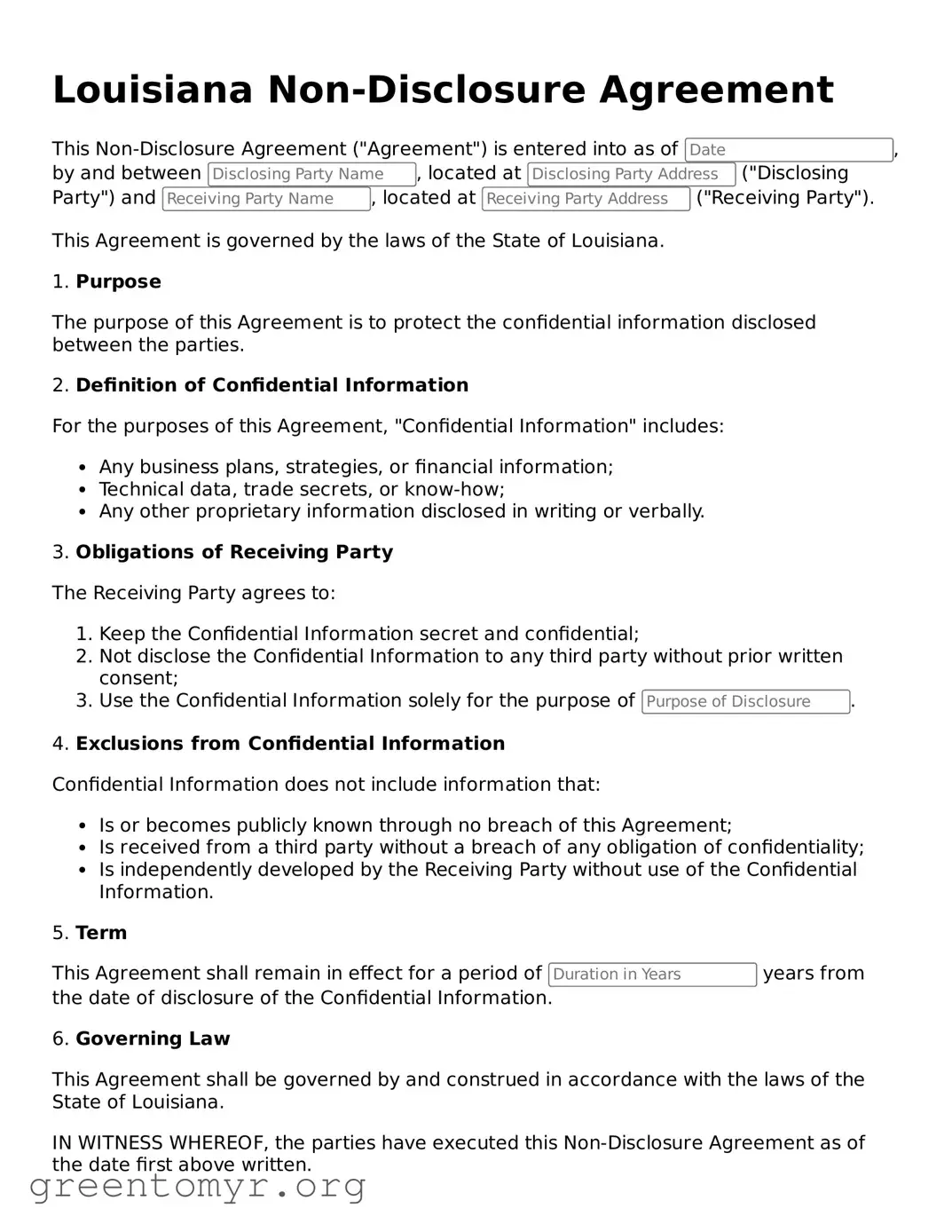
Louisiana Non-Disclosure Agreement

This Non-Disclosure Agreement ("Agreement") is entered into as of , by and between , located at ("Disclosing Party") and , located at ("Receiving Party").

This Agreement is governed by the laws of the State of Louisiana.

1. Purpose

The purpose of this Agreement is to protect the confidential information disclosed between the parties.

2. Definition of Confidential Information

For the purposes of this Agreement, "Confidential Information" includes:

  • Any business plans, strategies, or financial information;
  • Technical data, trade secrets, or know-how;
  • Any other proprietary information disclosed in writing or verbally.

3. Obligations of Receiving Party

The Receiving Party agrees to:

  1. Keep the Confidential Information secret and confidential;
  2. Not disclose the Confidential Information to any third party without prior written consent;
  3. Use the Confidential Information solely for the purpose of .

4. Exclusions from Confidential Information

Confidential Information does not include information that:

  • Is or becomes publicly known through no breach of this Agreement;
  • Is received from a third party without a breach of any obligation of confidentiality;
  • Is independently developed by the Receiving Party without use of the Confidential Information.

5. Term

This Agreement shall remain in effect for a period of years from the date of disclosure of the Confidential Information.

6. Governing Law

This Agreement shall be governed by and construed in accordance with the laws of the State of Louisiana.

IN WITNESS WHEREOF, the parties have executed this Non-Disclosure Agreement as of the date first above written.

Disclosing Party

Receiving Party

PDF Form Features

Fact Name Description
Purpose The Louisiana Non-disclosure Agreement (NDA) is designed to protect confidential information shared between parties.
Governing Law This agreement is governed by the laws of the State of Louisiana.
Parties Involved The NDA typically involves at least two parties: the disclosing party and the receiving party.
Duration The duration of confidentiality obligations can vary, often lasting for a specified number of years.
Exclusions Information that is public knowledge or independently developed is usually excluded from the NDA.
Enforcement If a party breaches the NDA, the non-breaching party may seek legal remedies, including damages.
Mutual Agreements Sometimes, both parties may agree to keep each other's information confidential, creating a mutual NDA.

Guide to Using Louisiana Non-disclosure Agreement

Filling out the Louisiana Non-disclosure Agreement form requires careful attention to detail. After completing the form, it will need to be signed by all parties involved to ensure its validity.

  1. Begin by downloading the Louisiana Non-disclosure Agreement form from a reliable source.
  2. Open the form and read through the instructions provided to understand what information is required.
  3. Fill in the names of all parties involved in the agreement at the top of the form.
  4. Provide the addresses of each party, ensuring accuracy to avoid future complications.
  5. Clearly state the purpose of the non-disclosure agreement in the designated section.
  6. Outline the specific information that will be kept confidential, being as detailed as necessary.
  7. Include the duration of the confidentiality obligation. Specify how long the information will remain confidential.
  8. Review the terms and conditions section, and make any necessary modifications to fit the agreement's needs.
  9. Ensure that all parties review the document for accuracy and completeness before signing.
  10. Sign and date the agreement in the designated areas. Ensure that all parties do the same.
  11. Keep a copy of the signed agreement for your records and provide copies to all parties involved.

Get Answers on Louisiana Non-disclosure Agreement

What is a Louisiana Non-disclosure Agreement?

A Louisiana Non-disclosure Agreement (NDA) is a legal contract designed to protect confidential information shared between parties. It prevents one party from disclosing sensitive information to outside individuals or entities without permission. This agreement is often used in business settings, where proprietary information, trade secrets, or other confidential data needs protection.

When should I use a Non-disclosure Agreement?

Consider using an NDA in several situations, including:

  • When sharing business plans or strategies with potential investors.
  • During negotiations with partners or vendors where sensitive information is exchanged.
  • When hiring employees who will have access to confidential company data.
  • When discussing joint ventures or collaborations that involve proprietary information.

What are the key components of a Louisiana Non-disclosure Agreement?

A typical NDA includes several important elements:

  1. Definition of Confidential Information: Clearly outlines what information is considered confidential.
  2. Obligations of the Receiving Party: Specifies what the receiving party can and cannot do with the confidential information.
  3. Duration: States how long the agreement is in effect and how long the confidentiality obligations last.
  4. Exclusions: Identifies any information that is not covered by the NDA, such as information already in the public domain.

How can I enforce a Non-disclosure Agreement?

If you believe someone has violated an NDA, there are steps you can take:

  • Gather evidence of the breach, such as communications or documents that show the disclosure of confidential information.
  • Contact the other party to discuss the breach and seek resolution.
  • If necessary, consult with a legal professional to explore your options for enforcement, which may include mediation or legal action.

Common mistakes

When filling out the Louisiana Non-disclosure Agreement (NDA) form, individuals often make several common mistakes that can lead to complications later on. Awareness of these pitfalls can help ensure that the agreement serves its intended purpose effectively.

One frequent error is failing to clearly define the confidential information. Parties may assume that the term is understood, but ambiguity can create confusion. It is essential to specify what constitutes confidential information, such as trade secrets, business strategies, or client lists. Without this clarity, the protection intended by the NDA may be weakened.

Another mistake involves neglecting to include the duration of the confidentiality obligation. Some individuals forget to state how long the information must remain confidential. This omission can lead to misunderstandings about the time frame in which the parties are bound to secrecy. Clearly outlining the duration helps set expectations and provides legal clarity.

Additionally, many people overlook the importance of including the signatures of all parties involved. A signed NDA is a binding document. If one party fails to sign, the agreement may not be enforceable. Ensuring that all necessary signatures are present is crucial for the agreement to hold up in a legal context.

Furthermore, individuals sometimes fail to consider the governing law clause. This clause indicates which state’s laws will apply in case of a dispute. In Louisiana, it is vital to specify that Louisiana law governs the agreement. Without this specification, parties may find themselves in a complicated legal situation if a disagreement arises.

Lastly, individuals may rush through the process without fully understanding the implications of the NDA. Taking the time to read and comprehend each section is vital. Rushing can lead to misinterpretations or unintentional omissions. A thorough review ensures that all parties are on the same page and that the agreement is truly reflective of their intentions.

Documents used along the form

When entering into a Non-disclosure Agreement (NDA) in Louisiana, several other forms and documents may be relevant to ensure that all parties are adequately protected and informed. These documents can help clarify responsibilities, outline terms, and establish a solid foundation for the relationship between the parties involved. Below is a list of commonly used documents alongside an NDA.

  • Confidentiality Agreement: Similar to an NDA, this document specifically outlines what information must remain confidential and the obligations of the parties to protect that information.
  • Mutual Non-disclosure Agreement: This form is used when both parties will share confidential information with each other. It details the terms under which both sides agree to keep the information private.
  • Non-compete Agreement: This document restricts one party from engaging in business activities that compete with another party for a specified period and within a certain geographic area.
  • Service Agreement: This outlines the terms of service between parties, including the scope of work, payment terms, and confidentiality obligations regarding any sensitive information shared during the service.
  • Letter of Intent: Often used in business negotiations, this document expresses the intention of parties to enter into a formal agreement. It may include confidentiality clauses to protect sensitive discussions.
  • Employment Agreement: This document lays out the terms of employment, including confidentiality obligations, which protect the employer’s sensitive information during and after employment.

Utilizing these documents in conjunction with a Louisiana Non-disclosure Agreement can significantly enhance the protection of sensitive information. Each document serves a specific purpose and can help establish clear expectations between parties, ultimately fostering a more secure and trustworthy relationship.

Similar forms

A Non-disclosure Agreement (NDA) is a legal document designed to protect sensitive information from being disclosed to unauthorized parties. Several other documents serve similar purposes in different contexts. Here are six documents that share similarities with an NDA:

  • Confidentiality Agreement: Like an NDA, a confidentiality agreement restricts the sharing of proprietary information. Both documents ensure that the parties involved keep certain information private.
  • Non-Compete Agreement: This document prevents individuals from engaging in business activities that compete with a former employer. While NDAs focus on information, non-compete agreements protect business interests by limiting competition.
  • Mutual Non-Disclosure Agreement: In this type of agreement, both parties agree to protect each other’s confidential information. It is similar to a standard NDA but emphasizes reciprocity in confidentiality obligations.
  • Secrecy Agreement: Often used interchangeably with an NDA, a secrecy agreement also aims to keep sensitive information confidential. The terms and conditions are similar, focusing on the protection of trade secrets and proprietary data.
  • Privacy Policy: While primarily used by businesses to inform customers about data collection practices, a privacy policy outlines how personal information will be handled and protected, similar to the intentions behind an NDA.
  • Employment Agreement: This document may include clauses that address confidentiality and the handling of sensitive information. It establishes the expectations for employees regarding the protection of proprietary company data.

Dos and Don'ts

When filling out the Louisiana Non-disclosure Agreement form, it's essential to follow specific guidelines to ensure clarity and legality. Here’s a list of things you should and shouldn’t do:

  • Do read the entire agreement carefully before filling it out.
  • Do provide accurate and complete information.
  • Do sign and date the document at the appropriate places.
  • Do keep a copy of the signed agreement for your records.
  • Don't leave any required fields blank.
  • Don't use vague language or terms that could be misinterpreted.
  • Don't rush through the process; take your time to ensure accuracy.
  • Don't ignore any legal advice if you have questions about the agreement.

Following these guidelines will help you navigate the Non-disclosure Agreement process smoothly and effectively.

Misconceptions

Misconceptions about the Louisiana Non-disclosure Agreement (NDA) can lead to misunderstandings and improper use of this important legal tool. Here are seven common misconceptions:

  1. All NDAs are the same. Many believe that all NDAs are interchangeable. In reality, each NDA should be tailored to fit the specific needs and circumstances of the parties involved.
  2. NDAs are only for large companies. Some think that only big corporations use NDAs. However, individuals and small businesses often require NDAs to protect their confidential information.
  3. Signing an NDA means you can't share anything ever. People often assume that signing an NDA prohibits all sharing of information. In fact, NDAs typically allow for sharing under certain conditions, such as with consent or legal obligation.
  4. NDAs are only useful during employment. Many individuals believe NDAs are only relevant while employed. However, they can also be crucial during business negotiations, partnerships, or after employment ends.
  5. Once signed, an NDA cannot be changed. Some think that NDAs are set in stone. In truth, parties can negotiate changes to the agreement as long as both sides consent to the modifications.
  6. NDAs are enforceable in all situations. There is a misconception that all NDAs are legally binding. An NDA may not be enforceable if it is overly broad or if it violates public policy.
  7. NDAs are only for protecting trade secrets. While NDAs are often associated with trade secrets, they can also protect other sensitive information, such as business plans, customer lists, and proprietary processes.

Understanding these misconceptions can help individuals and businesses effectively utilize NDAs to safeguard their interests.

Key takeaways

When dealing with sensitive information in Louisiana, understanding how to properly fill out and utilize a Non-disclosure Agreement (NDA) is crucial. Here are some key takeaways to consider:

  • Confidential Information Definition: Clearly define what constitutes confidential information in the NDA. This helps both parties understand what information is protected.
  • Obligations of the Parties: Specify the obligations of each party regarding the handling and protection of the confidential information. This includes how the information can be used and who can access it.
  • Duration of Confidentiality: Indicate how long the confidentiality obligations will last. This period should be reasonable and reflect the nature of the information being protected.
  • Consequences of Breach: Outline the potential consequences if either party breaches the NDA. This can include legal action, financial penalties, or other remedies.

By paying attention to these elements, you can ensure that your NDA serves its purpose effectively and protects your interests.