The Louisiana Notary Acknowledgement form plays a crucial role in the legal landscape of the state, serving as a vital tool for ensuring the authenticity of signatures on important documents. This form is often required in various transactions, such as real estate sales, contracts, and other legal agreements. When a notary public completes this form, they confirm that the signer appeared before them, acknowledged their signature, and did so willingly. This process adds a layer of protection against fraud and helps maintain the integrity of legal documents. Additionally, the form typically includes essential details, such as the date of the acknowledgment, the name of the signer, and the notary's official seal. Understanding the purpose and requirements of the Louisiana Notary Acknowledgement form is essential for anyone involved in legal transactions within the state, as it helps ensure that documents are executed properly and can be upheld in a court of law.
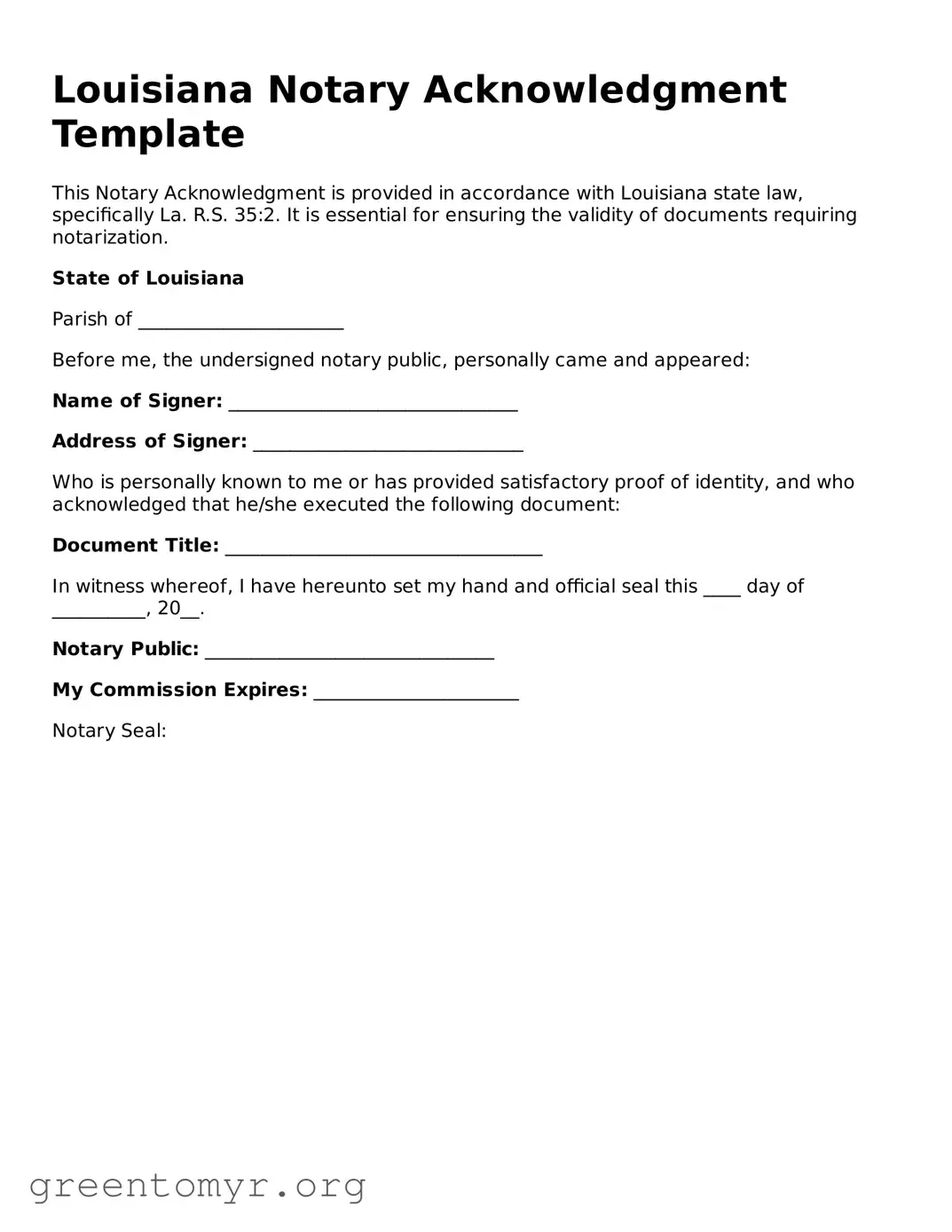
Louisiana Notary Acknowledgment Template
This Notary Acknowledgment is provided in accordance with Louisiana state law, specifically La. R.S. 35:2. It is essential for ensuring the validity of documents requiring notarization.
State of Louisiana
Parish of ______________________
Before me, the undersigned notary public, personally came and appeared:
Name of Signer: _______________________________
Address of Signer: _____________________________
Who is personally known to me or has provided satisfactory proof of identity, and who acknowledged that he/she executed the following document:
Document Title: __________________________________
In witness whereof, I have hereunto set my hand and official seal this ____ day of __________, 20__.
Notary Public: _______________________________
My Commission Expires: ______________________
Notary Seal:
| Fact Name | Description |
|---|---|
| Purpose | The Louisiana Notary Acknowledgment form serves to verify the identity of the signer and confirm their willingness to sign a document. |
| Governing Law | This form is governed by Louisiana Civil Code Article 1833 and the Louisiana Notary Public Law. |
| Required Elements | The form must include the notary's signature, the date of acknowledgment, and the name of the signer. |
| Format | The acknowledgment must be in writing and can be attached to the document being notarized. |
| Use Cases | This form is commonly used for real estate transactions, legal documents, and powers of attorney. |
| Witness Requirement | In Louisiana, a notary acknowledgment does not require witnesses to be valid. |
Completing the Louisiana Notary Acknowledgment form is a straightforward process that requires careful attention to detail. Once you have filled out the form, it will need to be signed in the presence of a notary public, who will then complete their section to finalize the document.
The Louisiana Notary Acknowledgement form is a legal document used to verify the identity of individuals signing a document. This form is crucial in ensuring that the signatures on legal documents are authentic. When a notary public acknowledges a signature, they confirm that the person signing the document did so willingly and was properly identified at the time of signing.
A Notary Acknowledgement is often required for various legal documents, including:
In general, any document that will be filed with a court or government agency may require a Notary Acknowledgement to ensure its acceptance and enforceability.
To complete a Notary Acknowledgement form, follow these steps:
It is essential to have the correct form and follow the procedures to avoid any issues with the document’s validity.
As of October 2023, Louisiana allows for remote notarization under specific conditions. This means that individuals can have their documents notarized without being physically present with the notary. However, both parties must use secure audio-visual technology that meets state regulations. It is important to check the current laws and guidelines, as they may change, to ensure compliance when opting for remote notarization.
Filling out the Louisiana Notary Acknowledgement form can seem straightforward, but many people make common mistakes that can lead to complications. One frequent error is failing to include the correct date. The date should reflect when the acknowledgment is made, not when the document was signed. This discrepancy can cause confusion and potentially invalidate the acknowledgment.
Another common mistake is neglecting to provide the name of the person whose signature is being acknowledged. It is essential to clearly state the name as it appears on the document. Omitting this detail can raise questions about the validity of the acknowledgment and may require additional steps to rectify.
People also often forget to include the notary’s signature. Without this crucial element, the acknowledgment lacks authenticity. A notary's signature serves as a verification of the identity of the signer and the circumstances under which the signature was made. Failing to obtain this signature can render the entire document ineffective.
In addition, some individuals make the mistake of not checking the notary's commission expiration date. A notary must be actively commissioned at the time of the acknowledgment. If the notary's commission has expired, the acknowledgment may be challenged, leading to legal complications.
Another issue arises when the notary fails to fill out the required information accurately. This includes the notary's name, title, and the location of the acknowledgment. Each of these details is vital for the acknowledgment to be complete and legally binding. Inaccuracies can create problems down the line.
Lastly, people often overlook the requirement for the notary to use a seal. The notary's seal is an important part of the acknowledgment process. It provides an additional layer of verification and authenticity. Without it, the acknowledgment may be deemed incomplete or invalid.
When working with the Louisiana Notary Acknowledgement form, it is often necessary to consider additional documents that may accompany it. These documents serve various purposes, ensuring that all legal requirements are met and that the intentions of the parties involved are clearly documented. Below is a list of some common forms and documents that are frequently used alongside the Notary Acknowledgement.
Understanding these documents and their roles can greatly enhance the clarity and legality of transactions. Each form serves a specific purpose, ensuring that the rights and responsibilities of all parties are respected and upheld.
When filling out the Louisiana Notary Acknowledgement form, it's important to follow specific guidelines to ensure that the document is completed correctly. Here’s a list of things you should and shouldn’t do:
Many people have misunderstandings about the Louisiana Notary Acknowledgement form. Here are five common misconceptions:
Notaries in Louisiana are authorized to perform specific acts, such as acknowledgments, oaths, and affirmations. However, they cannot provide legal advice or draft legal documents unless they are also licensed attorneys.
A notary's role is to verify the identity of the signer and ensure they are signing willingly. The notary does not guarantee the content or legality of the document itself.
In Louisiana, a notary acknowledgment can be completed after the document is signed, as long as the signer appears before the notary to acknowledge their signature.
While common in real estate, notary acknowledgments are required for various legal documents, including powers of attorney, contracts, and affidavits.
Louisiana law sets maximum fees that notaries can charge for their services. It is important to check these regulations to avoid unexpected costs.
When filling out and using the Louisiana Notary Acknowledgement form, keep these key takeaways in mind: