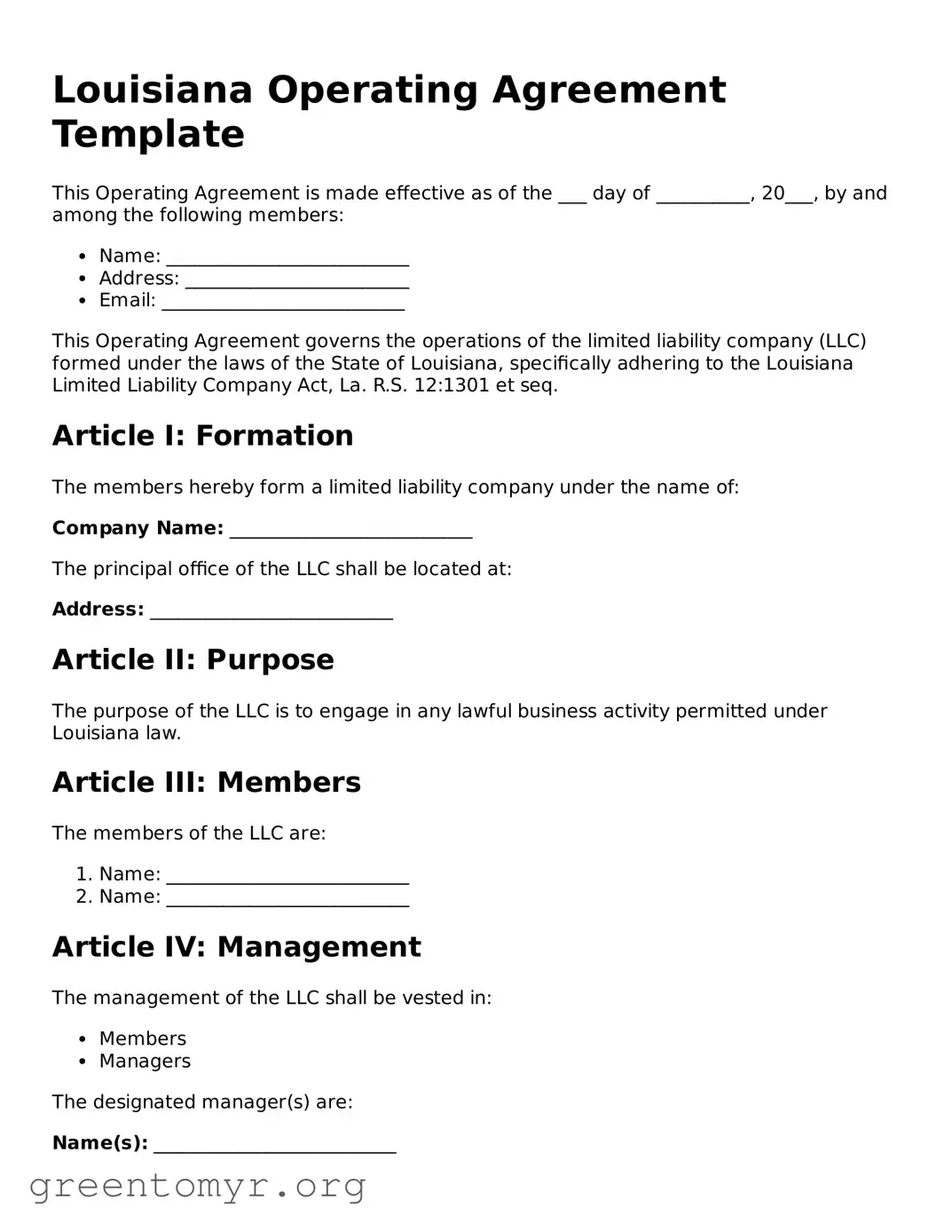
The Louisiana Operating Agreement form serves as a crucial document for limited liability companies (LLCs) operating within the state. This form outlines the internal management structure, rights, and responsibilities of members, ensuring clarity and preventing disputes. Key aspects include the distribution of profits and losses, procedures for adding or removing members, and guidelines for decision-making processes. Additionally, the agreement addresses the management roles, whether members will manage the LLC or appoint managers. By establishing these fundamental principles, the Operating Agreement provides a framework that supports smooth operations and protects the interests of all members involved. It is essential for LLCs to have this document in place, as it not only complies with state regulations but also fosters a sense of security among members, knowing that their rights and obligations are clearly defined.
Louisiana Operating Agreement Template
This Operating Agreement is made effective as of the ___ day of __________, 20___, by and among the following members:
This Operating Agreement governs the operations of the limited liability company (LLC) formed under the laws of the State of Louisiana, specifically adhering to the Louisiana Limited Liability Company Act, La. R.S. 12:1301 et seq.
Article I: Formation
The members hereby form a limited liability company under the name of:
Company Name: __________________________
The principal office of the LLC shall be located at:
Address: __________________________
Article II: Purpose
The purpose of the LLC is to engage in any lawful business activity permitted under Louisiana law.
Article III: Members
The members of the LLC are:
Article IV: Management
The management of the LLC shall be vested in:
The designated manager(s) are:
Name(s): __________________________
Article V: Capital Contributions
Each member shall contribute capital as follows:
Article VI: Distributions
Distributions of profits and losses shall be allocated as follows:
Article VII: Indemnification
The LLC shall indemnify any member or manager against expenses and liabilities incurred in connection with the LLC, to the fullest extent permitted by law.
Article VIII: Amendments
This Operating Agreement may be amended only by a written agreement signed by all members.
Article IX: Governing Law
This Agreement shall be governed by and construed in accordance with the laws of the State of Louisiana.
IN WITNESS WHEREOF, the undersigned have executed this Operating Agreement as of the date first above written.
Member Signatures:
| Fact Name | Description |
|---|---|
| Governing Law | The Louisiana Operating Agreement is governed by the Louisiana Revised Statutes, specifically Title 12, Chapter 22, which outlines the laws regarding limited liability companies (LLCs). |
| Purpose | This form serves as a foundational document for LLCs in Louisiana, detailing the management structure, member responsibilities, and operational procedures. |
| Customization | Members can customize the Operating Agreement to fit their specific needs, allowing for flexibility in governance and management. |
| Legal Requirement | While not mandatory, having an Operating Agreement is highly recommended in Louisiana to help prevent disputes among members and to clarify business operations. |
Filling out the Louisiana Operating Agreement form is a straightforward process that requires careful attention to detail. Once completed, this form will serve as a foundational document for your business, outlining the structure and operational guidelines for your limited liability company (LLC). Follow these steps to ensure you fill out the form accurately.
A Louisiana Operating Agreement is a legal document that outlines the management structure and operational procedures of a Limited Liability Company (LLC) in Louisiana. This agreement serves as a guideline for how the company will operate, detailing the rights and responsibilities of its members. While not required by law, having an Operating Agreement is highly recommended as it helps prevent misunderstandings among members and provides clarity in business operations.
Every LLC in Louisiana, regardless of size or number of members, should create an Operating Agreement. This document is especially important for multi-member LLCs, as it clarifies each member's role and contributions. Even single-member LLCs benefit from having an Operating Agreement, as it establishes the business as a separate entity and can protect personal assets. It’s a proactive step to ensure that all members are on the same page regarding the company’s operations.
An Operating Agreement should include several key elements to ensure comprehensive coverage of the business's operations. Consider including the following:
Including these elements helps ensure that all members understand their roles and responsibilities, reducing the potential for conflict.
Amending an Operating Agreement is a straightforward process. First, review the original agreement to determine the procedures for making changes. Typically, amendments require a vote among the members. Here’s a simple process to follow:
Keeping the Operating Agreement updated is crucial for maintaining clarity and ensuring that it reflects the current state of the business.
Filling out the Louisiana Operating Agreement form is a critical step for those forming a limited liability company (LLC). However, many individuals make common mistakes that can lead to complications down the line. Understanding these pitfalls can help ensure that the agreement is completed accurately and effectively.
One frequent error is failing to specify the management structure of the LLC. The form allows for either member-managed or manager-managed options. Not clearly indicating which structure applies can create confusion among members and lead to disputes regarding decision-making authority.
Another mistake is neglecting to outline the roles and responsibilities of each member. Without this clarity, members may have differing expectations about their contributions and obligations, which can result in misunderstandings or conflicts later on.
Additionally, some individuals overlook the importance of including provisions for profit and loss distribution. The agreement should clearly state how profits and losses will be allocated among members. Failing to do so can lead to disagreements and dissatisfaction among members regarding financial distributions.
Omitting a buy-sell agreement is also a common oversight. This provision is essential for addressing what happens if a member wants to exit the LLC or if certain triggering events occur. Without it, the remaining members may face uncertainty about how to handle such situations.
Many people also make the mistake of not updating the Operating Agreement as the LLC evolves. As circumstances change, such as the addition of new members or changes in business structure, the agreement should be revised accordingly. Neglecting this can result in outdated terms that no longer reflect the current state of the business.
Another issue arises when members do not properly date and sign the agreement. An unsigned or improperly dated document may not hold up in legal situations, leading to potential disputes about its validity. It is crucial for all members to sign and date the agreement to ensure its enforceability.
Some individuals fail to consult legal counsel when drafting the Operating Agreement. While templates may be available, each business is unique. Seeking professional advice can help tailor the agreement to the specific needs of the LLC and its members.
Finally, not considering state-specific requirements can lead to compliance issues. Louisiana has its own regulations that must be adhered to when forming an LLC. Ignoring these can result in fines or complications with the state, impacting the operation of the business.
By being aware of these common mistakes, individuals can take proactive steps to ensure their Louisiana Operating Agreement is comprehensive and effective. Attention to detail during this process can prevent future issues and support the smooth operation of the LLC.
When forming a Limited Liability Company (LLC) in Louisiana, the Operating Agreement is a crucial document that outlines the management structure and operating procedures of the business. However, several other forms and documents are often used in conjunction with the Operating Agreement to ensure a smooth and legally compliant setup. Here are four important documents that you may need:
Having these documents prepared and organized can streamline the process of establishing your LLC in Louisiana. Each plays a vital role in ensuring that your business operates smoothly and complies with state regulations.
When filling out the Louisiana Operating Agreement form, it's essential to keep a few key points in mind. Here’s a list of things you should and shouldn't do to ensure a smooth process.
By following these tips, you can ensure that your Louisiana Operating Agreement is filled out correctly and efficiently.
Below are seven common misconceptions about the Louisiana Operating Agreement form, along with explanations to clarify each point.
This is not true. While having an Operating Agreement is highly recommended for LLCs, it is not legally required in Louisiana. However, it helps define the management structure and operating procedures.
The Operating Agreement is a private document and does not need to be filed with the state. It should be kept with other important business records.
This is a misconception. The Operating Agreement can and should be updated as the business evolves or as members change, ensuring it always reflects the current state of the LLC.
While profit distribution is an important aspect, the Operating Agreement covers various topics, including management structure, member responsibilities, and procedures for resolving disputes.
While an Operating Agreement provides a framework for operations and can help protect members' interests, it does not guarantee immunity from legal issues. Compliance with laws and regulations is still necessary.
While it is best practice for all members to sign, the validity of the Operating Agreement can still stand if it is adopted by a majority of the members, depending on the terms outlined within it.
When filling out and using the Louisiana Operating Agreement form, several key points should be considered to ensure proper completion and functionality.