Content Navigation

In Louisiana, the Power of Attorney form serves as a crucial legal document that allows individuals to appoint someone else to make decisions on their behalf. This form can cover a wide range of powers, from managing financial affairs to making healthcare decisions. By granting this authority, the principal—who is the person giving the power—can ensure that their interests are represented, even if they are unable to communicate or act on their own. The document can be tailored to be durable, meaning it remains effective even if the principal becomes incapacitated, or it can be limited to specific tasks or timeframes. Additionally, Louisiana law requires certain formalities, such as signatures and notarization, to ensure the document is valid and enforceable. Understanding the intricacies of this form is essential for anyone considering appointing a trusted individual to act on their behalf, as it provides peace of mind and clarity in times of need.

Louisiana Power of Attorney Example

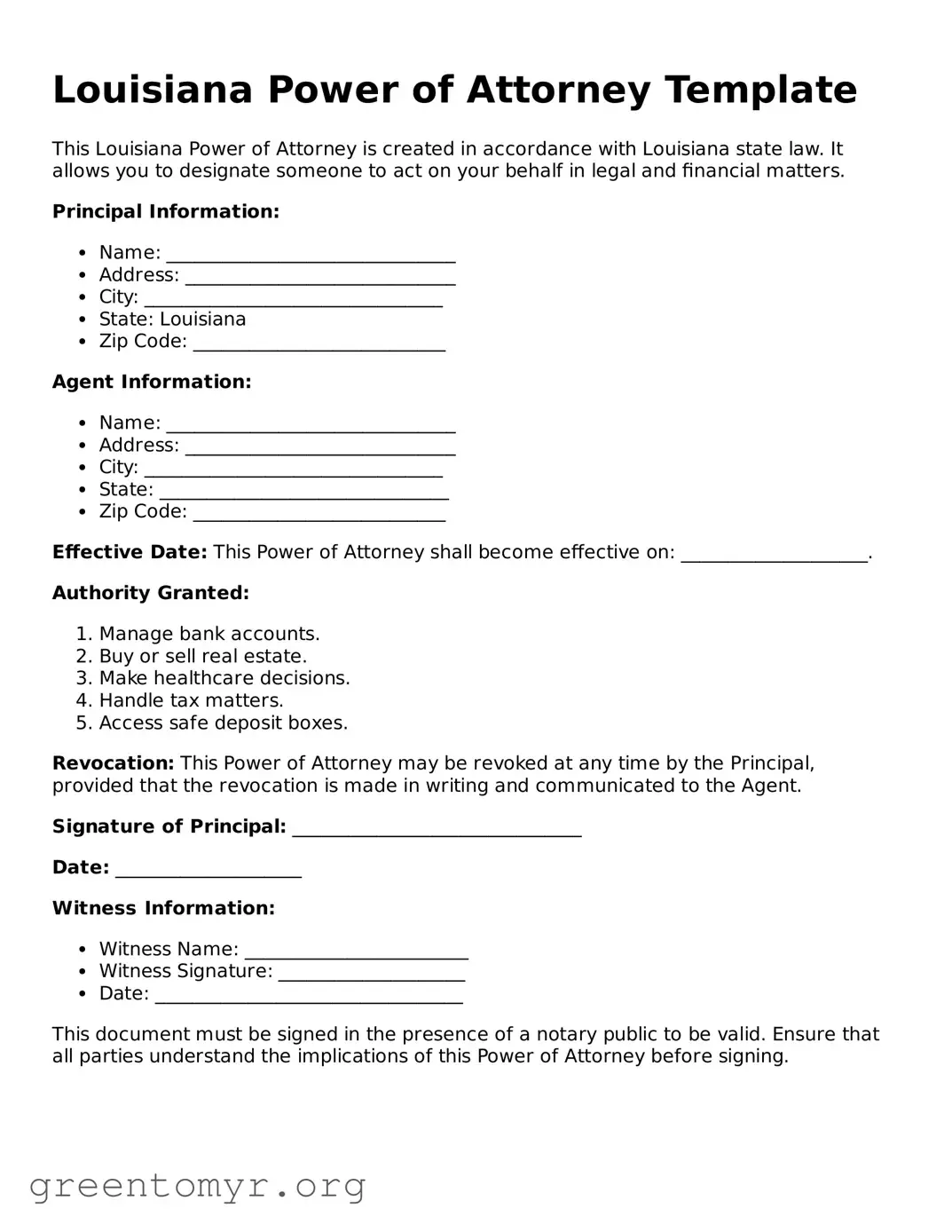
Louisiana Power of Attorney Template

This Louisiana Power of Attorney is created in accordance with Louisiana state law. It allows you to designate someone to act on your behalf in legal and financial matters.

Principal Information:

  • Name: _______________________________
  • Address: _____________________________
  • City: ________________________________
  • State: Louisiana
  • Zip Code: ___________________________

Agent Information:

  • Name: _______________________________
  • Address: _____________________________
  • City: ________________________________
  • State: _______________________________
  • Zip Code: ___________________________

Effective Date: This Power of Attorney shall become effective on: ____________________.

Authority Granted:

  1. Manage bank accounts.
  2. Buy or sell real estate.
  3. Make healthcare decisions.
  4. Handle tax matters.
  5. Access safe deposit boxes.

Revocation: This Power of Attorney may be revoked at any time by the Principal, provided that the revocation is made in writing and communicated to the Agent.

Signature of Principal: _______________________________

Date: ____________________

Witness Information:

  • Witness Name: ________________________
  • Witness Signature: ____________________
  • Date: _________________________________

This document must be signed in the presence of a notary public to be valid. Ensure that all parties understand the implications of this Power of Attorney before signing.

PDF Form Features

Fact Name Description
Definition A Louisiana Power of Attorney form allows an individual (the principal) to designate another person (the agent) to act on their behalf in legal and financial matters.
Governing Law The form is governed by the Louisiana Civil Code, specifically Article 3021 through Article 3072.
Durability The Power of Attorney can be durable, meaning it remains effective even if the principal becomes incapacitated, unless stated otherwise in the document.
Revocation The principal can revoke the Power of Attorney at any time, provided they are of sound mind and communicate their intent clearly.
Agent's Responsibilities The agent must act in the best interest of the principal, following their wishes and the guidelines set forth in the Power of Attorney document.

Guide to Using Louisiana Power of Attorney

After obtaining the Louisiana Power of Attorney form, you’ll be ready to complete it. This form allows you to designate someone to act on your behalf in legal and financial matters. Follow the steps below to ensure you fill it out correctly.

  1. Begin by entering the date at the top of the form.
  2. Provide your full name and address in the designated sections.
  3. Identify the person you are appointing as your agent. Include their full name, address, and relationship to you.
  4. Clearly state the powers you are granting to your agent. Be specific about the actions they can take on your behalf.
  5. Include any limitations or conditions on the powers you are granting, if applicable.
  6. Sign and date the form at the bottom. Ensure your signature matches the name you provided earlier.
  7. Have the form notarized. A notary public will verify your identity and witness your signature.
  8. Distribute copies of the completed form to your agent and any relevant institutions or individuals.

Once you have completed these steps, your Power of Attorney will be ready for use. Make sure to keep a copy for your records and inform your agent of their responsibilities.

Get Answers on Louisiana Power of Attorney

  1. What is a Power of Attorney in Louisiana?

    A Power of Attorney (POA) is a legal document that allows one person (the principal) to give another person (the agent or attorney-in-fact) the authority to make decisions on their behalf. In Louisiana, this document can cover financial matters, healthcare decisions, or both, depending on the type of POA created.

  2. What types of Power of Attorney are available in Louisiana?

    In Louisiana, there are several types of Power of Attorney, including:

    • General Power of Attorney: This grants broad authority to the agent to handle various matters.
    • Special Power of Attorney: This limits the agent's authority to specific tasks or situations.
    • Durable Power of Attorney: This remains in effect even if the principal becomes incapacitated.
    • Healthcare Power of Attorney: This specifically allows the agent to make medical decisions for the principal.
  3. How do I create a Power of Attorney in Louisiana?

    To create a Power of Attorney in Louisiana, follow these steps:

    1. Decide on the type of POA you need.
    2. Choose a trustworthy agent who will act in your best interest.
    3. Complete the Power of Attorney form, ensuring all necessary information is included.
    4. Sign the document in front of a notary public and have it witnessed by two individuals.
  4. Do I need a lawyer to create a Power of Attorney?

    No, you do not necessarily need a lawyer to create a Power of Attorney in Louisiana. However, consulting with a lawyer can help ensure that the document meets all legal requirements and reflects your wishes accurately. It can be especially helpful for complex situations.

  5. Can I revoke a Power of Attorney in Louisiana?

    Yes, you can revoke a Power of Attorney at any time as long as you are mentally competent. To revoke it, you should create a written document stating your intention to revoke the POA and notify your agent and any relevant institutions where the POA was used.

  6. What happens if I become incapacitated and have a Power of Attorney?

    If you become incapacitated and have a Durable Power of Attorney in place, your agent can continue to make decisions on your behalf. If you do not have a Durable POA, your authority will end, and a court may need to appoint a guardian to handle your affairs.

  7. Are there any limitations to what my agent can do under a Power of Attorney?

    Yes, there are limitations. The agent must act in your best interest and cannot make decisions that would benefit themselves at your expense. Additionally, the specific powers granted can be limited by the terms you include in the Power of Attorney document.

  8. Is a Power of Attorney valid in other states?

    A Power of Attorney created in Louisiana may be recognized in other states, but it’s important to check the specific laws of the state where it will be used. Some states may have different requirements or may require a new POA to be created.

  9. How long does a Power of Attorney last in Louisiana?

    A Power of Attorney remains valid until you revoke it, the agent resigns, or you pass away. If you create a Durable Power of Attorney, it will continue to be effective even if you become incapacitated.

Common mistakes

Filling out a Power of Attorney (POA) form in Louisiana can be straightforward, but many individuals make common mistakes that can lead to complications down the line. One significant error is failing to specify the powers granted. A POA can be broad or limited, and without clear language, it can lead to confusion about what the agent is authorized to do. Always ensure that the powers you wish to grant are explicitly stated.

Another frequent mistake is neglecting to date the document. A Power of Attorney must be dated to establish when it becomes effective. If the date is missing, it may create uncertainty about the validity of the document. This can be especially problematic if the principal becomes incapacitated, as the timing of the POA's effectiveness may come into question.

People also often overlook the importance of signing the document properly. In Louisiana, the principal must sign the POA in the presence of a notary public and, if required, witnesses. Failing to follow these requirements can render the document invalid. It is crucial to ensure that all signatures are obtained as required by law.

Another mistake is not considering the choice of agent carefully. The agent should be someone trustworthy and capable of handling the responsibilities that come with the role. Choosing someone without considering their qualifications or reliability can lead to issues, especially if the agent needs to make significant financial or health-related decisions on behalf of the principal.

Additionally, individuals sometimes forget to review and update their Power of Attorney documents regularly. Life circumstances change—such as marriage, divorce, or the death of an agent—and these changes can affect the appropriateness of the existing POA. Regular reviews ensure that the document remains relevant and effective.

Lastly, some people fail to distribute copies of the completed Power of Attorney to relevant parties. Once the document is signed and notarized, it is essential to provide copies to the agent and any institutions that may need to recognize the POA. Without these copies, the agent may face challenges when attempting to act on behalf of the principal.

Documents used along the form

When preparing a Louisiana Power of Attorney form, several other documents may be useful to ensure comprehensive management of personal and financial affairs. Below is a list of commonly associated forms that individuals may consider.

  • Durable Power of Attorney: This document allows an individual to appoint someone to make decisions on their behalf even if they become incapacitated. It remains effective until revoked or the principal passes away.
  • Advance Healthcare Directive: Also known as a living will, this document outlines an individual's wishes regarding medical treatment in the event they cannot communicate their preferences.
  • HIPAA Release Form: This form grants permission for designated individuals to access medical records and health information, ensuring that caregivers can make informed decisions.
  • Financial Power of Attorney: Similar to a general Power of Attorney, this document specifically focuses on financial matters, allowing the agent to manage financial transactions and obligations.
  • Living Trust: A legal entity that holds an individual’s assets during their lifetime and specifies how those assets should be distributed after death, often helping to avoid probate.
  • Will: This document outlines an individual’s wishes regarding the distribution of their assets after death, as well as any guardianship for dependents.

These documents can work together to provide a robust framework for managing personal and financial matters. It is important to consider each document's purpose and how it aligns with individual needs and preferences.

Similar forms

The Power of Attorney (POA) form is a legal document that allows one person to act on behalf of another. Several other documents share similarities with the POA, often serving similar purposes in different contexts. Here are eight documents that are comparable to the Power of Attorney:

  • Living Will: This document outlines an individual's wishes regarding medical treatment in case they become unable to communicate. Like a POA, it allows someone to make decisions on behalf of another, but it specifically addresses healthcare choices.
  • Healthcare Proxy: Similar to a POA, a healthcare proxy designates someone to make medical decisions if the individual cannot do so. It focuses solely on health-related matters.
  • Durable Power of Attorney: This is a specific type of POA that remains effective even if the principal becomes incapacitated. It ensures that decisions can still be made when the individual is unable to act.
  • Financial Power of Attorney: This document grants authority to another person to manage financial affairs. It is similar to a general POA but is specifically limited to financial matters.
  • Trust Agreement: A trust allows one party to hold property for the benefit of another. While it does not grant decision-making authority like a POA, it serves to manage assets on behalf of someone else.
  • Guardian Appointment: This document is used to appoint a guardian for a minor or incapacitated adult. Like a POA, it designates someone to make decisions for another, but it is often court-approved and focuses on personal care.
  • Executor Appointment: An executor is named in a will to manage the estate after someone's death. This role involves decision-making similar to a POA but occurs posthumously and pertains to estate management.
  • Living Trust: A living trust allows individuals to transfer assets into a trust while they are alive. It helps manage assets and can include provisions for decision-making, similar to a POA, but focuses on asset management rather than personal decisions.

Dos and Don'ts

When filling out the Louisiana Power of Attorney form, it’s important to ensure that you do it correctly to avoid any issues down the line. Here’s a helpful list of things to do and things to avoid.

  • Do read the entire form carefully before you start filling it out.
  • Do clearly identify the person you are appointing as your agent.
  • Do specify the powers you are granting to your agent, being as detailed as possible.
  • Do sign the document in front of a notary public.
  • Don't leave any sections blank; fill in all required information.
  • Don't assume that a verbal agreement is enough; written documentation is necessary.
  • Don't forget to provide copies of the signed form to your agent and any relevant institutions.

Following these guidelines can help ensure that your Power of Attorney is valid and reflects your intentions accurately.

Misconceptions

When it comes to the Louisiana Power of Attorney form, several misconceptions can lead to confusion. Understanding the truth behind these myths can help individuals make informed decisions. Here are four common misconceptions:

  • All Power of Attorney forms are the same across states. Many people believe that a Power of Attorney form is universally applicable. However, each state, including Louisiana, has its own requirements and laws governing these documents. It's essential to use the correct form for your state to ensure it holds up legally.
  • A Power of Attorney is only for financial matters. While many associate Power of Attorney with financial decisions, it can also cover healthcare and other personal matters. In Louisiana, you can designate someone to make medical decisions on your behalf, which is a crucial aspect of planning for the future.
  • Once I sign a Power of Attorney, I lose all control. This is a common fear, but it’s not true. You can create a Power of Attorney that allows you to retain control over your affairs. You can specify when the agent can act on your behalf, ensuring that you maintain oversight.
  • Power of Attorney documents are permanent and cannot be changed. Many people think that once a Power of Attorney is established, it cannot be altered. In reality, you can revoke or modify a Power of Attorney at any time, as long as you are mentally competent to do so. This flexibility allows you to adapt to changing circumstances.

By debunking these misconceptions, individuals can better navigate the process of creating a Power of Attorney in Louisiana and ensure their wishes are respected.

Key takeaways

Filling out and using the Louisiana Power of Attorney form can be a straightforward process if you keep a few key points in mind. Here are some essential takeaways to consider:

  • The Power of Attorney form allows you to designate someone to act on your behalf in financial or legal matters.
  • It is crucial to choose a trustworthy individual as your agent, as they will have significant authority over your affairs.
  • Make sure to specify the powers you are granting to your agent. This can include managing bank accounts, signing documents, or making healthcare decisions.
  • The form must be signed in the presence of a notary public to be legally valid in Louisiana.
  • Be aware that the Power of Attorney can be revoked at any time, as long as you are mentally competent.
  • Consider discussing your intentions with your agent before finalizing the document to ensure they understand their responsibilities.
  • Keep a copy of the signed Power of Attorney in a safe place, and provide copies to your agent and any relevant institutions.
  • Review the document periodically to ensure it still meets your needs, especially if your circumstances change.
  • In Louisiana, a Power of Attorney can be durable, meaning it remains effective even if you become incapacitated.
  • Consulting with a legal professional can provide clarity on any specific concerns you may have regarding the form.